The Lexus RX Hybrid Lineup: Two Paths to Electrification
The Lexus RX has been the best-selling luxury SUV in America for years, and for the 2026 model year it continues to offer two distinct hybrid powertrains: the conventional RX 350h (a self-charging hybrid that never needs plugging in) and the RX 450h+ plug-in hybrid (PHEV) that delivers genuine electric-only commuting range. Choosing between them — or deciding whether to skip electrification entirely — comes down to your daily mileage, charging access, and budget. This guide breaks down every number that matters.
RX 350h (HEV): A conventional hybrid. The gasoline engine and electric motor work together, and the small battery recharges through regenerative braking and the engine. You never plug it in. You simply fuel up at any gas station and enjoy improved MPG.
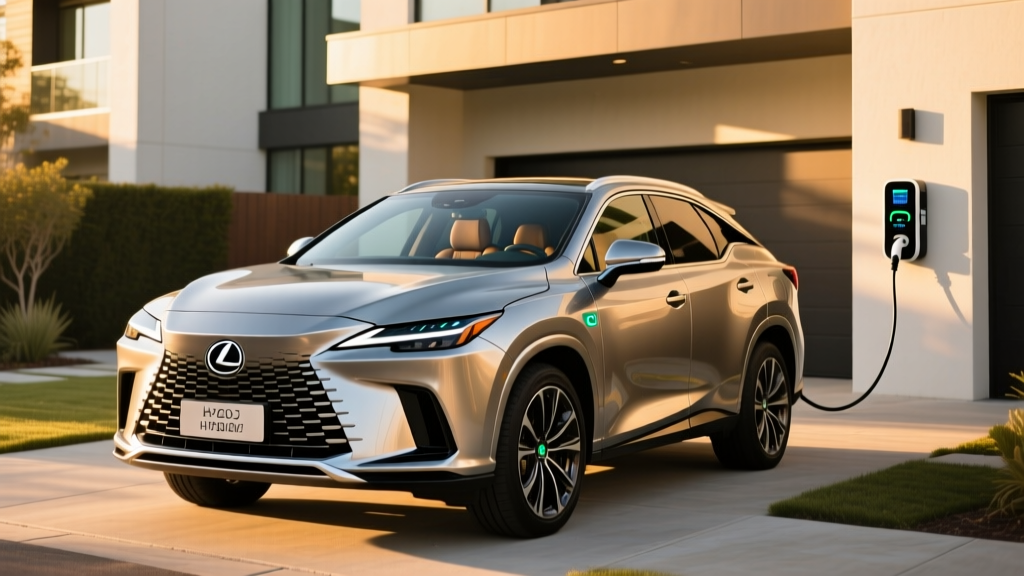
RX 450h+ (PHEV): A plug-in hybrid. It carries a larger 18.1 kWh battery that provides up to 37 miles of pure electric driving before the gas engine seamlessly engages. You can plug it in at home or at public Level 2 chargers to replenish the battery, but it also operates as a conventional hybrid once the electric range is depleted.
RX 350h vs RX 450h+: Side-by-Side Specs
| Specification | RX 350h (HEV) | RX 450h+ (PHEV) |
|---|---|---|
| Powertrain | 2.5L 4-cyl + 2 electric motors | 2.5L 4-cyl + 2 electric motors (higher output) |
| Combined Horsepower | 246 hp | 302 hp |
| 0–60 mph | 7.4 sec | 6.2 sec |
| Drivetrain | AWD (eAWD with rear motor) | AWD (eAWD with rear motor) |
| EPA MPG (City/Hwy/Combined) | 37 / 34 / 36 | 35 combined MPG (after EV range depleted) |
| Electric-Only Range (PHEV) | N/A | 37 miles (EPA) |
| Total Combined Range | ~560 miles | ~440+ miles (EV + gas) |
| Battery Capacity | ~1.6 kWh (NiMH) | 18.1 kWh (lithium-ion) |
| Level 2 Charge Time | N/A (no plug) | ~2.5 hours at 6.6 kW |
| DC Fast Charging | No | No |
| Starting MSRP | ~$53,500 | ~$64,500 |
Fuel Economy Breakdown: Real-World MPG vs EPA Sticker
| Metric | RX 350h (EPA) | RX 350h (Real-World) | RX 450h+ (EPA) |
|---|---|---|---|
| City | 37 MPG | 38–42 MPG* | N/A (EV mode first) |
| Highway | 34 MPG | 31–33 MPG | 35 MPG (hybrid mode) |
| Combined | 36 MPG | 35–38 MPG | 35 MPG (hybrid mode) |
| MPGe (EV mode, PHEV) | N/A | N/A | 83 MPGe combined |
*Hybrids routinely beat EPA city estimates in stop-and-go traffic because regenerative braking recovers energy that a gas car wastes as heat. Highway driving favors sustained engine load, which slightly reduces the hybrid advantage. Source: fueleconomy.gov
RX 450h+ Electric Range and Charging: What PHEV Owners Need to Know
The RX 450h+ carries an 18.1 kWh lithium-ion battery pack. The EPA rates its electric-only range at 37 miles — enough to cover the average American's one-way commute (approximately 16 miles each way, per Census Bureau data) with margin to spare.
Charging logistics:
- Level 1 (120V household outlet): ~10–12 hours for a full charge. Plug in overnight and you'll wake up to a full battery every morning.
- Level 2 (240V, home wallbox or public station): ~2.5 hours at the onboard charger's maximum rate of 6.6 kW.
- DC fast charging: Not available. The RX 450h+ uses a J1772 connector for AC charging only. This is typical for PHEVs — the battery is small enough that Level 2 charging is adequate.
Unlike a full battery-electric vehicle (BEV), the RX 450h+ eliminates range anxiety entirely. Once the 37-mile EV buffer is consumed, the 2.5-liter engine fires up seamlessly and the vehicle operates as a conventional hybrid delivering approximately 35 MPG combined. Total driving range exceeds 440 miles on a full tank plus full battery.
Performance and Powertrain Details
Both RX hybrid models pair a 2.5-liter inline-four Atkinson-cycle engine with Lexus's eAWD system — an electric motor on each axle providing all-wheel drive without a mechanical driveshaft.
The RX 350h produces a combined 246 horsepower. Acceleration is adequate (0–60 in 7.4 seconds) but not thrilling. The electric motor fills in torque at low RPMs, making around-town driving feel responsive even if highway passing requires some planning.
The RX 450h+ ups the output to 302 combined horsepower thanks to more powerful electric motors and a larger battery that can deliver higher discharge rates. The 0–60 time drops to 6.2 seconds — noticeably quicker and in line with what luxury SUV buyers expect. The PHEV also feels heavier through corners (the 18.1 kWh battery adds mass), but the low center of gravity from the under-floor battery pack keeps body motions composed.
Pricing, Trims, and Tax Credit Eligibility
Here's where the math gets interesting — and where many buyers leave money on the table.
RX 350h pricing (2026 model year): Starting MSRP is approximately $53,500 for the Premium trim, climbing to around $61,000 for the Luxury grade. The RX 350h is a conventional hybrid and does not qualify for the federal §30D new clean vehicle tax credit — that credit is reserved for plug-in vehicles (PHEVs and BEVs) meeting battery sourcing and critical mineral requirements.
RX 450h+ pricing (2026 model year): Starting MSRP is approximately $64,500 (Premium+), with the Luxury trim reaching roughly $70,000. The RX 450h+ may qualify for up to $7,500 under the IRS §30D credit, but eligibility depends on several conditions that change periodically:
- MSRP cap: SUVs must have an MSRP at or below $80,000. The RX 450h+ clears this threshold in most trims.
- Buyer income cap: Modified adjusted gross income must not exceed $150,000 (single), $225,000 (head of household), or $300,000 (joint filing).
- Battery component & critical mineral sourcing: The vehicle must meet phased-in percentages for North American battery component manufacturing and critical mineral extraction. These thresholds tighten annually — verify current-year compliance on the IRS's qualifying vehicle list at irs.gov.
- Point-of-sale transfer: As of 2024+, buyers can transfer the credit to the dealer at purchase, reducing the upfront price rather than waiting for a tax refund.
Reliability, Battery Warranty, and Long-Term Costs
Lexus covers the hybrid battery pack for 10 years or 150,000 miles, whichever comes first. This is one of the longest hybrid battery warranties in the luxury segment and applies to both the RX 350h's NiMH pack and the RX 450h+'s lithium-ion pack.
The general powertrain warranty covers 6 years / 70,000 miles, and the basic vehicle warranty covers 4 years / 50,000 miles.
Reliability track record: The RX nameplate has been a reliability benchmark for over two decades. Lexus consistently ranks at or near the top of J.D. Power's Vehicle Dependability Study, and the hybrid Synergy Drive system has been in production since the early 2000s with millions of units on the road. The RX 350h's nickel-metal hydride battery chemistry is particularly well-proven — it's the same chemistry used in the Toyota Prius for nearly 20 years with documented lifespans exceeding 200,000 miles.
Battery replacement cost: If the hybrid battery does fail outside of warranty (rare but possible at high mileage), expect approximately $3,000–$5,000 for an RX 350h NiMH pack replacement and $6,000–$9,000 for the RX 450h+ lithium-ion pack, including labor. Third-party refurbishment shops increasingly offer reconditioned packs at 40–60% of OEM cost. The 10-year/150,000-mile warranty makes out-of-pocket replacement unlikely for most first and second owners.
Who Should Choose the RX Hybrid — and Who Should Look Elsewhere?
Choose the RX 350h (HEV) if:
- You don't have access to home or workplace charging and don't want to rely on public infrastructure
- Your priority is maximum fuel savings with zero behavioral change — just drive and fill up normally
- You take frequent long road trips and want consistent 36 MPG without planning around EV range
- You want a lower purchase price (~$11,000 less than the PHEV)
Choose the RX 450h+ (PHEV) if:
- Your daily round-trip commute is under 37 miles and you can charge at home overnight
- You want to drive on electricity most days but need the flexibility of a gas engine for weekend trips
- You value the additional 56 horsepower and quicker acceleration
- You may qualify for the §30D federal tax credit, narrowing the price gap with the 350h
Choose a full EV (like the Lexus RZ or Tesla Model X) if:
- You have reliable Level 2 home charging and your daily driving is under 250 miles
- You want zero tailpipe emissions, minimal maintenance (no oil changes, no engine), and the lowest per-mile fuel cost
- You're ready to plan longer trips around DC fast-charging stops
RX 350h Pros
- 36 MPG combined with no plug-in required
- Lower starting price
- Proven NiMH battery reliability
- Over 560 miles total range
RX 350h Cons
- No federal tax credit eligibility
- Modest 246 hp — slowest in the lineup
- No electric-only driving mode
RX 450h+ Pros
- 37-mile EV range covers most commutes
- 302 hp — genuinely quick for a luxury SUV
- Potential $7,500 federal tax credit
- 83 MPGe in electric mode
RX 450h+ Cons
- $11,000 price premium over 350h
- No DC fast charging
- Hybrid-mode MPG slightly lower than 350h
- Tax credit eligibility not guaranteed
Frequently Asked Questions
How many MPG does the Lexus RX 350h hybrid get?
The EPA rates the 2026 RX 350h at 37 city / 34 highway / 36 combined MPG. In real-world city driving with frequent stops, many owners report 38–42 MPG thanks to regenerative braking. Highway driving at 75+ mph typically yields 31–33 MPG. Source: fueleconomy.gov
How far can the RX 450h+ drive on electric only?
The EPA rates the RX 450h+ at 37 miles of electric-only range. Real-world results vary: gentle city driving in mild weather can stretch this to 40+ miles, while aggressive acceleration, cold temperatures (below 40°F), and highway speeds above 65 mph can reduce it to 28–32 miles. The gasoline engine engages automatically when the battery is depleted.
Does the Lexus RX hybrid qualify for a tax credit?
The RX 350h conventional hybrid does not qualify for the federal §30D clean vehicle credit — it's reserved for plug-in vehicles. The RX 450h+ PHEV may qualify for up to $7,500, depending on current-year battery sourcing requirements, your income level, and the vehicle's MSRP (must be ≤$80,000 for SUVs). Always verify at irs.gov before purchasing.
Is the Lexus RX hybrid reliable? What about battery replacement cost?
Lexus ranks among the most reliable luxury brands in J.D. Power and Consumer Reports surveys, and the hybrid system has decades of proven durability. The hybrid battery is warrantied for 10 years / 150,000 miles. Out-of-warranty replacement costs range from approximately $3,000–$5,000 (RX 350h NiMH) to $6,000–$9,000 (RX 450h+ lithium-ion), though actual failures at typical ownership mileages are uncommon.
Do I need to plug in the RX 350h hybrid?
No. The RX 350h is a conventional self-charging hybrid. Its small battery is recharged entirely by the gasoline engine and regenerative braking during deceleration. You fuel it at any gas station and drive normally — no charging cables, no outlets, no apps. Only the RX 450h+ PHEV requires (or benefits from) plugging in.
How long does it take to charge the RX 450h+?
On a standard 120V household outlet (Level 1), a full charge takes approximately 10–12 hours. On a 240V Level 2 charger (home wallbox or public station), a full charge takes about 2.5 hours at the vehicle's maximum 6.6 kW onboard charge rate. The RX 450h+ does not support DC fast charging, which is standard for PHEVs with smaller battery packs.