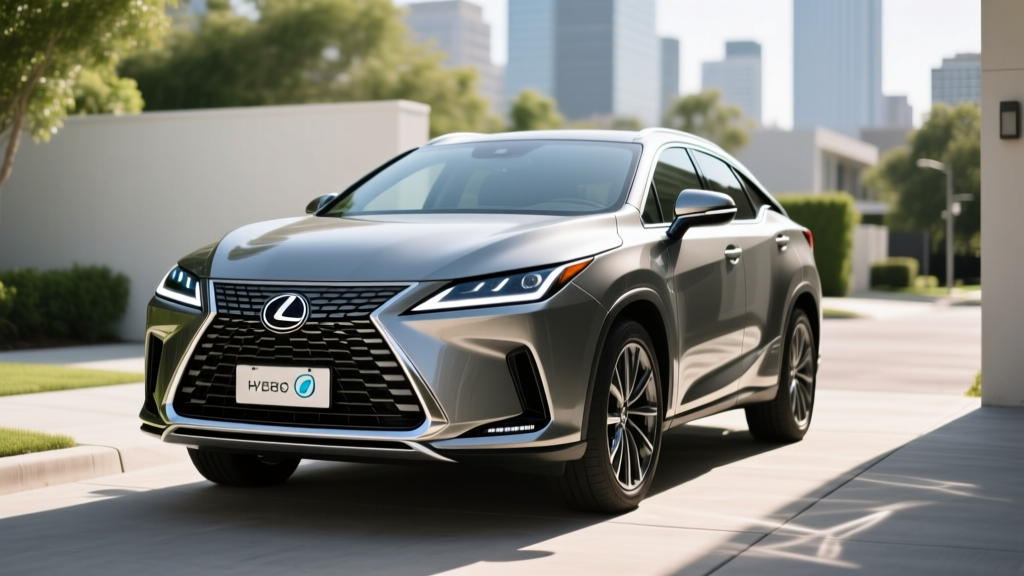
The midsize luxury SUV segment is crowded, but the 2026 Lexus RX 450h occupies a specific lane: premium comfort, standard all-wheel drive, and fuel economy that embarrasses competitors costing $15,000 more. As a conventional hybrid (HEV), it never needs to be plugged in — it generates electricity through regenerative braking and its gasoline engine. That makes it ideal for buyers who want electrified efficiency without altering their daily routine.
For 2026, the RX 450h continues with a 2.5-liter four-cylinder hybrid powertrain paired with electronic AWD, delivering an EPA-estimated 36 MPG combined. Below, we break down every number that matters — from real-world MPG to battery warranty costs — and explain where this hybrid fits against the plug-in RX 500h+ and full-electric alternatives.
HEV vs PHEV: Where the Lexus RX 450h Fits
Before examining specs, it's essential to distinguish between the two electrified RX models Lexus offers. The RX 450h is a conventional hybrid (HEV). The RX 500h+ (formerly RX 450h+) is a plug-in hybrid (PHEV). They share a platform but serve different buyers.
| Attribute | RX 450h (HEV) | RX 500h+ (PHEV) |
|---|---|---|
| Plug-in required? | No — self-charging | Yes — plug in for EV range |
| Electric-only range | N/A (EV assist only) | ~37 miles (EPA est.) |
| Battery capacity | ~1.6 kWh (NiMH) | ~18.1 kWh (lithium-ion) |
| Combined horsepower | 246 hp | 302 hp |
| EPA combined MPG/MPGe | 36 MPG | 35 MPG / 83 MPGe |
| Starting MSRP (2026) | ~$53,500 | ~$64,500 |
| Federal tax credit (§30D) | Not eligible | Up to $7,500* |
*PHEV credit subject to income caps, MSRP caps, and battery-sourcing rules per IRS §30D. Consult a tax professional.
If you cannot charge at home or work, the RX 450h HEV is the practical choice. You'll never search for a charger — just fill up with gas and let the hybrid system optimize efficiency automatically. If you have reliable Level 2 charging access and a commute under 35 miles, the PHEV variant lets you drive most weekdays on electricity alone.
Powertrain and Performance Specs
The 2026 RX 450h pairs a 2.5-liter Atkinson-cycle inline-four with two electric motor-generators and an electronically controlled CVT (eCVT). A third motor on the rear axle provides electronic AWD — there's no mechanical driveshaft connecting front and rear wheels.
| Specification | Value |
|---|---|
| Engine | 2.5L 4-cyl Atkinson cycle |
| Combined system horsepower | 246 hp |
| Transmission | eCVT (planetary gearset) |
| Drivetrain | Electronic AWD (eAWD) |
| 0–60 mph | 7.4 seconds |
| Towing capacity | 3,500 lbs |
| Hybrid battery | ~1.6 kWh NiMH |
| Curb weight | ~4,550 lbs |
| Cargo volume (rear seats up) | 29.6 cu ft |
| Cargo volume (rear seats folded) | 46.2 cu ft |
The 246 hp output is adequate rather than thrilling. The eCVT eliminates shift shock and keeps acceleration linear, but highway passing at 70+ mph requires planning. For comparison, the turbocharged RX 350 makes 275 hp with a traditional 8-speed automatic and feels more urgent above 50 mph. The trade-off is fuel economy: the RX 350 AWD returns 24 MPG combined versus the 450h's 36.
Fuel Economy: EPA Ratings and Real-World MPG
| Driving Cycle | EPA Estimate |
|---|---|
| City | 37 MPG |
| Highway | 34 MPG |
| Combined | 36 MPG |
Source: fueleconomy.gov
Toyota/Lexus hybrids consistently exceed their EPA city estimates in stop-and-go traffic, where regenerative braking recovers the most energy. Expect 38–42 MPG in urban driving. Highway cruising at 75 mph typically yields 30–33 MPG, as aerodynamic drag dominates and the engine carries more load. In cold weather (below 35°F), anticipate a 5–10% reduction as the engine runs longer to heat the cabin and warm the battery. Annual fuel cost at 12,000 miles/year and $3.40/gallon averages approximately $1,133 — roughly $700 less than the gas RX 350 AWD.
Pricing, Trims, and Tax Credit Eligibility
The 2026 Lexus RX 450h starts at an MSRP of approximately $53,500 (including destination) for the Premium trim. Available trims include Premium, Premium+, Luxury, and F SPORT Handling, with fully loaded examples reaching roughly $63,000.
Does the RX 450h qualify for a federal tax credit?
No. The RX 450h is a conventional hybrid (HEV), not a plug-in vehicle. The federal §30D New Clean Vehicle Credit applies only to battery-electric vehicles (BEVs) and plug-in hybrids (PHEVs) with batteries of at least 7 kWh that meet IRS sourcing and income requirements. Conventional hybrids do not qualify.
However, some states offer rebates or HOV-lane access for hybrids. Check your state's energy office or DMV for current programs. Lexus also periodically offers lease loyalty or conquest cash that can reduce out-of-pocket cost by $1,000–$2,000.
Reliability, Battery Warranty, and Replacement Cost
Lexus consistently ranks at or near the top of J.D. Power and Consumer Reports reliability surveys, and the RX hybrid powertrain is one of the brand's most proven systems. The hybrid architecture traces its lineage to the original RX 400h (2006), meaning nearly two decades of iterative refinement.
Lexus covers the RX 450h hybrid battery for 10 years or 150,000 miles (whichever comes first) in all 50 states. This applies to the current model year and reflects the extended coverage Toyota/Lexus adopted starting with 2020 models. The powertrain warranty covers 6 years/70,000 miles, and the basic bumper-to-bumper warranty is 4 years/50,000 miles.
What does a hybrid battery replacement cost?
If the hybrid battery fails outside warranty coverage, replacement typically costs between $3,000 and $5,000 installed at a Lexus dealer, including the battery pack and labor. Independent hybrid specialists may offer refurbished packs for $2,000–$3,000. In practice, Lexus hybrid batteries frequently last 150,000–200,000+ miles with minimal capacity loss, as the system never fully charges or fully depletes the pack — it operates in a narrow 40–80% state-of-charge window that dramatically extends cell life.
The 12V auxiliary battery (separate from the hybrid pack) may need replacement every 4–6 years at roughly $250–$400.
Driving Impressions and Daily Ownership
The RX 450h prioritizes refinement over engagement. The cabin is well-isolated from road and wind noise, the ride quality absorbs broken pavement gracefully, and the seats remain comfortable on long trips. The 14-inch touchscreen (standard on most trims) runs Lexus's latest infotainment with wireless Apple CarPlay and Android Auto, physical knobs for volume and tuning, and natural-language voice commands.
The Lexus Safety System+ 3.0 suite is standard and includes pre-collision braking with pedestrian detection, lane tracing assist, dynamic radar cruise control, and road sign assist. This is an SAE Level 2 driver-assistance system — it does not drive itself. The driver must keep hands on the wheel and eyes on the road at all times.
For daily commuting, the hybrid system is transparent. The transition between electric-only creeping (at low speeds and in parking lots) and engine engagement is nearly imperceptible. One-pedal-style driving is possible by selecting "B" mode on the shift lever, which increases regenerative braking — though it won't bring the SUV to a full stop like a BEV's one-pedal mode.
RX 450h vs RX 500h+ vs Full EV: Which Should You Choose?
RX 450h (HEV) — Pros
- No plug-in required; zero routine change
- 36 MPG combined saves ~$700/yr vs gas RX 350
- Proven reliability with 10yr/150k battery warranty
- Standard eAWD for all-weather traction
- Lower purchase price than PHEV variant
RX 450h (HEV) — Cons
- No federal tax credit eligibility
- Modest 246 hp; not a performance SUV
- No electric-only driving range
- Higher MSRP than gas RX 350 (~$7,000 premium)
- CVT drone under hard acceleration
- Choose the RX 450h (HEV) if: You want a luxury SUV that sips fuel without any charging infrastructure. You drive 10,000–15,000 miles/year, live in an apartment or street-park where home charging isn't feasible, and value Lexus reliability above performance.
- Choose the RX 500h+ (PHEV) if: You can install a Level 2 home charger, your commute is under 35 miles round-trip, and you want to drive on electricity most weekdays while retaining gas flexibility for road trips. The ~$11,000 price premium can be partially offset by the $7,500 federal credit (if eligible).
- Choose a full EV (e.g., BMW iX, Genesis Electrified GV70) if: You have reliable home charging, your daily driving is under 250 miles, you want zero tailpipe emissions, and you're comfortable with long-term battery degradation considerations.
Frequently Asked Questions
How many MPG does the Lexus RX 450h hybrid get?
The 2026 RX 450h is EPA-rated at 37 city / 34 highway / 36 combined MPG. In real-world city driving, owners frequently report 38–42 MPG. Highway driving at 75+ mph typically returns 30–33 MPG.
Does the Lexus RX 450h need to be plugged in?
No. The RX 450h is a conventional hybrid (HEV). It charges its small battery through regenerative braking and the gasoline engine. You fuel it like any other car — there is no plug, no charging cable, and no electric-only range to manage.
How far can the RX 450h go on electric only?
The RX 450h can creep at very low speeds (under ~25 mph) on electric power for short distances — typically a few hundred yards in parking lots or heavy stop-and-go traffic. It has no meaningful electric-only range. For EV-range capability, look at the RX 500h+ PHEV (~37 miles) or a full BEV.
Is the Lexus RX 450h hybrid reliable?
Yes. Lexus's hybrid systems are among the most reliable in the industry, with nearly 20 years of RX hybrid production. The hybrid battery is covered for 10 years/150,000 miles. Major failures before 150,000 miles are uncommon based on owner survey data.
What is the Lexus hybrid battery replacement cost?
Out-of-warranty hybrid battery replacement typically costs $3,000–$5,000 at a dealer. Refurbished packs from independent shops run $2,000–$3,000. Most Lexus hybrid batteries outlast 150,000 miles due to the conservative charge window the system maintains.
Does the RX 450h qualify for any tax credit?
The conventional RX 450h does not qualify for the federal §30D EV tax credit, which requires plug-in capability and a minimum 7 kWh battery. Some states may offer hybrid-specific rebates or HOV-lane access — check your state's energy office.
How does the RX 450h compare to the gas RX 350?
The RX 350 AWD gets 24 MPG combined (EPA) and starts around $48,500. The RX 450h costs roughly $5,000 more upfront but saves approximately $700/year in fuel at 12,000 miles/year. The hybrid also provides smoother low-speed driving and standard eAWD. Payback period is roughly 7 years at current fuel prices.
What's the difference between the RX 450h and RX 500h+?
The RX 450h is a conventional hybrid (no plug, 36 MPG, 246 hp). The RX 500h+ is a plug-in hybrid (~37 miles EV range, 302 hp, ~$64,500 MSRP, potentially eligible for the $7,500 federal tax credit). The PHEV requires home or workplace charging access to realize its electric-range benefits.