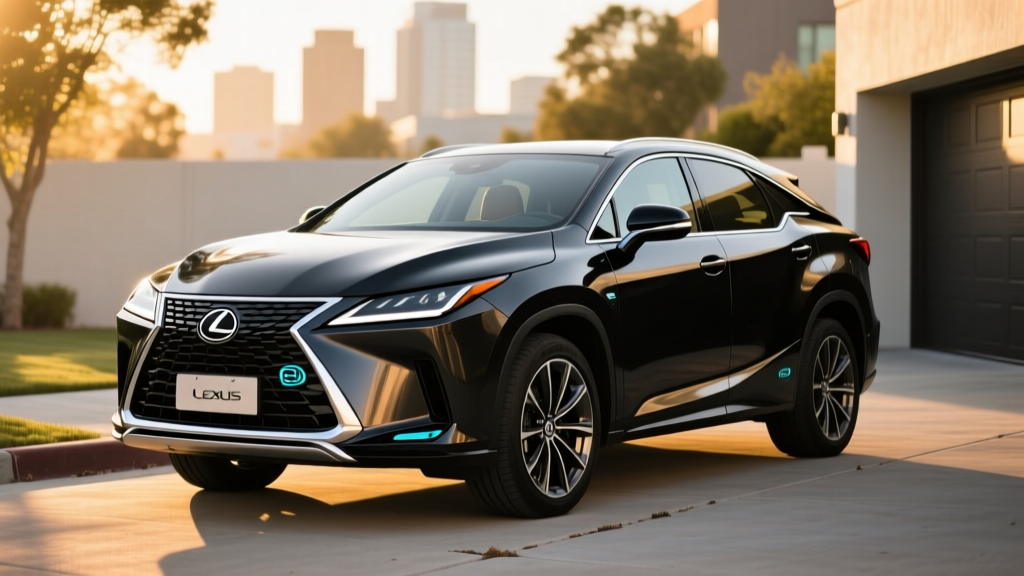
The midsize luxury SUV segment has no shortage of electrified options, but the 2026 Lexus RX 350h remains one of the most pragmatic choices for buyers who want hybrid efficiency without plugging in. Now in its fifth generation, the RX lineup offers three distinct powertrains: the conventional hybrid RX 350h, the performance-tuned RX 500h, and the plug-in hybrid RX 450h+. This guide focuses squarely on the volume-selling RX 350h — the trim most buyers actually drive home — while clarifying where the PHEV variant fits for those with home charging access.
If you're cross-shopping the RX 350h against a full battery-electric vehicle (BEV) like the Genesis Electrified GV70 or a gas-only competitor, the decision hinges on three variables: your daily commute length, your access to Level 2 home charging, and your tolerance for range planning on road trips. The RX 350h eliminates the last two concerns entirely.
HEV vs PHEV: Which Lexus RX Hybrid Are We Talking About?
Lexus sells two electrified RX variants that buyers frequently conflate. The distinction matters for your wallet and your daily routine.
| Attribute | RX 350h (HEV) | RX 450h+ (PHEV) |
|---|---|---|
| Powertrain type | Conventional hybrid — no plug | Plug-in hybrid — requires charging for EV mode |
| Electric-only range | ~1–2 miles at low speed | 37 miles (EPA) |
| Battery capacity | 1.1 kWh (NiMH, self-charging) | 18.1 kWh (lithium-ion) |
| Plug-in charging | No — regenerative braking only | Yes — Level 2 (240V), ~2.5 hours |
| DC fast charging | N/A | No DC fast charge capability |
| Combined horsepower | 246 hp | 302 hp |
| EPA combined MPG / MPGe | 36 MPG | 35 MPG (gas) / 83 MPGe (electric) |
| Federal tax credit (§30D) | Not eligible | Up to $7,500 (subject to sourcing/income rules) |
| Starting MSRP (2026) | $52,950 | $64,650 |
The RX 350h is a conventional hybrid (HEV). It captures energy through regenerative braking and engine-driven generation. You never plug it in. The small 1.1 kWh battery acts as a buffer, enabling electric assist during acceleration and low-speed crawling, but it cannot sustain electric-only driving beyond brief, low-speed stretches.
The RX 450h+ is a plug-in hybrid (PHEV). With an 18.1 kWh lithium-ion pack, it delivers a genuine 37 miles of electric-only range — enough to cover most daily commutes without burning a drop of gasoline. Once that electric buffer depletes, it operates as a conventional hybrid. The tradeoff: a $11,700 price premium and the need for a Level 2 home charger to realize the efficiency benefit.
2026 Lexus RX 350h Fuel Economy: EPA Ratings vs Real-World MPG
| Driving Cycle | EPA Rating | Real-World Expectation |
|---|---|---|
| City | 37 MPG | 38–42 MPG (hybrids excel in stop-and-go) |
| Highway | 34 MPG | 30–33 MPG (aerodynamic drag at 70+ mph) |
| Combined | 36 MPG | 33–37 MPG (depends on city/highway mix) |
The RX 350h's 2.5-liter inline-four paired with Lexus's fourth-generation hybrid system is tuned for urban efficiency. Like most hybrids, it actually exceeds its EPA city rating in real-world stop-and-go traffic, where regenerative braking recaptures energy that a gas-only vehicle wastes as heat. Owners who drive predominantly in city and suburban conditions routinely report 38–40 MPG on the trip computer.
Highway driving tells a different story. At sustained 70–80 mph speeds, the electric motor's contribution diminishes and the 2.5L engine carries most of the load while pushing a 4,600-pound SUV through the air. Expect 30–33 MPG on long interstate runs. Cold weather further reduces efficiency — battery chemistry slows, cabin heating demands engine runtime, and winter fuel blends carry less energy per gallon. In sub-freezing conditions, plan for a 5–10% reduction from combined EPA figures.
For context, the non-hybrid RX 350 (turbocharged 2.4L, 275 hp) returns 25 MPG combined. The hybrid's 11 MPG advantage translates to roughly 130 fewer gallons per year at 12,000 miles — about $450 in annual fuel savings at $3.50/gallon.
Powertrain Deep Dive: 246 Horsepower and Standard AWD
The RX 350h uses a series-parallel hybrid architecture. The 2.5-liter Atkinson-cycle four-cylinder produces 184 hp on its own, supplemented by a front electric motor and a rear electric motor that together bring the system total to 246 hp and 233 lb-ft of torque. Lexus's e-AWD system uses the rear motor to drive the back wheels independently — there's no mechanical driveshaft connecting front and rear axles.
This setup provides confident all-weather traction without the weight and friction losses of a traditional mechanical AWD system. The 0–60 mph time sits at 7.4 seconds, which is adequate for merging and passing but won't feel sporty. If acceleration matters, the RX 500h (366 hp, turbocharged hybrid, 0–60 in 5.7 seconds) fills that role at a significant price premium.
The hybrid system's seamless power delivery is a hallmark. There's no perceptible handoff between electric and gas power under normal driving — a refinement advantage Lexus has built over two decades of hybrid development since the original RX 400h in 2005.
Pricing, Trims, and Tax Credit Reality
The 2026 RX 350h starts at $52,950 (Premium trim, including destination). Key trim walk:
- Premium ($52,950): Heated/ventilated front seats, 14-inch touchscreen, wireless CarPlay/Android Auto, power liftgate
- Premium+ ($56,450): Panoramic roof, heated steering wheel, upgraded LED headlights, navigation
- Luxury ($60,150): Semi-aniline leather, 21-inch wheels, adaptive variable suspension, Mark Levinson audio
Because the RX 350h is a conventional hybrid (HEV), it does not qualify for the federal §30D clean vehicle tax credit. That credit — up to $7,500 — applies only to plug-in electric vehicles (BEVs and PHEVs) that meet battery sourcing, critical mineral, MSRP cap, and buyer income requirements per current IRS rules. If the federal tax credit is a deciding factor, the RX 450h+ PHEV is the electrified RX that may qualify, though buyers should verify current-year component sourcing requirements with a tax professional before purchase.
Some states offer separate rebates for conventional hybrids, but these are increasingly rare as incentive programs shift toward plug-in vehicles. Check your state energy office or fueleconomy.gov's incentive tracker for local availability.
Battery Longevity, Warranty, and Replacement Cost
Hybrid Battery Warranty: 10 years / 150,000 miles (whichever comes first), covering defects and capacity loss below a defined threshold. This applies in all 50 states under Lexus's current warranty terms. The smaller 12V auxiliary battery carries a separate 4-year/50,000-mile warranty.
Hybrid battery longevity is the single most common concern among first-time hybrid buyers — and it's the concern most often resolved by data. Toyota and Lexus hybrid systems have accumulated billions of real-world miles since 2000, and the nickel-metal hydride (NiMH) packs in the RX 350h are among the most proven in the industry.
Third-party fleet data and owner surveys consistently show Lexus hybrid batteries lasting 150,000–200,000+ miles with gradual, manageable capacity loss. Unlike full EV batteries, the RX 350h's 1.1 kWh pack is small, operates within a narrow state-of-charge window (the hybrid system never fully charges or fully depletes it), and experiences relatively gentle thermal loads. These factors dramatically reduce degradation compared to large BEV packs that cycle through wide SoC ranges.
If replacement becomes necessary outside warranty, a new OEM hybrid battery for the RX 350h typically costs between $3,000 and $4,500 installed. Refurbished and aftermarket options exist for $1,500–$2,500. For context, this is roughly equivalent to a single major service event on a European luxury SUV — and most RX 350h owners will never face it during their ownership.
Reliability Record and Safety Ratings
Lexus consistently ranks at or near the top of J.D. Power Vehicle Dependability Studies and Consumer Reports reliability surveys. The fifth-generation RX platform (introduced for 2023) has now accumulated several model years of field data, and the hybrid powertrain carries forward the proven e-CVT transaxle design that has avoided the reliability pitfalls of conventional automatic and dual-clutch transmissions.
The e-CVT is not a belt-and-pulley CVT — it's a planetary gearset that blends engine and motor power with no friction clutches, bands, or fixed gear ratios to wear out. This mechanical simplicity is a major factor in Lexus hybrid longevity.
For safety ratings, consult the latest results from NHTSA and IIHS. The RX comes standard with Lexus Safety System+ 3.0, which includes pre-collision braking with pedestrian detection, lane departure alert with steering assist, dynamic radar cruise control, and road sign assist. These are SAE Level 1–2 driver-assistance features — they support the driver but do not replace active attention and steering input.
Who Should Choose the RX 350h vs a PHEV or Full EV?
Choose the RX 350h (HEV) if:
- You lack access to home Level 2 charging (apartment, street parking, no garage)
- You want zero behavior change — no plugging in, no range planning, no charging apps
- Your annual mileage is moderate (10,000–15,000 miles) and fuel savings alone don't justify a PHEV premium
- You prioritize proven long-term reliability and low maintenance costs over maximum electrification
- You frequently take road trips exceeding 300 miles and don't want to plan DC fast-charging stops
Choose the RX 450h+ (PHEV) if:
- You have a garage or driveway where you can install a Level 2 (240V) charger
- Your daily commute is under 37 miles round-trip (you'll rarely use gasoline on weekdays)
- You want to reduce tailpipe emissions without committing to a full BEV
- The potential §30D tax credit (verify eligibility) narrows the price gap with the 350h
Choose a full BEV (e.g., Tesla Model X, Genesis Electrified GV70) if:
- You have reliable home charging and your daily driving is under 250 miles
- You want zero oil changes, zero emissions system maintenance, and lower per-mile fuel cost
- You're comfortable with DC fast-charging infrastructure for road trips
- You want to maximize federal and state incentives
Pros and Cons at a Glance
Pros
- 36 MPG combined — best-in-class for a luxury midsize SUV
- No plugging in required; zero lifestyle adjustment
- Standard e-AWD with independent rear motor
- 10-year/150,000-mile hybrid battery warranty
- Lexus reliability reputation and strong resale value
- Quiet, refined powertrain with seamless gas-electric blending
Cons
- 7.4-second 0–60 is leisurely for the segment
- No federal tax credit eligibility (HEV, not PHEV/BEV)
- Highway MPG drops to ~31 at sustained 75+ mph
- Base price is $4,000+ above the non-hybrid RX 350
- Rear cargo space slightly reduced vs non-hybrid (battery under rear seat)
- Infotainment learning curve for first-time Lexus owners
Frequently Asked Questions
How many MPG does the 2026 Lexus RX 350h get?
The EPA rates the RX 350h at 37 MPG city, 34 MPG highway, and 36 MPG combined. Real-world city driving often yields 38–42 MPG thanks to regenerative braking, while sustained highway driving at 70+ mph typically returns 30–33 MPG. Cold weather can reduce combined efficiency by 5–10%.
How far can the RX 450h+ PHEV go on electric only?
The RX 450h+ delivers an EPA-rated 37 miles of electric-only range on a full charge of its 18.1 kWh battery. This covers most daily commutes without engaging the gasoline engine. Once depleted, it operates as a conventional hybrid at 35 MPG combined. Total combined range (electric + gasoline) exceeds 420 miles.
Is the Lexus RX hybrid reliable, and what does battery replacement cost?
Lexus hybrid systems are among the most reliable in the industry, backed by over two decades of proven performance. The hybrid battery is warranted for 10 years/150,000 miles. If replacement is needed outside warranty, expect $3,000–$4,500 for a new OEM battery installed. Most owners never face this expense during typical ownership.
Does the 2026 Lexus RX 350h qualify for a federal tax credit?
No. The RX 350h is a conventional hybrid (HEV) and does not qualify for the federal §30D clean vehicle credit, which applies only to plug-in vehicles (BEVs and PHEVs). The RX 450h+ PHEV may qualify for up to $7,500, but eligibility depends on battery component sourcing, critical mineral requirements, MSRP caps, and buyer income limits — verify current-year rules at irs.gov or with a tax professional.
Do I need to plug in the RX 350h?
No. The RX 350h is a conventional hybrid that charges its small battery through regenerative braking and the gasoline engine. There is no plug, no charging cable, and no need for a home charger. You fuel it exactly like a gas car.
How does the RX 350h compare to the RX 500h?
The RX 500h is a performance-oriented hybrid with a turbocharged 2.4L engine, 366 combined hp, and a 0–60 time of 5.7 seconds — but it returns only 27 MPG combined and starts around $62,000. The 350h trades acceleration for 9 additional MPG and a $9,000+ lower starting price. For most luxury SUV buyers prioritizing daily comfort and efficiency, the 350h is the rational choice.