Quick Verdict: The Lexus NX Hybrid Lineup for 2026
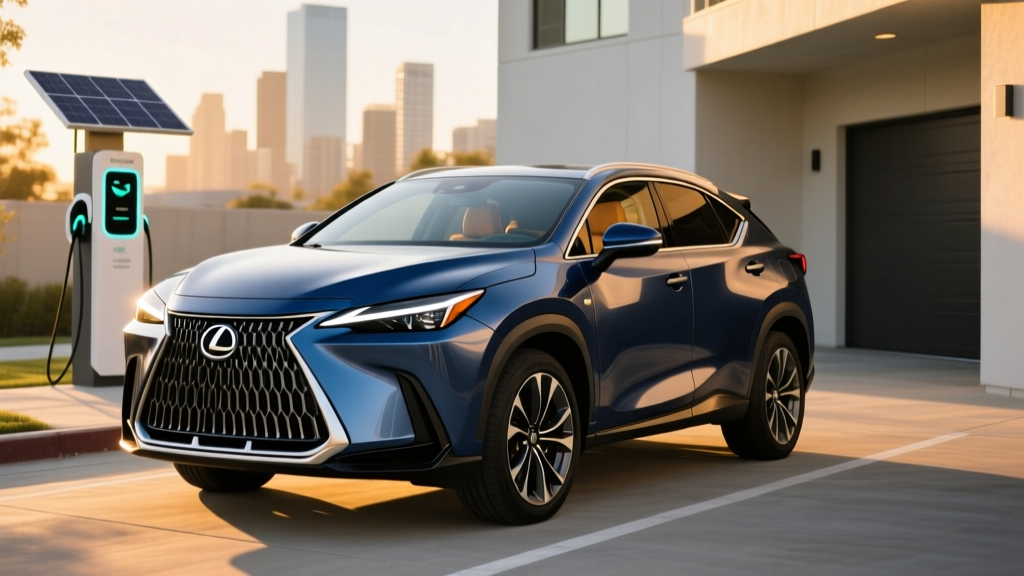
The 2026 Lexus NX continues to offer two distinct hybrid flavors: the conventional NX 350h (HEV) for buyers who want maximum simplicity and strong city fuel economy, and the plug-in NX 450h+ (PHEV) for those with home charging access who want a taste of electric-only commuting without range anxiety. Both share the same refined 2.5-liter four-cylinder foundation, but the powertrain tuning, battery capacity, and ownership economics diverge significantly. If you're cross-shopping the luxury compact SUV segment and want electrification without going full BEV, the NX hybrid pair deserves a close look — but the right choice depends entirely on your daily mileage and charging situation.
| Spec | NX 350h (HEV) | NX 450h+ (PHEV) |
|---|---|---|
| Powertrain | 2.5L I4 + 2 electric motors (AWD) | 2.5L I4 + 2 electric motors (AWD) |
| Combined Horsepower | 244 hp | 304 hp |
| 0–60 mph | 7.2 sec | 6.0 sec |
| EPA Combined MPG | 36 MPG | 36 MPG (hybrid mode) / 84 MPGe (EV+hybrid) |
| EPA City / Highway | 38 city / 33 highway | 38 city / 33 highway (hybrid mode) |
| Electric-Only Range | N/A | 37 miles |
| Total Combined Range | ~490 miles | ~510 miles |
| Traction Battery | 1.6 kWh NiMH | 18.1 kWh lithium-ion |
| DC Fast Charging | N/A | No (Level 2 AC only) |
| Level 2 Charge Time (0–100%) | N/A | ~4.5 hours (3.3 kW onboard) |
| Base MSRP | $43,965 | $61,505 |
| Federal Tax Credit (§30D) | Not eligible | Up to $7,500 (eligibility varies) |
| Hybrid Battery Warranty | 10 years / 150,000 miles | 10 years / 150,000 miles |
HEV vs. PHEV: What's the Real Difference?
Before diving into the numbers, it's essential to separate these two powertrains clearly — they serve different buyers.
| Feature | NX 350h (HEV) | NX 450h+ (PHEV) |
|---|---|---|
| Plug in to charge? | No — self-charging via regen & engine | Yes — plug in for full EV range |
| Electric-only driving | Very short, low-speed bursts (<1 mi) | Up to 37 miles at highway speeds |
| Home charger needed? | No | Yes, strongly recommended (Level 2) |
| Federal tax credit | No | Potentially up to $7,500 |
| Best for | Drivers without charging access; want simplicity | Drivers with home charging & short commutes |
The NX 350h operates exactly like Toyota's proven hybrid system: the gasoline engine and electric motors blend seamlessly, regenerative braking recovers energy, and a small battery buffer stores it. You never plug it in. The NX 450h+ uses a much larger 18.1 kWh lithium-ion battery that you charge overnight at home, giving you roughly 37 miles of pure electric driving before the gasoline engine fires up and the vehicle behaves like a conventional hybrid for the remaining ~473 miles of range.
Fuel Economy: EPA Numbers and Real-World MPG
| Model | City | Highway | Combined |
|---|---|---|---|
| NX 350h (HEV, AWD) | 38 MPG | 33 MPG | 36 MPG |
| NX 450h+ (PHEV, hybrid mode) | 38 MPG | 33 MPG | 36 MPG |
| NX 450h+ (PHEV, EV+hybrid combined) | 84 MPGe | ||
According to fueleconomy.gov, both models land at 36 MPG combined when operating as hybrids. But real-world results often differ from the sticker — and with Toyota/Lexus hybrids, the deviation tends to be favorable in city driving.
Real-world expectations for the NX 350h:
- City / stop-and-go: Hybrids excel here. Expect 37–40 MPG in urban driving where regenerative braking and engine-off coasting maximize efficiency. Some owners report touching 41 MPG in warm-weather city commuting.
- Highway cruising (70–80 mph): Expect 30–33 MPG. Aerodynamic drag dominates at speed, and the hybrid system provides less benefit than in the city.
- Cold weather (below 32°F): Plan for a 10–15% drop, bringing combined figures to roughly 31–33 MPG. The engine runs more frequently to provide cabin heat and maintain battery temperature.
- Mixed real-world combined: Most owners land between 33–37 MPG depending on driving style and climate.
Real-world expectations for the NX 450h+ (PHEV):
- Electric-only range: The EPA rates it at 37 miles. In moderate temperatures (55–80°F) with gentle driving, expect 34–39 miles. In freezing weather with cabin heat running, that drops to 28–32 miles.
- After battery depletion: The NX 450h+ operates as a conventional hybrid with identical 36 MPG combined — though the extra weight of the larger battery can shave 1–2 MPG in practice, yielding roughly 34–35 MPG.
- If you never plug in: You're carrying 400+ lbs of battery dead weight. You'll get slightly worse fuel economy than the NX 350h and waste the PHEV premium. Plug-in ownership only makes financial sense if you charge regularly.
Powertrain Deep Dive: 244 hp vs. 304 hp
Both NX hybrids use a 2.5-liter inline-four Atkinson-cycle engine paired with Toyota's e-CVT and dual electric motors driving all four wheels (E-Four AWD). The difference is in tuning and battery output.
NX 350h (HEV): The 2.5L engine produces 189 hp on its own; combined with electric motor assist, net system output is 244 hp. Acceleration to 60 mph takes 7.2 seconds — adequate for merging and passing, but not sporty. The e-CVT keeps the engine in its most efficient rpm band, which means smooth, linear acceleration without the rubber-band feel of older CVTs. The 1.6 kWh NiMH battery is small by design: it buffers energy for short electric assists and regenerative capture, not sustained electric driving.
NX 450h+ (PHEV): The larger 18.1 kWh lithium-ion pack enables more aggressive electric motor output, pushing combined system horsepower to 304 hp. The 0–60 time drops to 6.0 seconds — genuinely quick for a compact luxury SUV. In EV mode, you get silent, torque-rich acceleration up to about 84 mph before the engine intervenes. The PHEV also includes a dedicated CHARGE mode that uses the engine to replenish the battery while driving — useful if you want to save electric range for a zero-emission zone or city center later in your trip.
Charging the NX 450h+: What PHEV Owners Need to Know
The NX 450h+ comes with a 3.3 kW onboard charger, which is the limiting factor for charge speed. Here's what that means in practice:
| Charging Level | Power Source | Rate | 0–100% Time |
|---|---|---|---|
| Level 1 | 120V household outlet | ~1.4 kW | ~12 hours |
| Level 2 | 240V home charger / public station | 3.3 kW (vehicle-limited) | ~4.5 hours |
| DC Fast Charge | N/A | Not supported | — |
A critical detail: even if you plug the NX 450h+ into a 7.2 kW or 11.5 kW Level 2 station, the vehicle will only accept 3.3 kW. This is common for PHEVs (the onboard charger is smaller than a full BEV's), but it means you can't take advantage of faster public Level 2 chargers. A full charge from empty takes roughly 4.5 hours on Level 2 — easily achievable overnight on a standard 240V home installation.
Level 1 charging from a regular 120V outlet is technically possible but impractical as a daily routine: 12 hours for a full charge means you'd need to plug in immediately when you get home to be full by morning. Most PHEV owners invest in a Level 2 home charger — a 240V outlet installation typically costs $500–$2,000 depending on your electrical panel's proximity to the parking spot.
Pricing, Tax Credits, and Total Cost of Ownership
The 2026 NX hybrid lineup carries a meaningful price spread:
- NX 350h Premium: $43,965 MSRP
- NX 350h Luxury: ~$49,000 MSRP
- NX 450h+ Premium: $61,505 MSRP
- NX 450h+ Luxury: ~$66,000 MSRP
That's roughly a $17,500 gap between the base HEV and base PHEV. The PHEV's federal tax credit can narrow that gap — but eligibility is not guaranteed.
Federal §30D Tax Credit for the NX 450h+
The NX 450h+ may qualify for up to $7,500 under the IRS §30D Clean Vehicle Credit, but several conditions apply for the 2026 tax year:
- MSRP cap: SUVs must be at or below $80,000 — both NX 450h+ trims qualify.
- Buyer income cap: Modified AGI must not exceed $150,000 (single), $225,000 (head of household), or $300,000 (joint).
- Battery sourcing requirements: The credit is split into two halves — $3,750 for critical minerals and $3,750 for battery component sourcing. The NX 450h+ must meet escalating domestic-content thresholds that tighten each year. Check the current IRS qualified vehicle list before purchasing.
- Point-of-sale transfer: As of 2024, you can transfer the credit to the dealer at purchase, reducing your out-of-pocket cost immediately rather than waiting for tax filing. The dealer must be IRS-registered.
The NX 350h (conventional hybrid) does not qualify for the federal EV tax credit — it has no plug and doesn't meet the statute's definition of a clean vehicle. Some states offer modest hybrid rebates, but these vary widely; check your state energy office for current programs.
Five-Year Cost Comparison: NX 350h vs. NX 450h+ vs. NX 250 (Gas)
Assuming 15,000 miles/year, $3.50/gallon regular fuel, and $0.14/kWh electricity:
| Model | Efficiency | 5-Year Energy Cost | Notes |
|---|---|---|---|
| NX 250 (gas, AWD) | 28 MPG combined | ~$9,375 | Baseline |
| NX 350h (HEV) | 36 MPG combined | ~$7,290 | Saves ~$2,085 vs. gas |
| NX 450h+ (PHEV, 70% EV driving) | 84 MPGe blended | ~$3,800 | Saves ~$5,575 vs. gas (requires daily charging) |
The NX 350h pays for its ~$4,000 premium over the gas NX 250 within roughly 5–6 years through fuel savings alone. The NX 450h+ is harder to justify purely on fuel math — even with the $7,500 credit, the $17,500 price gap over the HEV takes many years to recoup. The PHEV makes sense if you value the electric driving experience, want to reduce tailpipe emissions on your commute, or have access to HOV lane incentives in your state.
Reliability, Battery Warranty, and Replacement Costs
Lexus Hybrid Battery Warranty: 10 years or 150,000 miles (whichever comes first), covering defects and capacity loss below a defined threshold. This applies to both the NX 350h NiMH pack and the NX 450h+ lithium-ion pack. Source: Lexus.
Toyota and Lexus have built a formidable reputation for hybrid reliability over two decades, starting with the Prius in 2000. The NX 350h's 1.6 kWh NiMH battery is a mature, conservative chemistry that degrades very slowly — many Toyota hybrids surpass 200,000 miles on the original pack. The NX 450h+'s 18.1 kWh lithium-ion pack is larger and operates under more stress (deeper cycles, higher charge/discharge rates), but Lexus engineers buffer a significant portion of gross capacity to protect long-term health.
Realistic battery replacement costs (out of warranty):
- NX 350h (NiMH): $2,500–$4,000 for a replacement pack plus labor. Refurbished packs are available for $1,500–$2,500.
- NX 450h+ (lithium-ion): $6,000–$9,000 for a new OEM pack plus labor. This is a more significant expense, though it's unlikely to be needed within the first 10–12 years based on current degradation data from similar Toyota/Lexus PHEV platforms.
For most original owners who sell or trade within 8–10 years, battery replacement is a non-issue. For second owners buying a used NX hybrid with 80,000+ miles, verify the battery's state of health through a dealer diagnostic scan before purchase.
Who Should Buy the NX 350h, the NX 450h+, or Look Elsewhere?
Choose the NX 350h (HEV) if:
- You don't have access to home or workplace Level 2 charging
- You want a fuel-efficient luxury SUV with zero behavior change from a gas car
- Your budget is under $50,000 and you want AWD, strong reliability, and 36 MPG
- You drive more than 50 miles per day and don't want to think about plugging in
Choose the NX 450h+ (PHEV) if:
- You have reliable home charging (garage or driveway with 240V access)
- Your daily commute is under 35 miles round-trip (you'll rarely use gas on weekdays)
- You want near-EV refinement on short trips but road-trip flexibility on weekends
- You qualify for the full $7,500 federal credit, narrowing the price gap
- You value the 304 hp power bump and 6.0-second 0–60 time
Consider a full EV (BEV) instead if:
- You have home charging and your daily driving is under 250 miles
- You want to eliminate gasoline entirely and minimize maintenance (no oil changes, fewer moving parts)
- You're open to vehicles like the Tesla Model Y, Genesis Electrified GV70, or BMW iX3, which offer longer electric range and lower operating costs
Stick with the gas NX 250 / NX 350 if:
- Your annual mileage is very low (under 8,000 miles) — fuel savings won't offset the hybrid premium
- You prioritize lowest possible purchase price over long-term efficiency
NX 350h Pros
- 36 MPG combined with no plug-in hassle
- Lower entry price ($43,965)
- Proven Toyota hybrid reliability
- Strong city MPG (38) exceeds EPA in real driving
- 10-year / 150,000-mile battery warranty
NX 350h Cons
- No federal tax credit
- 244 hp feels merely adequate for the segment
- Modest cargo space vs. rivals (22.7 cu ft behind rear seats)
- Infotainment learning curve for first-time Lexus users
NX 450h+ Pros
- 37 miles EV range covers most commutes
- 304 hp and 6.0-sec 0–60 — genuinely quick
- Potential $7,500 federal tax credit
- Silent, smooth EV-mode driving
- 510+ miles total range eliminates range anxiety
NX 450h+ Cons
- $17,500 premium over the HEV
- 3.3 kW onboard charger is slow for public Level 2
- No DC fast charging
- Heavy — reduced efficiency when battery is depleted
- PHEV value depends on charging regularly
Frequently Asked Questions
How many MPG does the 2026 Lexus NX hybrid get?
Both the NX 350h (HEV) and the NX 450h+ (in hybrid mode) are EPA-rated at 36 MPG combined, with 38 city and 33 highway. In real-world city driving, many owners of the NX 350h report 37–40 MPG thanks to regenerative braking. Highway driving at 75+ mph typically yields 30–33 MPG.
How far can the NX 450h+ go on electric only?
The EPA rates the NX 450h+ at 37 miles of electric-only range. In moderate temperatures with gentle driving, expect 34–39 miles. In freezing weather, plan for 28–32 miles as the battery is less efficient and cabin heating draws additional power.
Does the 2026 Lexus NX hybrid qualify for a tax credit?
The NX 350h (conventional hybrid) does not qualify for the federal §30D Clean Vehicle Credit. The NX 450h+ (PHEV) may qualify for up to $7,500, subject to buyer income limits ($150K single / $300K joint), the $80K SUV MSRP cap, and battery critical-mineral and component sourcing requirements. Check the current IRS qualified vehicle list before purchasing, as eligible models can change.
Is the Lexus NX hybrid reliable, and what does battery replacement cost?
Lexus/Toyota hybrids have an excellent long-term reliability track record spanning two decades. The hybrid battery is warranted for 10 years / 150,000 miles. Out-of-warranty replacement costs roughly $2,500–$4,000 for the NX 350h NiMH pack and $6,000–$9,000 for the NX 450h+ lithium-ion pack. Most owners will never need a replacement during their ownership period.
Do I need to plug in the NX 350h?
No. The NX 350h is a conventional hybrid (HEV) — it charges its small battery through regenerative braking and the gasoline engine. You fuel it like any other car. Only the NX 450h+ (PHEV) benefits from being plugged in.
How does the NX hybrid compare to a full EV like the Tesla Model Y?
A full EV like the Model Y offers 300+ miles of range, lower per-mile energy costs (~$0.04–0.06/mile vs. ~$0.10/mile for the NX 350h on gas), and near-zero drivetrain maintenance. However, you need reliable home charging, must plan for longer road trips around DC fast-charging stops, and face higher upfront pricing. The NX hybrids bridge the gap: they cut fuel use significantly without requiring any charging infrastructure (HEV) or with minimal infrastructure (PHEV). If your lifestyle supports full EV ownership, a BEV will save more over time; if it doesn't, the NX hybrids are a pragmatic middle ground.
Can the NX 450h+ DC fast charge?
No. The NX 450h+ only supports AC charging (Level 1 at 120V or Level 2 at 240V) at a maximum rate of 3.3 kW. DC fast charging is not available on this PHEV — a common limitation in the plug-in hybrid segment. Full charges take approximately 4.5 hours on Level 2.