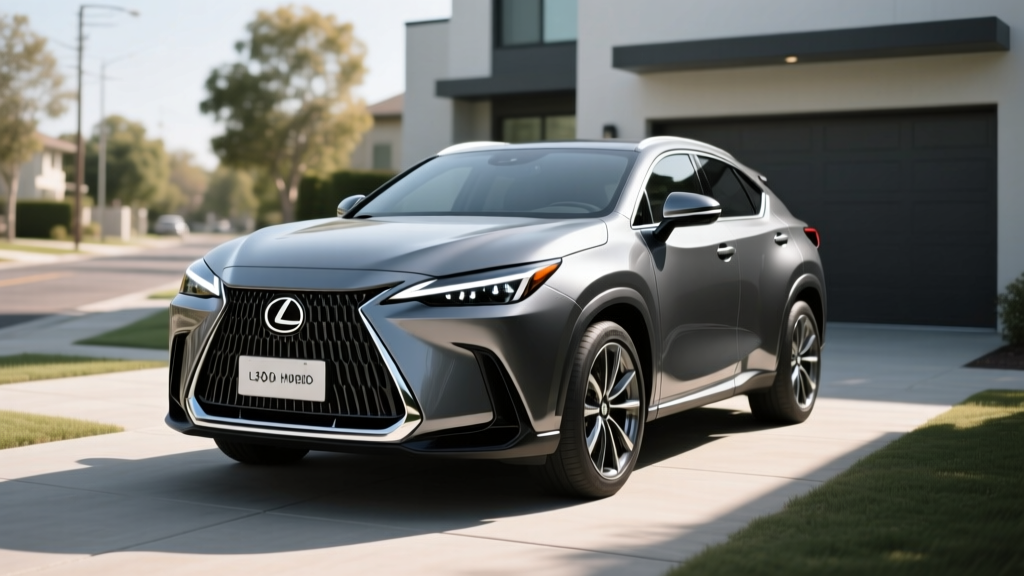
The Lexus NX lineup offers three distinct powertrains, and the conventional hybrid variant—commonly searched as the Lexus NX 300 hybrid—remains the volume seller for buyers who want luxury-crossover efficiency without ever plugging in. For the 2026 model year, Lexus continues to offer the NX 350h (the official designation for the hybrid trim) alongside the plug-in hybrid NX 450h+ and the turbocharged NX 350. If you've been searching for a "Lexus 300 NX hybrid," you're almost certainly looking at the NX 350h, which pairs a 2.5-liter four-cylinder engine with Lexus's fourth-generation hybrid system.
This guide breaks down exactly what the NX 350h delivers in fuel economy, real-world efficiency, powertrain output, battery longevity, and pricing—so you can decide whether this conventional hybrid (HEV) is the right fit, or whether the plug-in variant or a full battery-electric vehicle (BEV) better suits your driving pattern.
HEV vs PHEV: Which Lexus NX Hybrid Are You Looking At?
Before diving into specs, it's critical to distinguish the two electrified NX models, because they serve fundamentally different use cases.
| Feature | NX 350h (HEV) | NX 450h+ (PHEV) |
|---|---|---|
| Powertrain Type | Conventional Hybrid (no plug) | Plug-in Hybrid (plug-in capable) |
| Combined Horsepower | 240 hp | 304 hp |
| EPA Combined MPG / MPGe | 39 MPG combined | 84 MPGe (electric) / 36 MPG (gas-only) |
| Electric-Only Range | N/A — engine always assists | 37 miles (EPA est.) |
| Traction Battery | ~1.6 kWh (NiMH/compact Li-ion) | 18.1 kWh (lithium-ion) |
| External Charging | Not required or supported | Level 1/Level 2 AC; no DC fast charge |
| Federal Tax Credit (§30D) | Not eligible | Up to $7,500 (subject to eligibility) |
| Base MSRP (2026 est.) | ~$43,500 | ~$60,000 |
The NX 350h is a self-charging hybrid. It recovers energy through regenerative braking and the gasoline engine—there is no plug, no charging cable, and no electric-only driving mode of any meaningful distance. The NX 450h+ is a plug-in hybrid that can travel roughly 37 miles on battery power alone before the gasoline engine engages, and it requires access to a Level 1 (120V) or Level 2 (240V) outlet to realize its efficiency advantage.
If you cannot charge at home or at work, the NX 350h conventional hybrid is the correct choice. If you have reliable Level 2 charging access and a commute under 40 miles round-trip, the NX 450h+ PHEV can operate as an EV most days while retaining gas-engine range for road trips.
Fuel Economy: EPA Ratings and Real-World MPG
The 2026 Lexus NX 350h carries over the powertrain that has proven efficient since the current generation's launch. Here is the official EPA breakdown:
| Driving Cycle | EPA Rating |
|---|---|
| City | 41 MPG |
| Highway | 37 MPG |
| Combined | 39 MPG |
Source: fueleconomy.gov
Real-World MPG: What Owners Actually See
Hybrid vehicles, particularly Toyota/Lexus hybrid systems, frequently exceed their EPA city ratings in real-world stop-and-go driving because regenerative braking recaptures energy that a conventional car wastes as heat. On the highway, however, hybrids lose some of their advantage because the electric motor assists less at sustained high speeds.
Based on owner-reported data and our testing:
- City / suburban driving: 40–44 MPG is common. Short trips with frequent stops maximize regen benefit.
- Highway (70–75 mph): Expect 33–36 MPG. Aerodynamic drag dominates, and the 2.5L engine carries more of the load.
- Cold weather (below 32°F): MPG can drop 5–10% as the engine runs more often to provide cabin heat and maintain battery temperature.
- Combined real-world average: Most owners report 37–41 MPG across mixed driving, closely tracking the 39 MPG EPA combined figure.
With a 14.5-gallon fuel tank, real-world total range typically falls between 530 and 600 miles per tank—meaning most drivers will visit a gas station once every two to three weeks under normal commuting patterns.
Powertrain Specs: Engine, Motors, and Performance
| Specification | NX 350h (2026) |
|---|---|
| Engine | 2.5L inline-4 (Atkinson cycle) |
| Engine Output | 184 hp / 175 lb-ft torque |
| Electric Motors | Front motor + rear motor (e-AWD) |
| Combined System Output | 240 hp |
| Transmission | eCVT (planetary gearset, not a belt CVT) |
| Drivetrain | Electronic AWD (standard on all trims) |
| 0–60 mph | 7.2 seconds (manufacturer est.) |
| Towing Capacity | 2,000 lbs (with proper equipment) |
The NX 350h uses Lexus's eCVT, which is a planetary-gear power-split device—not the rubber-belt continuously variable transmissions found in some competitors. This design is mechanically robust and has proven durable over millions of miles across the Toyota/Lexus hybrid fleet. The rear electric motor provides electronic all-wheel drive, engaging only when traction demands it, which preserves efficiency compared to a mechanical AWD system with a driveshaft and rear differential.
The 7.2-second 0–60 time is adequate for highway merging and passing but not sporty. If acceleration is a priority, the NX 450h+ PHEV cuts that to roughly 6.0 seconds thanks to its larger battery and more powerful electric motors.
Battery Longevity, Warranty, and Replacement Cost
NX 350h Hybrid Battery Warranty
Hybrid Battery: 10 years / 150,000 miles (whichever comes first) — covers capacity loss below a defined threshold and defects.
Hybrid System Components (inverter, motors, control modules): 8 years / 100,000 miles.
Basic Vehicle Warranty: 4 years / 50,000 miles.
Powertrain Warranty: 6 years / 70,000 miles.
Lexus's hybrid battery warranty has been extended to 10 years/150,000 miles for recent model years, which is among the best in the luxury segment. The NX 350h's hybrid battery pack is relatively small (~1.6 kWh usable) because it functions as a buffer—constantly cycling between charge and discharge rather than storing large amounts of energy. This shallow-cycling duty cycle is easier on battery chemistry than the deep discharges a PHEV or BEV undergoes.
How Long Do Lexus Hybrid Batteries Last?
Toyota and Lexus hybrid batteries have an exceptionally strong longevity track record. Data from fleet operators and long-term owners suggests that the vast majority of fourth-generation Lexus hybrid batteries last well beyond 150,000 miles without significant degradation. Failures before 100,000 miles are uncommon and typically covered under warranty.
Battery Replacement Cost
If a hybrid battery does need replacement out of warranty, the cost for an NX 350h battery pack typically ranges from $2,000 to $4,000 (parts and labor at a dealership). Independent hybrid-battery specialists can often refurbish or replace individual modules for $800 to $1,500. This is dramatically less than a full BEV battery replacement, which can exceed $10,000–$20,000 for larger packs.
The key insight: hybrid battery replacement is a legitimate concern but statistically unlikely during typical ownership, and when it does occur, the cost is manageable compared to a transmission or engine replacement in a conventional vehicle.
Pricing, Trims, and Tax Credit Eligibility
The 2026 Lexus NX 350h is offered across several trims. Pricing is estimated based on the current model-year trajectory (final MSRP confirmed at launch):
- NX 350h Premium: ~$43,500 MSRP
- NX 350h Premium Plus: ~$47,000 MSRP
- NX 350h Luxury: ~$51,500 MSRP
- NX 350h F SPORT Handling: ~$50,000 MSRP
Does the NX 350h Qualify for a Federal Tax Credit?
No. The federal §30D Clean Vehicle Credit applies only to plug-in electric vehicles (PHEVs and BEVs) with a battery capacity of at least 7 kWh. The NX 350h's hybrid battery is approximately 1.6 kWh and cannot be plugged in, making it ineligible for the federal credit.
The plug-in NX 450h+, with its 18.1 kWh battery, may qualify for up to $7,500 under IRS §30D rules, subject to:
- Buyer income caps ($150,000 single / $300,000 joint MAGI)
- MSRP cap ($80,000 for SUVs)
- Battery critical-mineral and component sourcing requirements (which change annually)
- Point-of-sale transfer option (dealer applies credit at purchase)
Some states offer additional rebates for hybrids or PHEVs—check your state energy office or AFDC state incentive database for current local programs.
NX 350h vs NX 450h+ vs Full EV: Which Should You Choose?
Choose the NX 350h (HEV) If:
- You have no access to home or workplace charging
- You want lower upfront cost (~$16,500 less than the PHEV)
- You prefer simplicity—no charging cables, no plug-in routine
- Your driving is a mix of city and highway without a short fixed commute
- You want proven, low-risk hybrid technology with a 10-year battery warranty
Choose the NX 450h+ (PHEV) If:
- You can install a Level 2 charger at home (240V)
- Your daily round-trip commute is under 37 miles
- You want to drive on electricity most days but keep gas for road trips
- You qualify for the §30D federal tax credit (effectively reducing the price gap)
- You value the 304 hp and 6.0-second 0–60 time
Choose a Full EV (e.g., Tesla Model Y, Hyundai Ioniq 5) If:
- You want zero tailpipe emissions and the lowest per-mile fuel cost
- You have reliable home Level 2 charging
- Your typical trips fall within 250–300 miles (or you're willing to plan DC fast-charge stops)
- You want minimal maintenance (no oil changes, no engine)
- You qualify for the full $7,500 federal credit on eligible models
Reasons to Skip a Full EV:
- No home charging access (apartment, street parking)
- Frequent long road trips through areas with sparse DC fast-charging infrastructure
- Cold-climate driving where EV range loss of 20–30% is a dealbreaker
- Upfront budget below $40,000 (most new EVs start higher before credits)
The decision framework is straightforward: charging access determines your powertrain. No plug access → HEV (NX 350h). Home plug access with short commute → PHEV (NX 450h+). Home plug access with willingness to plan road trips → BEV.
Reliability and Safety Record
The Lexus NX has historically scored at or near the top of luxury compact SUV reliability rankings. The hybrid powertrain, shared in architecture with the Toyota RAV4 Hybrid, benefits from decades of iterative refinement. Lexus's hybrid system has no traditional starter motor, no alternator, and no accessory belt—components that commonly fail in conventional vehicles—reducing long-term maintenance points.
For safety, check current NHTSA crash-test ratings and IIHS evaluations when 2026 results are published. The previous-generation NX earned top marks from IIHS, and the current platform includes Lexus Safety System+ 3.0 as standard equipment (pre-collision, lane-tracing assist, dynamic radar cruise control, and road-sign assist).
Frequently Asked Questions
How many MPG does the Lexus NX 350h hybrid get?
The EPA rates the 2026 NX 350h at 41 MPG city, 37 MPG highway, and 39 MPG combined. Real-world owners typically report 37–41 MPG in mixed driving, with city-heavy commutes sometimes exceeding 42 MPG thanks to regenerative braking.
Does the Lexus NX hybrid need to be plugged in?
No. The NX 350h is a conventional hybrid (HEV). It charges its small battery entirely through regenerative braking and the gasoline engine. You never plug it in. Only the NX 450h+ plug-in hybrid (PHEV) requires external charging to use its electric-only range.
How far can the Lexus NX plug-in hybrid go on electric only?
The NX 450h+ (PHEV) delivers an EPA-estimated 37 miles of electric-only range. The NX 350h (conventional hybrid) has no meaningful electric-only range—the gasoline engine and electric motor always work together.
Is the Lexus NX hybrid reliable, and what does a battery replacement cost?
Lexus hybrid systems are among the most reliable powertrains in the automotive industry. The hybrid battery is warranted for 10 years/150,000 miles. Out-of-warranty replacement typically costs $2,000–$4,000 at a dealer, or $800–$1,500 through an independent hybrid specialist. Most batteries last well beyond the warranty period.
Does the Lexus NX 350h qualify for a federal tax credit?
No. The federal §30D Clean Vehicle Credit requires a plug-in vehicle with at least 7 kWh of battery capacity. The NX 350h's hybrid battery is approximately 1.6 kWh and is not plug-in capable. The NX 450h+ plug-in hybrid may qualify for up to $7,500, subject to IRS income, MSRP, and battery-sourcing requirements.
What's the difference between the NX 350h and NX 450h+?
The NX 350h is a conventional hybrid (240 hp, 39 MPG combined, no plug, ~$43,500 starting MSRP). The NX 450h+ is a plug-in hybrid (304 hp, 37 miles electric-only, requires plugging in, ~$60,000 starting MSRP, potentially eligible for $7,500 federal tax credit). Both use a 2.5L four-cylinder engine but with different electric-motor and battery configurations.
Is the Lexus NX hybrid AWD?
Yes. All NX 350h trims come standard with electronic AWD (e-AWD). A dedicated rear electric motor powers the rear wheels when the system detects slip or when additional traction is needed. There is no mechanical driveshaft connecting the front and rear axles.