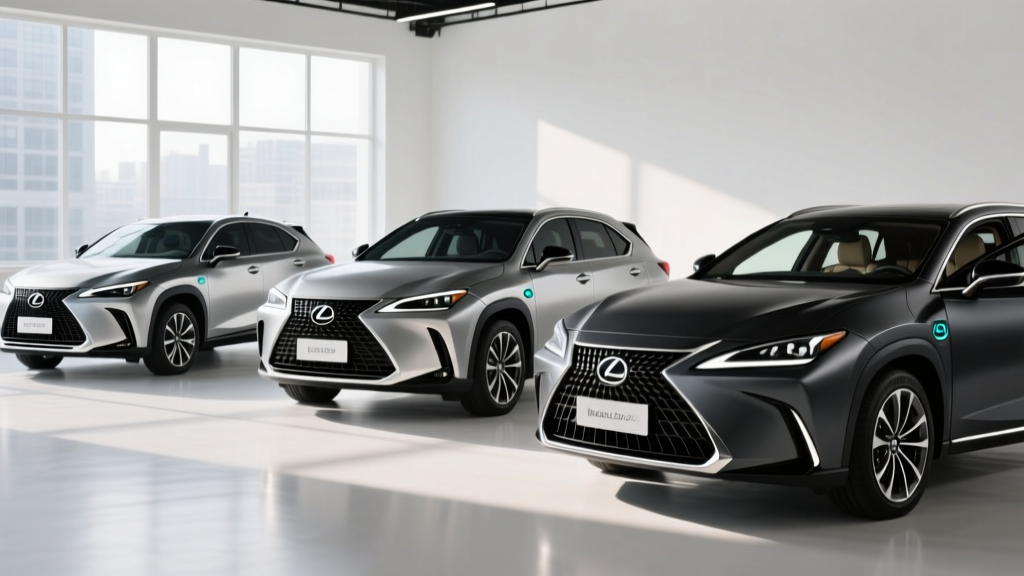
If you've been searching for a Lexus hybrid 300h, you've likely noticed the badge appears across several very different vehicles — a subcompact crossover, a compact luxury SUV, and a midsize sedan. The "300h" designation signals Lexus's mid-tier hybrid powertrain, but the actual fuel economy, driving dynamics, and ownership economics vary meaningfully between models. This guide breaks down every current 300h in the Lexus lineup for 2026, with exact EPA numbers, real-world fuel economy expectations, battery longevity data, and tax credit eligibility so you can pick the right one.
HEV vs PHEV: What the Lexus 300h Badge Actually Means
Every Lexus wearing the 300h badge is a conventional hybrid electric vehicle (HEV) — not a plug-in hybrid. This is a critical distinction:
- HEV (300h): The battery recharges through regenerative braking and the gasoline engine. You never plug it in. The electric motor assists the engine to reduce fuel consumption, typically yielding 35-44 MPG combined.
- PHEV (NX 450h+, RX 450h+): These higher-tier Lexus models feature a larger battery you plug in, offering 37-38 miles of electric-only driving before the hybrid system takes over. They qualify for federal tax credits; 300h models generally do not.
If plug-in electric range matters to you, look at Lexus's 450h+ models instead. The 300h lineup is purpose-built for drivers who want maximum MPG with zero changes to their fueling routine.
2026 Lexus 300h Models at a Glance: EPA MPG and Key Specs
Here's how the three current 300h models stack up on paper, using EPA data from fueleconomy.gov and Lexus manufacturer specifications:
| Specification | UX 300h | NX 300h | ES 300h |
|---|---|---|---|
| Body Style | Subcompact SUV | Compact SUV | Midsize Sedan |
| Powertrain | 2.0L 4-cyl + 2 electric motors (AWD) | 2.5L 4-cyl + 3 electric motors (AWD) | 2.5L 4-cyl + electric motor (FWD) |
| Combined Horsepower | 181 hp | 240 hp | 215 hp |
| EPA City MPG | 43 | 41 | 43 |
| EPA Highway MPG | 41 | 37 | 44 |
| EPA Combined MPG | 42 | 39 | 44 |
| Drivetrain | AWD (E-AWD rear motor) | AWD (E-AWD rear motor) | FWD |
| 0-60 mph | ~7.8 sec | ~7.2 sec | ~8.1 sec |
| Starting MSRP (2026) | $39,750 | $45,550 | $46,250 |
| Federal Tax Credit (§30D) | Not eligible | Not eligible | Not eligible |
Real-World MPG: What Owners Actually See
EPA estimates are a starting point, not a guarantee. Lexus hybrids consistently exceed their EPA city ratings in real-world driving because regenerative braking recaptures more energy in stop-and-go traffic than the test cycle captures. Here's what to expect based on owner-reported data and long-term testing patterns:
UX 300h: EPA 42 combined. Real-world city drivers regularly report 44-47 MPG. Highway cruising at 75+ mph drops to 37-39 MPG. In cold weather (below 30°F), expect a 5-8 MPG reduction due to engine running more frequently for cabin heat.
NX 300h: EPA 39 combined. City driving yields 40-43 MPG. Highway driving settles around 34-36 MPG. The larger, heavier body and AWD system create more highway drag than the sedan.
ES 300h: EPA 44 combined. This is the efficiency champion. City drivers see 45-49 MPG routinely. Highway numbers stay strong at 41-43 MPG thanks to the aerodynamic sedan profile and FWD-only layout. Cold-weather impact is the mildest here.
The ES 300h's highway advantage over the two SUVs is substantial — roughly 5-7 MPG better at interstate speeds. If your commute is predominantly highway, the sedan's efficiency edge compounds into hundreds of dollars in annual fuel savings.
How the Lexus 300h Hybrid Powertrain Works
All 300h models use Toyota/Lexus's fourth-generation hybrid synergy drive, though with displacement differences. The system pairs a naturally aspirated Atkinson-cycle gasoline engine with one or more electric motors connected through a planetary gearset (eCVT). There are no fixed gear ratios — the system continuously blends engine and motor torque.
UX 300h: The 2.0-liter inline-four produces 146 hp on its own. Two electric motors (one front, one rear for E-AWD) bring the combined system output to 181 hp. The hybrid battery is a compact lithium-ion pack mounted under the rear seats. Total system output is modest, but the UX's lighter curb weight (~3,600 lbs) keeps it responsive in city driving.
NX 300h: A larger 2.5-liter four-cylinder (184 hp) teams with three electric motors for 240 combined horsepower. The third motor is dedicated to the rear axle, providing on-demand AWD without a mechanical driveshaft. This is the most powerful 300h, and the extra output is noticeable in highway merging and passing.
ES 300h: The same 2.5-liter engine as the NX but tuned for efficiency over output, paired with a single front electric motor for 215 combined hp. The FWD layout saves weight and reduces drivetrain losses, which is why the ES 300h achieves the highest MPG in the family despite having more horsepower than the UX 300h.
Battery Longevity, Warranty, and Replacement Cost
Hybrid battery anxiety is the single most common concern among first-time hybrid buyers. Here's the data:
Warranty: All 2026 Lexus 300h models carry a 10-year / 150,000-mile hybrid battery warranty (whichever comes first). This covers capacity loss below a defined threshold and any manufacturing defects. California-emissions states extend certain hybrid component coverage further under CARB rules.
Real-world lifespan: Lexus/Toyota hybrid batteries routinely last 150,000-200,000+ miles before significant degradation. The lithium-ion packs in current-generation models have more robust thermal management than earlier nickel-metal hydride packs, reducing heat-related aging.
Replacement cost: If a battery fails out of warranty, expect $3,000-$5,000 for a new OEM pack installed at a Lexus dealer. Independent hybrid specialists often offer refurbished packs for $1,500-$2,500. Individual cell module replacement (rarely needed) runs $500-$1,000.
For context, Lexus hybrid battery failure rates within the warranty period are extremely low — well under 1% based on long-term fleet data. The hybrid system's power-split device and inverters carry the same 8-year/100,000-mile coverage. A Lexus 300h is statistically one of the lowest-risk electrified vehicles you can buy from a long-term maintenance standpoint.
Tax Credits and Incentives for Lexus 300h Models
Here's where the conventional hybrid reality matters for your wallet:
- Federal §30D Clean Vehicle Credit: None of the 2026 Lexus 300h models qualify. The IRS §30D credit requires a plug-in electric vehicle with a minimum battery capacity of 7 kWh and external charging capability. Conventional HEVs do not meet this threshold.
- Federal used-vehicle credit (§25E): If you purchase a qualifying pre-owned Lexus 300h (model year at least two years old, under $25,000 sale price, income caps apply), you may be eligible for up to $4,000 or 30% of the sale price. Check IRS guidelines on the used clean vehicle credit for current eligibility.
- State incentives: A handful of states offer rebates or HOV lane access for hybrids, though most incentive programs now prioritize BEVs and PHEVs. Check your state's energy office or DMV for current programs — these vary widely by jurisdiction and change annually.
The absence of a federal tax credit means the 300h's value proposition rests entirely on fuel savings, reliability, and lower purchase price versus PHEV or BEV alternatives.
Lexus 300h vs PHEV vs Full EV: Which Fits Your Driving Life?
Choose a Lexus 300h (HEV) if:
- You don't have reliable access to home or workplace charging
- You want EV-like city MPG with zero behavior change
- Your annual mileage is moderate (10,000-15,000 mi/yr) and fuel savings alone justify the hybrid premium
- You plan to keep the vehicle 8+ years and prioritize long-term reliability
- You want the lowest upfront price among electrified options
Choose a Lexus 450h+ (PHEV) if:
- You can charge at home (Level 2 preferred) and your daily commute is under 37 miles
- You want electric-only driving most days but need gas flexibility for road trips
- You qualify for the §30D federal tax credit (income and MSRP caps apply)
- You want HOV lane access in states that grant it to PHEVs
Choose a full BEV (e.g., Tesla Model Y, Hyundai Ioniq 5) if:
- You have dependable Level 2 home charging
- Your daily driving is under 250 miles and you road-trip infrequently
- You want the lowest per-mile energy cost (electricity vs. gasoline)
- You want the full $7,500 federal credit (if eligible) and maximum state incentives
- You want near-zero routine maintenance (no oil changes, no transmission fluid)
The 300h sweet spot is clear: apartment dwellers, street parkers, and anyone without charging access who still wants dramatically better fuel economy than a gas-only vehicle. The ES 300h in particular delivers nearly 45 MPG combined without a single plug or app download.
Pros
- 42-44 MPG combined across the lineup; real-world city driving often higher
- No charging infrastructure needed — fill up at any gas station
- 10-year/150,000-mile hybrid battery warranty
- Lexus reliability and resale value track record
- E-AWD on UX and NX adds all-weather capability with minimal efficiency penalty
- Lower MSRP than PHEV or BEV equivalents
Cons
- No federal tax credit eligibility
- No electric-only driving mode (engine always available)
- CVT-style powertrain lacks the direct acceleration feel of a BEV
- Highway MPG drops noticeably at 75+ mph (especially UX and NX)
- Not as future-proof as a full EV as charging infrastructure expands
Frequently Asked Questions
How many MPG does the Lexus 300h get?
It depends on the model. The ES 300h sedan leads at 44 MPG combined (43 city / 44 highway). The UX 300h crossover achieves 42 combined (43 city / 41 highway). The NX 300h compact SUV returns 39 combined (41 city / 37 highway). Real-world city driving often exceeds EPA estimates by 2-5 MPG thanks to aggressive regenerative braking in traffic.
Do I need to plug in a Lexus 300h?
No. Every Lexus 300h is a conventional hybrid (HEV). The battery charges automatically through regenerative braking and the gasoline engine. You fuel it exactly like a gas car — at any gas station, with regular unleaded. If you want plug-in capability, look at the NX 450h+ or RX 450h+.
Is the Lexus 300h hybrid reliable, and what does battery replacement cost?
Lexus hybrids rank among the most reliable electrified vehicles sold. The hybrid battery carries a 10-year/150,000-mile warranty, and real-world data shows these packs routinely last 150,000-200,000+ miles. Out-of-warranty replacement costs $3,000-$5,000 for an OEM pack, or $1,500-$2,500 for a refurbished unit from a hybrid specialist.
Does the Lexus 300h qualify for any tax credit?
The 2026 Lexus 300h does not qualify for the federal §30D Clean Vehicle Credit, which requires plug-in capability and a minimum 7 kWh battery. However, a used 300h purchased for under $25,000 may qualify for the federal §25E used clean vehicle credit (up to $4,000, subject to income limits). State incentives vary — check your local energy office.
How does the Lexus 300h compare to a full EV on cost?
A Lexus 300h at 42-44 MPG costs roughly $1,200-$1,500 per year in fuel at 12,000 miles driven (assuming $3.50/gallon). A comparable BEV charged at the national average of $0.16/kWh costs $500-$700 per year in electricity. However, the 300h's lower purchase price (no $7,500 credit needed to make the math work), zero charging infrastructure cost, and proven long-term reliability narrow the total cost of ownership gap significantly for drivers who keep vehicles 5+ years and lack home charging.
Which Lexus 300h is the most fuel-efficient?
The ES 300h sedan at 44 MPG combined. Its aerodynamic profile, lighter FWD drivetrain, and efficient 2.5L hybrid system give it a 2-5 MPG advantage over the UX and NX crossovers. For maximum fuel savings in the Lexus lineup, the ES 300h is the clear pick.