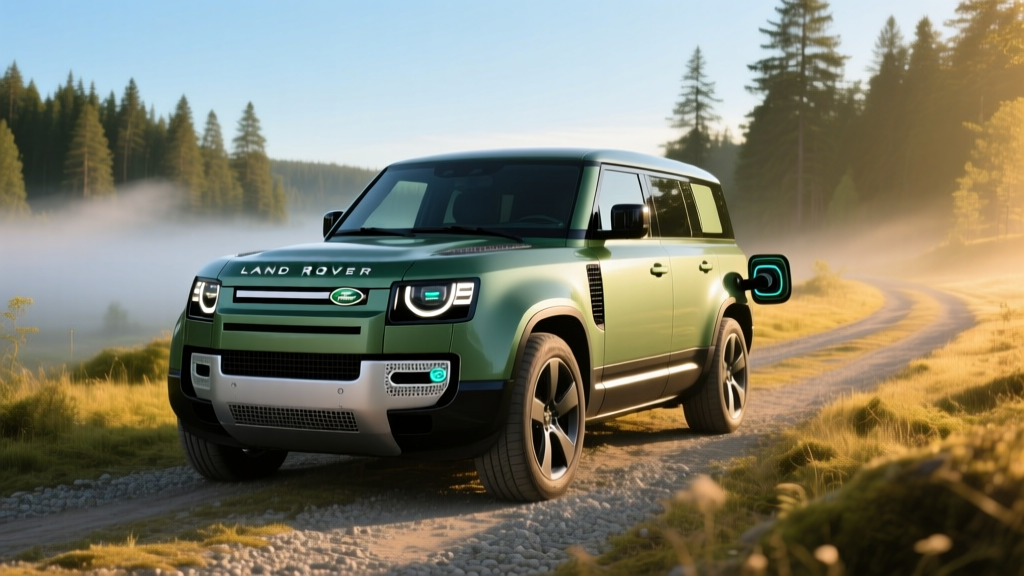
The Land Rover Defender has long been the benchmark for off-road credibility wrapped in luxury packaging. For 2026, the Defender lineup includes a plug-in hybrid variant — the P400e — that pairs a turbocharged inline-four with an electric motor for a combined 404 horsepower and a modest electric-only driving range. If you've been searching for a Defender hybrid, the P400e is the only electrified option in the current lineup, and it comes with important caveats around range, charging, and pricing that buyers need to understand before signing a lease or purchase agreement.
This guide covers the 2026 Defender P400e plug-in hybrid in detail — electric-only range, fuel economy, battery and charging specs, powertrain output, pricing, federal tax credit eligibility, and whether this PHEV actually makes sense compared to a full EV or a conventional gas Defender.
HEV vs PHEV: Which Defender Hybrid Exists?
Land Rover does not offer a conventional hybrid (HEV) version of the 2026 Defender. The only electrified Defender is the P400e plug-in hybrid (PHEV), which you plug into an external power source to recharge its battery. Here's the distinction:
| Feature | Conventional Hybrid (HEV) | Plug-in Hybrid (PHEV) — Defender P400e |
|---|---|---|
| Plugs in to charge? | No — regenerates via braking and engine | Yes — requires Level 1 or Level 2 plug-in |
| Electric-only driving? | Minimal (1-2 miles at low speed) | Yes — up to 19 miles EPA |
| Battery size | Small (1-2 kWh) | 19.2 kWh usable |
| Gas engine always needed? | Yes | No — can drive on electric alone for short trips |
The Defender also uses a 48-volt mild-hybrid (MHEV) system on its six-cylinder models (P300, P400, P500). This is not a true hybrid — it cannot drive on electric power alone. It simply smooths stop-start operation and provides a small torque assist. If a dealer calls a P400 "hybrid," clarify that only the P400e is a genuine plug-in hybrid with electric-only capability.
2026 Defender P400e: Powertrain, Horsepower, and Performance
The P400e pairs a 2.0-liter turbocharged inline-four gasoline engine with a 105 kW electric motor integrated into the 8-speed automatic transmission. Combined system output:
| Specification | 2026 Defender P400e (110 body style) |
|---|---|
| Combined Horsepower | 404 HP |
| Combined Torque | 472 lb-ft |
| Gas Engine | 2.0L turbo I4 (300 HP) |
| Electric Motor | 105 kW (141 HP) |
| Transmission | 8-speed automatic, AWD |
| 0-60 mph | 5.4 seconds (manufacturer est.) |
| Towing Capacity | 6,614 lbs (reduced vs gas models) |
| Battery (usable) | 19.2 kWh, lithium-ion NMC |
The 404 HP output puts the P400e in the upper tier of the Defender range — only the V8 P500 and V8 P525 variants produce more. The instant torque from the electric motor makes the P400e feel brisk around town, particularly in the first 30 mph where electric assist is most pronounced.
One trade-off: the P400e's towing capacity drops to approximately 6,614 lbs compared to 8,201 lbs on the P400 six-cylinder. The added weight of the battery and the smaller four-cylinder engine under heavy load are the reasons. If you plan to tow a large trailer regularly, the P400 or P500 gas models are better choices.
Electric-Only Range and Total Combined Range
The EPA rates the 2026 Defender 110 P400e at 19 miles of electric-only range. This is on the low end for a modern PHEV — competitors like the Jeep Wrangler 4xe (21 miles) and the Toyota RAV4 Prime (42 miles) offer more.
EPA Electric Range: 19 miles
Real-World Expectation: 14-17 miles in mixed driving; as low as 10-12 miles at highway speeds or in cold weather (below 40°F). The Defender's boxy aerodynamics and 5,400+ lb curb weight work against electric efficiency.
Once the battery depletes, the P400e operates as a conventional hybrid, with the gas engine and regenerative braking managing energy flow. Total combined range (electric + gas) is approximately 440 miles on a full tank and full battery, based on the 23.8-gallon fuel tank and charge-sustaining fuel economy.
Fuel Economy: EPA MPG and Real-World Numbers
When the battery is depleted and the P400e operates in charge-sustaining (hybrid) mode, fuel economy is modest for a vehicle of this size and weight:
| Driving Mode | City | Highway | Combined |
|---|---|---|---|
| Charge-Sustaining (gas only) | 18 MPG | 22 MPG | 19 MPG |
| With regular plug-in charging | Varies widely — see below | ||
| MPGe (electric + gas combined) | 48 MPGe (EPA) | ||
Real-world MPG context: The 19 MPG combined figure applies when you never plug in. If you charge daily and your commute is under 19 miles, you could go weeks without using gasoline. However, on long highway road trips — where the Defender is often used — expect fuel economy in the 18-21 MPG range regardless of battery charge, because aerodynamic drag dominates at speed.
For comparison, the non-hybrid Defender 110 P400 (mild-hybrid inline-six) achieves an EPA 17 city / 22 highway / 19 combined — nearly identical to the P400e in charge-sustaining mode. The PHEV's advantage is exclusively in short-trip, charge-between-drives scenarios.
Battery, Charging Time, and DC Fast Charging
The Defender P400e uses a 19.2 kWh usable lithium-ion battery pack (NMC chemistry) mounted under the rear floor. Charging options:
| Charging Level | Power | 0-100% Time | Notes |
|---|---|---|---|
| Level 1 (120V household) | ~1.4 kW | ~14 hours | Trickle charge; not practical for daily use |
| Level 2 (240V home/public) | 7.2 kW | ~2.5 hours | Standard onboard charger; practical for overnight |
| DC Fast Charging | Not supported | N/A | No CCS or NACS DC port on the P400e |
Key limitation: The Defender P400e cannot DC fast charge. There is no CCS or NACS DC charging port. The maximum charge rate is 7.2 kW on Level 2 AC, which means a full charge takes about 2.5 hours. This is adequate for overnight home charging but means you cannot quickly top up at a highway DC fast-charging station like you could with a full EV or some competing PHEVs (the Mitsubishi Outlander PHEV, for example, supports DC fast charging).
For home charging, a Level 2 wallbox (240V, 32A or higher) is strongly recommended. Installation costs typically range from $500 to $2,000 depending on electrical panel capacity and run length — budget for a licensed electrician to assess your setup. See our Level 2 home charger installation guide for a full cost breakdown.
Pricing, Trims, and Federal Tax Credit Eligibility
The 2026 Defender 110 P400e is offered in a single, well-equipped trim:
| Model | Starting MSRP | Est. After Federal Credit |
|---|---|---|
| Defender 110 P400e | $75,300 | Varies — see eligibility below |
Federal tax credit (§30D): The Defender P400e's eligibility for the up-to-$7,500 federal tax credit under IRS §30D is unlikely as of 2026. The current rules require that a percentage of battery critical minerals and components be sourced from the U.S. or free-trade-agreement countries, and that final assembly occur in North America. The Defender is assembled in Nitra, Slovakia, which disqualifies it from the new-vehicle §30D credit. Land Rover has not announced plans to shift Defender production.
For the most current rules, always verify with the IRS Clean Vehicle Credits page and consult a tax professional. State-level incentives may still apply — check your state's energy office or fueleconomy.gov's state incentive tool.
§30D Credit Checklist for 2026 Defender P400e:
- ❌ MSRP under $80,000 cap (SUV): Passes — $75,300 base
- ❌ North American final assembly: Fails — assembled in Slovakia
- ❌ Critical minerals sourcing requirement: Likely fails
- ❌ Battery component sourcing requirement: Likely fails
- ✅ Buyer income limits: $150K single / $300K joint (buyer must still qualify)
Bottom line: Do not count on the federal tax credit for the Defender P400e. Factor the full MSRP into your budget.
Battery Warranty, Reliability, and Replacement Cost
Hybrid Battery Warranty: 8 years / 100,000 miles (whichever comes first), covering defects and capacity loss below a specified threshold (typically 70% of original capacity).
Powertrain Warranty: 4 years / 50,000 miles
Limited Vehicle Warranty: 4 years / 50,000 miles
Reliability: Land Rover's overall brand reliability ratings remain below the industry average. J.D. Power and Consumer Reports consistently rank Land Rover in the lower third of brands. The P400e's added complexity — a turbocharged engine, electric motor, high-voltage battery, and sophisticated terrain-response systems — introduces more potential failure points than a simpler powertrain.
That said, the hybrid battery itself is covered by the 8-year/100,000-mile warranty mandated for emissions-related components. If the battery degrades below the warranty threshold within that period, Land Rover will repair or replace it at no cost. Out of warranty, a PHEV battery replacement for the Defender is estimated at $8,000 to $12,000 (parts and labor), though real-world data is still limited given the P400e's relatively recent introduction.
For long-term ownership peace of mind, an extended warranty is worth considering — particularly if you plan to keep the vehicle past the 4-year/50,000-mile bumper-to-bumper period.
Who Should Buy the Defender P400e vs. Gas or Full EV?
Choose the Defender P400e if:
- You have home Level 2 charging and a daily commute under 20 miles
- You want electric-around-town driving but need gas range for weekend overlanding or road trips
- You want the Defender's off-road capability with marginally lower fuel costs on short trips
- You value the 404 HP combined output and instant electric torque
Choose the gas Defender P400 (mild-hybrid I6) if:
- You tow regularly (8,201 lbs vs 6,614 lbs on PHEV)
- You don't have reliable home charging access
- You want a simpler powertrain with fewer failure points
- The $10,000+ price premium of the P400e doesn't pencil out for your driving patterns
Choose a full EV (e.g., Rivian R1S, Mercedes EQS SUV) if:
- You want 250+ miles of range and DC fast charging for road trips
- You want to eliminate gasoline entirely and reduce maintenance
- You qualify for the $7,500 federal credit on a qualifying EV (the R1S, for example, may qualify depending on sourcing)
- You don't need the Defender's specific off-road pedigree
The P400e's 19-mile electric range is genuinely useful only if your daily driving is short and predictable. A 15-mile round-trip commute, charged overnight, means you could burn almost no gasoline during the work week. But on a 400-mile highway drive to a trailhead, the P400e operates essentially as a 19-MPG gas Defender with extra weight.
Pros and Cons: 2026 Defender P400e at a Glance
Pros
- 404 HP combined with instant electric torque — the quickest non-V8 Defender
- Genuine electric-only driving for short commutes (up to 19 mi EPA)
- Full Defender off-road capability retained (wading, terrain response, locking diffs)
- Premium interior with Pivi Pro infotainment and configurable displays
- 440-mile total range eliminates range anxiety on long trips
Cons
- Only 19 miles EPA electric range — below most PHEV competitors
- No DC fast charging — Level 2 AC only, 2.5-hour full charge
- Does not qualify for $7,500 federal tax credit (Slovakia assembly)
- Towing reduced to 6,614 lbs (vs 8,201 lbs on gas models)
- Land Rover's below-average reliability ratings add risk for long-term ownership
- $75,300 starting price — significant premium over gas Defender 110
Frequently Asked Questions
How many MPG does the Defender hybrid get?
The 2026 Defender 110 P400e achieves an EPA-estimated 19 MPG combined (18 city / 22 highway) in charge-sustaining mode — when the battery is depleted and the gas engine does all the work. The EPA also rates it at 48 MPGe when combining electric and gas operation. Real-world highway fuel economy tends to fall in the 18-21 MPG range.
How far can the Defender P400e go on electric only?
The EPA rates the P400e at 19 miles of electric-only range. In real-world conditions — particularly at highway speeds, in cold weather, or with climate control running — expect 14-17 miles. This is enough for short commutes but insufficient for most daily driving beyond a 10-mile one-way trip.
Is the Defender PHEV reliable?
Land Rover ranks below average in brand reliability surveys from J.D. Power and Consumer Reports. The P400e's complex powertrain (turbo engine + electric motor + high-voltage battery) adds potential failure points. The hybrid battery is covered by an 8-year/100,000-mile warranty, which provides protection against premature degradation or defects.
What does a Defender hybrid battery replacement cost?
Out-of-warranty replacement of the P400e's 19.2 kWh battery pack is estimated at $8,000 to $12,000 including labor. However, the battery is warrantied for 8 years/100,000 miles against defects and excessive capacity loss. Most PHEV batteries in the industry have proven durable well beyond their warranty periods.
Does the Defender P400e qualify for the federal tax credit?
No. As of 2026, the Defender P400e does not qualify for the §30D federal clean vehicle tax credit (up to $7,500) because it is assembled in Nitra, Slovakia — not in North America. It also likely fails the battery sourcing requirements. Always verify current rules at IRS.gov and consult a tax professional.
Can the Defender P400e DC fast charge?
No. The Defender P400e only supports Level 1 (120V) and Level 2 (240V) AC charging, with a maximum onboard charger rate of 7.2 kW. A full Level 2 charge takes approximately 2.5 hours. There is no DC fast-charging port.
Hybrid vs PHEV vs EV — which Defender should I buy?
Land Rover only offers a PHEV (the P400e) — there is no conventional HEV Defender. If you have home charging and short daily drives, the P400e saves fuel on commutes. If you tow frequently or lack charging access, the gas P400 mild-hybrid is more practical. If you want to eliminate gas entirely, consider a full EV like the Rivian R1S, which offers 300+ miles of range, DC fast charging, and potential federal tax credit eligibility.
Sources: EPA fuel economy data via fueleconomy.gov; Land Rover USA specifications; IRS §30D Clean Vehicle Credit rules via irs.gov. All specifications reflect 2026 model year data available at time of publication. Verify pricing and incentive eligibility with your dealer and tax professional.