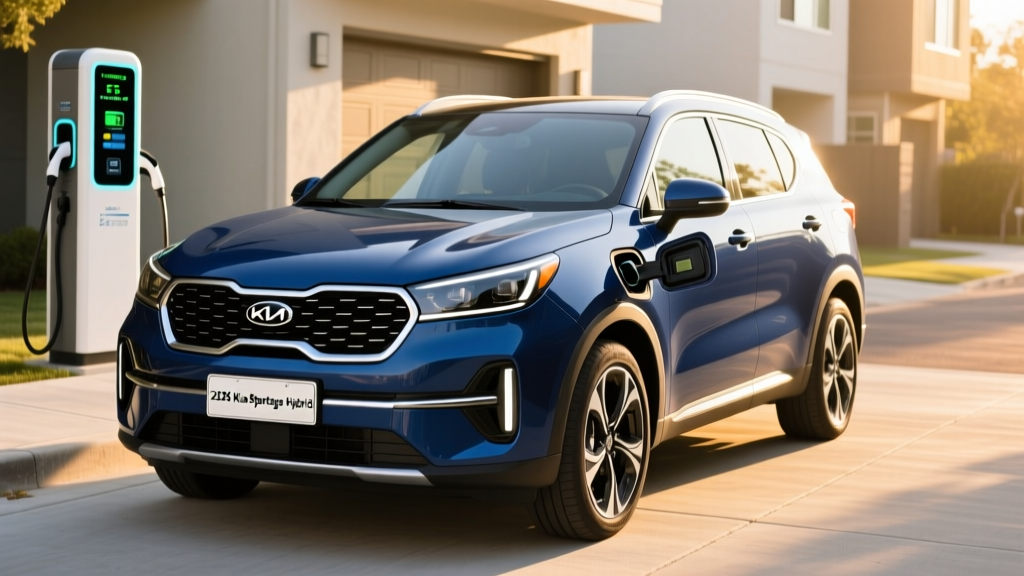
The Kia Sportage hybrid lineup occupies a specific niche: compact SUV practicality with electrified efficiency that doesn't require lifestyle changes. For 2026, Kia continues offering both a conventional hybrid (HEV) and a plug-in hybrid (PHEV) variant, each targeting different buyer priorities. This guide breaks down the exact Kia Sportage Hybrid MPG figures, PHEV electric range, powertrain specs, ownership costs, and who should actually consider one over a full EV or gas-only alternative.
HEV vs PHEV: Which Sportage Hybrid Are We Talking About?
Before diving into fuel economy numbers, it's critical to distinguish between the two Sportage hybrid variants, because they serve fundamentally different use cases:
Kia Sportage HEV (Conventional Hybrid)
No plug required. The HEV uses a small battery charged entirely through regenerative braking and the gasoline engine. You never plug it in — you simply fill up at a gas station like any other car. The hybrid system optimizes when to use the electric motor vs. the engine, delivering better MPG than a gas-only Sportage without any charging infrastructure needed.
Kia Sportage PHEV (Plug-In Hybrid)
Plug in for electric-only driving. The PHEV carries a larger battery (13.8 kWh usable) that you charge via a wall outlet, Level 2 home charger, or public station. This gives you roughly 34 miles of pure electric range for daily commuting, then the gasoline engine kicks in for longer trips — eliminating range anxiety while still cutting fuel use significantly if you charge regularly.
The distinction matters enormously for your wallet and daily routine. If you have home charging access and a commute under 35 miles, the PHEV can operate as an EV most days. If you lack charging access or take frequent long road trips, the HEV delivers consistent efficiency without behavioral changes.
Kia Sportage Hybrid MPG: EPA Numbers and Real-World Results
Here's the official EPA fuel economy data for the 2026 Sportage hybrid lineup, broken down by powertrain and drivetrain configuration:
| Model | City MPG | Highway MPG | Combined MPG | Drivetrain |
|---|---|---|---|---|
| Sportage HEV (FWD) | 42 | 44 | 43 | Front-Wheel Drive |
| Sportage HEV (AWD) | 38 | 38 | 38 | All-Wheel Drive |
| Sportage PHEV (AWD) | 36 (hybrid mode) | 35 (hybrid mode) | 35 (hybrid mode) / 84 MPGe (with charge) | All-Wheel Drive |
Real-world MPG reality check: Conventional hybrids like the Sportage HEV often exceed their EPA city estimates in stop-and-go traffic because regenerative braking recovers energy that gas cars waste as heat. Expect 44-46 MPG in urban driving with the FWD HEV. Highway MPG tends to land closer to or slightly below EPA figures at sustained 70+ MPH speeds — plan for 40-42 MPG highway in the FWD model. AWD models lose roughly 5 MPG across the board due to the weight and mechanical drag of the rear drivetrain.
For the PHEV, the 84 MPGe figure applies only when you're driving on a full charge within the electric range. Once the battery depletes to its hybrid buffer (around 15-20% state of charge), the PHEV operates as a conventional hybrid delivering approximately 35 MPG combined — slightly less than the HEV AWD due to the heavier battery pack.
Sportage PHEV Electric Range: How Far on Battery Alone?
The 2026 Sportage PHEV carries a 13.8 kWh lithium-ion battery pack (NMC chemistry) that delivers an EPA-rated 34 miles of electric-only range. Total combined range — electric plus the 11.1-gallon fuel tank — reaches approximately 430 miles.
Real-World PHEV Range Expectations
EPA Electric Range: 34 miles
Real-world (moderate temps, mixed driving): 30-34 miles
Cold weather (below 32°F): 24-28 miles (battery chemistry loses efficiency, cabin heating draws power)
Highway-only at 75 MPH: 26-29 miles (electric motors are less efficient at sustained high speeds)
For most commuters with a sub-30-mile round trip and home charging, the PHEV can cover daily driving entirely on electricity, using the gas engine only for weekend trips or longer errands.
Charging the PHEV battery:
- Level 1 (120V household outlet): ~3.3 kW charge rate, approximately 4.5 hours from empty to full
- Level 2 (240V home charger): ~7.2 kW charge rate, approximately 2 hours from empty to full
- DC fast charging: Not available. The Sportage PHEV does not support DC fast charging — a common limitation among PHEVs due to smaller battery size and cost considerations.
If you can install a Level 2 home charger (typically $500-$1,200 including equipment and electrician), you'll wake up to a full 34-mile electric range every morning. Without home charging, the PHEV advantage diminishes significantly — you'd be paying a premium for electric range you rarely use.
Powertrain Specs: What's Under the Hood?
| Specification | Sportage HEV | Sportage PHEV |
|---|---|---|
| Engine | 1.6L turbocharged 4-cylinder | 1.6L turbocharged 4-cylinder |
| Electric Motor | 44 kW (59 HP) | 66.9 kW (90 HP) |
| Combined System Output | 226 HP / 258 lb-ft torque | 261 HP / 258 lb-ft torque |
| Transmission | 6-speed automatic | 6-speed automatic |
| Battery Capacity | 1.49 kWh (small buffer) | 13.8 kWh usable |
| 0-60 MPH | ~7.5 seconds | ~7.0 seconds |
| Towing Capacity | 2,000 lbs | 2,000 lbs |
| Drivetrain | FWD or AWD | AWD only |
The PHEV's larger electric motor gives it a noticeable torque advantage off the line and in electric-only mode, where acceleration feels immediate and quiet. Both variants use Kia's turbocharged 1.6L engine, which provides adequate passing power once the battery buffer depletes. The 6-speed automatic is a traditional torque-converter unit — not a CVT — which some drivers prefer for its more natural shift feel.
Pricing and Tax Credit Eligibility
2026 Kia Sportage Hybrid pricing by trim (MSRP before destination or incentives):
- Sportage HEV LX (FWD): $30,090
- Sportage HEV EX (AWD): $33,590
- Sportage HEV SX-Prestige (AWD): $37,490
- Sportage PHEV X-Line (AWD): $39,890
- Sportage PHEV X-Line Prestige (AWD): $43,590
Federal tax credit for the PHEV: Under current IRS §30D rules, the Sportage PHEV may qualify for up to $3,750 in federal tax credits (not the full $7,500, as the battery sourcing requirements limit eligibility). However, this credit is subject to:
- Buyer income caps: $150,000 single / $300,000 joint modified AGI
- MSRP cap: $80,000 for SUVs (Sportage PHEV clears this easily)
- Battery critical mineral and component sourcing requirements (which may reduce the credit to $3,750 or zero depending on supply chain changes)
- Point-of-sale transfer option available at participating dealers
Important: The conventional Sportage HEV does not qualify for any federal tax credit — only plug-in vehicles with sufficient battery capacity are eligible under §30D. Some states offer additional rebates for PHEVs (check your state energy office), but these vary widely and change frequently.
Consult a tax professional before purchase to confirm your specific eligibility. IRS rules have tightened significantly since 2023, and battery sourcing requirements continue to evolve.
Battery Warranty, Reliability, and Replacement Costs
Kia Hybrid Battery Warranty Coverage
Sportage HEV: 10 years / 100,000 miles (whichever comes first)
Sportage PHEV: 10 years / 100,000 miles (whichever comes first)
Kia's hybrid battery warranty covers defects and capacity loss below approximately 70% of original capacity. This is among the longest hybrid battery warranties in the industry, matching Hyundai's coverage and exceeding Toyota's 8-year/100,000-mile standard.
Reliability track record: Kia's 1.6L turbo hybrid powertrain has been in production since 2022 (shared with Hyundai Tucson Hybrid). Early models showed no systemic battery failures, though some owners reported minor software glitches with the hybrid control module that were resolved via dealer updates. The NMC battery chemistry in the PHEV is proven technology used across millions of EVs and PHEVs globally.
Battery replacement cost (out of warranty):
- Sportage HEV hybrid battery: $2,500-$3,500 (smaller 1.49 kWh pack)
- Sportage PHEV traction battery: $6,000-$8,500 (13.8 kWh pack, labor-intensive removal)
These are worst-case scenarios. Hybrid batteries rarely fail completely — degradation is gradual, and most batteries retain 85-90% capacity after 100,000 miles. The 10-year warranty means most original owners will never face replacement costs.
Sportage Hybrid vs. Full EV vs. Gas: Who Should Buy What?
Choose the Sportage HEV If:
- You lack home or workplace charging access
- You want better MPG without changing habits
- You take frequent road trips (400+ miles between fill-ups)
- Your budget is under $35,000
- You live in an area with extreme cold (hybrids lose less range than EVs in winter)
Choose the Sportage PHEV If:
- You have Level 2 home charging and a commute under 35 miles
- You want EV-like daily driving with gas backup for trips
- You can access the $3,750 federal tax credit
- You're willing to pay ~$6,000 more than the HEV for electric range
- You want to reduce gas consumption by 60-80% on typical commutes
Choose a Full EV Instead If:
- You have reliable home and workplace charging
- Your daily driving is under 250 miles
- You want zero tailpipe emissions and minimal maintenance
- You can access the full $7,500 federal EV credit on models like the Hyundai Ioniq 5 or Tesla Model Y
- You're ready to plan road trips around DC fast charging
The Sportage HEV makes the most sense for apartment dwellers, street parkers, or anyone who can't install a home charger. You get 38-43 MPG combined without plugging in — a 40-60% improvement over the gas-only Sportage (26 MPG combined). The PHEV is ideal for homeowners with a garage and a predictable commute, offering EV economics on weekdays and gas-car flexibility on weekends. A full EV like the Hyundai Ioniq 5 (303-mile range, $42,500 base) makes sense only if you're confident in your charging access and ready to embrace trip planning.
Frequently Asked Questions
How many MPG does the Kia Sportage Hybrid get?
The 2026 Sportage HEV achieves 43 MPG combined (FWD) or 38 MPG combined (AWD) per the EPA. Real-world city driving often yields 44-46 MPG in the FWD model due to regenerative braking efficiency. Highway MPG typically lands 2-3 MPG below EPA estimates at sustained 70+ MPH speeds.
How far can the Sportage PHEV go on electric only?
The Sportage PHEV delivers 34 miles of EPA-rated electric range. Real-world range is 30-34 miles in moderate temperatures, dropping to 24-28 miles in sub-freezing weather due to battery chemistry limitations and cabin heating demands. Total range (electric + gas) is approximately 430 miles.
Does the Sportage Hybrid qualify for a tax credit?
The conventional Sportage HEV does not qualify for any federal tax credit. The Sportage PHEV may qualify for up to $3,750 under IRS §30D, subject to buyer income limits ($150K single / $300K joint), MSRP caps, and battery sourcing requirements. Always verify current eligibility with a tax professional before purchase.
Is the Sportage Hybrid reliable, and what's the battery replacement cost?
Kia's hybrid powertrain has shown solid reliability since its 2022 introduction, with no widespread battery failures reported. The hybrid battery is warrantied for 10 years / 100,000 miles. Out-of-warranty replacement costs $2,500-$3,500 for the HEV and $6,000-$8,500 for the PHEV, though most batteries retain 85-90% capacity well beyond the warranty period.
Do I need to plug in the Sportage HEV?
No. The conventional Sportage HEV charges its small hybrid battery entirely through regenerative braking and the gasoline engine. You never plug it in — just fill up at a gas station. Only the PHEV variant requires plug-in charging to access its electric range.
How long does it take to charge the Sportage PHEV?
On a Level 2 home charger (240V, 7.2 kW), the PHEV battery charges from empty to full in approximately 2 hours. On a standard 120V household outlet (Level 1, 3.3 kW), it takes about 4.5 hours. DC fast charging is not supported.
Sportage Hybrid vs. Toyota RAV4 Hybrid — which gets better MPG?
The Toyota RAV4 Hybrid (AWD) achieves 39 MPG combined, slightly edging out the Sportage HEV AWD at 38 MPG combined. However, the Sportage HEV FWD (43 MPG combined) beats the RAV4 Hybrid if you don't need AWD. The RAV4 Prime PHEV offers 42 miles of electric range vs. the Sportage PHEV's 34 miles, but starts at $44,590 — roughly $5,000 more than the Sportage PHEV.
Sources: EPA Fuel Economy, IRS Clean Vehicle Credits, Kia Motors America specifications. Pricing and tax credit rules current as of 2026 model year; verify with dealer and tax professional before purchase.