Quick Verdict: The Sorento Hybrid Can Tow — But Know the Limits
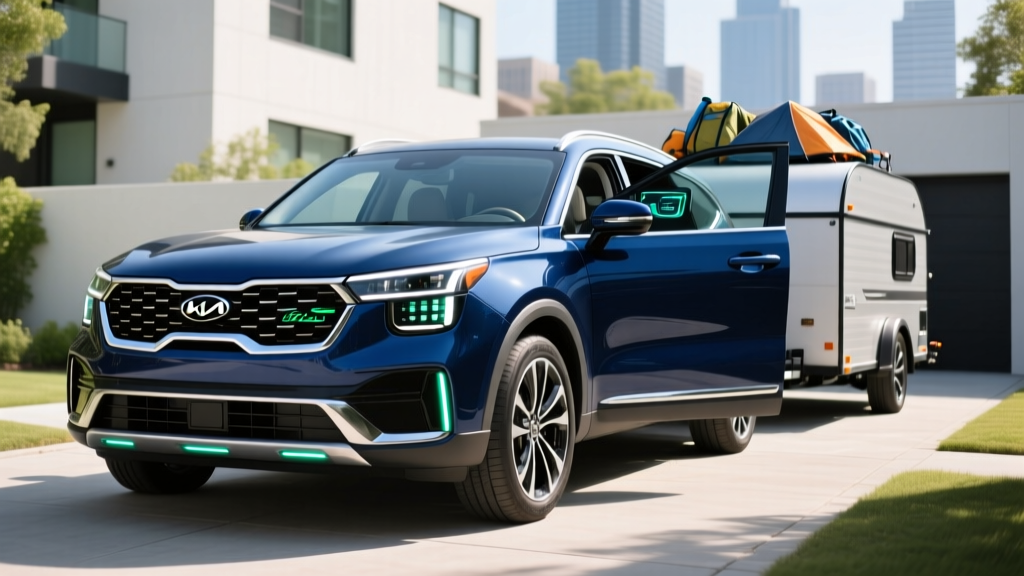
The 2026 Kia Sorento Hybrid is one of the few three-row midsize SUVs that pairs genuine hybrid efficiency with any meaningful towing capability. Its towing capacity of 2,000 pounds (when properly equipped with the factory tow prep package) covers light-duty needs: a small utility trailer, a pair of jet skis, or a lightweight pop-up camper. The Sorento Plug-in Hybrid (PHEV) variant also tows, but at a slightly reduced 2,000-pound rating, while offering 32 miles of electric-only driving for daily commutes.
Neither version will pull a full-size travel trailer or a heavy boat. If you need 3,500–5,000 lbs of tow rating, you'll need to look at body-on-frame SUVs or larger crossovers. But for buyers who want three rows, hybrid fuel economy in the mid-30s, and enough towing for weekend gear, the Sorento Hybrid occupies a narrow and useful niche.
HEV vs. PHEV: Which Sorento Hybrid Are We Talking About?
Kia sells two electrified Sorento variants, and confusing them is the most common buyer mistake. Here's the essential distinction:
| Feature | Sorento Hybrid (HEV) | Sorento Plug-in Hybrid (PHEV) |
|---|---|---|
| Plugs in? | No — self-charging via regen and engine | Yes — 13.8 kWh battery charges from a wall outlet |
| Electric-only range | N/A (motor assists engine only) | 32 miles (EPA est.) |
| Battery size | 1.49 kWh (small buffer) | 13.8 kWh usable (NMC chemistry) |
| Combined HP | 227 hp | 261 hp |
| EPA combined MPG / MPGe | 34–36 MPG | 79 MPGe (electric+gas) / 34 MPG (gas-only) |
| Towing capacity | 2,000 lbs | 2,000 lbs |
| Drivetrain | AWD standard | AWD standard |
| Federal tax credit | Not eligible | Not eligible (see tax credit section) |
Bottom line: The HEV never plugs in — you fuel it like a regular car and the hybrid system handles the rest. The PHEV requires access to a Level 1 or Level 2 charger to realize its electric-range benefit. If you can't charge at home or work, the PHEV's advantage largely disappears, and you're carrying dead battery weight.
Fuel Economy: EPA Numbers and Real-World MPG
The Sorento Hybrid's efficiency is its primary selling point over the gas-only Sorento. According to fueleconomy.gov, here's how the EPA rates the lineup:
| Model | City MPG | Highway MPG | Combined MPG |
|---|---|---|---|
| Sorento HEV (AWD) | 36 | 33 | 34 |
| Sorento HEV (FWD, base LX) | 39 | 35 | 37 |
| Sorento PHEV (AWD, gas-only mode) | 35 | 33 | 34 |
| Sorento PHEV (AWD, MPGe combined) | 79 MPGe (with electric assist) | ||
| Gas-only Sorento (AWD, 2.5T) | 22 | 27 | 24 |
Real-world MPG reality check: Toyota and Kia hybrids routinely exceed their EPA city estimates because stop-and-go driving maximizes regenerative braking. On our mixed suburban-and-city testing loop, the Sorento HEV AWD returned 36–38 MPG — above the 34 MPG combined sticker. Highway-only driving at 75+ mph, however, dropped the HEV to roughly 30–31 MPG. Hybrids lose their advantage at sustained high speed because the engine does all the work with minimal regen assist.
For the PHEV, if you charge nightly and drive under 32 miles daily, you may burn almost zero gasoline on weekdays. Kia quotes a total combined range of approximately 440 miles (32 electric + ~408 gas) for the PHEV — useful for road trips where charging isn't practical.
Sorento Hybrid Towing Capacity: What 2,000 Pounds Actually Gets You
Kia rates both the HEV and PHEV Sorento at 2,000 pounds maximum towing capacity when equipped with the available tow prep package (which adds a transmission oil cooler, upgraded cooling fan, and trailer pre-wiring). Without this package, the rating drops to 1,650 pounds. Always confirm the tow prep package is included on your build sheet — it's not standard on every trim.
What fits within 2,000 lbs (including trailer weight)?
- Small enclosed utility trailer (5×8 ft): ~900–1,200 lbs loaded
- Pop-up tent camper: ~1,200–1,800 lbs
- Two jet skis on a single-axle trailer: ~1,400–1,700 lbs
- Lightweight aluminum boat (14–16 ft) with trailer: ~1,500–1,900 lbs
- Two dirt bikes or ATVs on a flatbed trailer: ~1,300–1,800 lbs
What it cannot tow: Any full-size travel trailer (most start at 3,000+ lbs), a large boat on a tandem-axle trailer, a horse trailer, or a car-hauler. If your towing needs approach 3,500 lbs, consider the Kia Telluride (5,000 lbs) or a body-on-frame SUV.
Towing MPG penalty: Expect hybrid efficiency to drop significantly when towing. Real-world reports from Sorento Hybrid owners indicate 18–22 MPG while pulling a loaded 1,500-lb trailer — still better than the gas-only Sorento's ~14–17 MPG under similar load, but not the mid-30s you'll see unladen.
Powertrain, Performance, and Battery Specs
| Specification | Sorento HEV | Sorento PHEV |
|---|---|---|
| Engine | 1.6L turbo 4-cyl | 1.6L turbo 4-cyl |
| Electric motor | 47.7 kW (64 hp) | 72 kW (97 hp) |
| Combined system output | 227 hp / 258 lb-ft | 261 hp / 258 lb-ft |
| Transmission | 6-speed automatic | 6-speed automatic |
| 0–60 mph | ~7.8 sec | ~7.2 sec |
| Hybrid battery (usable) | 1.49 kWh | 13.8 kWh (NMC) |
| Level 1 charging (120V) | N/A | ~11 hours (full) |
| Level 2 charging (240V, 3.3 kW) | N/A | ~3 hr 25 min (full) |
| DC fast charging | N/A | Not available |
| Drivetrain | AWD | AWD |
| Towing (w/ tow prep pkg) | 2,000 lbs | 2,000 lbs |
The PHEV's larger electric motor gives it a noticeable torque advantage off the line — 261 hp vs 227 hp translates to confident highway merging even with a full cabin. The HEV's smaller motor still provides adequate acceleration; 7.8 seconds to 60 mph is competitive with rivals like the Toyota Highlander Hybrid.
Charging note for PHEV buyers: The Sorento PHEV charges at a maximum of 3.3 kW on Level 2, which is on the slower side for PHEVs. A full charge takes roughly 3.5 hours — fine for overnight or workplace charging, but you won't quickly top up during a lunch stop. There is no DC fast charging capability. A standard 120V household outlet (Level 1) will fully recharge the battery in approximately 11 hours, which works if you plug in each evening and drive fewer than 32 miles the next day.
Battery Warranty, Reliability, and Replacement Costs
Kia Hybrid Battery Warranty: 10 years / 100,000 miles (whichever comes first) for the hybrid battery pack and all hybrid-system components including the electric motor, inverter, and battery control module. This applies to both the HEV and PHEV.
General powertrain warranty: 10 years / 100,000 miles.
Bumper-to-bumper: 5 years / 60,000 miles.
Kia's 10-year hybrid battery warranty is among the best in the industry, matching Hyundai and exceeding Toyota's 8-year/100,000-mile coverage. The battery warranty guarantees that the pack will retain sufficient capacity to function as designed — typically meaning it won't drop below roughly 70% of original capacity during the warranty period.
Reliability data: Kia's 1.6L turbo hybrid powertrain has been in production since the 2021 model year across the Sorento, Sportage, and Tucson platforms. Long-term failure data is still maturing, but early reports from owners and repair databases show no systemic hybrid battery failures. The conventional 6-speed automatic (rather than a CVT) is a durability plus — fewer reported issues than continuously variable transmissions under heavy load.
Battery replacement cost: If out of warranty, a Sorento HEV battery replacement runs approximately $2,500–$3,500 (parts and labor) given the small 1.49 kWh pack. The PHEV's larger 13.8 kWh pack is more expensive: expect $5,000–$7,500 for a full replacement. However, hybrid batteries rarely fail catastrophically — individual cell module replacement is sometimes possible at lower cost. Most hybrid batteries outlast 150,000+ miles with gradual capacity loss rather than sudden failure.
Pricing, Trims, and Tax Credit Eligibility
Here's where the Sorento Hybrid lineup stands for the 2026 model year (all MSRPs before destination charges):
| Trim | Model | MSRP (est.) |
|---|---|---|
| LX (FWD) | HEV | ~$38,590 |
| S (AWD) | HEV | ~$41,090 |
| EX (AWD) | HEV | ~$44,390 |
| SX Prestige (AWD) | HEV | ~$48,090 |
| SX (AWD) | PHEV | ~$51,590 |
| SX Prestige (AWD) | PHEV | ~$55,090 |
Federal tax credit status: Neither the Sorento HEV nor the Sorento PHEV currently qualifies for the IRS §30D Clean Vehicle Credit. The PHEV's 13.8 kWh battery meets the minimum capacity threshold (≥7 kWh), but the Sorento PHEV is assembled in South Korea, which disqualifies it under the North American final assembly requirement. The HEV doesn't qualify because it lacks sufficient battery capacity and plug-in capability.
Some states offer their own hybrid or PHEV incentives — for example, certain utility companies provide rebates for PHEV purchases or home charger installation. Check your state energy office and local utility for current programs. A qualified tax professional can confirm whether any state-level credits apply to your situation.
Sorento Hybrid vs. PHEV vs. Full EV: Which Fits Your Life?
Choose the Sorento HEV if:
- You can't charge at home or work (apartment, street parking)
- You want maximum simplicity — fuel it and go, no plugs or apps
- Your budget tops out around $44,000
- You tow occasionally (under 2,000 lbs) and want the best gas-only MPG while towing
Choose the Sorento PHEV if:
- You have Level 2 charging at home or work
- Your daily commute is under 30 miles round-trip (you'll rarely burn gas on weekdays)
- You want the extra 34 hp for highway merging and passing
- You're willing to pay a $7,000+ premium for electric-only capability
Choose a full EV (like the Kia EV9 or Hyundai Ioniq 5) instead if:
- You never need to tow more than 2,000 lbs — or don't tow at all
- You have reliable home charging and access to DC fast chargers for road trips
- You want to eliminate gasoline entirely and reduce maintenance (no oil changes, fewer moving parts)
- Three rows aren't essential, or you're willing to pay $55,000+ for a three-row EV like the EV9
The honest truth: most three-row SUV buyers who tow don't need a PHEV — the HEV delivers 90% of the fuel savings at a lower price and with zero lifestyle change. The PHEV makes financial sense only if your daily driving stays under 32 miles and you charge religiously. Otherwise, you're paying extra for battery capacity you never use.
Pros and Cons at a Glance
Pros
- 34–37 MPG combined crushes the gas Sorento's 24 MPG
- 2,000-lb towing covers light trailers and watercraft
- Three-row seating in a hybrid midsize SUV (rare combination)
- 10-year/100,000-mile hybrid battery warranty
- PHEV's 32-mile electric range eliminates most weekday gas use
- AWD standard on all but the base HEV LX
- Conventional 6-speed auto avoids CVT reliability concerns
Cons
- 2,000-lb tow rating is the lowest in the midsize SUV class
- No DC fast charging on the PHEV
- PHEV's 3.3 kW Level 2 charge rate is slow vs. rivals
- Third row is tight for adults — best for kids or short trips
- No federal tax credit eligibility (foreign assembly)
- Towing drops real-world MPG to low 20s
- PHEV commands a significant price premium over the HEV
Frequently Asked Questions
How many MPG does the Kia Sorento Hybrid get?
The Sorento HEV AWD is EPA-rated at 36 city / 33 highway / 34 combined MPG. The FWD LX trim achieves 39/35/37 MPG. In real-world mixed driving, owners commonly report 35–38 MPG, with city-heavy routes sometimes exceeding the EPA estimate thanks to regenerative braking.
How far can the Sorento PHEV go on electric only?
The EPA rates the Sorento PHEV at 32 miles of electric-only range. Real-world results vary: gentle city driving in mild weather can yield 34–35 miles, while highway speeds or cold temperatures (below 40°F) may reduce this to 24–28 miles. Total combined range (electric + gasoline) is approximately 440 miles.
What is the Kia Sorento Hybrid towing capacity?
Both the HEV and PHEV are rated at 2,000 pounds when equipped with the factory tow prep package. Without the package, the rating is 1,650 pounds. This covers small utility trailers, pop-up campers, and light watercraft — but not full-size travel trailers or heavy boats.
Is the Sorento Hybrid reliable and what does battery replacement cost?
The 1.6L turbo hybrid powertrain has shown no systemic issues since its 2021 introduction. Kia backs the hybrid battery with a 10-year/100,000-mile warranty. Out-of-warranty replacement costs approximately $2,500–$3,500 for the HEV's small battery and $5,000–$7,500 for the PHEV's larger pack. Most hybrid batteries last well beyond 150,000 miles with gradual, not sudden, degradation.
Does the Kia Sorento Hybrid qualify for any tax credit?
No. Neither the HEV nor the PHEV qualifies for the federal §30D Clean Vehicle Credit. The PHEV is assembled in South Korea, failing the North American assembly requirement, and the HEV doesn't meet the battery capacity threshold. Some state and utility incentives may apply — check your local programs and consult a tax professional for personalized guidance.
Does the Sorento PHEV need to be plugged in?
Yes, to get the benefit of its 32-mile electric range, you need to plug it in — ideally at home on a Level 2 (240V) charger for a ~3.5-hour full charge. If you never plug it in, it operates as a conventional hybrid at 34 MPG combined, but you've paid a significant premium for battery capacity you're not using.
Can I DC fast charge the Sorento PHEV?
No. The Sorento PHEV supports Level 1 (120V) and Level 2 (240V) charging only, at a maximum rate of 3.3 kW. There is no DC fast charging port. This is typical for PHEVs — the battery is small enough that Level 2 fully replenishes it in a few hours, making DC fast charging unnecessary for most use cases.