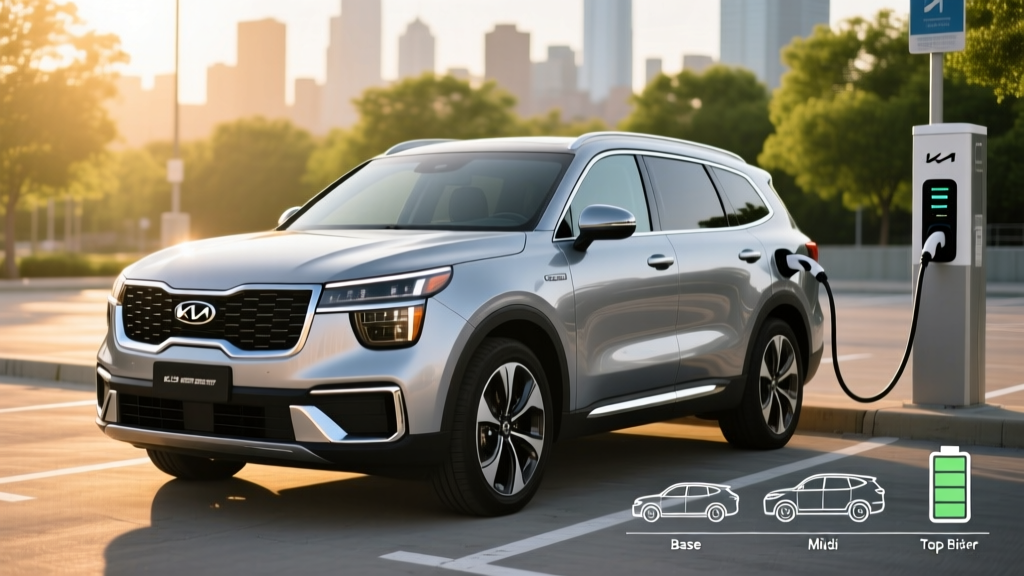
If you need three rows of seating but aren't ready to commit to a full battery-electric vehicle, the Kia Sorento hybrid lineup is one of the most practical midsize crossovers available. Kia offers two distinct electrified versions: the conventional Sorento Hybrid (HEV) and the Sorento Plug-in Hybrid (PHEV). Both use the same 1.6-liter turbocharged engine paired with an electric motor, but their fuel economy, electric-only range, and pricing diverge significantly.
This guide breaks down the exact EPA ratings, real-world fuel economy expectations, battery specs, warranty coverage, and tax-credit eligibility for both models — so you can determine which Sorento actually fits your driving pattern and budget.
HEV vs. PHEV: Which Kia Sorento Hybrid Are We Talking About?
Before diving into numbers, it's critical to understand that "Sorento Hybrid" can mean two very different vehicles. Kia sells both, and confusing them is the most common buyer mistake.
| Feature | Sorento Hybrid (HEV) | Sorento Plug-in Hybrid (PHEV) |
|---|---|---|
| Plug-in charging required? | No — charges via regen and engine | Yes — plug in to access EV range |
| Battery capacity | ~1.5 kWh (small buffer) | 13.8 kWh usable (lithium-ion polymer) |
| Electric-only driving | Brief low-speed assist only | Up to 32 miles (EPA) |
| Charging port | None | J1772 (Level 1/2 AC) |
| DC fast charging | N/A | No DC fast charge capability |
| Federal tax credit | Not eligible | Eligible (up to $7,500, rules apply) |
The HEV operates like a traditional hybrid: you never plug it in. The small battery recaptures energy during braking and assists the gas engine during acceleration. The PHEV has a substantially larger battery that enables genuine electric-only commuting — but only if you charge it regularly.
Kia Sorento Hybrid Gas Mileage: EPA Ratings Breakdown
Here are the official EPA fuel economy figures for both powertrains, sourced from fueleconomy.gov:
| Powertrain | City MPG | Highway MPG | Combined MPG |
|---|---|---|---|
| Sorento Hybrid (HEV) FWD | 39 | 35 | 37 |
| Sorento Hybrid (HEV) AWD | 36 | 33 | 34 |
| Sorento PHEV (AWD, hybrid mode) | 36 | 33 | 34 |
| Sorento PHEV (AWD, MPGe combined) | 79 MPGe (charge-depleting + sustaining) | ||
Real-world MPG expectations: Conventional hybrids like the Sorento HEV tend to exceed their EPA city rating in stop-and-go traffic because regenerative braking is most effective at low speeds. Expect 38–42 MPG in city driving with the FWD HEV. Highway cruising at 75+ MPH typically drops to 31–33 MPG due to aerodynamic drag — this is normal for a boxy three-row crossover. In cold weather (below 35°F), expect a 5–10% reduction across the board as the engine runs longer for cabin heat.
Sorento PHEV Electric-Only Range and Total Range
The Sorento PHEV's 13.8 kWh battery delivers an EPA-rated 32 miles of electric-only range. That's enough to cover most daily commutes without burning a drop of gasoline — provided you charge nightly.
| PHEV Metric | Value |
|---|---|
| Battery capacity (usable) | 13.8 kWh |
| EPA electric-only range | 32 miles |
| Combined MPGe (EV + gas) | 79 MPGe |
| Gas-only range (after EV depleted) | ~390 miles |
| Total combined range | ~422 miles |
| Level 1 charge (120V, 12A) | ~12 hours (0–100%) |
| Level 2 charge (240V, 32A) | ~3 hours 45 minutes (0–100%) |
| DC fast charging | Not supported |
The lack of DC fast charging is a notable limitation. If you rely on public charging, you'll be limited to Level 2 speeds. For most PHEV owners, this isn't a problem — the 13.8 kWh battery tops up overnight on a standard 240V home charger, and you rarely need a full charge mid-day.
Kilowatt vs. kilowatt-hour reminder: The battery stores 13.8 kWh of energy (think of it as the "tank size"). A 32-amp Level 2 charger delivers up to 7.7 kW of power (the "flow rate"). That's why a full charge takes roughly 13.8 ÷ 7.7 ≈ 1.8 hours at peak rate, though charging slows near 100% to protect the cells, stretching the total to about 3:45.
Powertrain Specs: Horsepower, Engine, and Drivetrain
Both the HEV and PHEV use Kia's 1.6-liter turbocharged inline-four paired with an electric motor integrated into the 6-speed automatic transmission. The PHEV gets a more powerful motor and standard all-wheel drive.
| Specification | Sorento HEV | Sorento PHEV |
|---|---|---|
| Engine | 1.6L turbo I-4 | 1.6L turbo I-4 |
| Engine output | 178 HP / 195 lb-ft | 178 HP / 195 lb-ft |
| Electric motor output | 47.7 kW (64 HP) | 66.9 kW (90 HP) |
| Combined system output | 227 HP / 258 lb-ft | 261 HP / 258 lb-ft |
| Transmission | 6-speed automatic | 6-speed automatic |
| Drivetrain | FWD or AWD | AWD (standard) |
| 0–60 MPH | ~7.8 sec (FWD) | ~7.2 sec |
| Towing capacity | 2,000 lbs | 2,000 lbs |
The PHEV's extra 34 horsepower makes it the quicker variant, and the standard AWD is a meaningful advantage in snow-belt states. The HEV's available FWD is the efficiency play — it's lighter and returns the highest combined MPG in the lineup.
Pricing, Trims, and Federal Tax Credit Eligibility
For the 2026 model year, the Sorento hybrid lineup spans multiple trims. Pricing below reflects base MSRP before destination charges:
| Trim | Powertrain | MSRP (approx.) |
|---|---|---|
| S (FWD) | HEV | $38,590 |
| EX (FWD/AWD) | HEV | $41,390 |
| SX Prestige (AWD) | HEV | $46,190 |
| SX Prestige (AWD) | PHEV | $52,490 |
Does the Sorento Hybrid qualify for a tax credit?
The conventional Sorento HEV does not qualify for any federal tax credit. It's not a plug-in vehicle.
The Sorento PHEV may qualify for up to $7,500 under IRS §30D, but eligibility is not guaranteed for every buyer. Current rules require:
- Vehicle MSRP cap: SUVs must be priced at or below $80,000 (Sorento PHEV qualifies)
- Buyer income cap: Modified AGI ≤ $150,000 (single), $225,000 (head of household), $300,000 (joint)
- Battery sourcing: Critical minerals and battery components must meet phased-in percentage thresholds from FTA-partner countries — these requirements tighten annually through 2029
- Point-of-sale transfer: You can apply the credit at the dealership to reduce your purchase price directly, rather than waiting to claim it on your tax return
Because battery-sourcing rules change and vary by production batch, always confirm current eligibility with your dealer and consult IRS.gov §30D guidance or a tax professional before finalizing your purchase.
Real-World MPG: What Owners Actually Report
EPA ratings are standardized lab tests. Real-world results depend heavily on your driving mix. Based on owner-reported data and independent testing:
Sorento HEV (FWD): Owners consistently report 35–40 MPG combined, with city-heavy drivers seeing 38–42 MPG and highway-dominant commutes (75+ MPH) dropping to 30–33 MPG. The HEV excels in urban environments where regenerative braking is maximized.
Sorento PHEV (AWD): If you charge nightly and drive under 32 miles daily, you may use almost no gasoline for weeks — effectively achieving 100+ MPGe in daily operation. Once the battery depletes, expect 32–35 MPG in mixed driving, consistent with the EPA gas-only rating. Long road trips without charging revert to the same 34 MPG combined as the HEV AWD.
Cold-weather impact: Below freezing, expect the HEV to drop 3–5 MPG combined as the engine runs longer for cabin heating and the battery's charge-acceptance rate slows. The PHEV's electric-only range may shrink to 24–27 miles in winter due to cabin heating demands and reduced battery efficiency at low temperatures.
Battery Warranty, Reliability, and Replacement Cost
Battery longevity is a top concern for hybrid buyers. Kia backs both powertrains with strong warranty coverage:
| Coverage | Duration / Mileage |
|---|---|
| Hybrid battery warranty | 10 years / 100,000 miles (original owner) |
| Hybrid system components | 10 years / 100,000 miles |
| Basic vehicle warranty | 5 years / 60,000 miles |
| Powertrain warranty | 10 years / 100,000 miles |
Kia warrants the hybrid battery to retain at least 70% of its original capacity over the 10-year/100,000-mile period. If degradation exceeds that threshold, Kia covers replacement or repair.
How reliable is the Sorento Hybrid?
Kia's 1.6T hybrid powertrain has been in production since the 2021 model year, giving it a multi-year track record. The conventional HEV variant is mechanically simpler (smaller battery, no charging hardware) and has proven durable. The PHEV's larger battery and additional charging systems add complexity but have not shown widespread failure patterns in early model years.
NHTSA and IIHS ratings should be checked for the specific model year, as crash-test performance can vary between the HEV and PHEV due to weight differences (the PHEV is approximately 300 lbs heavier).
What does a hybrid battery replacement cost?
Out-of-warranty replacement for the Sorento HEV's ~1.5 kWh battery pack typically runs $2,000–$3,500 including labor. The PHEV's larger 13.8 kWh pack is more expensive — expect $5,000–$8,000 if replaced outside warranty coverage. However, hybrid battery failure before 150,000 miles is uncommon based on industry-wide data. Most degradation is gradual, and the battery rarely fails catastrophically.
Who Should Choose the Sorento HEV, PHEV, or a Full EV?
The decision between these three electrified options comes down to your charging access, daily mileage, and willingness to plug in.
Choose the Sorento HEV if:
- You cannot install a home charger (apartment, street parking, no garage)
- You want the lowest purchase price in the hybrid lineup
- Your driving is mostly city and suburban with frequent stops
- You don't want to think about charging — ever
Choose the Sorento PHEV if:
- You have access to Level 2 home charging (240V outlet or installed charger)
- Your daily commute is under 35 miles round-trip
- You want electric daily driving but gas flexibility for road trips
- You may qualify for the §30D federal tax credit, narrowing the price gap with the HEV
Choose a full EV (e.g., Kia EV9, Tesla Model Y) if:
- You have reliable home and/or workplace charging
- You rarely drive more than 250 miles in a single day
- You want the lowest per-mile fuel cost and minimal maintenance
- You're ready to plan road trips around DC fast-charging stops
Sorento Hybrid Lineup — Pros
- Three-row seating in a hybrid — rare in this segment
- HEV requires zero lifestyle change; no plugging in
- PHEV's 32-mile EV range covers most commutes
- 10-year/100,000-mile hybrid battery warranty
- AWD available (HEV) or standard (PHEV)
- Competitive towing capacity (2,000 lbs) for a hybrid crossover
Sorento Hybrid Lineup — Cons
- PHEV lacks DC fast charging
- Third row is tight for adults on long trips
- Highway MPG drops noticeably above 75 MPH
- PHEV is only available in the top SX Prestige trim (higher entry price)
- ~300-lb weight penalty on PHEV vs. HEV affects handling feel
Frequently Asked Questions
How many MPG does the Kia Sorento Hybrid get?
The Sorento HEV FWD achieves 39 city / 35 highway / 37 combined MPG per the EPA. The AWD HEV drops to 36/33/34. The PHEV matches the AWD HEV at 34 MPG combined once the battery is depleted, but delivers 79 MPGe when factoring in electric-only driving.
How far can the Sorento PHEV go on electric power alone?
The EPA rates the Sorento PHEV at 32 miles of electric-only range. In real-world conditions, expect 28–32 miles in mild weather and 24–27 miles in freezing temperatures. Above 65 MPH, the gasoline engine may engage even with battery charge remaining.
Do I need to plug in the Sorento Hybrid?
No. The conventional Sorento HEV never needs to be plugged in — it charges its small battery through regenerative braking and the gasoline engine. Only the Sorento PHEV benefits from plug-in charging, which is how you access its 32-mile electric range.
Does the Kia Sorento Hybrid qualify for a tax credit?
The HEV does not qualify for any federal tax credit. The PHEV may qualify for up to $7,500 under IRS §30D, subject to buyer income limits, vehicle MSRP caps (the Sorento PHEV is under the $80,000 SUV cap), and battery-sourcing requirements that tighten annually. Confirm eligibility at purchase and consult a tax professional.
Is the Sorento Hybrid battery expensive to replace?
The HEV battery replacement runs approximately $2,000–$3,500 out of warranty. The PHEV battery is $5,000–$8,000. Both are covered by Kia's 10-year/100,000-mile hybrid battery warranty, which guarantees at least 70% capacity retention. Catastrophic battery failure before 150,000 miles is statistically rare.
Which is more efficient for city driving — the HEV or PHEV?
If you charge daily and your city commute is under 32 miles, the PHEV uses zero gasoline and is far cheaper per mile (electricity at ~$0.14/kWh ≈ $0.04/mile vs. gas at ~$0.12/mile for the HEV). If you never charge the PHEV, the lighter HEV FWD actually returns slightly better gas mileage in city driving due to its lower curb weight.