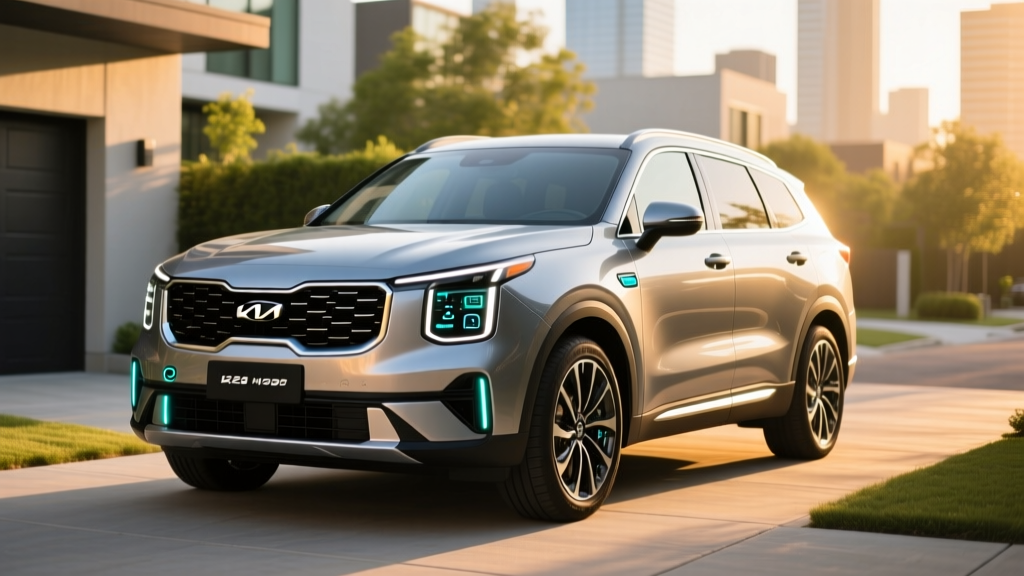
Quick Verdict: The Kia Santa Fe Hybrid at a Glance
The 2026 Kia Santa Fe Hybrid occupies a pragmatic middle ground in the midsize SUV segment. It pairs a turbocharged 1.6-liter four-cylinder with an electric motor for a combined 232 horsepower and 271 lb-ft of torque — all without ever requiring you to plug in. For families who want the cargo space and three-row flexibility of the Santa Fe but aren't ready to commit to a full battery-electric vehicle (BEV) or deal with charging infrastructure, this conventional hybrid (HEV) delivers meaningful fuel savings over the gas-only model with zero lifestyle compromise.
Kia also offers the Santa Fe as a plug-in hybrid (PHEV), which we cover below, but the standard HEV is the volume seller — and for good reason. With an EPA-estimated 34 MPG combined and a starting MSRP around $39,990, it undercuts many competitors on price while delivering competitive efficiency.
Fuel Economy: EPA Ratings and Real-World MPG
| Metric | EPA Estimate | Real-World Expectation |
|---|---|---|
| City MPG | 33 MPG | 34–36 MPG (hybrids excel in stop-and-go) |
| Highway MPG | 35 MPG | 30–32 MPG (turbo + aerodynamic drag at 70+ mph) |
| Combined MPG | 34 MPG | 31–34 MPG (mixed driving) |
Source: EPA fueleconomy.gov
For comparison, the gas-only 2026 Santa Fe with the 2.5T engine returns an EPA-estimated 22 MPG combined — meaning the hybrid saves roughly 1.5 gallons per 100 miles, or about $400–$550 annually at 15,000 miles/year and $3.40/gallon regular unleaded.
HEV vs PHEV: Which Santa Fe Hybrid Is Right for You?
| Attribute | Santa Fe Hybrid (HEV) | Santa Fe Plug-In Hybrid (PHEV) |
|---|---|---|
| Plug-in required? | No — self-charging via regen + engine | Yes — 13.8 kWh battery, plug to charge |
| Electric-only range | N/A (motor assists engine) | EPA-est. 33 miles |
| Total range | ~510 miles (17.5-gal tank) | ~430 miles combined (electric + gas) |
| Combined horsepower | 232 hp | 261 hp |
| Battery capacity | ~1.5 kWh (small buffer) | 13.8 kWh usable |
| DC fast charging | N/A | No DC fast charge — Level 2 only (~3.5 hours) |
| Level 2 charge time | N/A | ~3.5 hours at 3.3 kW |
| Starting MSRP | ~$39,990 | ~$47,590 |
| Federal tax credit (§30D) | Not eligible | Up to $7,500 (see eligibility below) |
The HEV is the simpler, more affordable choice. You fuel it like a normal car, and the hybrid system handles the rest. The PHEV makes sense if you have reliable home charging (a standard 120V outlet works overnight, though a 240V Level 2 setup is faster) and a commute under 33 miles round-trip — effectively turning your daily drive into an EV experience with a gas backup for road trips.
Powertrain and Performance
| Specification | Detail |
|---|---|
| Engine | 1.6L turbocharged 4-cylinder |
| Electric motor | 47.7 kW (64 hp) permanent-magnet synchronous |
| Combined output | 232 hp / 271 lb-ft torque |
| Transmission | 6-speed automatic (torque-converter, not CVT) |
| Drivetrain | AWD standard (all trims) |
| 0–60 mph | ~7.8 seconds (est.) |
| Towing capacity | 2,000 lbs |
| Fuel tank | 17.5 gallons (regular 87 octane) |
Kia's decision to pair the hybrid system with a conventional 6-speed automatic rather than a CVT gives the Santa Fe HEV a more natural driving feel. Acceleration is linear, and highway passing confidence is solid. The AWD system uses the electric motor to drive the rear axle on demand — there's no mechanical driveshaft, which reduces weight and parasitic loss.
Pricing, Trims, and Tax Credit Eligibility
The 2026 Kia Santa Fe Hybrid is offered in three trims:
- HEV EX: ~$39,990 MSRP — includes 12.3-inch dual displays, heated front seats, power liftgate, Highway Driving Assist 2
- HEV SX Prestige: ~$44,590 MSRP — adds leather, panoramic sunroof, Harman Kardon audio, ventilated front seats
- PHEV SX Prestige: ~$47,590 MSRP — plug-in powertrain, 33-mile EV range, all Prestige features
Reliability, Battery Warranty, and Replacement Costs
Hybrid battery replacement cost, should it be needed outside warranty, typically ranges from $2,500–$4,500 for the HEV's smaller pack and $5,000–$8,000 for the PHEV's larger 13.8 kWh battery. However, modern lithium-ion hybrid batteries rarely require full replacement — degradation is gradual, and most outlast 150,000+ miles before capacity drops meaningfully. The PHEV battery is also required to retain at least 70% capacity over the warranty period per federal emissions-warranty guidelines.
Kia's hybrid powertrains have shown strong reliability in recent model years. The 1.6T hybrid system, shared with Hyundai Motor Group siblings, has been in production since 2022 with no widespread failure patterns. IIHS safety testing and NHTSA ratings should be checked closer to on-sale dates for the latest crash-test results.
Who Should Choose the Santa Fe Hybrid vs a Full EV or Gas Car?
Choose the Santa Fe HEV if:
- You drive 12,000–18,000 miles/year and want lower fuel costs without plug-in hassle
- You lack reliable home or workplace charging access
- You want three-row seating and AWD under $45,000
- You frequently take road trips where charging infrastructure is sparse
- You prefer the simplicity of gas-station refueling with better efficiency
Look elsewhere (EV or PHEV) if:
- You have home charging and a short commute — the PHEV or a BEV like the Ioniq 5 saves more
- You want to maximize federal tax credits (BEVs and some PHEVs qualify; HEVs do not)
- You prioritize silent, electric-only city driving
- Your state offers additional EV-only rebates or HOV-lane access
- You want to eliminate tailpipe emissions entirely in daily use
The Santa Fe HEV is fundamentally a no-compromise efficiency upgrade. You sacrifice nothing in cargo space, towing, or drivability compared to the gas model — you simply visit the gas station less often. The PHEV variant is a stronger value play if the $7,500 credit applies to your purchase, effectively closing the price gap with the HEV while giving you 33 miles of daily electric driving.
Frequently Asked Questions
How many MPG does the Kia Santa Fe Hybrid get?
The 2026 Kia Santa Fe Hybrid achieves an EPA-estimated 33 city / 35 highway / 34 combined MPG. Real-world results vary: expect 34–37 MPG in city driving thanks to regenerative braking, and 30–32 MPG on sustained highway trips above 70 mph.
How far can the Santa Fe PHEV go on electric only?
The Santa Fe Plug-In Hybrid delivers an EPA-estimated 33 miles of electric-only range on its 13.8 kWh battery. That covers most daily commutes. Once the battery is depleted, it operates as a conventional hybrid with the 1.6T engine, delivering roughly 32 MPG combined in hybrid mode.
Does the Santa Fe Hybrid qualify for any tax credit?
The conventional hybrid (HEV) does not qualify for the federal §30D clean vehicle credit. The plug-in hybrid (PHEV) may qualify for up to $7,500, subject to IRS income caps ($150K single / $300K joint), MSRP caps ($80K for SUVs), and battery sourcing requirements. Always verify current rules at IRS.gov before purchasing. Some states offer additional hybrid or PHEV rebates — check your state energy office.
Is the hybrid battery reliable and expensive to replace?
Kia covers the hybrid battery for 10 years / 100,000 miles. Out-of-pocket replacement runs $2,500–$4,500 for the HEV and $5,000–$8,000 for the PHEV, but full replacements are rare — most hybrid batteries retain usable capacity well beyond 150,000 miles. Degradation is gradual and typically manifests as a small reduction in electric-assist range, not sudden failure.
Do I need to plug in the Santa Fe Hybrid?
No. The standard Santa Fe HEV is a self-charging conventional hybrid. It recovers energy through regenerative braking and the gasoline engine — there is no plug and no charging cable. Only the PHEV variant requires (and benefits from) plugging in to access its 33-mile electric range.
How does the Santa Fe Hybrid compare to competitors?
Against the Toyota Highlander Hybrid (35 MPG combined, ~$42,000) and Hyundai Tucson Hybrid (37 MPG combined but smaller cargo area), the Santa Fe HEV offers a strong balance of interior volume, three-row availability, and competitive efficiency at a lower entry price. It trades a few MPG to the Tucson Hybrid but delivers more interior space and standard AWD across all trims.