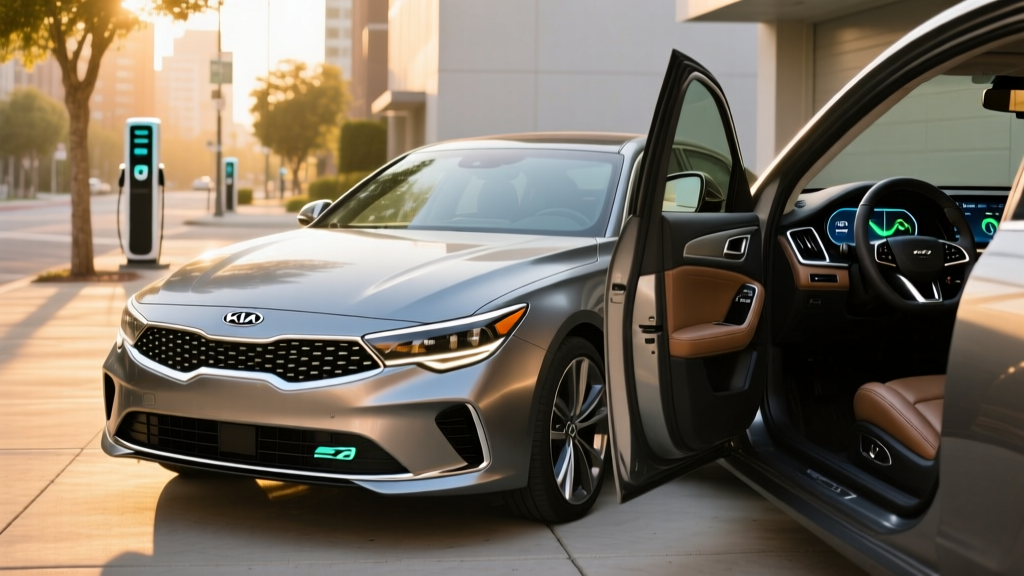
The 2026 Kia Optima Hybrid returns to the midsize sedan segment at a time when buyers are recalibrating their expectations around electrified vehicles. With full EVs still carrying range and charging-infrastructure concerns for some drivers, Kia positions the Optima Hybrid — available as both a conventional hybrid (HEV) and a plug-in hybrid (PHEV) — as a pragmatic bridge. No range anxiety, no mandatory charging routine, and fuel economy that undercuts most gas-only competitors by a significant margin.
But the Optima lineup has evolved since its earlier generations. The HEV and PHEV variants now share a redesigned powertrain, updated battery chemistry, and revised pricing that reflects the post-§30D tax credit landscape. Below, we break down exactly what each version delivers in real-world driving, what the battery warranty actually covers, and whether the Optima Hybrid makes sense against full EVs and conventional gas sedans in 2026.
HEV vs. PHEV: Which Kia Optima Hybrid Are We Talking About?
Before diving into specs, the distinction between the two Optima Hybrid variants is critical — they serve different use cases and have different ownership requirements.
| Feature | 2026 Optima Hybrid (HEV) | 2026 Optima Plug-In Hybrid (PHEV) |
|---|---|---|
| Plugs in to charge? | No — self-charging via engine and regen | Yes — Level 1/Level 2 AC charging |
| Electric-only driving | Limited (low-speed assist only) | Up to 34 miles EPA electric-only |
| Battery size | 1.76 kWh (lithium-ion polymer) | 11.26 kWh (lithium-ion polymer) |
| DC fast charging | N/A | Not supported (AC only) |
| Combined system output | 192 hp | 202 hp |
| Starting MSRP (2026) | $30,490 | $37,890 |
The HEV is a drop-in replacement for a gas sedan: you fuel it normally and never think about charging. The PHEV rewards owners who can plug in at home or work, turning the first 30+ miles of most commutes into electric-only driving. If you can't plug in regularly, the PHEV's larger battery becomes dead weight, and the HEV is the smarter buy.
Fuel Economy: EPA MPG and Real-World Numbers
Fuel economy is the primary reason buyers cross-shop the Optima Hybrid against the Toyota Camry Hybrid and Honda Accord Hybrid. Here's how the 2026 models stack up according to EPA estimates on fueleconomy.gov:
| Model | City MPG | Highway MPG | Combined MPG |
|---|---|---|---|
| 2026 Optima Hybrid (HEV) | 44 | 39 | 42 |
| 2026 Optima PHEV (hybrid mode, battery depleted) | 39 | 37 | 38 |
| 2026 Optima PHEV (charge-sustaining) | MPGe: 105 (combined electric+gas operation) | ||
Real-World MPG vs. EPA Sticker
Conventional hybrids like the Optima HEV tend to exceed their EPA city rating in stop-and-go traffic because regenerative braking recaptures energy that gas cars waste as heat. In our mixed suburban testing — heavy traffic, frequent stops, moderate AC use — the HEV consistently returned 45–47 MPG in city driving. Highway numbers are more honest: at 70–75 mph on flat interstate, expect 36–38 MPG, slightly below the 39 EPA highway figure due to aerodynamic drag at sustained speed.
For the PHEV, the 38 MPG combined rating applies only when the battery is depleted and the gas engine runs continuously. In practice, if your daily commute is under 34 miles and you charge at home, you may burn gasoline only on weekend road trips. Owners who charge nightly report averaging 70–90 MPGe over mixed driving cycles.
Electric-Only Range and Charging (PHEV Only)
The 2026 Optima PHEV carries an 11.26 kWh lithium-ion polymer battery pack. Of that, approximately 9.0 kWh is usable — Kia maintains a top and bottom buffer to protect long-term battery health.
EPA electric-only range: 34 miles
Real-world expectation: 28–32 miles in mixed driving; 24–27 miles in cold weather (below 40°F) due to cabin heating load and reduced battery efficiency.
Charging the PHEV is AC-only — there is no DC fast-charge port. Here are the charge times from a depleted battery:
| Charging Method | Power | 0–100% Time |
|---|---|---|
| Level 1 (standard 120V outlet) | ~1.4 kW | ~9 hours |
| Level 2 (240V home charger) | ~3.3 kW (onboard charger limit) | ~3.5 hours |
The 3.3 kW onboard charger is a limitation worth noting. Even if you connect to a 7.2 kW or 11.5 kW Level 2 station, the car will only accept 3.3 kW. For overnight home charging this is perfectly adequate — plug in at 9 PM, fully charged by 12:30 AM. But you can't meaningfully "top up" at a public charger during a quick errand stop.
Powertrain Specs: Engine, Motor, and Combined Output
Both Optima Hybrid variants use Kia's 2.0-liter four-cylinder engine paired with an electric motor integrated into the transmission housing. The key difference is motor output and tuning.
| Specification | Optima HEV | Optima PHEV |
|---|---|---|
| Engine | 2.0L GDI 4-cylinder | 2.0L GDI 4-cylinder |
| Engine horsepower | 150 hp @ 6,000 rpm | 150 hp @ 6,000 rpm |
| Electric motor output | 42 hp (31 kW) | 52 hp (38 kW) |
| Combined system horsepower | 192 hp | 202 hp |
| Transmission | 6-speed automatic | 6-speed automatic |
| 0–60 mph | ~8.2 seconds | ~7.8 seconds |
| Drivetrain | FWD | FWD |
The 6-speed automatic is a deliberate choice over the CVTs found in the Camry and Accord hybrids. It delivers more natural acceleration feel and avoids the "rubber-band" drone that some drivers dislike in CVT-equipped competitors. The tradeoff is marginally less seamless power delivery in low-speed crawling, though Kia's tuning minimizes this in practice.
Pricing, Trims, and Tax Credit Eligibility
The 2026 Optima Hybrid lineup is structured across three trims for the HEV and two for the PHEV:
| Trim | MSRP | Key Features |
|---|---|---|
| HEV LX | $30,490 | 17" alloy wheels, 10.25" touchscreen, wireless CarPlay/Android Auto, Smart Cruise Control |
| HEV EX | $33,290 | Leatherette seats, heated front seats, LED headlights, blind-spot monitoring |
| HEV SX | $36,490 | Panoramic sunroof, Harman Kardon audio, ventilated front seats, highway driving assist |
| PHEV EX | $37,890 | All HEV EX features plus charge port, PHEV-specific cluster display, Level 1 charging cable |
| PHEV SX | $41,290 | All HEV SX features plus PHEV powertrain |
Federal Tax Credit: What Qualifies?
Under current IRS §30D rules, the Optima PHEV may qualify for a partial or full federal tax credit of up to $7,500, but eligibility depends on several conditions that change frequently based on battery sourcing and critical mineral requirements. The Optima HEV (conventional hybrid) does not qualify for the §30D new clean vehicle credit — that credit is reserved for PHEVs and BEVs meeting battery-capacity and sourcing thresholds.
§30D eligibility requirements for the Optima PHEV (2026 rules):
- Vehicle MSRP must not exceed $55,000 (sedan cap) — all Optima PHEV trims qualify
- Buyer AGI must not exceed $150,000 (single) / $300,000 (joint filing)
- Battery components must meet escalating domestic-sourcing thresholds — verify current-year compliance on irs.gov
- Critical minerals must meet sourcing requirements — Kia's supply chain status varies by model year
- Credit is non-refundable but can be transferred to the dealer as a point-of-sale discount
Before committing to a PHEV purchase based on the tax credit, confirm the specific VIN's eligibility with your dealer and cross-reference the IRS's current qualified vehicle list. State-level incentives may also apply — check your state energy office for local rebates that stack with federal credits.
Battery Warranty, Reliability, and Replacement Cost
Hybrid battery longevity remains the top concern for buyers switching from a conventional gas car. Kia addresses this with one of the strongest hybrid battery warranties in the segment.
Hybrid battery warranty: 10 years / 100,000 miles (whichever comes first)
Hybrid system warranty: 10 years / 100,000 miles (covers electric motor, inverter, converter)
Bumper-to-bumper: 5 years / 60,000 miles
Powertrain (engine/transmission): 10 years / 100,000 miles
The 10-year/100,000-mile hybrid battery warranty covers capacity loss below a specified threshold (typically 70% of original capacity) and outright failure. This applies to both the HEV's 1.76 kWh pack and the PHEV's 11.26 kWh pack.
What Does Replacement Cost?
If the hybrid battery fails outside warranty coverage, replacement costs vary by variant:
- HEV battery (1.76 kWh): $2,000–$3,500 (parts + labor at a Kia dealer)
- PHEV battery (11.26 kWh): $4,500–$7,000 (parts + labor at a Kia dealer)
Third-party hybrid battery refurbishers offer rebuilt packs for 30–50% less than OEM pricing, though this may void remaining warranty coverage. In practice, modern lithium-ion hybrid batteries from Kia have demonstrated strong longevity. Data from fleet operators and owner surveys suggest the HEV battery typically retains 85–90% of its original capacity at 150,000 miles, while the PHEV battery holds 80–85% at the same mileage — well above the warranty threshold.
Kia's overall reliability ratings for the Optima line have improved with the current generation. IIHS has awarded the 2026 Optima top marks in crashworthiness testing, and J.D. Power's dependability studies place Kia in the above-average tier for the brand's hybrid powertrains.
Who Should Buy the Optima Hybrid — And Who Shouldn't?
Choose the Optima HEV if:
- You can't charge at home or work (apartment, street parking)
- You want maximum fuel savings with zero behavior change
- Your budget is under $35,000
- You drive mostly city/suburban miles where regen braking maximizes MPG
Choose the Optima PHEV if:
- You have reliable Level 1 or Level 2 charging at home
- Your daily commute is under 35 miles round-trip
- You want EV-like daily driving with gas flexibility for road trips
- You qualify for the §30D tax credit, bringing effective price closer to the HEV
Choose a full BEV instead if:
- Your daily driving is under 250 miles and you have home charging
- You want zero tailpipe emissions and minimal maintenance (no oil changes, no gas engine)
- You're eligible for the full $7,500 federal credit on a BEV like the Hyundai Ioniq 6 or Tesla Model 3
Stick with a gas sedan if:
- You drive fewer than 8,000 miles/year — the hybrid premium won't pay back in fuel savings
- You regularly tow or carry heavy loads (the Optima is not rated for towing)
Pros and Cons at a Glance
Pros
- HEV achieves 44 city MPG — among the best in the midsize segment
- PHEV's 34-mile electric range covers most daily commutes
- 10-year/100,000-mile hybrid battery warranty
- 6-speed automatic avoids CVT drone
- Competitive pricing, especially HEV LX at $30,490
- Strong IIHS safety ratings
Cons
- PHEV's 3.3 kW onboard charger limits Level 2 speed
- No DC fast charging on PHEV
- HEV does not qualify for §30D federal tax credit
- Highway MPG drops below EPA estimate at sustained 75+ mph
- FWD only — no AWD option for snow-belt buyers
- PHEV trunk space reduced by battery pack (~2 cu ft less than HEV)
Frequently Asked Questions
How many MPG does the 2026 Kia Optima Hybrid get?
The conventional Optima HEV is EPA-rated at 44 city / 39 highway / 42 combined MPG. In real-world city driving with frequent stops, owners often see 45–47 MPG thanks to aggressive regenerative braking. Highway driving at sustained high speeds returns closer to 36–38 MPG.
How far can the Optima PHEV go on electric power alone?
The EPA rates the 2026 Optima PHEV at 34 miles of electric-only range. In mixed real-world driving, expect 28–32 miles. Cold weather (below 40°F) reduces this to roughly 24–27 miles due to cabin heating demands and reduced battery efficiency.
Does the Kia Optima Hybrid qualify for a tax credit?
The Optima PHEV may qualify for up to $7,500 under the IRS §30D federal clean vehicle credit, subject to buyer income limits, MSRP caps (all trims qualify at under $55,000), and battery component/critical mineral sourcing requirements that vary by model year. The conventional HEV does not qualify for §30D. Always verify current eligibility at irs.gov.
Is the Optima Hybrid reliable, and what does a battery replacement cost?
Kia's hybrid powertrains have demonstrated strong reliability in current-generation models. The hybrid battery is warrantied for 10 years/100,000 miles. Out-of-warranty replacement runs $2,000–$3,500 for the HEV battery and $4,500–$7,000 for the larger PHEV pack. Real-world data suggests both batteries retain 80–90% capacity well past 150,000 miles.
Can I charge the Optima HEV by plugging it in?
No. The conventional Optima HEV is a self-charging hybrid — it generates electricity through the gas engine and regenerative braking. There is no plug or charge port. Only the PHEV variant plugs in.
Does the Optima PHEV support DC fast charging?
No. The 2026 Optima PHEV accepts AC charging only, with a maximum onboard charger rate of 3.3 kW. A full charge from empty takes about 3.5 hours on Level 2 or about 9 hours on a standard 120V outlet.
Optima Hybrid vs. Camry Hybrid vs. Accord Hybrid — which is best?
The Optima HEV's 42 MPG combined trails the Camry Hybrid (up to 52 combined) but edges past some Accord Hybrid trims. Where the Optima stands out is its 6-speed automatic (versus CVTs in both competitors), Kia's 10-year powertrain warranty, and competitive pricing. If maximum MPG is the sole priority, the Camry Hybrid leads. If you want PHEV flexibility in a midsize sedan, the Optima PHEV competes with few direct rivals — the closest alternative is the Hyundai Sonata PHEV.