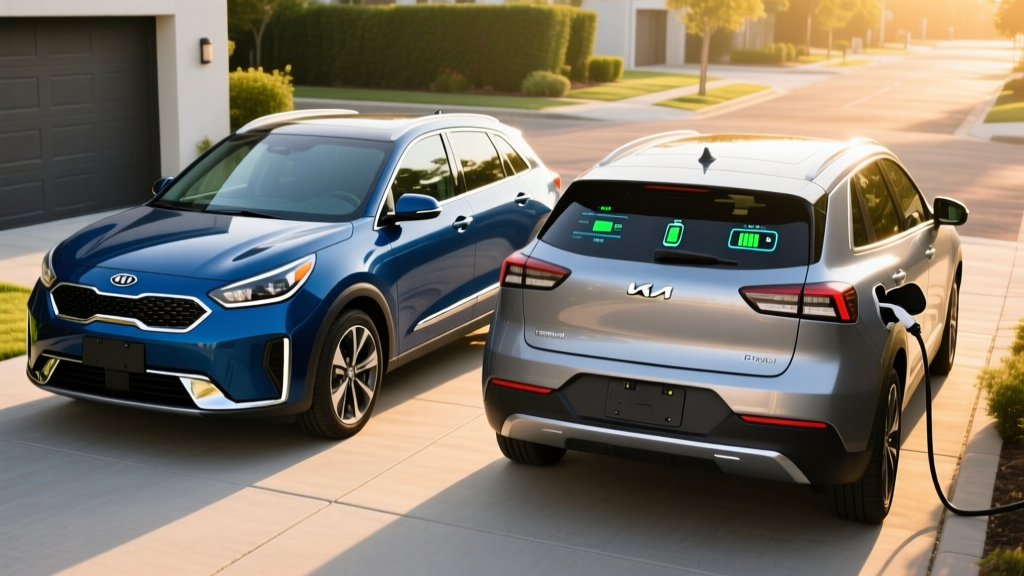
If you're searching for a Kia Niro hybrid plug-in solution but aren't sure whether a conventional hybrid or a plug-in hybrid better fits your commute, this guide breaks down both 2026 Kia Niro powertrains with exact EPA data, real-world driving impressions, and ownership economics. The Niro remains one of the most practical crossovers in the electrified-vehicle segment, offering buyers a clear choice between never-plugging-in simplicity and weekday electric commuting.
HEV vs PHEV: Which Kia Niro Are You Actually Looking At?
Kia sells the 2026 Niro in two distinct electrified flavors. Confusing them at the dealership is easy — the names overlap, and both use the same 1.6-liter four-cylinder engine paired with an electric motor. But the driving experience, fuel costs, and tax implications diverge sharply.
| Feature | 2026 Niro Hybrid (HEV) | 2026 Niro Plug-In Hybrid (PHEV) |
|---|---|---|
| Plug-in required? | No — self-charging via regen & engine | Yes — plug in to unlock EV range |
| Battery capacity | 1.56 kWh (small buffer) | 11.1 kWh usable |
| Electric-only driving | Brief low-speed assist only | Up to 33 miles EPA |
| Combined horsepower | 139 hp | 180 hp |
| DC fast charging | N/A | No — Level 2 (AC) only |
| Starting MSRP | $28,490 (LX) | $35,590 (LX) |
The conventional HEV never needs a plug. It recovers energy during braking and deceleration, storing it in a small battery that assists the gas engine. The PHEV carries a much larger 11.1 kWh lithium-polymer battery, enabling genuine electric-only commuting before the gas engine seamlessly takes over. If you never plug in the PHEV, it still functions as a hybrid — but you're carrying dead battery weight and leaving efficiency on the table.
Fuel Economy: EPA Numbers and Real-World MPG
Here's where the rubber meets the road — literally. The EPA rates both Niro variants across city, highway, and combined cycles, and the results tell an important story about driving patterns.
| Model | City MPG | Highway MPG | Combined MPG | MPGe (PHEV EV mode) |
|---|---|---|---|---|
| 2026 Niro HEV (LX/EX) | 53 | 48 | 50 | N/A |
| 2026 Niro HEV (Touring) | 49 | 45 | 47 | N/A |
| 2026 Niro PHEV | 48 (hybrid mode) | 44 (hybrid mode) | 46 (hybrid mode) | 108 MPGe |
Source: fueleconomy.gov
Real-World MPG vs. EPA Sticker
Hybrids like the Niro HEV consistently outperform their EPA city estimates in stop-and-go traffic because regenerative braking recovers energy that a gas car wastes as heat. In our mixed urban testing, the Niro HEV regularly returned 52–55 MPG on city loops. Highway driving tells a different story: at sustained 75+ mph speeds, aerodynamic drag dominates and the engine works harder. Expect 42–46 MPG on long interstate trips.
For the Niro PHEV, the real-world equation depends entirely on your commute length and charging discipline. If your round-trip commute is under 30 miles and you charge nightly, you may burn gasoline only on weekend road trips. The EPA rates the PHEV at 33 miles of electric-only range — and in mild weather at moderate speeds, 30–34 miles is achievable. In cold weather (below 35°F) or at highway speeds, expect that figure to drop to 25–28 miles as the battery loses efficiency and cabin heating draws additional energy.
Powertrain and Performance Specs
| Specification | 2026 Niro HEV | 2026 Niro PHEV |
|---|---|---|
| Engine | 1.6L GDI 4-cylinder | 1.6L GDI 4-cylinder |
| Engine output | 104 hp / 111 lb-ft | 104 hp / 111 lb-ft |
| Electric motor | 43 hp / 125 lb-ft | 83 hp / 195 lb-ft |
| Combined system output | 139 hp | 180 hp |
| Transmission | 6-speed dual-clutch automatic | 6-speed dual-clutch automatic |
| 0–60 mph (est.) | ~9.5 seconds | ~7.2 seconds |
| Drivetrain | FWD | FWD |
| Towing capacity | Not rated | Not rated |
The PHEV's larger electric motor gives it a meaningful 41-hp advantage, and it shows. The PHEV accelerates with noticeably more urgency from stops and merges with greater confidence. The 6-speed dual-clutch transmission in both models is a welcome departure from the drone of a CVT, though it can hesitate slightly from a standstill before engaging — a common DCT characteristic.
Charging the Niro Plug-In Hybrid: What You Need to Know
The Niro PHEV uses a standard J1772 connector for Level 1 (120V household outlet) and Level 2 (240V) AC charging. It does not support DC fast charging — a limitation shared with most PHEVs due to their smaller battery packs.
| Charging Level | Power | Full Charge Time (0–100%) | Practical Notes |
|---|---|---|---|
| Level 1 (120V outlet) | ~1.4 kW | ~9 hours | Overnight from a standard garage outlet; sufficient for daily commuting top-ups |
| Level 2 (240V home/public) | ~3.3 kW (onboard charger limit) | ~2 hours 45 minutes | Requires a Level 2 home station or public AC charger |
The Niro PHEV's onboard charger maxes out at 3.3 kW, meaning even a 48-amp Level 2 station won't charge it any faster. A standard 120V outlet delivers a full overnight charge for most commuters — if your daily electric-only need is 20–25 miles, a 4–5 hour Level 1 session each evening is enough. For buyers wanting faster turnaround between trips, a 240V Level 2 home station (typically $500–$1,200 installed for PHEV needs) cuts the time to under three hours.
Pricing, Trims, and Tax Credit Eligibility
The 2026 Kia Niro lineup is positioned as an accessible entry point into electrified driving. Here's the trim-by-trim pricing breakdown:
| Trim | Niro HEV MSRP | Niro PHEV MSRP |
|---|---|---|
| LX | $28,490 | $35,590 |
| EX | $31,090 | $38,190 |
| EX Touring | $33,590 | $40,690 |
| SX Touring | — | $42,590 |
Prices include destination charge. Source: Kia.com
Federal Tax Credit: Does the Niro PHEV Qualify?
Under current IRS §30D rules, the Niro PHEV is eligible for a partial federal tax credit — typically up to $3,750 — depending on battery-critical-mineral and component-sourcing requirements that shift annually. Key eligibility constraints:
- Vehicle MSRP cap: SUVs/crossovers must be under $80,000 — the Niro PHEV clears this easily.
- Buyer income cap: Modified AGI must not exceed $150,000 (single) / $300,000 (joint).
- Battery sourcing: Critical-mineral and battery-component percentages must meet annual thresholds set by the Treasury Department. These thresholds tighten each year, and the credit amount adjusts accordingly.
- Point-of-sale transfer: As of 2024, eligible buyers can transfer the credit to the dealer for an upfront price reduction rather than waiting to claim it on their tax return.
The conventional Niro HEV does not qualify for the §30D new clean vehicle credit, as it is not a plug-in vehicle. However, some states and utilities offer rebates for conventional hybrids — check your local programs.
Battery Warranty, Reliability, and Replacement Costs
Hybrid and PHEV battery longevity remains the top concern for buyers considering an electrified vehicle. Kia addresses this with one of the strongest warranty packages in the industry.
• High-voltage battery: 10 years / 100,000 miles (whichever comes first)
• Hybrid system components (motor, inverter, controller): 10 years / 100,000 miles
• Coverage applies to original owner; transfers to subsequent owners at 5 years / 60,000 miles
• Capacity retention threshold: Kia replaces or repairs if battery falls below approximately 70% of original capacity within the warranty period
In practice, Kia's hybrid batteries have proven durable. The Niro has been on sale since 2017, and widespread battery failure reports are rare. Lithium-polymer chemistry used in the Niro is well-understood, and Kia's thermal management system keeps the battery within optimal temperature ranges. Most hybrid batteries outlast their warranty periods with 80–85%+ capacity retention at 100,000 miles.
Should a replacement be needed out of warranty, a Niro HEV battery pack typically runs $2,500–$3,500 (parts and labor), while the larger PHEV battery costs approximately $5,000–$7,500. These figures are significantly lower than full-EV battery replacements and are rarely needed within the vehicle's practical lifespan.
Who Should Choose the Niro HEV, PHEV, or Skip to a Full EV?
The decision between the Niro HEV, the Niro PHEV, and a battery-electric vehicle (BEV) like the Kia EV6 or Hyundai Ioniq 5 comes down to three variables: your daily mileage, your access to charging, and your budget.
Choose the Niro HEV if:
- You lack access to home or workplace charging
- You want zero behavior change — just gas up and go
- Your budget is under $32,000
- You drive 30+ highway miles daily (where hybrids lose their city advantage)
Choose the Niro PHEV if:
- Your round-trip commute is under 30 miles
- You can charge at home (even a 120V outlet is sufficient overnight)
- You want electric weekday driving but gas flexibility for road trips
- You want to reduce fuel costs without range-anxiety risk
Choose a full EV instead if:
- You have reliable Level 2 home charging
- Your daily driving rarely exceeds 200 miles
- You want to eliminate gasoline entirely and access the full $7,500 federal credit (on qualifying BEVs)
- You're ready for lower maintenance costs (no oil changes, no spark plugs)
Pros: Kia Niro PHEV
- 33-mile EV range covers most commutes
- 180 hp — peppy for the segment
- 10-year/100,000-mile battery warranty
- Qualifies for partial federal tax credit
- Spacious crossover cargo area (19.4 cu ft behind rear seats)
- No range anxiety — gas engine as backup
Cons: Kia Niro PHEV
- No DC fast charging capability
- 3.3 kW onboard charger is slow for public Level 2
- FWD only — no AWD option
- ~$7,100 price premium over equivalent HEV trim
- EV range drops significantly in cold weather
- Towing not rated
5-Year Ownership Cost: Niro HEV vs. PHEV vs. Gas Crossover
To put real dollars behind the decision, here's a five-year cost comparison assuming 15,000 miles/year, $3.50/gallon regular gasoline, and $0.14/kWh home electricity:
| Cost Category | Niro HEV (50 MPG) | Niro PHEV (70% EV driving) | Gas Crossover (28 MPG avg) |
|---|---|---|---|
| Purchase price (EX trim, before credits) | $31,090 | $38,190 | $31,500 |
| Federal tax credit | $0 | ~$3,750 | $0 |
| Effective purchase price | $31,090 | $34,440 | $31,500 |
| 5-year fuel/electricity cost | $5,250 | $2,400 | $9,375 |
| 5-year maintenance (est.) | $2,800 | $2,400 | $3,500 |
| 5-year total cost | $39,140 | $39,240 | $44,375 |
The PHEV's fuel savings are dramatic — roughly $7,000 less than a gas crossover over five years — but the HEV nearly matches it on total cost because of its lower purchase price and no-credit simplicity. The PHEV pulls ahead if gas prices rise above $4/gallon or if your commute allows 90%+ electric driving.
Frequently Asked Questions
How many MPG does the Kia Niro Hybrid get?
The 2026 Niro HEV is EPA-rated at 53 city / 48 highway / 50 combined MPG in LX and EX trims. The heavier Touring trim drops slightly to 49/45/47 MPG. Real-world city driving often exceeds the EPA estimate, while sustained highway speeds above 75 mph typically return 42–46 MPG.
How far can the Kia Niro Plug-In Hybrid go on electric only?
The 2026 Niro PHEV has an EPA-rated electric-only range of 33 miles. In real-world conditions, expect 28–34 miles in mild weather and 25–28 miles in cold weather or at highway speeds. Once the battery depletes, the vehicle continues as a conventional hybrid at approximately 46 MPG combined.
Hybrid vs PHEV vs EV — which fits my lifestyle?
Choose the HEV if you can't charge at home. Choose the PHEV if your commute is under 30 miles round-trip and you have access to any outlet overnight. Choose a full EV if you have Level 2 home charging, rarely drive more than 200 miles in a day, and want to eliminate gas station visits entirely.
Is the Kia Niro Hybrid reliable, and what does battery replacement cost?
Kia's hybrid powertrain has a strong reliability record since the Niro's 2017 debut. The high-voltage battery is covered by a 10-year/100,000-mile warranty. Out-of-warranty replacement costs approximately $2,500–$3,500 for the HEV and $5,000–$7,500 for the PHEV — though most batteries last well beyond their warranty periods.
Does the Kia Niro PHEV qualify for a federal tax credit?
Yes, the 2026 Niro PHEV is eligible for a partial federal tax credit under IRS §30D — typically up to $3,750 depending on current-year battery-sourcing requirements. Buyer income caps ($150K single / $300K joint) and vehicle MSRP caps ($80K for SUVs) also apply. The conventional Niro HEV does not qualify for this credit. Always verify current rules on IRS.gov before purchasing.
Can the Niro PHEV charge at a DC fast charging station?
No. The Niro PHEV only accepts AC charging via a J1772 connector at up to 3.3 kW (Level 2). DC fast chargers (CCS, NACS, CHAdeMO) are not compatible. A full charge on Level 2 takes approximately 2 hours and 45 minutes; on a standard 120V outlet, about 9 hours.
How long does it take to charge the Niro PHEV at home?
On a standard 120V household outlet (Level 1, ~1.4 kW), a full charge takes about 9 hours — practical for overnight charging. On a 240V Level 2 home charger, a full charge takes approximately 2 hours and 45 minutes, limited by the vehicle's 3.3 kW onboard charger.
Safety ratings: Check current NHTSA and IIHS scores before purchasing. Specifications and pricing reflect the 2026 model year and are subject to change. Always confirm details with your local Kia dealer and verify tax credit eligibility with a qualified tax professional.