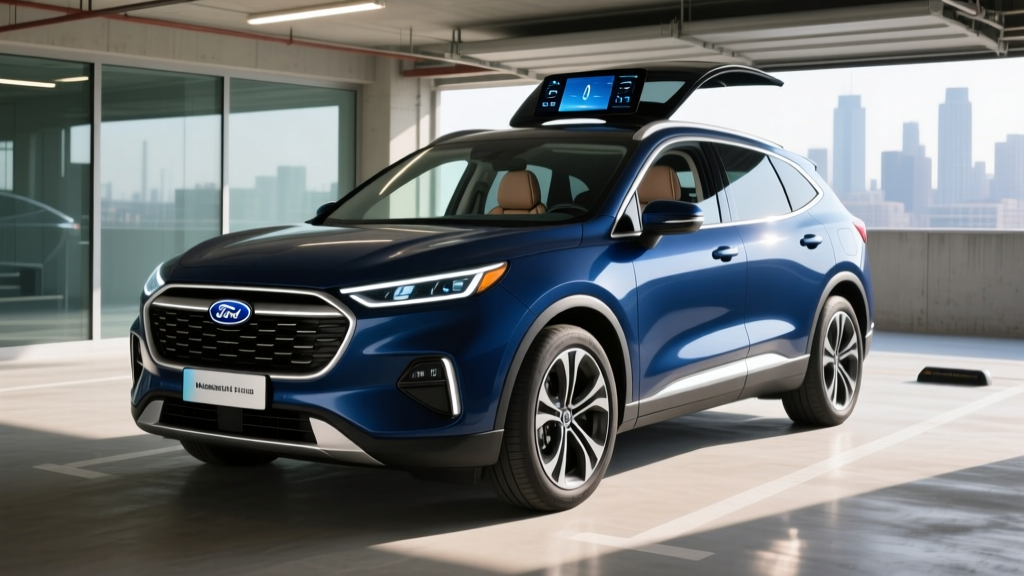
The 2025 Ford Escape Hybrid occupies a practical middle ground: it delivers genuine fuel savings without requiring you to plug in, change your driving habits, or compromise on cargo space. For shoppers searching for the 2025 Ford Escape Hybrid interior layout, tech features, and real-world efficiency, this guide breaks down every spec that matters — from EPA MPG figures to battery warranty coverage and how it stacks up against plug-in and full-electric alternatives.
2025 Ford Escape Hybrid Interior: Space, Tech, and Materials
The Escape Hybrid shares its cabin architecture with the conventional gas-powered Escape, meaning the hybrid powertrain doesn't eat into passenger or cargo volume. The battery pack is mounted low and compact enough to preserve the rear floor.
Inside, the 2025 model features a standard 13.2-inch touchscreen running SYNC 4 with wireless Apple CarPlay and Android Auto, a 12.3-inch digital instrument cluster (on most trims), and a rotary gear selector that frees up center-console storage. Higher trims (ST-Line Select and Platinum) add ActiveX synthetic leather seating, a panoramic sunroof, and a 10-speaker B&O audio system.
Key interior dimensions:
- Front headroom: 40.0 inches
- Rear legroom: 38.9 inches — competitive for the compact SUV segment
- Cargo volume (behind rear seats): 34.4 cubic feet
- Cargo volume (rear seats folded): 60.8 cubic feet
The hybrid-specific instrument cluster includes a power-flow display showing real-time energy distribution between the 2.5L engine and electric motor, plus a coaching feature that gamifies efficient driving. It's a useful tool for maximizing MPG in stop-and-go traffic, where hybrids naturally excel.
HEV vs. PHEV: Which Escape Hybrid Is Right for You?
Ford offers the Escape in two electrified forms for 2025: the conventional Escape Hybrid (HEV) and the Escape Plug-In Hybrid (PHEV). They share the same 2.5-liter Atkinson-cycle four-cylinder engine but differ significantly in battery size, electric capability, and charging requirements.
| Attribute | Escape Hybrid (HEV) | Escape Plug-In Hybrid (PHEV) |
|---|---|---|
| Powertrain type | Self-charging hybrid | Plug-in hybrid |
| Battery capacity | ~1.1 kWh (NiMH) | 14.4 kWh (lithium-ion) |
| Combined horsepower | 210 hp | 210 hp |
| Electric-only range | N/A (brief EV assist only) | 37 miles (EPA) |
| Requires plugging in | No | Yes, for EV range benefit |
| DC fast charging | N/A | No (Level 2 AC only) |
| Drivetrain options | FWD or AWD | FWD only |
| EPA combined MPG | 39 MPG (FWD) | 40 MPG (gas) / 105 MPGe (EV+gas) |
The distinction matters. The HEV generates all its electricity internally through regenerative braking and the engine — you never plug it in. The PHEV can be charged at home or at public Level 2 stations to unlock 37 miles of electric-only driving before the gas engine engages. If your commute is under 35 miles round-trip and you have home charging access, the PHEV can function as a daily EV with a gas-engine safety net for road trips.
Fuel Economy: EPA Ratings and Real-World MPG
| Drivetrain | City MPG | Highway MPG | Combined MPG |
|---|---|---|---|
| FWD | 42 | 36 | 39 |
| AWD | 42 | 36 | 39 |
Source: EPA Fuel Economy
How does this translate to real-world driving? Hybrids typically exceed their EPA city rating in stop-and-go traffic because regenerative braking recovers energy that a gas car wastes as heat. In mixed suburban and city driving, owners frequently report 40–44 MPG. On sustained highway trips at 70+ mph, expect the engine to carry more of the load, yielding closer to 33–35 MPG.
EPA Combined: 39 MPG
City-heavy driving: 40–44 MPG (regen maximized)
Highway cruising (70+ mph): 33–35 MPG
Cold weather (below 32°F): 34–37 MPG (engine runs more for cabin heat)
For the PHEV variant, the EPA rates it at 105 MPGe when operating in combined EV and gas mode, and 40 MPG combined once the battery is depleted and the engine takes over. The 37-mile electric-only range is EPA-verified; expect 30–34 miles in cold weather or at highway speeds.
Powertrain Specs and Performance
| Spec | HEV | PHEV |
|---|---|---|
| Engine | 2.5L Atkinson-cycle I4 | 2.5L Atkinson-cycle I4 |
| Electric motor | Permanent-magnet AC synchronous | Permanent-magnet AC synchronous |
| Combined system output | 210 hp | 210 hp |
| Transmission | eCVT (power-split device) | eCVT (power-split device) |
| 0-60 mph (est.) | ~7.5 seconds | ~7.8 seconds |
| Max towing capacity | 1,500 lbs | 1,500 lbs |
The eCVT is not a traditional belt-and-pulley CVT — it's a planetary gearset that seamlessly blends engine and motor power. The result is smooth, linear acceleration without the rubber-band feel some CVTs produce. The 210-hp combined output is adequate for merging and passing, though the Escape Hybrid prioritizes efficiency over sportiness.
Pricing, Trims, and Tax Credit Eligibility
| Trim | Drivetrain | MSRP |
|---|---|---|
| ST-Line | FWD | $34,490 |
| ST-Line | AWD | $36,490 |
| ST-Line Select | FWD | $37,990 |
| ST-Line Select | AWD | $39,990 |
| Platinum | AWD | $41,490 |
The PHEV variant starts at $40,400 (ST-Line FWD) and climbs to approximately $44,900 in Platinum trim.
Does the 2025 Escape Hybrid Qualify for a Federal Tax Credit?
Here's where the HEV and PHEV diverge sharply:
- Escape Hybrid (HEV): Does not qualify for the federal §30D clean vehicle credit. Conventional hybrids are not eligible — the credit applies only to plug-in vehicles with a battery of at least 7 kWh.
- Escape Plug-In Hybrid (PHEV): Qualifies for up to $3,750 under current IRS rules, provided the buyer meets income caps ($150K single / $300K joint), the vehicle MSRP is under $80,000 (it is), and the battery's critical minerals and components meet North American sourcing thresholds. This credit can be transferred to the dealer as a point-of-sale discount. Verify current-year eligibility on IRS.gov before purchasing, as sourcing requirements tighten annually.
Some states offer additional rebates for PHEVs (California's CVRP, for example), but these vary by jurisdiction and funding availability. Check your state energy office or Alternative Fuels Data Center for local incentives.
Battery Warranty, Reliability, and Replacement Costs
HEV: 8 years / 100,000 miles (whichever comes first)
PHEV: 8 years / 100,000 miles (whichever comes first)
Coverage threshold: Battery must retain sufficient capacity; Ford covers repair or replacement if it falls below functional specification during the warranty period.
Ford's hybrid system has been in production since the early 2000s (the Escape Hybrid debuted for the 2005 model year), giving it one of the longest track records in the segment. The current-generation 2.5L hybrid powertrain is shared with the Maverick Hybrid and Bronco Sport Hybrid, meaning parts availability and technician familiarity are strong.
Out-of-warranty battery replacement costs vary:
- HEV battery: $2,000–$3,500 (smaller NiMH pack, simpler replacement)
- PHEV battery: $6,000–$9,000 (larger 14.4 kWh lithium-ion pack)
In practice, hybrid battery failures before 150,000 miles are uncommon. Many first-generation Escape Hybrids are still running on their original batteries at 200,000+ miles. The most common hybrid-related service item is the hybrid battery cooling fan filter, which should be inspected and cleaned periodically to prevent overheating-related degradation.
Who Should Choose the Escape Hybrid vs. a PHEV or Full EV?
- You don't have access to home or workplace charging
- You want maximum simplicity — no plugs, no range planning
- Your driving is a mix of city and highway with no predictable short commute
- You want AWD availability (not offered on the PHEV)
- Budget is a priority — the HEV starts ~$6,000 lower than the PHEV
- You can charge at home (Level 2, ~4 hours from empty)
- Your daily round-trip commute is under 35 miles
- You want EV-like daily driving with gas-engine flexibility for road trips
- You qualify for the ~$3,750 federal credit, narrowing the price gap
- You have reliable home Level 2 charging
- Your daily driving is under 250 miles and you're comfortable with DC fast charging on road trips
- You want to eliminate gasoline costs and maintenance entirely
- You qualify for the full $7,500 federal EV credit
Pros and Cons at a Glance
- 42 MPG city is best-in-class for a compact AWD SUV
- Spacious interior with 34.4 cu ft cargo — no hybrid penalty
- No plug-in required; zero behavior change from a gas car
- Proven powertrain with 20 years of Ford hybrid evolution
- AWD available on HEV (not on PHEV)
- Competitive starting price at $34,490
- Highway MPG drops to ~33-35 in real-world driving
- 210 hp is adequate but not quick — 0-60 in ~7.5 seconds
- HEV does not qualify for any federal tax credit
- PHEV is FWD only — no AWD option
- Infotainment can be slow to respond on base SYNC 4
- Towing limited to 1,500 lbs
Frequently Asked Questions
How many MPG does the 2025 Ford Escape Hybrid get?
The EPA rates the 2025 Escape Hybrid at 42 city / 36 highway / 39 combined for both FWD and AWD. In real-world city-heavy driving, many owners report 40–44 MPG thanks to aggressive regenerative braking. Highway-only trips at 75+ mph typically yield 33–35 MPG.
How far can the Escape PHEV go on electric only?
The 2025 Escape PHEV delivers an EPA-rated 37 miles of electric-only range. Real-world results vary: expect 30–34 miles in cold weather or at sustained highway speeds, and up to 37 miles in mild conditions at city speeds. Once the battery depletes, the PHEV operates as a conventional hybrid at 40 MPG combined.
Does the 2025 Escape Hybrid need to be plugged in?
No. The conventional Escape Hybrid (HEV) charges its small battery entirely through regenerative braking and the gasoline engine. You fuel it like any other gas car. Only the Escape Plug-In Hybrid (PHEV) benefits from being plugged in to a Level 1 or Level 2 charger.
Is the Escape Hybrid reliable, and what does battery replacement cost?
Ford's hybrid system has been in continuous production since 2005 and is considered one of the more proven hybrid powertrains on the market. The hybrid battery is warrantied for 8 years/100,000 miles. Out-of-warranty replacement runs $2,000–$3,500 for the HEV and $6,000–$9,000 for the PHEV. Failures before 150,000 miles are rare based on long-term fleet data.
Does the 2025 Escape Hybrid qualify for a tax credit?
The conventional Escape Hybrid (HEV) does not qualify for the federal §30D clean vehicle credit — that credit is reserved for plug-in vehicles. The Escape Plug-In Hybrid (PHEV) may qualify for up to $3,750, subject to buyer income limits, MSRP caps, and battery-sourcing requirements that change annually. Confirm eligibility on IRS.gov before purchase.
How long does it take to charge the Escape PHEV?
On a standard 120V household outlet (Level 1), the PHEV's 14.4 kWh battery charges in approximately 10–12 hours. On a 240V Level 2 home charger or public station, expect a full charge in roughly 3.5–4 hours. The Escape PHEV does not support DC fast charging.