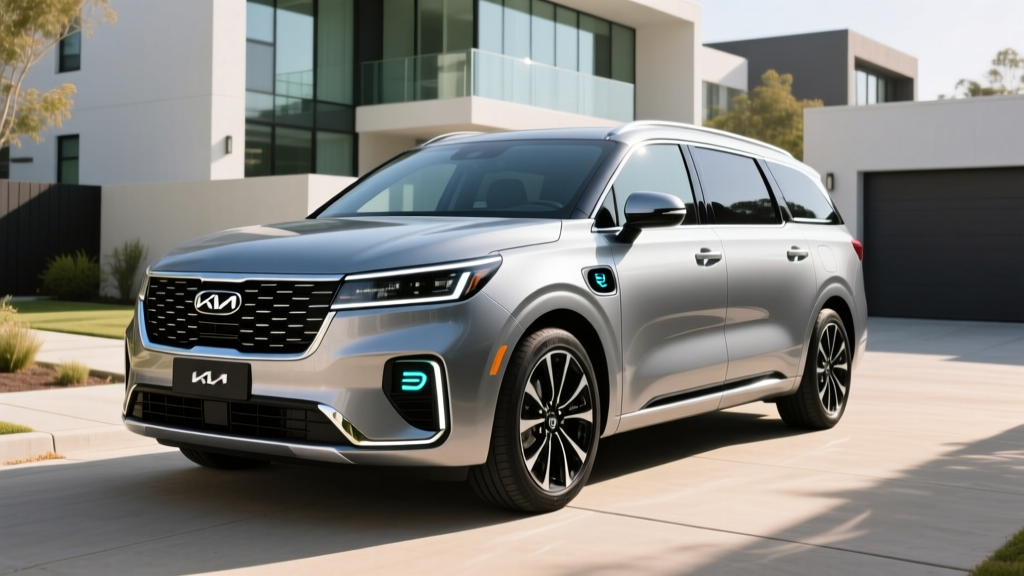
The minivan segment has gone hybrid, and the 2026 Kia Carnival Turbo Hybrid is Kia's answer to the Toyota Sienna's hybrid-only dominance. By pairing a turbocharged 1.6-liter four-cylinder engine with an electric motor, Kia squeezed 245 combined horsepower out of a powertrain that returns an EPA-estimated 33 MPG combined — a significant leap over the outgoing V6's 22 MPG. For families who need three rows of seating but want to cut fuel costs without plugging in, the Carnival Turbo Hybrid occupies a compelling middle ground.
This guide covers everything buyers need to know: EPA fuel economy versus real-world results, the turbo hybrid powertrain, pricing across trims, battery longevity, and how it stacks up against plug-in hybrids and full EVs.
2026 Kia Carnival Turbo Hybrid: Quick Specs at a Glance
| Specification | 2026 Kia Carnival Turbo Hybrid |
|---|---|
| Powertrain | 1.6L Turbo I-4 + Electric Motor |
| Combined Horsepower | 245 hp |
| Combined Torque | 271 lb-ft |
| Transmission | 6-Speed Automatic |
| EPA MPG (City / Hwy / Combined) | 34 / 31 / 33 |
| Drivetrain | Front-Wheel Drive |
| Battery Type | Lithium-Ion (1.49 kWh) |
| Seating Capacity | 7–8 passengers |
| Cargo Volume (Behind 3rd / 2nd / Max) | 41.1 / 86.4 / 145.1 cu ft |
| Starting MSRP | $41,600 (LXS trim) |
| Hybrid Battery Warranty | 10 years / 100,000 miles |
Fuel Economy: EPA Estimates vs. Real-World MPG
The EPA rates the 2026 Carnival Turbo Hybrid at 34 MPG city, 31 MPG highway, and 33 MPG combined. These figures come from fueleconomy.gov and represent the official government testing cycle.
| Driving Scenario | EPA Estimate | Real-World Expectation |
|---|---|---|
| City / Stop-and-Go | 34 MPG | 32–36 MPG (hybrids often exceed EPA in city) |
| Highway (70–80 mph) | 31 MPG | 27–30 MPG (aero drag reduces hybrid advantage) |
| Combined Mixed | 33 MPG | 30–33 MPG |
| Cold Weather (Below 32°F) | — | 26–29 MPG (engine runs more for cabin heat) |
The real-world behavior is worth understanding. Hybrid systems recapture energy through regenerative braking, which is why city MPG often exceeds highway MPG — the opposite of conventional gas vehicles. In stop-and-go traffic and suburban driving with frequent deceleration, the Carnival's electric motor handles low-speed propulsion, and the turbo engine stays off more often. Owners running errands and school routes typically report figures at or slightly above the EPA city rating.
Highway driving tells a different story. At sustained 75–80 mph speeds, regenerative braking opportunities disappear, and the turbo engine carries the full load while overcoming aerodynamic drag on a 4,700-pound minivan. Expect 27–30 MPG on long road trips. In freezing temperatures, the engine runs more frequently to provide cabin heat and maintain battery temperature, dropping real-world economy into the mid-20s.
How the Turbo Hybrid Powertrain Works
The Carnival Turbo Hybrid uses a conventional hybrid electric vehicle (HEV) architecture — meaning it does not plug in. The system charges its small battery pack entirely through regenerative braking and the gasoline engine. You fuel it at any gas station like a conventional vehicle.
HEV vs. PHEV: What's the Difference?
| Feature | Conventional Hybrid (HEV) | Plug-In Hybrid (PHEV) |
|---|---|---|
| Plugs in to charge? | No — charges via regen + engine | Yes — has onboard charging port |
| Battery size | ~1–2 kWh | ~12–25 kWh |
| Electric-only driving | Brief low-speed assists only | 20–45 miles on battery alone |
| Fuel economy advantage | 30–40% better than gas-only | 50–100+ MPGe on short trips |
| Upfront cost premium | ~$1,500–$3,000 over gas | ~$5,000–$10,000 over gas |
| Federal tax credit | None | Up to $7,500 (§30D, if eligible) |
The Carnival's powertrain pairs a 1.6-liter turbocharged inline-4 (producing roughly 178 hp on its own) with an electric motor integrated into the transmission housing. Together, they deliver 245 combined horsepower and 271 lb-ft of torque. The electric motor fills in torque at low RPMs before the turbo spools up, which gives the Carnival surprisingly responsive acceleration from a stop — useful for merging and highway on-ramps.
The 1.49 kWh lithium-ion battery pack sits under the second-row seats. It's small by design: large enough to capture regenerative braking energy and provide electric assist during acceleration, but not so large that it adds excessive weight or eats into cargo space. Kia uses a traditional 6-speed automatic transmission rather than the CVT-type setups found in Toyota's hybrid system, which some drivers prefer for its more familiar shift feel.
Pricing by Trim and Tax Credit Eligibility
The 2026 Kia Carnival Turbo Hybrid starts at $41,600 for the LXS trim and climbs through several configurations:
- LXS: $41,600 — 8-passenger seating, dual 12.3-inch displays, Smart Power Liftgate
- EX: $44,600 — Power sliding doors, heated front seats, leatherette upholstery
- SX: $47,600 — Navigation, Bose premium audio, Highway Driving Assist 2
- SX Prestige: $52,900 — Nappa leather, ventilated front seats, dual-screen rear entertainment, Surround View Monitor
Does the Carnival Turbo Hybrid Qualify for a Federal Tax Credit?
No. The Carnival Turbo Hybrid is a conventional HEV, not a plug-in vehicle. Under current IRS §30D Clean Vehicle Credit rules, only battery electric vehicles (BEVs) and plug-in hybrid electric vehicles (PHEVs) with sufficient battery capacity are eligible for the federal tax credit of up to $7,500. Conventional hybrids do not qualify.
Kia does not currently offer a Carnival PHEV variant in the United States. If federal incentives are a priority in your purchase decision, you would need to look at plug-in alternatives like the Chrysler Pacifica PHEV (32 miles electric-only, eligible for partial credit) or a fully electric three-row SUV.
Some states and local utilities offer smaller rebates for hybrid purchases. Check your state energy office and local utility for current programs, as these vary widely by jurisdiction.
Battery Longevity, Warranty, and Replacement Cost
Kia Hybrid Battery Warranty
Coverage: 10 years or 100,000 miles (whichever comes first)
What's covered: Battery capacity loss below a defined threshold, defects in hybrid system components including the electric motor, inverter, and battery control module
Transferable: Yes, to subsequent owners (terms may vary — confirm with dealer)
Hybrid battery degradation is one of the most common concerns among first-time hybrid buyers, but the data is reassuring. Modern lithium-ion hybrid batteries are engineered for shallow cycling — they never fully charge or fully discharge, which dramatically extends their lifespan. Toyota's hybrid taxis routinely surpass 200,000 miles on original battery packs, and Kia's system follows similar engineering principles.
The 1.49 kWh battery in the Carnival is small and relatively inexpensive compared to a full EV battery pack. If replacement is ever needed out of warranty, industry estimates for hybrid battery replacement in minivans and midsize SUVs typically range from $2,000 to $4,000 including parts and labor. For comparison, a full EV battery replacement can cost $10,000–$20,000+.
Beyond the hybrid battery, Kia backs the Carnival with a 5-year/60,000-mile limited warranty and a 10-year/100,000-mile powertrain warranty covering the engine and transmission.
Who Should Buy the Carnival Turbo Hybrid?
Pros
- 33 MPG combined saves ~$600–$900/year vs. the gas V6 Carnival (at 22 MPG, $3.50/gal, 15K mi/yr)
- 245 hp provides confident highway merging and passing
- No plugging in — zero lifestyle change from a gas vehicle
- Class-leading cargo volume: 145.1 cu ft max
- 10-year/100,000-mile hybrid battery warranty
- Smooth, quiet operation at low speeds in EV-assist mode
Cons
- No AWD option (Toyota Sienna hybrid offers AWD)
- Highway MPG drops to ~27–30 on long road trips
- No federal tax credit (HEV, not PHEV)
- Starting price ~$3,000–$4,000 above gas-only Carnival
- 6-speed automatic can hunt for gears under hard acceleration
Decision Framework: Hybrid, PHEV, or Full EV?
Choose the Carnival Turbo Hybrid (HEV) if: You want better fuel economy with zero behavioral change — no plugging in, no range planning, no charging apps. You drive 12,000–18,000 miles per year in a mix of city and highway, and you want a three-row minivan with strong cargo space and a proven warranty.
Choose a PHEV minivan (e.g., Chrysler Pacifica Hybrid) if: You have reliable home charging access, your daily driving is under 30 miles, and you want to drive mostly on electricity for weekday errands while keeping a gas engine for road trips. PHEVs may qualify for partial federal tax credits, offsetting their higher purchase price.
Choose a full EV three-row SUV (e.g., Kia EV9, Rivian R1S) if: You have home Level 2 charging, your daily range needs fit within 250–300 miles, you want to eliminate gasoline entirely, and you qualify for the full $7,500 federal tax credit. EVs have lower per-mile fuel costs but require charging infrastructure investment.
How It Compares to the Toyota Sienna Hybrid
The Sienna has been hybrid-only since 2021, making it the Carnival's most direct competitor. Here's how the numbers stack up:
| Spec | 2026 Kia Carnival Turbo Hybrid | 2026 Toyota Sienna Hybrid |
|---|---|---|
| Combined HP | 245 hp | 245 hp |
| EPA Combined MPG | 33 MPG | 36 MPG |
| EPA City / Highway | 34 / 31 | 36 / 36 |
| AWD Available | No | Yes (optional) |
| Max Cargo Volume | 145.1 cu ft | 101.0 cu ft |
| Starting MSRP | $41,600 | $39,485 |
| Hybrid Battery Warranty | 10 yr / 100K mi | 10 yr / 150K mi |
The Sienna wins on fuel economy (36 MPG combined vs. 33) and offers available AWD — a significant advantage in snow-belt states. The Carnival counters with dramatically more cargo space (145.1 vs. 101.0 cu ft), a more premium interior at higher trims, and a turbocharged powertrain that feels more responsive under hard acceleration. Both carry excellent hybrid battery warranties, though Toyota extends coverage to 150,000 miles.
Real-World Ownership Costs: 5-Year Projection
| Cost Category | Carnival Turbo Hybrid (33 MPG) | Carnival Gas V6 (22 MPG) |
|---|---|---|
| Purchase Price (LXS) | $41,600 | $36,600 |
| Fuel Cost (5 yrs, 15K mi/yr, $3.50/gal) | $7,955 | $11,932 |
| Fuel Savings vs. Gas | ~$3,977 saved over 5 years | |
| Estimated Maintenance (5 yrs) | ~$2,800 | ~$3,200 |
| 5-Year Total (Purchase + Fuel + Maint.) | ~$52,355 | ~$51,732 |
The hybrid's $5,000 price premium over the gas V6 Carnival is largely offset by fuel savings within 5–6 years of typical driving. Maintenance costs are slightly lower on the hybrid because regenerative braking reduces wear on the friction brake pads, and the engine operates fewer total hours due to electric assist at low speeds. Insurance costs are comparable between the two powertrains.
Frequently Asked Questions
How many MPG does the Kia Carnival Turbo Hybrid get?
The EPA rates the 2026 Carnival Turbo Hybrid at 34 MPG city, 31 MPG highway, and 33 MPG combined. In real-world city driving with frequent stops, owners often match or slightly exceed the 34 MPG city figure. Highway driving at sustained speeds typically yields 27–30 MPG.
Does the Carnival Hybrid need to be plugged in?
No. The Carnival Turbo Hybrid is a conventional HEV, not a plug-in hybrid. Its small battery charges automatically through regenerative braking and the gasoline engine. You refuel it at any gas station, just like a regular vehicle.
Is the Kia Carnival Hybrid reliable?
Kia's turbo hybrid powertrain is based on proven technology shared with the Hyundai Motor Group, which has deployed similar systems in the Sorento Hybrid and Tucson Hybrid since 2022. Early reliability data from those models has been strong. The Carnival's hybrid battery is covered by a 10-year/100,000-mile warranty, and Kia's overall powertrain warranty is among the best in the industry.
What does a Carnival Hybrid battery replacement cost?
If replacement is needed out of warranty, hybrid battery packs in vehicles of this class typically cost $2,000–$4,000 including parts and labor. However, most hybrid batteries outlast the vehicle itself — shallow cycling and active thermal management keep degradation minimal. Many owners never need a replacement.
Does the Carnival Turbo Hybrid qualify for any tax credit?
No. Under current IRS §30D rules, only plug-in electric vehicles (BEVs and PHEVs) qualify for the federal Clean Vehicle Credit. The Carnival Turbo Hybrid is a conventional HEV and is not eligible. Check your state and local utility for any hybrid-specific rebates, which vary by jurisdiction.
Can the Carnival Hybrid drive on electric power alone?
Only briefly and at very low speeds (typically under 25 mph for short distances). The 1.49 kWh battery is too small for sustained electric-only driving. For meaningful electric-only range, you would need a PHEV like the Chrysler Pacifica Hybrid (32 miles EV-only).
Is the Carnival Hybrid available with AWD?
No. The 2026 Carnival Turbo Hybrid is front-wheel drive only. If AWD is a priority, the Toyota Sienna hybrid offers an available electronic AWD system across multiple trims.
Sources: fueleconomy.gov (EPA fuel economy data), IRS §30D Clean Vehicle Credit rules, Kia Motors America official specifications. Pricing and specifications reflect the 2026 model year and are subject to change. Tax credit eligibility depends on individual circumstances — consult a tax professional.