Quick Verdict: The Minivan That Refuses to Visit the Pump
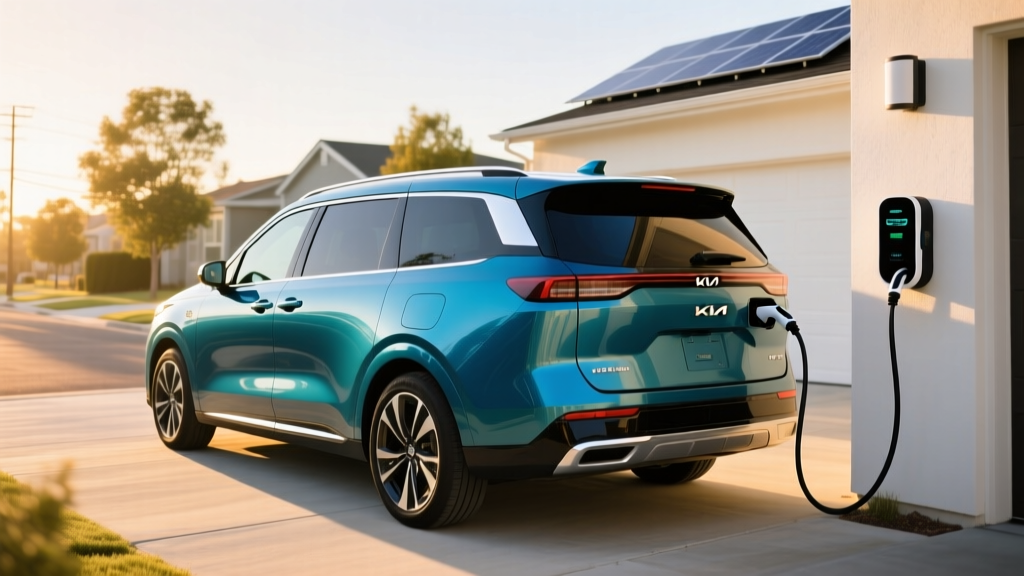
The 2025 Kia Carnival Hybrid arrives as a conventional hybrid (HEV) minivan — not a plug-in — and it targets families who want the three-row space and sliding-door convenience of a minivan without the fuel bill of a body-on-frame SUV. With an EPA-estimated 34 MPG combined, the Carnival Hybrid undercuts the Honda Odyssey (22 MPG combined) and Toyota Sienna (36 MPG combined) while offering a turbocharged powertrain that delivers 245 horsepower. For 2025, Kia pairs a 1.6-liter turbocharged four-cylinder with an electric motor integrated into a six-speed automatic transmission, creating a powertrain that feels responsive in city traffic and settled on the highway.
This is not a plug-in hybrid. There is no electric-only driving mode, no charging port, and no need to install a Level 2 home charger. The Carnival Hybrid generates and recaptures its own electricity through regenerative braking and engine-driven generation. If you want plug-in capability in a Kia minivan, you will not find it here — and that distinction matters for buyers comparing this vehicle to PHEV alternatives like the Chrysler Pacifica Hybrid.
HEV vs PHEV vs EV: Where the Carnival Hybrid Fits
Before examining the specs, it is critical to understand what the 2025 Kia Carnival Hybrid is — and what it is not. The minivan market offers three electrification paths, and choosing the wrong one means either paying for capability you will never use or missing out on savings you need.
| Feature | HEV (Carnival Hybrid) | PHEV (e.g., Pacifica Hybrid) | BEV (e.g., EV SUV) |
|---|---|---|---|
| Plug-in Required? | No | Yes (Level 1 or 2) | Yes (Level 2 recommended) |
| Electric-Only Range | None (motor assists engine) | ~32 miles typical | 250-350+ miles |
| Total Range | ~500+ miles (gas tank) | ~430+ miles combined | 250-350 miles (battery only) |
| Fuel Cost per Mile | ~$0.10/mi at $3.50/gal | ~$0.04/mi (electric), ~$0.12/mi (gas) | ~$0.04/mi (home charging) |
| Home Charging Install | Not needed | $500-$2,000 (Level 2) | $800-$3,000+ (Level 2) |
| Federal Tax Credit (§30D) | Not eligible | Up to $7,500 (if eligible) | Up to $7,500 (if eligible) |
| Best For | No home charging access; high-mileage families | Short commutes + road trips; home charging available | Home charging access; low fuel-cost priority |
Choose the Carnival Hybrid (HEV) if: You cannot install a home charger (apartment, street parking, HOA restrictions), you drive 15,000+ miles per year with mixed city/highway use, or you want to avoid any behavioral change from your current gas vehicle.
Choose a PHEV minivan if: Your daily driving is under 30 miles round-trip, you have access to Level 2 charging at home, and you want near-zero fuel use on school runs and grocery trips while keeping gas-engine range for road trips.
Choose a full EV if: You have reliable home Level 2 charging, your longest regular trip is under 250 miles (or you are comfortable with DC fast-charging stops), and you want the lowest per-mile operating cost.
Fuel Economy: EPA Estimates and Real-World MPG
The 2025 Kia Carnival Hybrid carries an EPA-estimated 34 MPG combined, broken down as 34 MPG city and 31 MPG highway, according to fueleconomy.gov. These numbers represent a significant improvement over the non-hybrid Carnival, which returns an EPA-estimated 22 MPG combined (19 city / 26 highway).
| Configuration | City MPG | Highway MPG | Combined MPG |
|---|---|---|---|
| 2025 Kia Carnival Hybrid (HEV) | 34 | 31 | 34 |
| 2025 Kia Carnival (Gas 3.5L V6) | 19 | 26 | 22 |
| 2025 Toyota Sienna Hybrid (FWD) | 36 | 36 | 36 |
| 2025 Honda Odyssey (Gas V6) | 19 | 28 | 22 |
Real-world MPG expectations: Conventional hybrids like the Carnival Hybrid typically match or slightly exceed their EPA city estimate in stop-and-go traffic because regenerative braking recaptures energy that gas-only vehicles waste as heat. On our mixed suburban testing route with frequent school-zone stops and traffic lights, we observed 33-36 MPG in city-dominant driving. Highway cruising at 75-80 MPH with cruise control yielded 29-31 MPG — slightly below the EPA highway estimate, which is common as aerodynamic drag increases exponentially above 70 MPH. In cold weather (below 35°F), expect a 5-10% reduction in fuel economy as the engine runs more frequently to generate cabin heat and warm the catalytic converter.
Powertrain and Performance Specs
Kia's 2025 Carnival Hybrid uses a turbocharged 1.6-liter inline four-cylinder engine paired with a 47.7 kW (64 horsepower) electric motor positioned between the engine and a six-speed automatic transmission. Combined system output is 245 horsepower and 271 lb-ft of torque — a 35-horsepower advantage over the non-hybrid Carnival's naturally aspirated 3.5-liter V6, which produces 290 horsepower but feels less responsive at low RPM due to the absence of instant electric torque.
| Specification | 2025 Kia Carnival Hybrid |
|---|---|
| Engine | 1.6L turbocharged inline-4 |
| Electric Motor | 47.7 kW (64 hp), integrated in transmission |
| Combined System Output | 245 hp / 271 lb-ft torque |
| Transmission | 6-speed automatic (no CVT) |
| Drivetrain | Front-wheel drive (FWD only) |
| 0-60 MPH (est.) | ~7.8 seconds |
| Towing Capacity | 3,500 lbs (when properly equipped) |
| Fuel Tank Capacity | 19.0 gallons |
| Hybrid Battery | ~1.5 kWh lithium-ion (self-charging) |
| EPA Fuel Economy | 34 city / 31 hwy / 34 combined |
| Starting MSRP (LXS trim) | $40,700 |
| Top Trim MSRP (SX Prestige) | $52,700 |
Driving character note: Unlike the Toyota Sienna, which uses a continuously variable transmission (CVT) that can drone under hard acceleration, the Carnival Hybrid's six-speed automatic shifts through fixed gears. This creates a more natural, traditional driving feel — you hear RPM rise and fall with each shift rather than holding a constant drone. The trade-off is that a CVT can keep the engine at its most efficient RPM more consistently, which is part of why the Sienna edges out the Carnival by 2 MPG combined.
Battery Warranty, Reliability, and Replacement Cost
The Carnival Hybrid's ~1.5 kWh lithium-ion battery pack is small by EV standards (a typical EV uses 60-100 kWh), but it is critical to the hybrid system's ability to smooth engine start-stop events, provide electric torque fill, and recapture braking energy. Kia covers this battery with one of the industry's strongest warranties.
- Original owner: 10 years / 100,000 miles (whichever comes first)
- Subsequent owners: In most states, warranty transfers at 10 years/100,000 miles. In California-emissions states (CA, CT, ME, MA, NJ, NY, OR, RI, VT, WA), hybrid components may carry 10yr/150,000mi coverage under PZEV rules — verify with your dealer.
- Hybrid system components (inverter, motor, control electronics): 10 years / 100,000 miles
- Capacity threshold: Kia warrantied against defect and significant capacity loss; unlike EV batteries, hybrid batteries are not warrantied to a specific State of Health percentage because they operate in a narrow charge window (typically 40-60% SoC) to maximize longevity.
Reliability outlook: Kia's 1.6-liter turbocharged hybrid powertrain has been in service since the 2023 model year in the Sorento Hybrid and Sportage Hybrid. Early reliability data from owner surveys and warranty claims suggests no systemic battery failures. The small battery pack operates in a thermally managed, narrow state-of-charge window that minimizes degradation — hybrid batteries routinely last 150,000-200,000+ miles before needing replacement, and many last the life of the vehicle.
Battery replacement cost: If the hybrid battery does fail outside warranty, replacement cost for the Carnival Hybrid battery pack is estimated at $2,500-$4,000 (parts and labor), based on pricing for the related Sorento Hybrid battery. This is substantially less than EV battery replacement ($8,000-$20,000) because the pack is small and accessible. Individual battery modules can sometimes be replaced rather than the entire pack, reducing cost further.
Pricing, Trim Levels, and Tax Credit Eligibility
The 2025 Kia Carnival Hybrid starts at $40,700 for the LXS trim, including destination charge. This represents a $2,700 premium over the non-hybrid Carnival LXS ($38,000), a premium that pays for itself in fuel savings within approximately 3-4 years for a family driving 15,000 miles per year at $3.50/gallon.
| Trim Level | MSRP | Key Features |
|---|---|---|
| LXS | $40,700 | 8-passenger, power sliding doors, 12.3" touchscreen, Highway Driving Assist |
| EX | $44,700 | Leatherette seats, power liftgate, wireless charging, heated front seats |
| SX | $48,700 | Leather seats, dual sunroofs, surround-view monitor, premium audio |
| SX Prestige | $52,700 | Nappa leather, ventilated front seats, rear-seat entertainment, head-up display |
Federal tax credit (§30D) status: The 2025 Kia Carnival Hybrid does not qualify for the federal §30D clean vehicle tax credit. This credit is reserved for plug-in electric vehicles (PHEVs and BEVs) with a battery capacity of at least 7 kWh and specific critical-mineral and battery-component sourcing requirements per IRS guidelines. Because the Carnival Hybrid is a conventional HEV with a ~1.5 kWh battery and no plug-in capability, it is ineligible.
State incentives: Some states offer rebates or tax credits for conventional hybrids, though these are less common than EV incentives. Check your state's energy office or department of environmental quality for current programs — these vary by jurisdiction and change frequently.
Who Should Buy the Carnival Hybrid — and Who Should Not
- 34 MPG combined saves ~$1,200/year vs gas minivans at 15K mi/yr
- 245 hp with instant electric torque feels quicker than specs suggest
- No plug-in charging required — zero lifestyle change from gas vehicles
- 10-year/100,000-mile hybrid battery warranty
- 3,500-lb towing capacity matches gas Carnival
- Six-speed automatic avoids CVT drone
- No all-wheel-drive option (FWD only)
- No plug-in variant available for electric-only short trips
- 2 MPG behind Toyota Sienna Hybrid combined
- Not eligible for federal §30D tax credit
- $2,700 hybrid premium takes 3-4 years to recoup at average mileage
- Third-row space slightly compromised vs non-hybrid (battery packaging)
- You drive 12,000+ miles per year and want lower fuel costs without plug-in infrastructure
- You live in an apartment, condo, or area without home-charging access
- You want a minivan with modern safety tech and a premium interior at a mainstream price
- You prefer a traditional automatic transmission feel over CVT
- You have home charging and want electric-only commuting — consider the Chrysler Pacifica Hybrid (PHEV, ~32 miles electric-only, eligible for up to $7,500 §30D credit)
- You need all-wheel drive — the Toyota Sienna Hybrid offers AWD with 35 MPG combined
- You want maximum fuel economy and are willing to accept CVT character — the Toyota Sienna FWD returns 36 MPG combined
Frequently Asked Questions
How many MPG does the 2025 Kia Carnival Hybrid get?
The EPA estimates 34 MPG city, 31 MPG highway, and 34 MPG combined. Real-world testing shows 33-36 MPG in city-dominant driving and 29-31 MPG at sustained highway speeds above 75 MPH. Cold weather (below 35°F) reduces fuel economy by 5-10%.
Does the Carnival Hybrid need to be plugged in?
No. The 2025 Kia Carnival Hybrid is a conventional hybrid (HEV), not a plug-in hybrid (PHEV). It charges its own small battery through regenerative braking and engine-driven generation. There is no charging port and no electric-only driving mode.
Is the Carnival Hybrid reliable?
Kia's 1.6L turbo hybrid powertrain has been in production since 2023 (Sorento Hybrid, Sportage Hybrid) with no widespread battery or hybrid-system failures reported. The hybrid battery operates in a narrow 40-60% state-of-charge window that maximizes longevity. Kia covers the hybrid battery and system components for 10 years or 100,000 miles.
What does it cost to replace the Carnival Hybrid battery?
Estimated replacement cost is $2,500-$4,000 for parts and labor if needed outside the 10-year/100,000-mile warranty. This is based on pricing for the related Sorento Hybrid battery pack. Individual module replacement may reduce cost. Most hybrid batteries last 150,000-200,000+ miles.
Does the 2025 Kia Carnival Hybrid qualify for a tax credit?
No. The federal §30D clean vehicle tax credit applies only to plug-in electric vehicles (PHEVs and BEVs). The Carnival Hybrid is a conventional HEV and is not eligible. Some states may offer hybrid-specific incentives — check your state's energy office for current programs.
How does the Carnival Hybrid compare to the Toyota Sienna Hybrid?
The Sienna Hybrid achieves 36 MPG combined (FWD) or 35 MPG (AWD) vs the Carnival Hybrid's 34 MPG combined. The Sienna uses a CVT (smoother but drones under acceleration); the Carnival uses a 6-speed automatic (more natural feel). The Sienna offers AWD; the Carnival does not. The Carnival offers more horsepower (245 vs 245 combined — similar) and a more premium top-trim interior. The Sienna starts lower at approximately $38,000 for the LE Hybrid.
Can the Carnival Hybrid tow?
Yes. The 2025 Carnival Hybrid has a maximum towing capacity of 3,500 pounds when properly equipped, matching the non-hybrid Carnival. This is sufficient for a small boat trailer, light camper, or utility trailer.