Quick Verdict: The Family Hauler That Sips Fuel
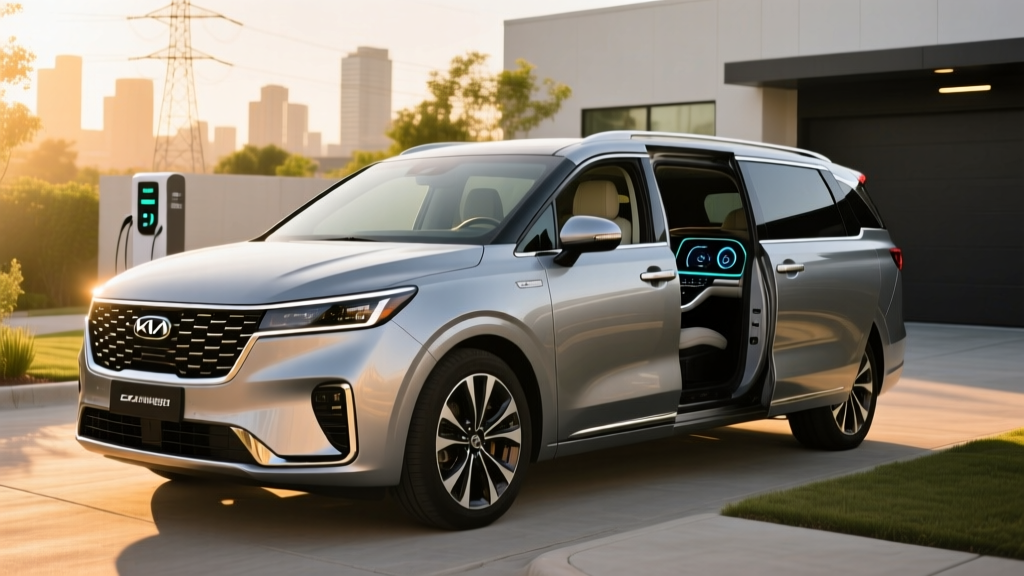
The 2026 Kia Carnival EX Hybrid targets a very specific buyer: the family that needs minivan space and three-row comfort but refuses to accept the fuel bills that traditionally come with it. With an EPA-estimated 34 MPG combined and a 1.6-liter turbocharged hybrid powertrain producing 245 horsepower, the Carnival Hybrid threads the needle between practicality and efficiency. It doesn't plug in, it doesn't pretend to be an EV — it simply makes the minivan formula dramatically more efficient without asking you to change a single habit.
The EX trim sits in the middle of the Carnival Hybrid lineup and represents the value sweet spot, bundling the most-used family features — power sliding doors, leatherette seating, an 8-passenger layout, and Kia's full suite of driver-assistance tech — without the premium-tier price jump. Here's everything you need to know before you buy.
Powertrain and Performance Specs
The Carnival Hybrid uses Kia's turbocharged hybrid architecture, which pairs a 1.6-liter turbocharged four-cylinder engine with an electric motor integrated into the transmission housing. This isn't a carryover from the older naturally aspirated hybrid systems — the turbo gives it notably better passing power and highway confidence, especially when the minivan is fully loaded with passengers and cargo.
| Specification | Value |
|---|---|
| Powertrain | 1.6L Turbo I-4 + Electric Motor (HEV) |
| Combined Horsepower | 245 hp |
| Combined Torque | 271 lb-ft |
| Transmission | 6-Speed Automatic |
| Drivetrain | Front-Wheel Drive |
| EPA Fuel Economy (City / Hwy / Combined) | 34 / 31 / 34 MPG |
| Fuel Tank Capacity | 15.9 gallons |
| Total Driving Range | ~540 miles |
| 0–60 mph (est.) | ~7.8 seconds |
| Towing Capacity | 3,500 lbs |
| Seating Capacity | 8 passengers |
| Cargo Volume (behind 3rd row) | 41.1 cu ft |
| Max Cargo Volume | 145.1 cu ft |
The 245-horsepower combined output is competitive with the Toyota Sienna's 245 hp hybrid system, but the Kia's turbocharged torque curve gives it a more responsive feel at lower RPMs. The Sienna uses an all-wheel-drive option that the Carnival Hybrid does not offer — a point worth noting for buyers in snow-belt states.
Fuel Economy: EPA Numbers vs. Real-World MPG
The EPA rates the 2026 Carnival EX Hybrid at 34 MPG combined, with 34 MPG city and 31 MPG highway. That city-highway inversion — where city mileage matches or beats highway — is the hallmark of a well-tuned hybrid system. Regenerative braking recaptures energy during stop-and-go driving, and the electric motor handles low-speed propulsion where gasoline engines are least efficient.
| Driving Condition | EPA Estimate | Real-World Expectation |
|---|---|---|
| City | 34 MPG | 33–37 MPG (hybrids often exceed EPA in city) |
| Highway | 31 MPG | 28–31 MPG (aerodynamic drag at 70+ mph) |
| Combined | 34 MPG | 31–35 MPG depending on driving mix |
In real-world mixed driving, owners of the Carnival Hybrid platform typically report averaging between 31 and 35 MPG. Suburban drivers who do a lot of school-drop-off and errand-style trips at lower speeds often see the upper end of that range. Sustained highway road trips at 75–80 mph will push you toward the lower end. Cold-weather operation (below 35°F) can drop observed economy by 2–4 MPG because the engine runs more frequently to maintain cabin heat and battery temperature.
Compared to the gas-only Carnival's 22 MPG combined, the hybrid saves roughly 12 MPG — translating to approximately $600–$800 per year in fuel savings for a driver covering 15,000 miles annually at $3.40/gallon regular unleaded.
HEV vs. PHEV vs. EV: Which Powertrain Fits Your Family?
The Carnival Hybrid is a conventional hybrid (HEV). It does not plug in. It has no electric-only driving range. It charges its small battery pack entirely through regenerative braking and the gasoline engine. If you're looking for a plug-in hybrid (PHEV) or a full battery-electric minivan, the Carnival Hybrid is not that vehicle — and that's by design.
Understanding the Three Electrified Options
| Feature | HEV (Carnival Hybrid) | PHEV (e.g., Chrysler Pacifica Hybrid) | BEV (e.g., future electric minivans) |
|---|---|---|---|
| Plugs In? | No | Yes | Yes |
| Electric-Only Range | None | ~32 miles | 250–350+ miles |
| Total Range | ~540 miles | ~520 miles | 250–350+ miles |
| Fueling / Charging | Gas station only | Gas + Level 1/2 charging | Level 1/2/DC fast charging |
| Home Charger Needed? | No | Recommended (Level 2) | Essential (Level 2) |
| Federal Tax Credit (§30D) | Not eligible | Up to $7,500 (if eligible) | Up to $7,500 (if eligible) |
| Best For | No home charging access; long road trips | Home charging + short daily commutes | Home charging; low daily operating cost |
Which Should You Choose?
Choose the Carnival HEV if: You don't have reliable access to home or workplace charging, you take frequent long road trips, you want the lowest upfront cost, and you want zero behavior change from your current gas vehicle.
Choose a PHEV minivan if: You can install a Level 2 home charger, your daily driving is under 30 miles round-trip, and you still want gas flexibility for longer trips.
Choose a full EV if: You have home charging, you want the lowest per-mile operating cost, and your typical trips fall within 250 miles (or you're willing to plan DC fast-charging stops on road trips).
Pricing, Trims, and Tax Credit Eligibility
The 2026 Kia Carnival EX Hybrid starts at an MSRP of approximately $42,600 (including destination). The EX trim is positioned between the base LXS Hybrid (~$40,600) and the upper SX and SX Prestige trims (up to ~$52,000). Key EX-trim equipment includes power sliding doors, power liftgate, heated front seats, synthetic leather upholstery, a 12.3-inch touchscreen with wireless Apple CarPlay and Android Auto, and Kia's full Highway Driving Assist suite.
Regarding federal incentives: the Carnival Hybrid, as a conventional HEV, does not qualify for the §30D Clean Vehicle Credit. That credit — up to $7,500 — is reserved for plug-in vehicles (PHEVs and BEVs) that meet battery sourcing, MSRP caps, and buyer income requirements as defined by the IRS. The Carnival Hybrid's efficiency gains are realized entirely at the fuel pump, not at the dealership or on your tax return.
Some states offer their own incentives for hybrid vehicles, though these are increasingly rare as state programs shift focus to plug-in vehicles. Check your state's energy office or department of environmental quality for current programs.
Hybrid Battery Warranty, Reliability, and Replacement Costs
Battery and Powertrain Coverage
- Hybrid Battery Warranty: 10 years / 100,000 miles (whichever comes first)
- Hybrid System Components: 10 years / 100,000 miles
- Powertrain Warranty: 10 years / 100,000 miles
- Limited Vehicle Warranty: 5 years / 60,000 miles
Kia's hybrid battery warranty is among the strongest in the segment. The 10-year/100,000-mile coverage exceeds the federal minimum requirement of 8 years/80,000 miles for hybrid battery components and provides long-term peace of mind for buyers who plan to keep the vehicle through its full depreciation curve.
On reliability: Kia's 1.6L turbo hybrid powertrain has been deployed across multiple models (Sorento Hybrid, Sportage Hybrid) since 2023, and early data has been positive. The hybrid battery pack in a conventional HEV is relatively small — typically around 1.5–2.0 kWh — and operates within a narrow state-of-charge window managed by the vehicle's battery management system. This shallow-cycling approach is extremely gentle on battery chemistry, which is why hybrid battery failures before 150,000 miles are uncommon.
If a hybrid battery replacement is needed out of warranty (after 10 years or 100,000 miles), expect a cost in the range of $2,500–$4,500 including parts and labor at a Kia dealership. Independent hybrid specialists may offer refurbished or aftermarket packs at lower cost. This is significantly less expensive than a full EV battery replacement, which can exceed $10,000–$20,000, because the hybrid battery pack is much smaller.
For safety context, the Carnival platform has earned strong ratings from the IIHS and NHTSA in prior model years. Check current-year crash-test results as they are published, since the hybrid variant's added weight and component placement can marginally affect test outcomes.
Daily Ownership: What It's Actually Like
The Carnival EX Hybrid drives like a well-sorted minivan with an efficiency bonus. The turbo hybrid powertrain delivers smooth, linear acceleration from a stop — the electric motor fills in the torque gap while the turbo spools up. Highway merging and passing are confident, which matters when you're carrying a full load of passengers and luggage.
Inside, the EX trim offers Kia's latest infotainment interface with over-the-air update capability, dual 12.3-inch displays, and the full complement of USB-C ports across all three rows. The 8-passenger seating configuration with a second-row bench (rather than captain's chairs) is standard on EX; captain's chairs are available on higher trims and reduce seating to seven.
Cargo versatility remains the Carnival's calling card. With the third row folded into the floor well, you get 86.8 cubic feet of space. With both rear rows folded, the maximum 145.1 cubic feet rivals a compact cargo van. The hybrid powertrain doesn't compromise any cargo or passenger volume — the battery pack is packaged under the floor without intruding into the cabin.
Driver-assistance technology on the EX trim includes Highway Driving Assist (a Level 2 system combining adaptive cruise control with lane-centering), forward collision-avoidance assist with pedestrian and cyclist detection, blind-spot collision-avoidance assist, rear cross-traffic collision-avoidance assist, and a surround-view monitor. Note: Level 2 systems require the driver to remain fully engaged and attentive at all times — these are driver-assist features, not autonomous driving.
Pros and Cons
Pros
- 34 MPG combined — a major improvement over the gas Carnival's 22 MPG
- 245 hp turbo hybrid provides confident highway passing power
- No plug-in charging required — zero behavior change from gas vehicles
- 10-year/100,000-mile hybrid battery and powertrain warranty
- Class-leading cargo volume with no hybrid-packaging compromise
- ~540 miles of total range reduces fuel-stop frequency on road trips
- Competitive pricing vs. the Toyota Sienna Hybrid
Cons
- No AWD option (Sienna Hybrid offers AWD)
- Not eligible for the §30D federal tax credit (HEV, not PHEV/BEV)
- Highway MPG drops to 31 — less impressive on long interstate trips
- EX trim uses synthetic leather; genuine leather requires SX Prestige
- No plug-in hybrid variant available for short-commute electric driving
- Towing limited to 3,500 lbs (adequate for light trailers, not boats)
Frequently Asked Questions
How many MPG does the 2026 Kia Carnival EX Hybrid get?
The EPA rates the 2026 Carnival EX Hybrid at 34 MPG city, 31 MPG highway, and 34 MPG combined. Real-world results typically fall between 31 and 35 MPG depending on driving conditions. City-heavy driving often yields results at or slightly above the EPA city estimate, while sustained highway driving at higher speeds pulls the average down.
Does the Carnival Hybrid need to be plugged in?
No. The Carnival Hybrid is a conventional hybrid (HEV), not a plug-in hybrid (PHEV). It charges its battery entirely through regenerative braking and the gasoline engine. You fuel it at a gas station exactly like a conventional vehicle. There is no charging port, no electric-only range, and no need for any home charging infrastructure.
Does the Kia Carnival Hybrid qualify for a federal tax credit?
No. The federal §30D Clean Vehicle Credit applies only to plug-in electric vehicles (PHEVs and BEVs) that meet specific battery sourcing, MSRP, and buyer income requirements. Because the Carnival Hybrid is a conventional HEV with no plug-in capability, it is not eligible. Some states may offer separate hybrid incentives — check your state's current programs.
Is the Carnival Hybrid reliable, and what does battery replacement cost?
Kia's 1.6L turbo hybrid system has been in production since 2023 across multiple models, and reliability data has been favorable. The hybrid battery is covered by a 10-year/100,000-mile warranty. Out-of-warranty replacement costs typically range from $2,500 to $4,500, which is far less than a full EV battery replacement thanks to the much smaller pack size (approximately 1.5–2.0 kWh). Hybrid batteries that operate within shallow charge cycles tend to have very long service lives, often exceeding 150,000 miles without significant degradation.
How does the Carnival Hybrid compare to the Toyota Sienna Hybrid?
Both are hybrid minivans with 245 combined horsepower, but they differ in key ways. The Sienna Hybrid offers available AWD and is rated at 36 MPG combined (slightly higher than the Carnival's 34). The Carnival Hybrid counters with more cargo volume (145.1 cu ft max vs. the Sienna's ~101 cu ft), a more upscale interior on upper trims, and a longer powertrain warranty (10 years vs. Toyota's 5 years). If AWD is essential for your climate, the Sienna is the pick. If cargo space and interior quality matter more, the Carnival wins.
What's the difference between the Carnival Hybrid and a PHEV minivan?
A plug-in hybrid like the Chrysler Pacifica Hybrid offers approximately 32 miles of electric-only range before the gas engine engages, which can cover most daily school runs and errands without burning fuel. However, PHEVs require home charging infrastructure (a Level 2 charger is recommended) and carry a higher purchase price. The Carnival HEV costs less upfront, requires no charging setup, and delivers strong fuel economy without any infrastructure investment. The trade-off is that you'll always use gasoline, even on short trips.
Can I tow with the Carnival Hybrid?
Yes. The 2026 Carnival Hybrid is rated to tow up to 3,500 pounds when properly equipped. That's sufficient for a small utility trailer, a pair of personal watercraft, or a lightweight camping trailer. It is not rated for larger boat trailers or heavy travel trailers. Towing will reduce fuel economy — expect a drop to roughly 22–26 MPG when pulling near the maximum rating.