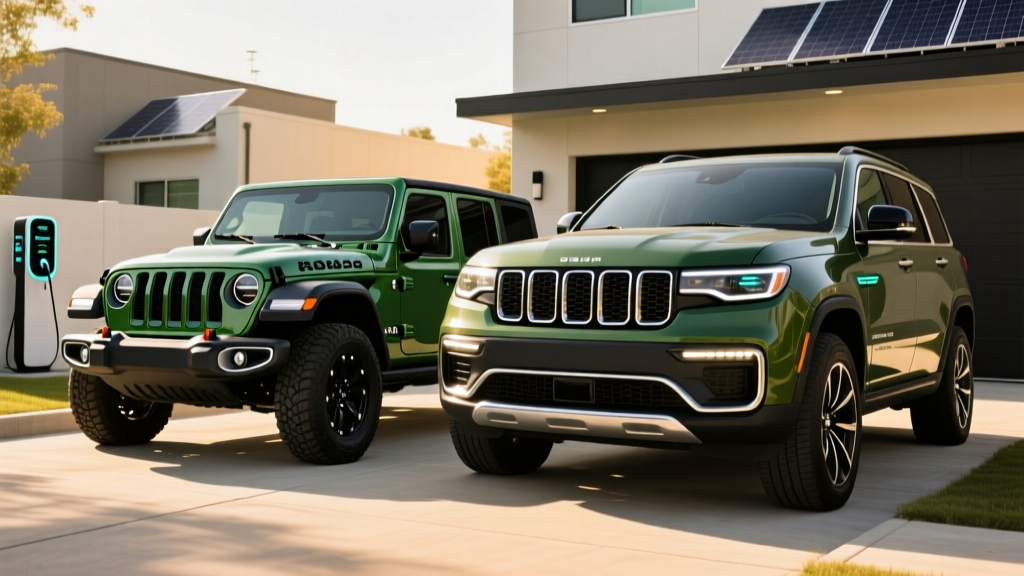
If you're researching a Jeep hybrid in 2026, you're looking at plug-in hybrid (PHEV) territory. Jeep does not currently sell a conventional hybrid (HEV) in the U.S. — every electrified Jeep wears the 4xe badge, meaning it pairs a turbocharged gasoline engine with an electric motor and a battery you can plug in to recharge. The two models that matter are the Wrangler 4xe and the Grand Cherokee 4xe. Both offer short electric-only commutes, serious off-road capability, and a safety net of gas-engine range for longer trips.
This guide breaks down exactly what each Jeep hybrid delivers — EPA MPG, electric-only range, battery capacity, charging times, real-world efficiency, pricing, and federal tax credit eligibility — so you can decide which one fits your driving pattern, or whether a full EV or conventional gas model makes more sense.
HEV vs. PHEV: What Jeep's 4xe System Actually Is
Before diving into specs, it's worth clarifying the terminology because it trips up many shoppers.
Conventional Hybrid (HEV)
A conventional hybrid like the Toyota RAV4 Hybrid uses a small battery (typically 1–2 kWh) that recharges through regenerative braking and the gas engine. You never plug it in. Electric-only driving is limited to very low speeds for short distances. Think of it as a gas car that's more efficient.
Plug-In Hybrid (PHEV) — Jeep 4xe
A PHEV like the Wrangler 4xe or Grand Cherokee 4xe carries a much larger battery (17.3 kWh usable) and a more powerful electric motor. You plug it in to recharge (Level 1 or Level 2). It can drive 22–25 miles on electricity alone at highway speeds before the gas engine kicks in. Think of it as a short-range EV with a gas backup.
Jeep's 4xe system uses a 2.0-liter turbocharged inline-4 engine mated to an electric motor integrated into the 8-speed automatic transmission. Combined output is 375 horsepower and 470 lb-ft of torque in both the Wrangler and Grand Cherokee. The system can operate in three modes:
- Electric: Battery-only driving until the pack is depleted or you floor it.
- Hybrid: The default — the system blends electric and gas for maximum efficiency.
- e-Save: Reserves battery charge for later (useful if you want electric mode for a city destination after a highway stretch).
2026 Jeep Wrangler 4xe: MPG, Electric Range, and Specs
The Wrangler 4xe remains one of the best-selling PHEVs in the U.S., and for good reason: it's a genuinely capable off-roader that can also do your weekday commute on electricity. Here's what the numbers look like for the current model year.
| Powertrain | 2.0L turbo I-4 + electric motor, 8-speed auto, 4WD |
| Combined Output | 375 hp / 470 lb-ft torque |
| Battery (usable) | 17.3 kWh, NMC lithium-ion |
| EPA Electric-Only Range | 22 miles |
| EPA Combined (gas-only, after depletion) | 20 MPG |
| MPGe (combined, with full charge) | 49 MPGe |
| Total Range (gas + electric) | ~370 miles |
| Level 2 Charging (0–100%) | ~2 hours at 7.2 kW |
| DC Fast Charging | Not available |
| 0–60 mph | ~6.0 seconds |
| Towing Capacity | 3,500 lbs |
| Base MSRP (Willys 4xe) | $51,790 |
Real-World Range vs. EPA Sticker
The EPA rates the Wrangler 4xe at 22 miles of electric-only range. In real-world driving, expect 18–20 miles in mixed conditions and as little as 14–16 miles in cold weather (below 35°F) or sustained highway speeds above 70 mph. The boxy aerodynamics and 5,000+ lb curb weight work against efficiency. On gas only, owners report 18–21 MPG in mixed driving — close to the EPA's 20 MPG combined figure. City driving at lower speeds can push this slightly higher thanks to regenerative braking.
2026 Jeep Grand Cherokee 4xe: MPG, Electric Range, and Specs
If the Wrangler is the rugged icon, the Grand Cherokee 4xe is the refined family hauler. It shares the same powertrain architecture but benefits from better aerodynamics and a more car-like platform, translating to slightly better electric range and fuel economy.
| Powertrain | 2.0L turbo I-4 + electric motor, 8-speed auto, 4WD |
| Combined Output | 375 hp / 470 lb-ft torque |
| Battery (usable) | 17.3 kWh, NMC lithium-ion |
| EPA Electric-Only Range | 25 miles |
| EPA Combined (gas-only, after depletion) | 23 MPG |
| MPGe (combined, with full charge) | 56 MPGe |
| Total Range (gas + electric) | ~440 miles |
| Level 2 Charging (0–100%) | ~2 hours at 7.2 kW |
| DC Fast Charging | Not available |
| 0–60 mph | ~6.0 seconds |
| Towing Capacity | 6,000 lbs (properly equipped) |
| Base MSRP (4xe) | $61,690 |
Real-World Range vs. EPA Sticker
The Grand Cherokee 4xe earns an EPA rating of 25 miles electric-only. Real-world testing typically yields 21–24 miles in mild weather with mixed driving. Highway-only trips at 75+ mph may drop this to 17–19 miles. Cold weather reduces it further. On gas alone, owners consistently report 22–25 MPG combined, with city driving occasionally reaching 26–27 MPG thanks to regen braking — slightly above the EPA estimate.
Charging the Jeep 4xe: What You Need to Know
Both Jeep 4xe models use a J1772 connector for AC charging and do not support DC fast charging. This is a deliberate design choice — the 17.3 kWh battery is small enough that Level 2 charging fills it quickly, and Jeep likely avoided the cost and weight of DC fast-charge hardware.
| Charging Level | Power | 0–100% Time | Miles of Range Added per Hour |
|---|---|---|---|
| Level 1 (120V household outlet) | ~1.4 kW | ~12–14 hours | ~2 miles/hr |
| Level 2 (240V home or public) | 7.2 kW | ~2 hours | ~12 miles/hr |
| DC Fast Charging | N/A | N/A | Not supported |
For most owners, overnight Level 1 charging from a standard 120V outlet is sufficient to replenish the battery for a 22–25 mile electric commute. However, a Level 2 home charger (240V, 32–40 amp circuit) is recommended if you want a full charge in roughly 2 hours — useful for mid-day top-ups or if you share the outlet with another EV. A Level 2 home installation typically costs $500–$1,500 for equipment and electrician labor, depending on your panel capacity and run distance.
Pricing, Trims, and Federal Tax Credit Eligibility
Pricing for the Jeep 4xe lineup starts in the low $50Ks for the Wrangler and low $60Ks for the Grand Cherokee, before any incentives. Here's how the current federal tax credit landscape applies.
Does the Jeep 4xe Qualify for the Federal EV Tax Credit?
Under the IRS §30D Clean Vehicle Credit, new PHEVs can qualify for up to $7,500 — but eligibility depends on several factors that change frequently:
- MSRP Cap: SUVs (both Wrangler and Grand Cherokee qualify as SUVs) must have an MSRP under $80,000. Most 4xe trims fall under this cap, but fully loaded Grand Cherokee Summit Reserve 4xe models may approach or exceed it.
- Buyer Income Cap: Modified adjusted gross income must not exceed $150,000 (single), $225,000 (head of household), or $300,000 (joint).
- Battery Sourcing Requirements: The vehicle must meet critical minerals and battery component sourcing thresholds that tighten annually. Jeep's 4xe battery supply chain has been affected by these rules — eligibility can change mid-year.
- North American Assembly: Both models are assembled in the U.S. (Toledo, OH for Wrangler; Detroit, MI for Grand Cherokee), satisfying this requirement.
- Point-of-Sale Transfer: As of 2024, eligible buyers can transfer the credit to the dealer for an upfront price reduction at purchase rather than waiting to claim it on their tax return.
Important: Verify current eligibility on IRS.gov and fueleconomy.gov before purchasing. Battery sourcing rules have disqualified and re-qualified several PHEVs since 2023, and the credit amount can be $3,750 (partial) or $7,500 (full) depending on whether one or both sourcing thresholds are met.
Reliability, Battery Warranty, and Replacement Costs
Hybrid and PHEV battery longevity is consistently the top concern for buyers moving from a conventional gas vehicle. Here's what Jeep offers and what the data shows.
Jeep 4xe Battery & Powertrain Warranty
- High-Voltage Battery: 8 years / 100,000 miles (whichever comes first)
- Powertrain (engine, transmission, motor): 5 years / 60,000 miles
- Bumper-to-Bumper: 3 years / 36,000 miles
- Capacity Retention Threshold: Stellantis covers the battery if it falls below approximately 70% of original capacity during the warranty period.
The 17.3 kWh NMC battery in the 4xe system is liquid-cooled, which helps manage thermal degradation — a key factor in battery longevity. Based on data from earlier 4xe models now reaching 80,000+ miles, reported capacity loss is typically in the 5–10% range over the first 3–4 years, which is within normal expectations for NMC chemistry.
Battery Replacement Cost
Out-of-warranty replacement for the 4xe high-voltage battery currently runs $7,000–$10,000 including parts and labor, based on dealer estimates. This is a worst-case scenario — the vast majority of PHEV batteries outlast their warranty periods with meaningful capacity remaining. For context, the Toyota Prius (a conventional hybrid with a smaller battery) has demonstrated battery lifespans exceeding 150,000 miles with gradual degradation.
Reliability for the 4xe powertrain has been mixed in owner surveys. The electric motor and battery system have been largely trouble-free, but the 2.0L turbo engine and 8-speed transmission have drawn some complaints related to software glitches and rough shifting in early model years (2021–2023). Jeep has issued several software updates to address these issues, and 2025–2026 models benefit from these refinements. Check NHTSA.gov for any open recalls on specific model years.
Jeep Hybrid vs. Full EV vs. Gas: Which Is Right for You?
The 4xe occupies a specific niche. Here's a decision framework to determine whether it fits your situation.
Choose the Jeep 4xe (PHEV) if:
- Your daily commute is under 25 miles round-trip and you can charge at home overnight.
- You want genuine off-road capability (Wrangler) or towing capacity (Grand Cherokee) that most EVs can't match.
- You take regular road trips to areas with sparse charging infrastructure.
- You want to reduce fuel consumption without committing to a full EV.
Choose a Full EV (like the Rivian R1S or Tesla Model X) if:
- Your daily driving exceeds 30 miles and you want zero gas use.
- You have reliable home and workplace charging.
- You want the lowest per-mile fuel cost and minimal maintenance.
- You don't need hardcore off-road articulation or 6,000+ lb towing.
Choose a Conventional Gas Jeep if:
- You can't charge at home (no garage, no outlet access).
- Your budget is tighter — gas Wranglers start ~$15,000 less than the 4xe.
- You drive very few miles annually, so fuel savings won't offset the PHEV price premium.
Ownership Cost Snapshot: Wrangler 4xe vs. Gas Wrangler
| Category | Wrangler 4xe (PHEV) | Wrangler Gas (2.0L Turbo) |
|---|---|---|
| Purchase Price (base, before credit) | $51,790 | $36,590 |
| Federal Tax Credit | Up to –$7,500 | $0 |
| Effective Purchase Price | ~$44,290 | $36,590 |
| Fuel / Electricity (5 yrs) | ~$5,200 | ~$9,400 |
| Maintenance (5 yrs) | ~$3,000 | ~$3,800 |
| Insurance (5 yrs) | ~$9,500 | ~$8,200 |
| Estimated 5-Yr Total | ~$61,990 | ~$57,990 |
The 4xe narrows the cost gap significantly when the federal credit applies, and fuel savings of $4,000–$5,000 over 5 years are realistic if you charge regularly. Insurance tends to run 10–15% higher on the PHEV due to the more complex powertrain and higher replacement cost.
Pros — Jeep 4xe
- 22–25 miles of electric-only driving covers most commutes
- 375 hp / 470 lb-ft delivers strong acceleration
- Unmatched off-road capability in the PHEV segment (Wrangler)
- Gas engine eliminates range anxiety on road trips
- Qualifies for HOV lane access in several states
- Potential $7,500 federal tax credit + point-of-sale transfer
Cons — Jeep 4xe
- Gas-only MPG (20–23 combined) is poor once the battery is depleted
- No DC fast charging — road trip top-ups are slow
- High starting price vs. gas-only equivalents
- Electric range drops significantly in cold weather
- Added weight from battery affects handling and braking feel
- Tax credit eligibility is subject to sourcing-rule changes
Frequently Asked Questions
How many MPG does the Jeep hybrid get?
The Wrangler 4xe gets 20 MPG combined on gas after the battery is depleted, and 49 MPGe when factoring in electric driving. The Grand Cherokee 4xe gets 23 MPG combined on gas and 56 MPGe with electric driving. In real-world use, city driving can push gas-only MPG 1–3 MPG above the EPA estimate thanks to regenerative braking, while sustained highway driving at 75+ mph may drop it 1–2 MPG below.
How far can the Jeep 4xe go on electric only?
The Wrangler 4xe is EPA-rated for 22 miles of electric-only driving; the Grand Cherokee 4xe for 25 miles. Real-world range depends on temperature, speed, and terrain — expect 18–24 miles in normal conditions and 14–18 miles in freezing weather or at sustained highway speeds.
Does the Jeep 4xe qualify for the $7,500 federal tax credit?
It can, but eligibility depends on current-year IRS rules around battery sourcing, buyer income, and MSRP caps. Both models are assembled in the U.S. and fall under the $80,000 SUV MSRP cap in most trims. Check fueleconomy.gov for the most up-to-date qualification status before purchasing, as sourcing-rule changes can shift eligibility.
Is the Jeep 4xe reliable, and what does battery replacement cost?
The 4xe's electric motor and battery system have been largely reliable. Early model years (2021–2023) had some software and transmission complaints, but these have been addressed through updates. The high-voltage battery is warrantied for 8 years/100,000 miles. Out-of-warranty battery replacement is estimated at $7,000–$10,000, though most PHEV batteries retain usable capacity well beyond their warranty period.
Do I need to plug in the Jeep 4xe?
Yes — to get the benefit of the electric-only range, you should plug in regularly. If you never plug it in, the 4xe functions as a heavy, less-efficient gas vehicle (20–23 MPG combined). The vehicle will still drive without plugging in, but you'll miss the entire point of the PHEV system. If you can't charge at home, a conventional gas Jeep or a standard HEV from another brand may be a better fit.
Can the Jeep 4xe use DC fast chargers?
No. The 4xe only supports AC charging via J1772 — Level 1 (120V) or Level 2 (240V). A full Level 2 charge takes about 2 hours. This is adequate for home and workplace charging but means you cannot quickly top up on a road trip the way a full EV can.
Hybrid vs. PHEV vs. EV — which should I choose?
If your commute is under 25 miles, you can charge at home, and you need off-road or towing capability, the Jeep 4xe (PHEV) is a strong fit. If you want zero gas use and have good charging access, consider a full EV like the Rivian R1S. If you can't charge at home at all, a conventional hybrid (HEV) from Toyota or Honda — or a gas-only Jeep — makes more sense, since PHEVs that are never plugged in waste their efficiency advantage.