The Only Plug-In Hybrid Wrangler: What the 4xe Actually Delivers
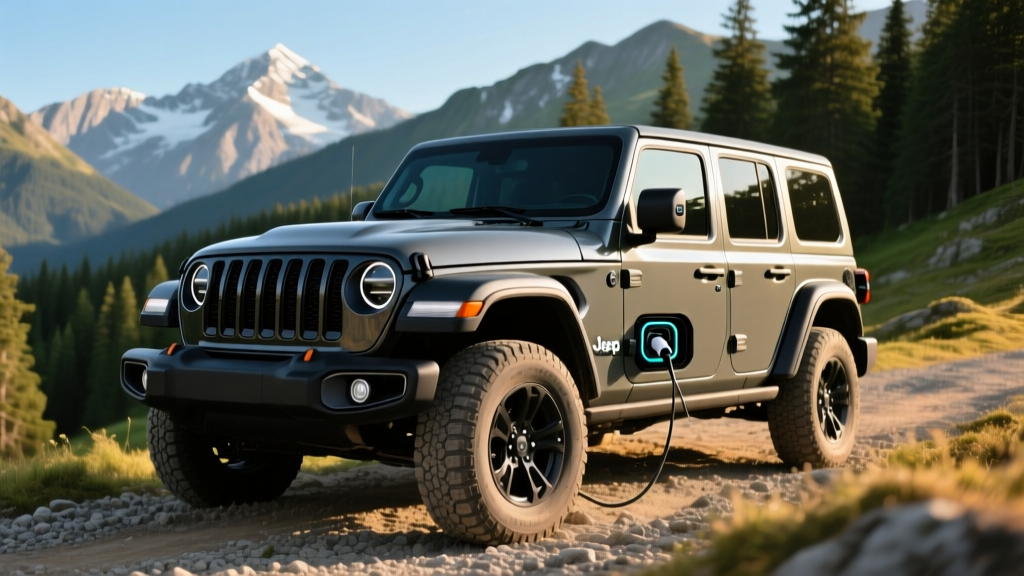
The Jeep Wrangler 4xe (pronounced "four-by-e") remains the sole electrified option in the Wrangler lineup for 2026, and it occupies a specific niche: a body-on-frame off-roader that can handle daily commuting on electric power before its turbocharged gas engine kicks in. If you've been searching for a hybrid Jeep Wrangler, the 4xe is the model — but it's a plug-in hybrid (PHEV), not a conventional hybrid, and that distinction matters for how you'll use it.
This review breaks down the 2026 Wrangler 4xe's real-world efficiency, electric-only range, charging behavior, powertrain specs, pricing, and federal tax credit eligibility. We'll also address the question every PHEV shopper asks: does plugging in actually save you money, or are you better off with a gas Wrangler or a full EV?
HEV vs. PHEV: Why the Wrangler 4xe Is a Plug-In, Not a Standard Hybrid
Conventional Hybrid (HEV)
A conventional hybrid like the Toyota RAV4 Hybrid uses a small battery (1-2 kWh) that charges exclusively through regenerative braking and the gas engine. You never plug it in. Electric-only driving is limited to brief low-speed moments. Expect 35-40 MPG combined in a typical SUV.
Plug-In Hybrid (PHEV) — Wrangler 4xe
The Wrangler 4xe carries a 17.3 kWh battery pack (usable capacity approximately 14.0 kWh) that you charge via a plug — either a standard 120V outlet or a 240V Level 2 charger. That larger battery enables a genuine electric-only driving range before the 2.0L turbo engine engages. Once the battery is depleted, it operates as a conventional hybrid.
There is no conventional HEV version of the Wrangler. If you want an electrified Wrangler, the 4xe PHEV is the only option. Jeep's mild-hybrid eTorque system, previously available on V6 Wranglers, was discontinued after the 2023 model year and provided negligible electric assist — it was not a true hybrid.
Fuel Economy: EPA MPG, MPGe, and Real-World Expectations
The EPA rates the 2026 Wrangler 4xe using two metrics: MPGe (miles per gallon equivalent) when operating on combined electric and gas power, and standard MPG once the battery is depleted and it runs as a hybrid.
| Metric | City | Highway | Combined |
|---|---|---|---|
| Charge-depleting (MPGe) | — | 49 MPGe | |
| Charge-sustaining (MPG) | 20 MPG | 20 MPG | 20 MPG |
| Electric-only range | 22 miles (EPA) | ||
| Total range (electric + gas) | ~370 miles | ||
Real-world MPG reality check: The 20 MPG combined figure in charge-sustaining mode is honest for a 5,000+ lb box-on-frame vehicle with the aerodynamics of a brick. On the highway at 75 mph, expect 18-19 MPG. Around town in hybrid mode, you may see 21-22 MPG thanks to regenerative braking. The key efficiency win comes from daily commutes under 22 miles, where you might burn zero gasoline for weeks at a time — provided you plug in nightly.
If you never plug the 4xe in, you're carrying 800+ lbs of battery and electric motor hardware for no benefit, and you'll get the same ~20 MPG as a gas Wrangler with the 2.0L turbo — arguably worse, given the added weight. Plug-in hybrids only deliver their efficiency advantage when you actually plug them in.
Real-world expectation: 18-20 miles in mixed driving; 14-16 miles at sustained highway speeds or in cold weather (below 35°F). The Wrangler's solid axles, aggressive tires, and flat frontal area work against electric efficiency more than in any car-based PHEV.
Powertrain: 375 Horsepower from a Turbo-Four and Two Electric Motors
| Gas engine | 2.0L turbocharged inline-4 |
| Engine output | 270 hp / 295 lb-ft torque |
| Electric motors | Two: one integrated in the 8-speed transmission (P2), one engine-mounted (P0 for start/stop and regen) |
| Electric motor output | 134 hp / 181 lb-ft (P2 motor) |
| Combined system output | 375 hp / 470 lb-ft torque |
| Transmission | TorqueFlite 8-speed automatic |
| 0-60 mph | ~6.0 seconds |
| Battery pack | 17.3 kWh total / ~14.0 kWh usable, NMC lithium-ion |
| Battery location | Under rear seat (preserves cargo space) |
| Towing capacity | 3,500 lbs |
| Curb weight | ~5,100-5,300 lbs (varies by trim) |
The 470 lb-ft of combined torque is the 4xe's party trick off-road. Electric motors deliver peak torque at zero RPM, giving the 4xe precise low-speed crawling control that a gas-only Wrangler can't match. In Electric mode, the 4xe is eerily quiet on trails — an advantage for wildlife-conscious overlanding and a novelty that never gets old.
The P2 motor sits between the engine and transmission, meaning it routes through the same transfer case and locking differentials as a conventional Wrangler. All 4WD modes (4H, 4L, locking diffs, sway-bar disconnect on Rubicon) function identically whether you're on electric or gas power.
Charging: Level 1, Level 2, and What to Expect
The 2026 Wrangler 4xe uses a J1772 connector for AC charging. It does not support DC fast charging — a common limitation among PHEVs due to smaller battery packs and cost constraints.
| Charging Level | Power (kW) | 0-100% Time | Practical Notes |
|---|---|---|---|
| Level 1 (120V household) | ~1.4 kW | ~12 hours | Overnight charge from a standard outlet; sufficient for daily commuters |
| Level 2 (240V) | ~3.3 kW (onboard charger limited) | ~4.5 hours | Home wallbox or public Level 2; faster but limited by the 4xe's 3.3 kW onboard charger |
| DC Fast Charge | Not supported | ||
The 3.3 kW onboard charger is a bottleneck. Even at a 7.2 kW or 11.5 kW public Level 2 station, the 4xe will only accept 3.3 kW. This is typical for PHEVs — the Toyota RAV4 Prime charges at 3.3 kW as well — but it means you won't top up quickly at a shopping-center charger. Plan your charging around overnight home sessions.
Home charging setup: Most 4xe owners charge on a standard 120V outlet in their garage. At 1.4 kW, replenishing the ~14 kWh usable battery takes roughly 10-12 hours — fine for overnight. If you want faster turnaround, a 240V Level 2 home charger (like a ChargePoint Home Flex or Emporia V2) reduces this to about 4.5 hours, but the investment ($500-$1,200 for equipment plus $300-$800 for electrician installation) may not justify the speed gain for a 22-mile battery. A 120V outlet is usually sufficient.
Pricing, Trims, and Federal Tax Credit Eligibility
The 2026 Jeep Wrangler 4xe is available across multiple trims, each carrying a significant premium over the gas-only equivalent:
| Trim | Starting MSRP |
|---|---|
| Willys 4xe | $51,790 |
| Sport S 4xe | $53,290 |
| Sahara 4xe | $57,790 |
| Rubicon 4xe | $60,790 |
| High Altitude 4xe | $64,290 |
Destination charge of $1,995 additional.
Federal Tax Credit: §30D Eligibility
The 2026 Wrangler 4xe may qualify for up to $3,750 under the IRS §30D Clean Vehicle Credit, but eligibility depends on several factors that change annually:
- MSRP cap: SUVs must be under $80,000 — all 4xe trims qualify.
- Buyer income cap: Modified AGI must not exceed $150,000 (single), $225,000 (head of household), or $300,000 (joint filers).
- Battery sourcing: Critical minerals and battery component requirements phase in annually. The 4xe's battery sourcing determines whether you receive $3,750 (one requirement met) or $7,500 (both met). For 2026, check the latest IRS guidance on qualifying vehicles before purchase.
- Point-of-sale transfer: You can transfer the credit to the dealer at purchase, reducing your out-of-pocket cost immediately rather than waiting for tax filing.
Always confirm current eligibility on fueleconomy.gov and consult a tax professional for your specific situation.
Battery Longevity, Warranty, and Replacement Costs
Wrangler 4xe Hybrid Battery Warranty
Coverage: 8 years / 100,000 miles (whichever comes first)
Capacity threshold: Stellantis warrants the high-voltage battery against defects and excessive capacity loss. While the exact degradation threshold for a warranty claim is typically below 70% of original capacity, confirm specific terms in your purchase documentation.
Estimated replacement cost: $8,000–$12,000 for the high-voltage battery pack out of warranty, based on current PHEV battery replacement pricing. This is a significant figure, but real-world data from 4xe owners (the model launched for 2021) shows minimal degradation reports through the first 4-5 years of ownership.
The 4xe's NMC battery sits under the rear seat, sealed and protected — it does not intrude on cargo space or ground clearance. Thermal management is liquid-cooled, which helps preserve battery health in extreme temperatures. For context, PHEV batteries experience less stress than full EV batteries because they operate in a narrower state-of-charge window (the system maintains a buffer at both the top and bottom), which generally extends cycle life.
Most 4xe owners will trade or sell the vehicle well before the battery requires replacement. If you plan to keep yours past 150,000 miles, budget for the possibility — but the 8-year warranty provides substantial coverage for the ownership period where most issues would surface.
Who Should Buy the Wrangler 4xe — And Who Shouldn't
Choose the Wrangler 4xe if:
- Your daily commute is under 20 miles round-trip and you have access to a garage outlet for overnight charging
- You want genuine off-road capability (solid axles, locking diffs, 4:1 low range) with the quiet torque advantage of electric motors on trails
- You need a removable roof/doors and a fold-down windshield — features no electric SUV offers
- You want to reduce gasoline consumption without range anxiety on road trips into remote areas
- Tax credit eligibility brings the effective price closer to a loaded gas Wrangler
Skip the 4xe and consider alternatives if:
- You cannot charge at home or work — without plugging in, you're hauling dead weight at 20 MPG
- Your priority is maximum fuel savings — a RAV4 Prime (42 mi electric, 38 MPG hybrid) or a full EV like the Ford F-150 Lightning will save far more
- You want three rows or car-like ride quality — the Wrangler's solid-axle architecture trades comfort for capability
- You plan to drive 25,000+ highway miles annually — the 4xe's highway efficiency is poor once the battery depletes
Pros
- 470 lb-ft of instant torque transforms off-road crawling and on-road passing
- 22-mile electric range covers most daily commutes gasoline-free
- Full Wrangler capability retained — 4WD, lockers, sway-bar disconnect, 33"+ tire clearance
- Quieter trail driving in EV mode
- Federal tax credit reduces effective price by $3,750-$7,500
Cons
- Only 22 miles of electric range — shortest among mainstream PHEVs
- 20 MPG hybrid mode is no better than a gas 2.0L Wrangler
- 3.3 kW onboard charger makes public Level 2 charging painfully slow
- $5,000-$8,000 premium over equivalent gas trims
- No DC fast charging capability
- Ride quality and road noise are compromises inherent to the platform
Wrangler 4xe vs. Full EV vs. Gas Wrangler: Which Fits Your Life?
| Vehicle | Type | Electric Range | Combined MPG/MPGe | Starting Price |
|---|---|---|---|---|
| Wrangler 4xe | PHEV | 22 mi | 49 MPGe / 20 MPG | $51,790 |
| Wrangler 3.6L V6 (gas) | Gas | — | 19 MPG | $38,995 |
| Ford F-150 Lightning | BEV | 230-320 mi | 70-77 MPGe | $54,995 |
| Toyota RAV4 Prime | PHEV | 42 mi | 94 MPGe / 38 MPG | $44,915 |
The Wrangler 4xe exists because no full-electric Wrangler is available yet. Stellantis has previewed a battery-electric Wrangler concept but has not announced a production timeline. If you need a Wrangler specifically — the removable doors, the fold-flat windshield, the Dana axles, the aftermarket ecosystem — the 4xe is the only electrified path.
If your needs are broader (daily commuting efficiency, road-trip comfort, low operating cost), the RAV4 Prime offers nearly double the electric range with far better hybrid-mode MPG in a more comfortable package. And if you can charge at home and rarely drive past 250 miles without stopping, a full EV eliminates gasoline entirely.
Frequently Asked Questions
How many MPG does the hybrid Jeep Wrangler get?
The 2026 Wrangler 4xe achieves 49 MPGe combined when operating with a charged battery (blending electric and gas). Once the battery is depleted, it returns 20 MPG combined as a conventional hybrid — 20 city / 20 highway. Real-world highway driving at 75 mph typically yields 18-19 MPG in hybrid mode.
How far can the Wrangler 4xe go on electric power alone?
The EPA rates the 4xe at 22 miles of electric-only range. In real-world conditions, expect 18-20 miles in mixed driving and as low as 14-16 miles in cold weather or at sustained highway speeds. This is enough for short commutes but shorter than most PHEV competitors.
Does the Wrangler 4xe qualify for a federal tax credit?
It may qualify for up to $3,750 or $7,500 under the §30D Clean Vehicle Credit, depending on battery-component and critical-mineral sourcing requirements that update annually. The vehicle meets the $80,000 MSRP cap for SUVs. Buyer income caps apply ($150K single / $300K joint). Confirm eligibility at fueleconomy.gov before purchasing.
Is the Wrangler 4xe reliable, and what does battery replacement cost?
The 4xe has been in production since the 2021 model year, and early data shows typical Stellantis powertrain reliability. The high-voltage battery is warrantied for 8 years / 100,000 miles. Out-of-warranty replacement is estimated at $8,000-$12,000. Most owners will not need a replacement within typical ownership periods, and PHEV batteries generally experience slower degradation than full EV batteries due to smaller charge-discharge cycles.
Do I have to plug the Wrangler 4xe in?
You are not required to, but you should. Without plug-in charging, the 4xe operates solely as a conventional hybrid at 20 MPG — offering zero efficiency advantage over a gas Wrangler while carrying extra weight. The entire value proposition depends on regular plug-in charging, even from a standard 120V household outlet.
Can the Wrangler 4xe use DC fast chargers?
No. The 4xe supports only AC charging: Level 1 (120V, ~1.4 kW) and Level 2 (240V, limited to 3.3 kW by the onboard charger). This is common for PHEVs with smaller battery packs.
How does the 4xe perform off-road compared to a gas Wrangler?
Identically in terms of hardware — same transfer case, same locking differentials, same ground clearance and approach/departure angles. The advantage is electric torque delivery: instant, precise, and silent at low crawling speeds. The 4xe also enables quiet operation in EV mode, which is useful for wildlife observation and reduces trail noise.
Sources: EPA Fuel Economy — Jeep Wrangler 4xe, IRS §30D Clean Vehicle Credit, Jeep.com Wrangler 4xe.