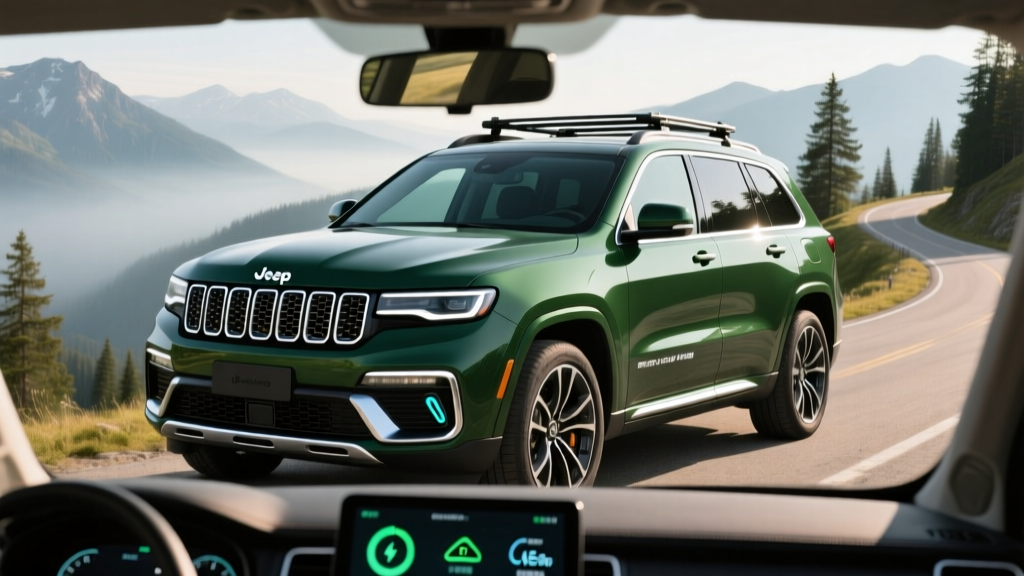
The Jeep Grand Cherokee 4xe occupies a narrow but compelling lane: a midsize, body-on-frame-capable SUV that can run on electricity for your daily commute and burn gas on a weekend trail run. For 2025, the Grand Cherokee plug-in hybrid carries over the powertrain formula introduced with the WL-generation refresh — a 2.0-liter turbocharged four-cylinder paired with two electric motors and a 17.3 kWh battery pack. The result is 375 combined horsepower, an EPA-rated 25 miles of electric-only range, and 56 MPGe when blending electric and gas driving.
But spec sheets only tell part of the story. Below, we break down real-world efficiency, charging logistics, tax-credit eligibility under current IRS §30D rules, and whether this PHEV actually makes financial sense versus a conventional hybrid Grand Cherokee, a full battery-electric SUV, or a gas-only competitor.
HEV vs. PHEV: What Jeep Actually Sells
Before diving into numbers, it's worth clarifying what's in the Grand Cherokee lineup, because Jeep sells two distinct electrified flavors alongside the conventional gas models:
| Attribute | Grand Cherokee (Gas) | Grand Cherokee 4xe (PHEV) |
|---|---|---|
| Powertrain | 3.6L V6 or 2.0L Turbo I4 | 2.0L Turbo I4 + 2 electric motors |
| Plug-in capable? | No | Yes — Level 1 & Level 2 |
| Electric-only range | 0 miles | 25 miles (EPA) |
| Combined output | 293 hp (V6) / 270 hp (I4) | 375 hp / 470 lb-ft |
| Battery | 12V auxiliary only | 17.3 kWh high-voltage pack |
| Starting MSRP (2025) | ~$39,000 | ~$59,490 (4xe base) |
There is no conventional hybrid (HEV) Grand Cherokee for 2025. If you want electrification without plugging in, you'd need to look at a competitor like the Toyota Highlander Hybrid. The 4xe is strictly a plug-in hybrid — meaning it has a larger battery you charge from the grid, plus a gas engine for extended range.
Range, MPGe, and Fuel Economy Breakdown
The EPA rates the 2025 Grand Cherokee 4xe at 25 miles of all-electric range and 56 MPGe (miles per gallon equivalent) when operating in blended electric-gas mode. Once the battery is depleted and the 4xe operates as a conventional hybrid, the EPA rates it at 23 MPG combined.
| Driving Mode | City | Highway | Combined |
|---|---|---|---|
| Electric-only (MPGe) | — | — | 56 MPGe |
| Gas-only (hybrid mode) | 23 MPG | 24 MPG | 23 MPG |
Total combined range — electric plus a full 15.8-gallon gas tank — comes to approximately 440 miles. That's meaningful for road-trip flexibility and eliminates the range anxiety that some full-EV buyers face in rural or cold-weather regions.
On the gas side, the 23 MPG combined hybrid-mode figure is unimpressive for a PHEV. The Grand Cherokee 4xe is a heavy vehicle — over 5,000 pounds — and the 2.0-liter engine is working hard once the battery is spent. For comparison, the Toyota RAV4 Prime achieves 38 MPG combined in hybrid mode. If you frequently drive long distances without charging, the 4xe's fuel economy advantage narrows significantly.
Powertrain and Performance Specs
| Specification | 2025 Grand Cherokee 4xe |
|---|---|
| Engine | 2.0L turbocharged I4 |
| Electric motors | 2 (one integrated in transmission, one on crankshaft) |
| Combined horsepower | 375 hp |
| Combined torque | 470 lb-ft |
| Transmission | 8-speed automatic (TorqueFlite) |
| 0–60 mph | ~6.0 seconds |
| Drivetrain | 4WD standard |
| Towing capacity | 6,000 lbs |
| Battery capacity | 17.3 kWh (total) / ~14 kWh usable |
| Battery chemistry | NMC (nickel manganese cobalt) |
The 375-hp combined output makes the 4xe the most powerful non-SRT Grand Cherokee. Torque delivery is immediate thanks to the electric motors, which gives the 4xe a surprisingly responsive feel around town — especially in Electric mode where the gas engine stays dormant. The 8-speed automatic manages the transition between electric and gas power smoothly in most conditions, though you may notice a slight hesitation during hard acceleration requests when the system is deciding whether to engage the engine.
Notably, the 4xe retains Jeep's Quadra-Trac II 4WD system and available air suspension, so off-road capability isn't sacrificed for electrification. The battery pack is mounted under the rear cargo floor, which preserves ground clearance but does eliminate the spare tire (a tire-inflator kit is included).
Charging: Speeds, Equipment, and Logistics
The Grand Cherokee 4xe uses a standard J1772 connector for Level 1 and Level 2 AC charging. There is no DC fast-charging capability — this is common among PHEVs, which have smaller batteries that don't justify the added cost and weight of DC hardware.
| Charging Level | Power | Time (0–100%) | Notes |
|---|---|---|---|
| Level 1 (120V household outlet) | ~1.4 kW | ~10–12 hours | Adequate for overnight top-off |
| Level 2 (240V home/public) | ~7.2 kW (max onboard charger) | ~2.5–3 hours | Recommended for daily use |
| DC Fast Charge | Not supported | N/A | — |
For most PHEV owners, Level 1 charging from a standard 120V outlet is actually sufficient. The 17.3 kWh battery is small enough that an overnight plug (10–12 hours) will fully replenish it. However, a Level 2 home charger is ideal if you want to top off midday or have a shorter overnight window. A basic Level 2 home station (24–40 amp) costs $300–$600 for equipment, with installation running $500–$2,000 depending on your electrical panel's proximity to the parking spot — factor in a potential $1,000–$3,000 panel upgrade if you're running an older 100-amp service.
Jeep provides access to public Level 2 charging via partner networks, and the 4xe is compatible with any J1772-equipped public station. Just don't expect to pull up to a DC fast charger — you'll need an adapter for NACS or CCS stations, and even then, only Level 2 AC will function.
Pricing, Trims, and Federal Tax Credit Eligibility
The 2025 Grand Cherokee 4xe starts at $59,490 (including destination) for the base 4xe trim. Higher trims push the price significantly:
- 4xe (base): ~$59,490
- 4xe Trailhawk: ~$67,000
- 4xe Overland: ~$69,000
- 4xe Summit Reserve: ~$78,000+
- Maximum credit: Up to $3,750 for the Grand Cherokee 4xe (partial credit — it may not meet all critical-minerals and battery-component sourcing requirements for the full $7,500)
- MSRP cap: SUVs must be under $80,000 — most 4xe trims qualify, but the Summit Reserve may exceed this threshold depending on options
- Buyer income cap: AGI must not exceed $150,000 (single) / $300,000 (joint)
- Battery sourcing: Critical-mineral and battery-component requirements phase in stricter percentages each year; check current IRS eligible vehicle list before purchasing
- Point-of-sale transfer: Eligible buyers can transfer the credit to the dealer at purchase, reducing the purchase price directly
The tax credit situation for the Grand Cherokee 4xe is fluid. Battery-sourcing rules under the Inflation Reduction Act tightened significantly in 2024 and 2025, and many PHEVs have seen their credit eligibility reduced or eliminated depending on the production batch. Always verify the specific VIN's eligibility on the IRS qualified vehicles list and consult a tax professional before counting on a specific credit amount. State-level incentives vary widely and may add $1,000–$4,000 depending on your jurisdiction — check your state energy office for current programs.
Battery Longevity, Warranty, and Replacement Costs
Plug-in hybrid batteries are smaller and less stressed than full-EV packs, which generally translates to better longevity. The NMC chemistry in the 4xe is well-understood, and the thermal management system keeps the pack within optimal temperature ranges. Based on data from earlier Jeep PHEV models (Wrangler 4xe, Pacifica Hybrid), significant degradation in the first 5 years is uncommon — most owners report 90%+ capacity retention at year three.
If the battery does need replacement out of warranty, expect a cost in the range of $6,000–$9,000 for the pack itself, plus $1,000–$2,000 in labor. This is considerably less than a full-EV battery replacement (which can exceed $15,000–$20,000) because the pack is smaller. However, it's still a meaningful expense to budget for if you plan to keep the vehicle past the 8-year/100,000-mile mark.
Reliability data for the 4xe powertrain is mixed. The engine and transmission are proven components, but the added complexity of the hybrid system — dual electric motors, high-voltage wiring, power electronics — introduces more potential failure points than a conventional gas drivetrain. Jeep's brand-level reliability scores from Consumer Reports and J.D. Power tend to fall in the below-average to average range. Buyers should weigh this against the warranty coverage and consider an extended powertrain warranty for long-term ownership.
Who Should Buy the Grand Cherokee 4xe?
Choose the Grand Cherokee 4xe if:
- Your daily commute is under 25 miles and you can charge at home overnight
- You need 6,000-lb towing capacity and genuine 4WD capability
- You take regular road trips where EV charging infrastructure is sparse
- You want electric-mode driving without committing to a full BEV
Look elsewhere if:
- Your commute exceeds 30 miles one-way — the electric range won't cover it, and hybrid-mode MPG is mediocre
- You don't have access to home or workplace charging — without plugging in, you're just driving a heavy, expensive gas SUV
- You prioritize fuel efficiency above all — the RAV4 Prime or Hyundai Tucson PHEV deliver far better MPG
- You want three rows of seating — the 4xe is only available in the two-row Grand Cherokee (the three-row Grand Cherokee L does not offer a PHEV variant)
- 375 hp and 470 lb-ft — genuinely quick for a midsize SUV
- Real 4WD with low-range capability (Trailhawk)
- 25-mile electric range covers most daily commutes
- 6,000-lb towing — rare for a PHEV
- Premium interior on upper trims
- 23 MPG hybrid-mode is poor for a PHEV
- No DC fast charging
- High starting price ($59,490+)
- Tax credit eligibility uncertain and reduced
- Below-average brand reliability ratings
- Heavy curb weight (5,200+ lbs) hurts efficiency
Grand Cherokee 4xe vs. Full EV vs. Gas SUV
Where does the 4xe sit in the broader buying decision? Here's a practical comparison framework:
| Factor | Grand Cherokee 4xe (PHEV) | Full EV (e.g., Rivian R1S) | Gas SUV (e.g., Grand Cherokee V6) |
|---|---|---|---|
| Starting price | $59,490 | $75,900+ | ~$39,000 |
| Daily electric commuting | Yes (25 mi) | Yes (300+ mi) | No |
| Road-trip flexibility | Excellent (440 mi total) | Requires charging stops | Excellent |
| Towing | 6,000 lbs | 7,700 lbs | 6,200 lbs |
| Fuel cost (annual, 12k mi) | ~$1,200–$1,800 | ~$500–$800 | ~$2,200–$2,800 |
| Maintenance complexity | High (two powertrains) | Low | Moderate |
The 4xe makes the most sense as a bridge vehicle — for buyers who want some electric driving today but aren't ready to depend entirely on charging infrastructure. If your lifestyle includes frequent towing, off-road use, and long rural drives, the PHEV compromise is genuinely practical. If your driving is mostly suburban and you have reliable home charging, a full EV will deliver lower operating costs and a smoother driving experience over time.
Frequently Asked Questions
How many MPG does the Grand Cherokee 4xe get?
The EPA rates the 2025 Grand Cherokee 4xe at 56 MPGe in blended electric-gas mode and 23 MPG combined (23 city / 24 highway) once the battery is depleted and it operates as a conventional hybrid. In real-world driving, owners report hybrid-mode MPG between 21–25 depending on driving style, terrain, and temperature. The 23 MPG figure is modest — this is a heavy SUV with a turbocharged engine doing a lot of work.
How far can the Grand Cherokee 4xe go on electric only?
The EPA rates it at 25 miles of all-electric range. In real-world conditions, expect 18–22 miles in cold weather and up to 27–28 miles in mild conditions with gentle city driving. Highway speeds above 65 mph reduce electric range to roughly 17–19 miles. The electric top speed is approximately 75 mph, so it's fully usable on freeways — just not for very long.
Does the Grand Cherokee 4xe qualify for a federal tax credit?
Possibly, but the amount is uncertain. Under current IRS §30D rules, the 4xe may qualify for a partial credit of up to $3,750, depending on battery-sourcing compliance at the time of manufacture. The full $7,500 credit requires meeting both critical-mineral and battery-component thresholds that have become stricter each year. Additionally, buyer income caps ($150K single / $300K joint) and the $80,000 SUV MSRP cap apply. Always verify eligibility on the IRS qualified vehicles list and consult a tax professional before purchasing.
Is the Grand Cherokee 4xe reliable?
Reliability is a mixed picture. The 2.0L turbo engine and 8-speed transmission are proven components, but the hybrid system adds complexity — dual electric motors, high-voltage electronics, and additional cooling circuits. Jeep as a brand scores below average in most reliability surveys (Consumer Reports, J.D. Power). The 8-year/100,000-mile hybrid component warranty provides a safety net, but buyers planning long-term ownership should consider an extended warranty. Common issues reported by early 4xe owners include software glitches in the powertrain control module and occasional rough transitions between electric and gas modes.
What does it cost to replace the 4xe battery?
Out-of-warranty high-voltage battery replacement for the Grand Cherokee 4xe is estimated at $6,000–$9,000 for the pack, plus $1,000–$2,000 in labor. This is less expensive than a full-EV battery replacement thanks to the smaller 17.3 kWh pack. However, battery failure before the 8-year/100,000-mile warranty expires is rare based on data from similar Stellantis PHEV systems.
Can the Grand Cherokee 4xe charge at a Tesla Supercharger?
No. The 4xe only supports AC Level 1 and Level 2 charging via a J1772 connector. Tesla Superchargers (and all other DC fast-charging networks) deliver DC power, which the 4xe's onboard systems cannot accept. You can use any J1772-equipped public Level 2 station, including ChargePoint, EVgo Level 2, and Electrify America Level 2 chargers.
Hybrid vs. PHEV vs. EV — which should I choose?
If you can charge at home and your daily driving is under 25 miles, the 4xe PHEV lets you commute on electricity while keeping gas-engine flexibility for road trips. If you never want to plug in, a conventional hybrid (not available in the Grand Cherokee — look at the Toyota Highlander Hybrid) offers better gas-only MPG. If you have reliable home charging, rarely drive more than 250 miles in a day, and want the lowest operating cost, a full EV like the Hyundai Ioniq 5 or Ford Explorer EV will serve you better long-term. The PHEV is a bridge — excellent for some buyers, but a compromise for those who could fully commit to either gas or electric.
Sources: EPA fuel economy data via fueleconomy.gov; IRS §30D qualified vehicle list via irs.gov; Jeep Grand Cherokee 4xe specifications via jeep.com.