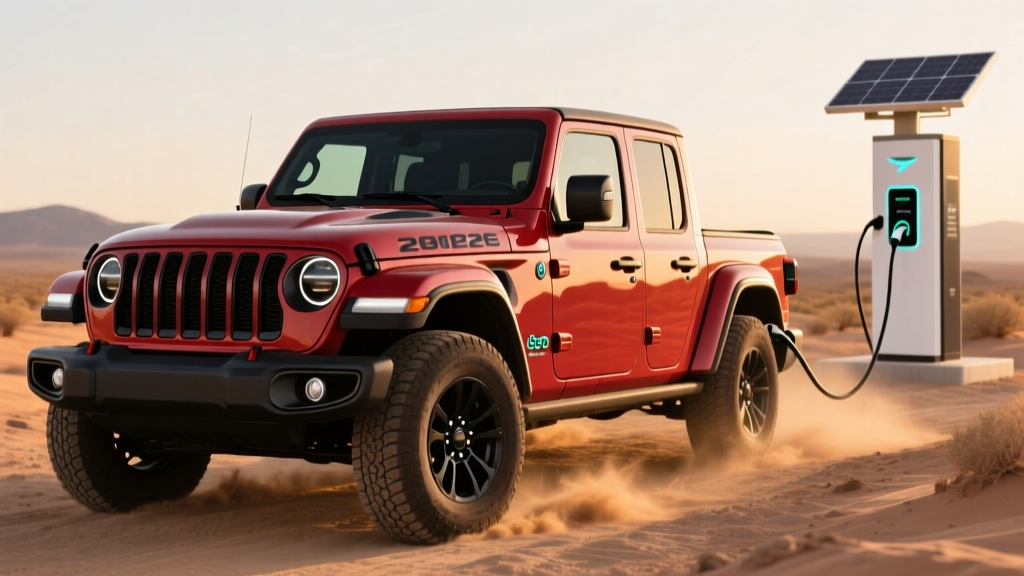
The midsize pickup truck segment has resisted electrification longer than almost any other. That changes with the Jeep Gladiator hybrid — officially the Gladiator 4xe — a plug-in hybrid (PHEV) variant of Jeep's body-on-frame truck that pairs a turbocharged engine with an electric motor and a battery pack you can charge from a wall outlet. If you've been watching the Wrangler 4xe carve out a niche as the best-selling PHEV in America, the Gladiator 4xe applies that same formula to a truck bed, a tow hitch, and a 5-foot cargo box.
But a PHEV pickup raises unique questions. Can you actually tow on electric power? How much range do you lose with a heavy payload? Does the battery compromise ground clearance on the Rubicon trim? This guide breaks down every spec that matters — EPA MPG, electric-only range, battery capacity, tow ratings, and federal tax credit eligibility — so you can decide whether the Gladiator hybrid fits your driveway or whether a full EV truck or a conventional gas model makes more sense.
HEV vs PHEV: What the Gladiator 4xe Actually Is
Before diving into specs, it's worth clarifying the terminology, because "hybrid" gets thrown around loosely. The Gladiator 4xe is a plug-in hybrid electric vehicle (PHEV), not a conventional hybrid (HEV) like a Toyota Prius.
| Feature | Conventional Hybrid (HEV) | Plug-In Hybrid (PHEV) — Gladiator 4xe |
|---|---|---|
| Plug-in charging? | No — charges via regen & engine | Yes — Level 1 (120V) and Level 2 (240V) |
| Electric-only driving | Minimal (1-2 mi at low speed) | ~25-28 mi EPA-estimated |
| Battery size | 1-2 kWh | 17.3 kWh (usable ~14.5 kWh) |
| Federal tax credit | None | Up to $3,750 (§30D, if eligible) |
| Gas engine always available | Yes | Yes — seamless hybrid operation |
The distinction matters for two reasons. First, a PHEV gives you a genuine electric-only commute window — enough for many daily errands without burning a drop of gas. Second, PHEVs can qualify for a partial federal tax credit under IRS §30D rules, while conventional hybrids cannot. The Gladiator hybrid is not an HEV, and it does require access to a plug if you want to capture its full efficiency benefit.
Powertrain: Turbo Four, Electric Motor, and Combined Output
The Gladiator 4xe uses a powertrain architecture shared with the Wrangler 4xe, adapted for the truck's longer wheelbase and higher tow rating:
| Specification | Gladiator 4xe (2026) |
|---|---|
| Engine | 2.0L turbocharged inline-4 |
| Electric motor | Integrated into 8-speed automatic transmission |
| Combined horsepower | 375 hp |
| Combined torque | 470 lb-ft |
| Transmission | TorqueFlite 8-speed automatic |
| Drivetrain | 4WD (Selec-Trac or Rock-Trac on Rubicon) |
| 0-60 mph (est.) | ~6.5 seconds |
| Battery chemistry | NMC (nickel manganese cobalt) lithium-ion |
| Battery capacity (gross / usable) | 17.3 kWh / ~14.5 kWh |
The 470 lb-ft of combined torque is the headline figure. That's available nearly instantly from the electric motor at low RPM, which matters both for off-road crawling precision and for towing acceleration from a stop. The 2.0L turbo four-cylinder may sound undersized for a truck, but the electric motor fills in the torque gap that a smaller displacement engine would otherwise leave.
EPA MPG, Electric-Only Range, and Real-World Efficiency
Fuel economy is where the Gladiator hybrid diverges most sharply from its gas-only sibling. Here's the EPA-estimated breakdown:
| Driving Mode | EPA Estimate | Real-World Expectation |
|---|---|---|
| Combined (hybrid, battery depleted) | ~22 MPG | 20-23 MPG (varies with load, terrain) |
| City (hybrid mode) | ~23 MPG | 24-26 MPG (regen recaptures more in stop-and-go) |
| Highway (hybrid mode) | ~21 MPG | 18-20 MPG (aero drag dominates at 70+ mph) |
| Combined MPGe (charge-sustaining + electric) | ~49 MPGe | Depends on how often you charge |
| Electric-only range | ~25-28 miles | 20-25 mi (highway, cold weather reduces to ~16-20 mi) |
| Total combined range | ~370-400 miles | ~340-380 mi with mixed driving |
The key efficiency insight for PHEV owners: your actual MPG depends almost entirely on your charging habits. If you have a 15-mile one-way commute and charge every night, you may burn almost zero gasoline on weekdays. If you never plug in, you're driving a heavy conventional hybrid that returns low-20s MPG — still better than the gas Gladiator's ~19 MPG combined, but not transformative.
Hybrids typically outperform their EPA city estimates because regenerative braking recovers energy in stop-and-go traffic that a gas vehicle wastes as heat. The Gladiator 4xe follows this pattern: expect city MPG to slightly exceed the sticker, while highway efficiency falls short due to the truck's boxy aerodynamics and weight.
Charging: Level 1, Level 2, and What You Need at Home
The Gladiator 4xe battery can be charged two ways at home. It does not support DC fast charging — a limitation common to most PHEVs due to their smaller battery packs and cost constraints.
| Charging Level | Power | 0-100% Time | Setup |
|---|---|---|---|
| Level 1 (120V household outlet) | ~1.4 kW | ~12-14 hours | Standard outlet — included cord |
| Level 2 (240V, 32A) | ~7.7 kW | ~2.5-3 hours | Requires dedicated circuit or wall charger |
For most PHEV owners, Level 1 charging is actually sufficient. The 17.3 kWh battery is small enough that an overnight plug into a standard 120V garage outlet will replenish a full day's electric range. Level 2 becomes worthwhile if you want to top up midday (say, between a morning commute and an afternoon errand) or if you use the truck's electric range heavily and want faster turnaround.
A Level 2 home charger installation typically costs $500-$1,500 for the equipment and electrician labor, assuming your electrical panel has capacity. No panel upgrade is usually needed for a PHEV's modest 7.7 kW draw — unlike full EVs that may pull 11.5-19.2 kW and require 60A circuits.
Towing, Payload, and Off-Road Capability
This is where the Gladiator hybrid must prove itself against both gas trucks and full EVs like the Rivian R1T or Ford F-150 Lightning. The 4xe powertrain adds roughly 500-600 lbs of battery and motor weight compared to the gas Gladiator, which affects payload but has been engineered around for towing.
| Capability | Gladiator 4xe (Est.) | Gas Gladiator (3.6L V6) |
|---|---|---|
| Max towing capacity | ~5,500-6,000 lbs | 7,700 lbs |
| Max payload | ~1,200-1,400 lbs | 1,700 lbs |
| Ground clearance (Rubicon) | ~10.8 inches | 11.1 inches |
| Water fording depth | ~30 inches | 30 inches |
The tow rating drop is the trade-off. The battery weight eats into the Gladiator's gross combined weight rating (GCWR), meaning the 4xe cannot legally tow as much as the gas V6 model. If you regularly tow a 6,000+ lb boat or camper, the gas Gladiator or a heavy-duty platform remains the better choice. For light-to-moderate towing — a utility trailer, a pair of dirt bikes, a small camping trailer — the 4xe handles it, and the electric motor's instant torque makes low-speed trailer maneuvering notably easier.
Off-road, the 4xe's electric-only mode is a genuine advantage. Silent, zero-emission trail crawling with precise torque delivery is something neither the gas model nor most competitors can match. The battery pack is mounted under the rear seats, preserving the underbody clearance that Rubicon buyers demand.
Pricing, Trims, and Federal Tax Credit Eligibility
The Gladiator 4xe carries a price premium over the gas model, justified by the additional powertrain hardware and electric capability:
| Trim | Estimated MSRP (2026) | Key Features |
|---|---|---|
| Sport 4xe | ~$49,000-$51,000 | Base 4xe, cloth seats, 5" infotainment |
| Willys 4xe | ~$53,000-$55,000 | Off-road tires, LED lights, rock rails |
| Rubicon 4xe | ~$58,000-$62,000 | Rock-Trac 4WD, locking diffs, sway bar disconnect |
| High Tide / Mojave 4xe | ~$57,000-$61,000 | Desert-runner suspension, upgraded interior |
Federal tax credit status: Under current IRS §30D rules, PHEVs with battery packs of at least 7 kWh can qualify for a partial credit based on battery capacity. The Gladiator 4xe's 17.3 kWh pack makes it eligible for up to $3,750 — not the full $7,500 available to some full EVs, but a meaningful offset to the PHEV premium. However, eligibility depends on multiple factors:
- MSRP cap: Trucks must have an MSRP under $80,000 — all Gladiator 4xe trims clear this.
- Buyer income cap: Modified adjusted gross income must not exceed $150,000 (single) or $300,000 (joint filing). Check your AGI against IRS §30D guidelines.
- Battery sourcing: Critical minerals and battery component requirements phase in annually. Jeep/Stellantis sourcing compliance varies by model year — verify current-year status on fueleconomy.gov before purchasing.
- Point-of-sale transfer: As of 2024+, eligible buyers can transfer the credit to the dealer at purchase, reducing the sale price directly rather than waiting for a tax refund.
Always confirm eligibility with a tax professional before relying on the credit in your purchase math. Sourcing rules tighten each year, and a model that qualifies in January may face supply-chain-related disqualification later.
Battery Warranty, Reliability, and Replacement Cost
Hybrid battery reliability is one of the most-cited concerns among prospective buyers, but the data is reassuring. The Wrangler 4xe has been on the road since the 2021 model year with no widespread battery failure pattern. NMC lithium-ion packs in PHEVs experience less stress than those in full EVs because they operate in a narrower state-of-charge window (the system rarely lets the battery fully deplete or fully charge, which preserves longevity).
If a battery replacement is needed out of warranty, expect a cost in the $8,000-$12,000 range for the pack itself plus labor. That's a significant sum, but it's comparable to a transmission replacement on a conventional truck and is rarely needed within the first 150,000 miles based on current PHEV fleet data.
The 12V auxiliary battery — which powers lights, infotainment, and computers — is a separate maintenance item and typically needs replacement every 4-6 years, just like any conventional vehicle. A weak 12V battery can prevent the high-voltage system from engaging, so don't ignore it.
Gladiator Hybrid vs Full EV Truck vs Gas Truck: Which Fits You?
Choose the Gladiator 4xe (PHEV) if:
- You want electric commuting for a short daily drive (under 25 miles) but need gas range for weekend towing or remote trails
- You lack reliable access to public DC fast charging in your area
- Off-road capability is a priority and you want silent electric trail crawling
- You want to reduce fuel costs without committing to full EV range limitations
Choose a full EV truck (Rivian R1T, F-150 Lightning) if:
- You have home Level 2 charging and your daily driving is under 250 miles
- You want maximum torque, lowest per-mile fuel cost, and zero tailpipe emissions
- You qualify for the full $7,500 federal tax credit
Choose the gas Gladiator if:
- You regularly tow over 6,000 lbs and need maximum tow rating
- You can't charge at home or work and don't want to adapt your routine
- Upfront purchase price is your primary constraint
Pros
- 25-28 mi electric-only range covers many commutes
- 470 lb-ft torque for towing and off-road precision
- No range anxiety — gas engine covers long trips
- Partial federal tax credit (~$3,750)
- Silent electric trail crawling capability
- Level 1 overnight charging is sufficient for most owners
Cons
- Reduced tow rating vs gas Gladiator (~5,500-6,000 lbs vs 7,700 lbs)
- No DC fast charging
- Highway MPG drops significantly above 70 mph
- Premium price over gas model ($5,000-$8,000 more)
- Electric range drops 20-30% in cold weather
- Heavier curb weight reduces payload capacity
Frequently Asked Questions
How many MPG does the Gladiator hybrid get?
The Gladiator 4xe returns an EPA-estimated ~22 MPG combined when operating as a hybrid with a depleted battery. In city driving, regenerative braking pushes that to ~23-26 MPG real-world. Highway driving at sustained speeds drops to ~18-20 MPG due to aerodynamic drag. When the battery is charged, the combined MPGe rating is approximately 49 MPGe, but this figure depends heavily on how frequently you plug in.
How far can the Gladiator 4xe go on electric only?
The EPA estimates 25-28 miles of electric-only range under ideal conditions. In real-world driving — especially highway speeds or cold weather — expect 20-25 miles in moderate temperatures and 16-20 miles in freezing conditions. This is enough for many daily commutes but requires nightly charging to maintain.
Does the Gladiator hybrid qualify for a tax credit?
Yes, partially. Under current IRS §30D rules, the Gladiator 4xe qualifies for up to $3,750 based on its battery capacity, subject to buyer income limits ($150K single / $300K joint AGI), MSRP caps (under $80K for trucks), and battery component/critical mineral sourcing requirements that tighten annually. Verify current eligibility on fueleconomy.gov and consult a tax professional before purchase.
Is the Gladiator 4xe reliable, and what does battery replacement cost?
The Wrangler 4xe powertrain (shared with the Gladiator 4xe) has been in production since 2021 with no systemic battery failure pattern. The high-voltage battery is warrantied for 8 years / 100,000 miles (10 years / 150,000 miles in CARB states) with a 70% capacity retention threshold. Out-of-warranty battery replacement is estimated at $8,000-$12,000, though replacements within the first 150,000 miles are uncommon based on current fleet data.
Can the Gladiator 4xe tow on electric power alone?
Technically yes, but with significant range impact. Towing a trailer on electric-only mode will cut the 25-mile EV range roughly in half or more, depending on trailer weight and terrain. For practical towing, the hybrid system operates best in hybrid mode, combining engine and motor power. The reduced tow rating (~5,500-6,000 lbs vs the gas model's 7,700 lbs) is the more important limitation.
Does the Gladiator hybrid need to be plugged in?
No — it operates as a conventional hybrid when the battery is depleted, using the gas engine and regenerative braking. However, you'll miss the entire efficiency and cost advantage if you never plug in. The 25-mile electric range and ~$3,750 tax credit both assume regular charging. If you can't install a charger at home or work, a conventional gas Gladiator may be the more honest choice.