Quick Verdict: The Civic Hybrid Finally Has the Power to Match Its Efficiency
For years, Honda's hybrid compact sacrificed acceleration at the altar of fuel economy. The 2025 Civic Hybrid flips that script. With a combined 200 horsepower from its two-motor system and a 0-60 mph time of approximately 7.2 seconds, it's genuinely quick for a 50-MPG compact sedan — and only a few tenths behind the turbocharged Civic Si. If you've been waiting for a hybrid that doesn't feel like a compromise, this is it.
But the 2025 Civic Hybrid 0-60 story is only half the picture. Below, we break down the EPA fuel economy numbers, real-world MPG observations, the hybrid battery warranty that should ease long-term ownership concerns, and whether this HEV makes more sense for your commute than a PHEV or full battery-electric vehicle.
2025 Civic Hybrid Full Spec Sheet
| Specification | 2025 Civic Hybrid (Sport / Sport Touring) |
|---|---|
| Combined Horsepower | 200 hp |
| Combined Torque | 232 lb-ft |
| Engine | 2.0L 4-cylinder Atkinson-cycle + 2 electric motors |
| 0-60 mph | ~7.2 seconds |
| EPA MPG (City / Hwy / Combined) | 50 / 47 / 49 mpg (Sport sedan) |
| Drivetrain | FWD, e-CVT |
| Hybrid Battery | ~1.0 kWh lithium-ion (not plug-in) |
| Fuel Tank | 12.4 gallons |
| Total Range | ~607 miles (EPA combined) |
| Starting MSRP | $29,845 (Sport sedan) / $32,845 (Sport Touring sedan) |
| Battery Warranty | 8 years / 100,000 miles (10 yr / 150,000 mi in CARB states) |
Sources: EPA Fuel Economy, Honda Civic Official Specs
EPA Fuel Economy vs Real-World MPG
| Metric | EPA Sticker | Real-World Expectation |
|---|---|---|
| City | 50 mpg | 48–54 mpg (hybrids often exceed EPA in stop-and-go) |
| Highway | 47 mpg | 43–48 mpg (sustained 75+ mph reduces regen benefit) |
| Combined | 49 mpg | 46–52 mpg depending on driving mix |
Here's what makes Honda's fourth-generation two-motor hybrid system interesting: unlike many hybrids that lose their edge on the highway, the Civic Hybrid's larger 2.0L Atkinson-cycle engine can operate more directly at cruising speeds, reducing the efficiency gap between city and highway driving. In real-world mixed driving, owners frequently report averaging between 46 and 52 MPG — with city-heavy commuters sometimes exceeding the EPA's 50-MPG city estimate thanks to aggressive regenerative braking in stop-and-go traffic.
On a 200-mile highway loop at 70 mph with moderate temperatures, expect roughly 45–47 MPG. Cold weather (below 35°F) will drop that by roughly 5–8% due to reduced battery efficiency and increased engine operation for cabin heat. This is normal hybrid behavior and still dramatically outperforms the non-hybrid Civic's 33–36 MPG combined rating.
Powertrain Deep Dive: How 200 HP Gets You to 60 in 7.2 Seconds
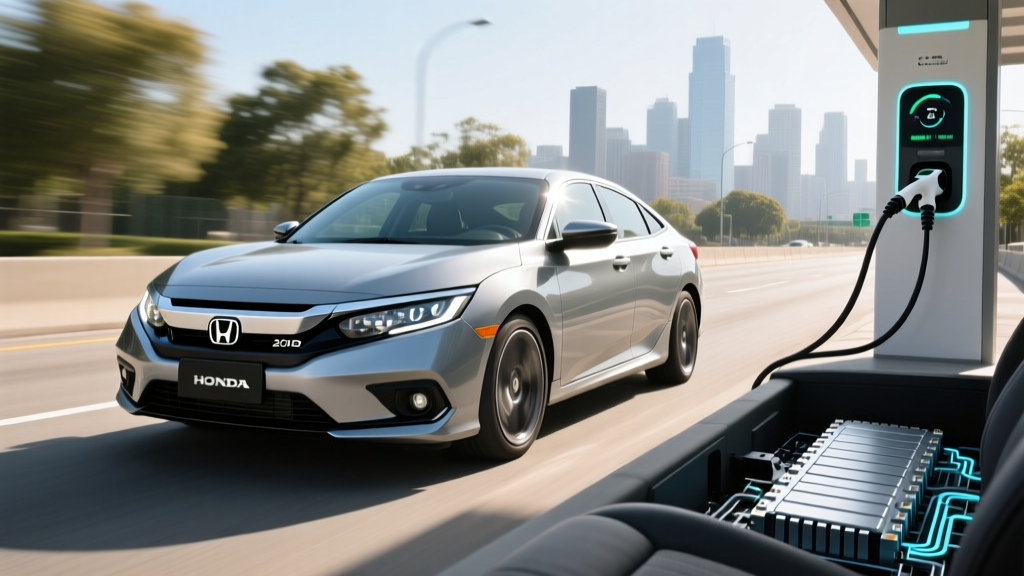
The 2025 Civic Hybrid uses Honda's latest two-motor hybrid system, which is fundamentally different from Toyota's planetary-gear e-CVT approach. Here's how it works:
- Primary propulsion motor: 184 hp, 232 lb-ft — this motor drives the front wheels in most driving scenarios (EV mode, hybrid mode at low-to-medium speeds)
- Generator motor: Works as a starter, generator, and secondary torque contributor
- 2.0L Atkinson-cycle engine: Primarily acts as a generator to feed the propulsion motor; at highway speeds, a lock-up clutch allows direct mechanical drive for efficiency
- Combined system output: 200 hp / 232 lb-ft
The 2025 Civic Hybrid 0-60 time of approximately 7.2 seconds is possible because the electric propulsion motor delivers its full 232 lb-ft of torque from 0 RPM. There's no turbo lag, no transmission shift delay — just immediate electric torque off the line. For context, that's quicker than the non-hybrid 2025 Civic EX (which uses a 1.5L turbo making 180 hp and hits 60 in roughly 7.5 seconds) and only about 0.5 seconds behind the performance-oriented Civic Si.
What you'll notice in daily driving is the responsiveness at partial throttle. The electric motor fills in the torque gap that small-displacement turbo engines often exhibit below 2,000 RPM. Overtaking on two-lane roads and merging onto highways feels confident without the engine screaming.
Battery Warranty, Lifespan, and Replacement Costs
Coverage: 8 years / 100,000 miles nationwide
CARB States: 10 years / 150,000 miles (CA, CT, CO, ME, MD, MA, NJ, NY, OR, RI, VT, WA, and others adopting CARB standards)
Capacity Threshold: Honda covers defects and significant capacity loss that affects vehicle operation
Estimated Out-of-Warranty Replacement: $2,000–$4,000 (battery pack + labor)
The Civic Hybrid's ~1.0 kWh lithium-ion battery pack is far smaller than a full EV's 60–100 kWh pack, and it operates within a narrow state-of-charge window (roughly 20–80% SoC). Honda's hybrid system never fully charges or fully depletes the battery, which significantly reduces degradation stress. This is a key longevity advantage.
Based on long-term data from Honda's earlier hybrid systems (Insight, Accord Hybrid, CR-V Hybrid), these packs routinely last 150,000–200,000+ miles before any meaningful capacity loss. The third-generation Insight, which used a similar architecture, has shown excellent battery durability in fleet data. If you plan to own the Civic Hybrid for 10 years and 120,000 miles, the battery will almost certainly remain under warranty — and even beyond warranty, replacement costs are a fraction of what a full EV battery swap would require.
For comparison, a full EV battery replacement (say, a Chevrolet Bolt or Tesla Model 3) typically runs $8,000–$16,000. The Civic Hybrid's small pack and simpler system keep that number manageable.
Pricing, Trims, and Tax Credit Eligibility
The 2025 Civic Hybrid is available in two trim levels for the sedan:
| Trim | MSRP | Key Features |
|---|---|---|
| Sport Sedan | $29,845 | Hybrid powertrain, 7" touchscreen, wireless Apple CarPlay/Android Auto, Honda Sensing suite, 18" alloy wheels |
| Sport Touring Sedan | $32,845 | Everything in Sport + Bose 12-speaker audio, wireless charging, heated front seats, leather-trimmed interior, navigation, low-speed braking control |
Federal tax credit status: The 2025 Civic Hybrid does not qualify for the federal §30D Clean Vehicle Credit. That credit ($3,750–$7,500) applies only to battery electric vehicles (BEVs) and plug-in hybrids (PHEVs) meeting specific battery-sourcing and critical-mineral requirements. Conventional hybrids like the Civic Hybrid are excluded under current IRS rules.
However, the Civic Hybrid's lower purchase price — roughly $10,000–$15,000 less than most new EVs — means the total cost of ownership equation often favors it for buyers who lack home charging access or who drive in areas with limited public charging infrastructure. Factor in no charging installation costs, no electricity-rate variability, and a lower insurance premium, and the break-even point versus a more expensive EV takes years to reach for many drivers.
Hybrid vs PHEV vs EV: Which Fits Your Situation?
| Factor | Civic Hybrid (HEV) | Typical PHEV | Typical BEV |
|---|---|---|---|
| Plug-in Required? | No | Yes (for EV range) | Yes |
| Electric-Only Range | ~1 mi (low-speed only) | 25–45 mi | 230–350 mi |
| Total Range | ~607 mi | 400–500 mi | 230–350 mi |
| Home Charging Install | Not needed | $500–$2,000 (Level 2) | $500–$2,500 (Level 2) |
| Federal Tax Credit | $0 | $3,750–$7,500* | $3,750–$7,500* |
| Fuel Cost (per mile) | ~$0.07–$0.09 | ~$0.03–$0.08 | ~$0.03–$0.06 |
| Road Trip Ease | Excellent (gas stations) | Good (gas backup) | Requires planning |
* §30D credit eligibility depends on MSRP caps, buyer income limits, battery sourcing, and critical-mineral requirements. Check IRS.gov for current rules.
Choose the Civic Hybrid if: You want 50 MPG without changing your fueling habits, you don't have access to home or workplace charging, you frequently take long road trips, or you want a lower upfront purchase price.
Choose a PHEV (e.g., Toyota Prius Prime) if: You have home charging, your daily commute is under 40 miles, and you want electric-only weekday driving with gas-engine weekend flexibility.
Choose a full EV (e.g., Chevy Equinox EV, Tesla Model 3) if: You have reliable home Level 2 charging, your daily driving is under 250 miles, you want the lowest per-mile fuel cost, and you're eligible for the full federal tax credit.
Reliability: What Honda's Hybrid Track Record Tells Us
Honda has been building production hybrids since the 1999 Insight — over 25 years of real-world data. The current two-motor system, introduced with the 2014 Accord Hybrid and refined through successive generations in the CR-V Hybrid, Accord Hybrid, and now the Civic Hybrid, has demonstrated strong reliability.
Key reliability advantages of this system:
- No traditional transmission: The e-CVT is a direct-drive system with a lock-up clutch — there are no gear sets, bands, or torque converters to fail. This eliminates one of the most expensive repair categories in conventional cars.
- Regenerative braking reduces wear: The electric motor handles most deceleration, meaning brake pads and rotors last significantly longer — often 80,000–100,000+ miles before replacement.
- Simplified engine operation: The Atkinson-cycle engine runs within a narrower RPM band and often at optimal load, reducing thermal stress compared to a conventional engine that sees wide load swings.
Based on NHTSA complaint data and long-term owner surveys, the primary wear items on Honda's hybrid system are the 12V auxiliary battery (standard replacement every 4–6 years, ~$150–$250) and eventually the hybrid battery pack beyond the warranty window. Major hybrid-system failures within the warranty period are uncommon.
Pros and Cons at a Glance
- 200 hp / 232 lb-ft — genuinely quick for a hybrid
- 50/47/49 MPG EPA — class-leading efficiency
- No plug-in charging required
- ~607-mile total range between fill-ups
- Strong regenerative braking extends brake life
- Honda Sensing ADAS suite standard
- Lower purchase price than comparable EVs
- No federal tax credit eligibility
- Not a PHEV — no meaningful electric-only range
- Highway MPG drops more than city (regen-dependent)
- Only available in Sport and Sport Touring trims
- FWD only — no AWD option
- e-CVT drone under hard acceleration (common to hybrids)
- Higher MSRP than non-hybrid Civic LX ($24,950)
Frequently Asked Questions
How fast is the 2025 Civic Hybrid 0-60?
The 2025 Honda Civic Hybrid reaches 0-60 mph in approximately 7.2 seconds. That's enabled by the electric propulsion motor's instant 232 lb-ft of torque from standstill. It's quicker than the non-hybrid Civic EX (1.5T, ~7.5 sec) and competitive with many turbocharged compact sedans, while delivering roughly 40% better fuel economy.
How many MPG does the 2025 Civic Hybrid actually get?
The EPA rates the Civic Hybrid Sport sedan at 50 city / 47 highway / 49 combined MPG. In real-world driving, city-heavy commuters often see 48–54 MPG (hybrids benefit from stop-and-go regenerative braking), while sustained highway driving at 75+ mph yields roughly 43–48 MPG. Cold weather reduces these figures by approximately 5–8%. Over a full tank, expect roughly 560–620 miles of range.
Does the Civic Hybrid plug in? Is there a Civic PHEV?
No. The 2025 Civic Hybrid is a conventional hybrid (HEV). You never plug it in — it charges its small ~1.0 kWh battery through regenerative braking and the gasoline engine. Honda does not currently offer a plug-in hybrid (PHEV) version of the Civic in the US market. If you want a Honda PHEV, the closest option is the Clarity Plug-In Hybrid (discontinued after 2021) or the CR-V Hybrid (which is also a conventional HEV, not a PHEV). For a plug-in compact from another brand, consider the Toyota Prius Prime (44 miles electric-only range, up to $7,500 federal credit eligibility).
Is the 2025 Civic Hybrid reliable, and what does battery replacement cost?
Honda's two-motor hybrid system has over a decade of proven reliability across the Accord Hybrid, CR-V Hybrid, and Insight lineups. The hybrid battery pack is warrantied for 8 years/100,000 miles (10 years/150,000 miles in CARB states). Based on historical data, these packs typically last 150,000–200,000+ miles. If replacement is needed out of warranty, expect $2,000–$4,000 for the battery pack and labor — far less than a full EV battery replacement ($8,000–$16,000+). The e-CVT design also eliminates traditional transmission failure risk.
Does the 2025 Civic Hybrid qualify for any tax credit?
No. The federal §30D Clean Vehicle Credit applies only to battery electric vehicles and plug-in hybrids that meet battery-sourcing and critical-mineral requirements, MSRP caps, and buyer income limits. The Civic Hybrid is a conventional HEV and is excluded. Some states or local utilities may offer small rebates for high-efficiency vehicles, but these vary by jurisdiction — check your state energy office or utility provider for current programs. The lack of a federal credit is offset by the Civic Hybrid's lower base price (~$29,845 vs. $35,000–$45,000 for most credit-eligible EVs) and zero home-charging installation costs.
How does the Civic Hybrid compare to the Toyota Prius?
The 2025 Toyota Prius (conventional hybrid) is rated at up to 57 MPG combined (LE trim) and hits 0-60 in roughly 7.0 seconds with 196 hp. The Prius is slightly more efficient but has a more polarizing design and a lower-rent interior feel in base trims. The Civic Hybrid trades a few MPG for a more refined cabin, sharper handling, and Honda's strong resale value. Both are excellent choices — the Prius wins on pure efficiency; the Civic Hybrid wins on driving dynamics and interior quality at the Sport Touring level.