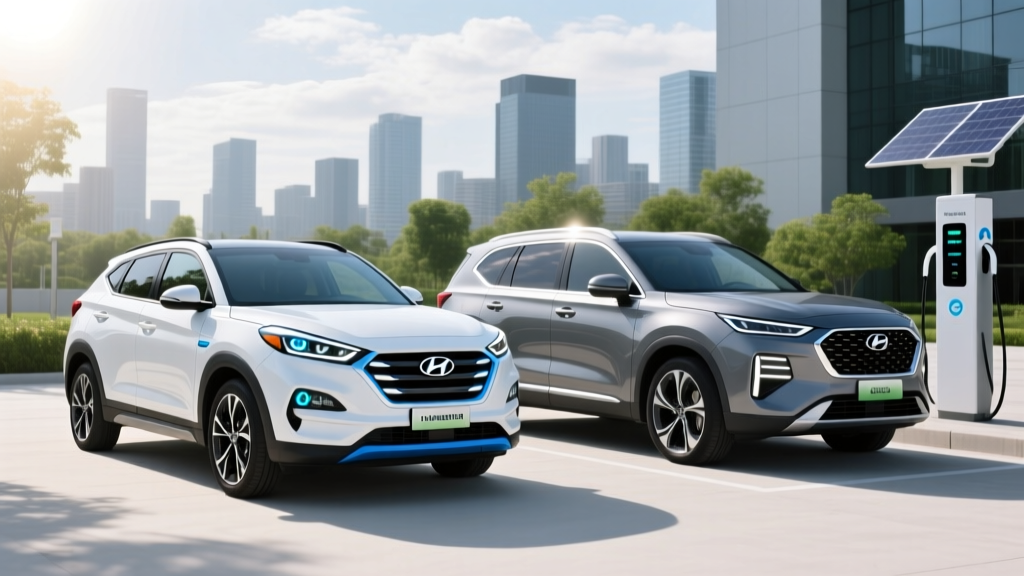
If you're searching for a Hyundai SUV hybrid in 2026, you have two strong candidates — and four distinct powertrains — to evaluate. The compact Hyundai Tucson and the midsize Hyundai Santa Fe both offer conventional hybrid (HEV) and plug-in hybrid (PHEV) variants, each with very different economics, charging needs, and daily-driving implications. This guide breaks down exact EPA figures, real-world expectations, pricing, and tax-credit eligibility so you can match the right Hyundai hybrid to your driving pattern.
HEV vs PHEV: What Hyundai SUV Hybrid Buyers Need to Know
Before comparing models, the HEV-vs-PHEV distinction is the single most important decision point. Hyundai sells both architectures across its SUV lineup, and confusing them is the most common buyer mistake.
Conventional Hybrid (HEV) — Tucson Hybrid & Santa Fe Hybrid
- No plug required. The battery recharges through regenerative braking and the gasoline engine.
- Small battery (~1.5 kWh usable) — not designed for sustained electric-only driving.
- Behavior: Electric motor assists the engine at low speeds and during acceleration; the engine handles highway cruising. You fuel up at a gas station exactly like a conventional car.
- Best for: Drivers without home charging access, apartment dwellers, or those who want better MPG without changing any habits.
Plug-In Hybrid (PHEV) — Tucson PHEV & Santa Fe PHEV
- Plug-in charging required to unlock electric-only range. Uses a J1772 connector for Level 1/Level 2 AC charging.
- Larger battery (13.8 kWh usable in Tucson PHEV, ~18.1 kWh in Santa Fe PHEV) enabling 30-40+ miles of electric-only driving.
- Behavior: Operates as a pure EV for daily commuting, then seamlessly switches to hybrid mode when the battery depletes or you need highway power.
- No DC fast charging. Hyundai's PHEV SUVs use AC-only onboard chargers (7.2 kW max), so Level 2 is the fastest public option.
- Best for: Households with home Level 2 charging, commutes under 35 miles round-trip, and a desire to minimize gas use without full EV range commitment.
2026 Hyundai Tucson Hybrid & PHEV: Specs and MPG
The Tucson remains Hyundai's volume compact SUV, and its hybrid powertrains account for a significant share of sales. For 2026, the Tucson Hybrid and Tucson PHEV share a 1.6-liter turbocharged four-cylinder paired with an electric motor, but the PHEV uses a larger motor and battery.
| Specification | Tucson Hybrid (HEV) | Tucson PHEV |
|---|---|---|
| Combined Horsepower | 226 hp | 261 hp |
| Engine | 1.6L turbo I-4 + 44 kW motor | 1.6L turbo I-4 + 72 kW motor |
| Battery (usable) | ~1.5 kWh (HEV) | 13.8 kWh (lithium-ion polymer) |
| EPA Electric-Only Range | N/A | 33 miles |
| EPA Combined MPG (hybrid mode) | 38 MPG combined | 35 MPG combined (after battery depleted) |
| EPA City / Highway MPG | 38 city / 38 highway | 35 city / 35 highway (hybrid mode) |
| MPGe (PHEV combined) | N/A | 80 MPGe |
| Total Combined Range | ~430 miles | ~420 miles (electric + gas) |
| Level 2 Charge Time (0-100%) | N/A | ~1 hr 45 min at 7.2 kW |
| DC Fast Charging | No | No |
| 0-60 mph | ~7.1 sec | ~6.3 sec |
| Drivetrain | AWD (HTRAC) | AWD (HTRAC) |
| Cargo Volume | 38.7 cu ft (rear seats up) | 38.5 cu ft (rear seats up) |
Real-World MPG vs EPA: What Tucson Hybrid Owners Actually See
The EPA rates the Tucson Hybrid at 38 MPG combined. In real-world driving, city-heavy commuters often report 39-42 MPG because hybrid systems recapture braking energy most effectively in stop-and-go traffic. Highway-dominant drivers at 75+ mph typically see 33-36 MPG, as the gasoline engine carries more of the load at sustained speed. Cold-weather operation (below 30°F) reduces fuel economy by roughly 8-12% due to engine warm-up cycles and reduced battery efficiency — a pattern consistent across all hybrids.
2026 Hyundai Santa Fe Hybrid & PHEV: Specs and MPG
The Santa Fe moved to a boxier, three-row-capable design for its current generation, and the hybrid variants are key to its powertrain strategy. The Santa Fe is larger and heavier than the Tucson, so MPG figures are modestly lower, but the PHEV version gains a larger battery for more electric-only range.
| Specification | Santa Fe Hybrid (HEV) | Santa Fe PHEV |
|---|---|---|
| Combined Horsepower | 230 hp | 278 hp |
| Engine | 1.6L turbo I-4 + 48 kW motor | 1.6L turbo I-4 + 74 kW motor |
| Battery (usable) | ~1.5 kWh (HEV) | 18.1 kWh (lithium-ion polymer) |
| EPA Electric-Only Range | N/A | 36 miles |
| EPA Combined MPG (hybrid mode) | 34 MPG combined | 31 MPG combined (after battery depleted) |
| EPA City / Highway MPG | 35 city / 33 highway | 31 city / 31 highway (hybrid mode) |
| MPGe (PHEV combined) | N/A | 76 MPGe |
| Total Combined Range | ~470 miles | ~460 miles (electric + gas) |
| Level 2 Charge Time (0-100%) | N/A | ~2 hr 30 min at 7.2 kW |
| DC Fast Charging | No | No |
| 0-60 mph | ~7.5 sec | ~6.5 sec |
| Drivetrain | AWD (HTRAC) | AWD (HTRAC) |
| Seating | Available 3rd row | Available 3rd row |
For the Santa Fe PHEV, 36 miles of electric-only range is enough to cover the average American commute (roughly 32 miles round-trip, per FHWA data) entirely on electricity — meaning many owners visit a gas station only for longer weekend trips. When the battery depletes, the 31 MPG combined hybrid mode keeps fuel costs reasonable for a three-row SUV.
Pricing, Trims, and Federal Tax Credit Eligibility
Hyundai's hybrid SUV pricing for 2026 reflects the premium of electrification, but both models remain competitively positioned against rivals like the Toyota RAV4 Hybrid and Honda CR-V Hybrid.
| Model | Base MSRP | Top Trim MSRP | Est. Federal Tax Credit |
|---|---|---|---|
| Tucson Hybrid (Blue/SEL) | $33,985 | $41,585 (Limited) | Not eligible (§30D requires plug-in) |
| Tucson PHEV (SEL/Limited) | $40,485 | $45,985 (Limited) | Up to $3,750–$7,500* |
| Santa Fe Hybrid (SEL Premium) | $40,485 | $48,485 (Calligraphy) | Not eligible (§30D requires plug-in) |
| Santa Fe PHEV (SEL Premium/Limited) | $47,485 | $53,985 (Calligraphy) | Up to $3,750–$7,500* |
*All prices include destination. Tax credit amounts depend on current-year IRS §30D rules.
§30D Federal Tax Credit Checklist for Hyundai PHEVs (2026 Rules)
Only the PHEV variants qualify — conventional HEVs are ineligible. To claim the credit, all of the following must be met:
- MSRP cap: SUVs must have an MSRP at or below $80,000 (all Hyundai PHEV SUVs clear this threshold).
- Buyer income cap: Modified AGI must not exceed $150,000 (single), $225,000 (head of household), or $300,000 (joint).
- Battery sourcing: A percentage of critical minerals and battery components must be sourced from the U.S. or FTA partners — this percentage increases annually. Hyundai has been progressively shifting supply chains, but the exact credit amount ($3,750 for meeting one requirement, $7,500 for both) depends on the specific model year's compliance. Check the latest IRS qualified vehicles list before purchasing.
- Point-of-sale transfer: As of 2024, buyers can transfer the credit to the dealer for an immediate price reduction at purchase, rather than waiting to claim it on their tax return.
Battery Warranty, Reliability, and Replacement Costs
Hybrid battery longevity is the top concern for buyers transitioning from conventional vehicles. Hyundai addresses this with one of the strongest warranty packages in the industry.
Hyundai Hybrid & PHEV Battery Warranty
- Hybrid/EV battery: 10 years / 100,000 miles (whichever comes first)
- Hybrid system components (motor, inverter, controller): 10 years / 100,000 miles
- Powertrain warranty: 10 years / 100,000 miles
- New vehicle limited warranty: 5 years / 60,000 miles
- Capacity retention threshold: Hyundai covers the PHEV battery if it falls below approximately 70% of original capacity during the warranty period.
On reliability, Hyundai's 1.6L turbo hybrid powertrain has been in service across the Tucson, Santa Fe, Kia Sportage, and Kia Sorento since the early 2020s. The architecture is well-proven. Hybrid-specific failures are rare — the most commonly reported issues involve the dual-clutch automatic transmission (used in earlier model years, now replaced with a conventional 6-speed automatic in current HEV/PHEV models), which improved long-term durability.
For battery replacement cost outside of warranty: a Tucson PHEV battery pack replacement runs approximately $5,000–$7,500 (parts and labor), while the Santa Fe PHEV's larger pack is estimated at $6,500–$9,000. Conventional HEV battery replacement is significantly cheaper — roughly $2,000–$3,500 — because the battery is much smaller. In practice, modern lithium-ion hybrid batteries are designed to outlast the 10-year/100,000-mile warranty, and real-world degradation data from Hyundai/Kia platforms shows typical capacity loss of only 8-15% over 100,000 miles.
Hyundai SUV Hybrid vs Full EV vs Gas: Which Fits You?
Choosing between a Hyundai hybrid SUV, a plug-in hybrid, or a full battery-electric vehicle (like the Hyundai Ioniq 5) depends on your charging access, driving patterns, and budget.
Decision Framework
Choose the Tucson or Santa Fe Hybrid (HEV) if:
- You live in an apartment or lack access to home charging.
- You want better fuel economy without any behavioral changes — no plugging in, no route planning.
- Your budget is below $42,000 and you don't want to stretch for a PHEV premium.
- You drive 12,000+ miles/year with a mix of city and highway.
Choose the Tucson or Santa Fe PHEV if:
- You have a garage or driveway where a Level 2 (240V) charger can be installed.
- Your daily round-trip commute is under 35 miles — you'll rarely use gasoline on weekdays.
- You want to reduce fuel costs significantly without committing to a full EV's range limitations on road trips.
- You qualify for the §30D tax credit, which effectively reduces the PHEV premium over the HEV by $3,750–$7,500.
Choose a full EV (e.g., Hyundai Ioniq 5) if:
- You have reliable home Level 2 charging and access to DC fast charging along your common routes.
- You want the lowest per-mile energy cost (electricity at $0.14/kWh averages ~$0.04/mile vs. ~$0.12/mile for a 35 MPG hybrid at $3.20/gallon).
- You're ready to plan road trips around charging infrastructure.
- You want maximum federal and state incentives (full EVs qualify for the full $7,500 credit more consistently).
Pros of Hyundai SUV Hybrids
- Class-leading 10-year/100,000-mile hybrid battery warranty
- HEV models require zero charging infrastructure
- PHEV models cover most commutes on electricity alone (33-36 mi range)
- AWD standard on all hybrid and PHEV trims
- Strong real-world city MPG that often exceeds EPA estimates
- PHEV eligibility for §30D tax credit reduces effective price
Cons of Hyundai SUV Hybrids
- HEV models ineligible for federal purchase tax credits
- PHEV models cannot DC fast charge — Level 2 only (7.2 kW max)
- Santa Fe PHEV pricing pushes into luxury-adjacent territory ($47K+)
- Highway MPG in hybrid mode is modest vs. dedicated highway-efficient designs
- PHEV cargo space slightly reduced vs. gas-only models due to battery placement
Real-World Ownership Costs: 5-Year Comparison
To put the economics in perspective, here's a 5-year/75,000-mile ownership estimate comparing the Tucson Hybrid, Tucson PHEV, and a gasoline Tucson (2.5L turbo AWD, 25 MPG combined) at $3.20/gallon and $0.14/kWh national averages.
| Model | Fuel/Energy Cost | Est. Maintenance | 5-Yr Total (fuel + maint.) |
|---|---|---|---|
| Tucson 2.5T Gas (25 MPG) | $9,600 | $3,800 | $13,400 |
| Tucson Hybrid (38 MPG) | $6,315 | $3,400 | $9,715 |
| Tucson PHEV (60% electric driving) | $3,900 | $3,200 | $7,100 |
The PHEV's advantage is dramatic for drivers who charge daily at home. However, if you cannot charge at home and operate the PHEV primarily in hybrid mode (35 MPG), the fuel savings over the HEV shrink considerably — and the HEV's lower purchase price becomes the smarter financial play. Source: EPA fueleconomy.gov data and AAA maintenance cost averages.
Charging the Hyundai PHEV SUVs at Home
If you're considering a Tucson or Santa Fe PHEV, home charging is the linchpin of the ownership experience. Here's what to expect:
| Charging Level | Power | Tucson PHEV (0-100%) | Santa Fe PHEV (0-100%) | Practical Notes |
|---|---|---|---|---|
| Level 1 (120V outlet) | ~1.4 kW | ~10 hours | ~13 hours | Adequate for overnight top-up; slow for full recharge |
| Level 2 (240V, 32A) | 7.2 kW | ~1 hr 45 min | ~2 hr 30 min | Recommended for daily use; full recharge during evening |
| DC Fast Charging | N/A | Not supported | Not supported | Hyundai PHEVs lack DC inlet |
A Level 2 home charger installation typically costs $500–$2,000 (equipment + electrician), depending on your electrical panel's capacity and the distance from panel to garage. Most PHEV owners charge nightly on Level 2 and wake to a full battery every morning. If your panel is maxed out (common in older homes with 100A service), a panel upgrade to 200A adds $1,500–$3,000 to the project.
Frequently Asked Questions
How many MPG does the Hyundai Tucson Hybrid get in real-world driving?
The EPA rates the 2026 Tucson Hybrid at 38 MPG combined (38 city / 38 highway). In practice, city-dominant drivers commonly achieve 39-42 MPG thanks to aggressive regenerative braking. Highway-heavy driving at 75+ mph typically yields 33-36 MPG. Cold weather (below 30°F) reduces these figures by roughly 8-12%.
How far can the Hyundai Santa Fe PHEV go on electric only?
The 2026 Santa Fe PHEV achieves an EPA-rated 36 miles of electric-only range on its 18.1 kWh battery. Real-world range varies: gentle city driving in mild weather can yield 38-40 miles, while cold-weather or aggressive highway driving may reduce it to 28-30 miles. Once depleted, the SUV operates as a conventional hybrid at 31 MPG combined.
Does the Hyundai Tucson Hybrid qualify for a federal tax credit?
No. The conventional Tucson Hybrid (HEV) does not qualify for the §30D federal clean vehicle tax credit because it is not a plug-in vehicle. Only the Tucson PHEV and Santa Fe PHEV are potentially eligible, with credits of $3,750 or $7,500 depending on battery-sourcing compliance and buyer income limits. Always verify current eligibility on the IRS qualified vehicles list.
Are Hyundai hybrid SUVs reliable? What does battery replacement cost?
Hyundai's hybrid system is well-proven across multiple models since 2020, and the company backs it with a 10-year/100,000-mile hybrid battery warranty — among the best in the industry. Out-of-warranty battery replacement costs approximately $5,000–$7,500 for the Tucson PHEV and $6,500–$9,000 for the Santa Fe PHEV. The conventional HEV battery is smaller and cheaper to replace at roughly $2,000–$3,500. Real-world degradation data suggests 8-15% capacity loss over 100,000 miles, meaning most batteries will outlast the warranty period.
Should I buy a Hyundai hybrid SUV or go fully electric?
Choose a Hyundai hybrid (HEV) if you lack home charging or want zero behavioral change. Choose a PHEV if you have home charging and a sub-35-mile commute — you'll drive mostly on electricity with no range anxiety on road trips. Choose a full EV like the Ioniq 5 if you want the lowest per-mile cost, maximum incentives, and are comfortable planning around DC fast charging on longer trips. The PHEV is the strongest "bridge" option for households transitioning from gas to electric.
Can Hyundai PHEV SUVs use DC fast chargers on road trips?
No. Neither the Tucson PHEV nor the Santa Fe PHEV supports DC fast charging. They use a J1772 AC inlet limited to 7.2 kW (Level 2). On road trips, PHEV owners simply drive in hybrid mode using gasoline — the transition is seamless and requires no charging stops. This is actually an advantage over full EVs on long highway trips where DC charging infrastructure may be sparse.