Quick Verdict: The Sonata Hybrid Is a Commuter's Efficiency Benchmark
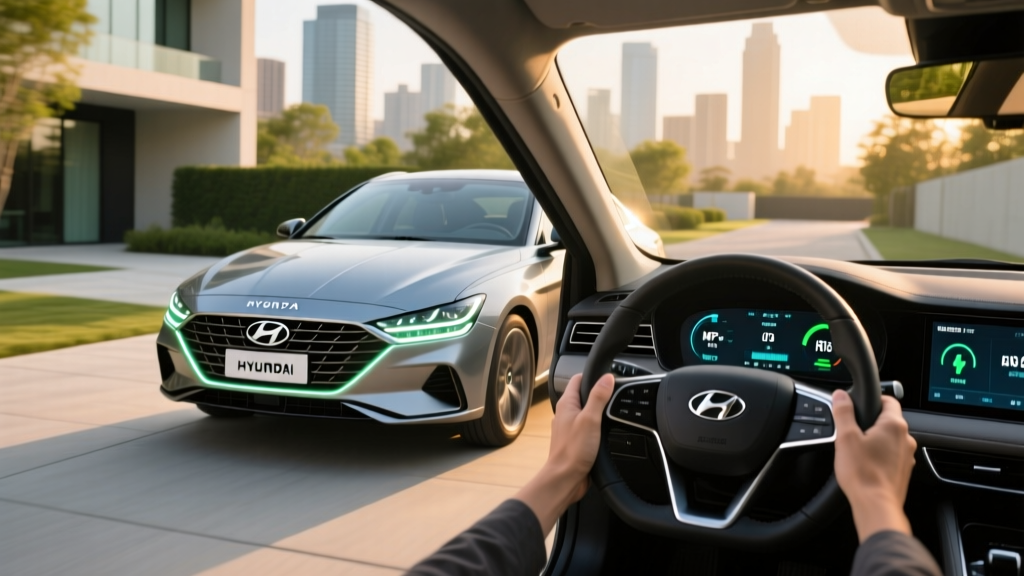
The 2026 Hyundai Sonata Hybrid occupies a specific niche in the electrified sedan market: it delivers top-tier hybrid fuel economy without requiring a plug, a lifestyle change, or a premium price tag. With an EPA-estimated 52 MPG combined on the Blue trim, it sits among the most efficient midsize sedans you can buy — rivaling the Toyota Camry Hybrid while offering more standard technology and a longer warranty.
But the Sonata Hybrid isn't the only electrified Sonata. Hyundai also offers a Sonata Plug-in Hybrid (PHEV) variant in select markets, which adds roughly 30 miles of electric-only driving for commuters who can charge at home. This guide breaks down both versions with exact numbers, real-world efficiency data, and a clear framework for deciding which — if either — fits your driving pattern.
HEV vs PHEV: Which Sonata Hybrid Are We Talking About?
Before diving into specs, it's essential to distinguish the two electrified Sonata variants, because they serve different use cases and have different pricing structures.
| Feature | Sonata Hybrid (HEV) | Sonata Plug-in Hybrid (PHEV) |
|---|---|---|
| Requires plugging in? | No — charges via regenerative braking and engine | Yes — for electric-only range benefit |
| Battery capacity | 1.6 kWh (lithium-ion) | 13.8 kWh usable (lithium-ion polymer) |
| Electric-only driving | Short low-speed assists only (~1 mi) | ~30 miles EPA est. |
| DC fast charging | No | No — Level 2 AC only |
| Combined HP | 194 hp | 202 hp |
| EPA combined MPG / MPGe | 47–52 MPG | 40 MPG (gas) / 99 MPGe (electric+gas) |
| Federal tax credit (§30D) | Not eligible | Up to $3,750 (subject to sourcing rules) |
| Starting MSRP (2026) | $31,450 | $37,950 |
Key distinction: The conventional Sonata Hybrid (HEV) never needs to be plugged in. It generates electricity through its gasoline engine and regenerative braking. The PHEV variant can be plugged into a standard 120V outlet or a 240V Level 2 charger to fill its larger battery, enabling daily electric-only commutes.
Fuel Economy: EPA Numbers and Real-World MPG
Fuel efficiency is the primary reason buyers choose the Sonata Hybrid. Here's how the EPA rates each trim, alongside what you can expect in real-world driving.
| Trim / Variant | City MPG | Highway MPG | Combined MPG |
|---|---|---|---|
| Sonata Hybrid Blue | 51 | 54 | 52 |
| Sonata Hybrid SEL / Limited | 44 | 51 | 47 |
| Sonata PHEV (charge-depleting) | 99 MPGe combined | ~30 mi electric | |
| Sonata PHEV (charge-sustaining) | 39 | 42 | 40 |
Source: fueleconomy.gov
Real-World MPG vs. EPA Sticker
Hybrids tend to exceed their EPA city ratings in stop-and-go traffic because regenerative braking recovers energy that a gas-only car wastes as heat. In owner-reported data and independent testing, the Sonata Hybrid Blue consistently achieves 48–55 MPG in mixed suburban commuting. Highway-only driving at 75+ mph typically drops to 42–46 MPG, since the electric motor contributes less at sustained high speeds and aerodynamic drag increases.
In cold weather (below 30°F), expect a 5–10% reduction in fuel economy due to longer engine warm-up cycles, increased cabin heating load, and reduced battery efficiency. This is less severe than a full EV's cold-weather range loss (typically 20–30%) but still measurable over a full tank.
The SEL and Limited trims lose 5 MPG combined compared to the Blue trim. The reason is weight and equipment: larger 18-inch alloy wheels, additional sound insulation, a panoramic sunroof, and more electronics add roughly 100–130 lbs and increase rolling resistance. If maximum MPG is your priority, the Blue trim is the clear choice.
Powertrain and Performance Specifications
| Specification | Sonata Hybrid (HEV) | Sonata PHEV |
|---|---|---|
| Engine | 2.0L inline-4 GDI | 2.0L inline-4 GDI |
| Engine output | 150 hp / 139 lb-ft | 150 hp / 139 lb-ft |
| Electric motor output | 39 kW (52 hp) / 151 lb-ft | 50 kW (67 hp) / 151 lb-ft |
| Combined system output | 194 hp | 202 hp |
| Transmission | 6-speed automatic w/ electric motor integrated | 6-speed automatic w/ electric motor integrated |
| 0–60 mph (est.) | ~7.5 seconds | ~7.2 seconds |
| Drivetrain | FWD | FWD |
| Battery (traction) | 1.6 kWh lithium-ion | 13.8 kWh lithium-ion polymer |
| Fuel tank | 13.2 gallons | 13.2 gallons |
| Total range (est.) | ~686 miles (Blue trim) | ~530 miles (gas) + 30 mi electric |
Hyundai uses a conventional 6-speed automatic transmission rather than the continuously variable transmissions (CVTs) found in the Toyota Camry Hybrid and Honda Accord Hybrid. This gives the Sonata Hybrid a more natural, stepped acceleration feel that many drivers prefer, though CVTs can extract marginally better efficiency at constant speeds. The tradeoff is subtle: the Sonata Hybrid Blue's 52 MPG combined matches or beats most CVT-equipped competitors.
PHEV Electric-Only Range and Charging
The Sonata PHEV's 13.8 kWh battery delivers an EPA-estimated 30 miles of electric-only range at speeds up to ~75 mph. This covers the average American one-way commute (approximately 16 miles, per U.S. Census data) with margin to spare, meaning a PHEV owner with home charging can complete most daily driving on electricity alone.
Charging the PHEV battery:
- Level 1 (120V standard outlet): ~2.4 kW draw — full charge in approximately 6 hours
- Level 2 (240V, 32A): ~7.2 kW draw — full charge in approximately 2 hours
- DC fast charging: Not supported. The Sonata PHEV uses a J1772 AC connector only.
The lack of DC fast charging is typical for PHEVs in this class. The battery is small enough that Level 2 charging fully replenishes it during a workday or overnight, making DC capability unnecessary for most use cases.
Pricing, Tax Credits, and Ownership Economics
Sonata Hybrid (HEV) Pricing
The 2026 Sonata Hybrid starts at $31,450 for the Blue trim (including destination). The SEL trim adds approximately $2,500, and the Limited trim starts around $37,000. These prices place the Sonata Hybrid roughly $1,000–$2,000 above the Toyota Camry Hybrid LE but with more standard features (larger touchscreen, digital key, highway driving assist).
Federal tax credit: The conventional Sonata Hybrid (HEV) does not qualify for the IRS §30D Clean Vehicle Credit. That credit is available only for plug-in electric vehicles (BEVs and PHEVs) meeting battery sourcing, MSRP cap, and buyer income requirements. However, some states and utilities offer rebates for high-efficiency hybrids — check your local programs.
Sonata PHEV Pricing and Tax Credit Eligibility
The Sonata PHEV starts at $37,950. Under current IRS §30D rules, qualifying PHEVs may be eligible for a federal tax credit of up to $3,750 (the critical minerals portion of the credit; the battery component portion depends on North American sourcing compliance, which varies by model year and production batch).
§30D Credit Requirements for the Sonata PHEV (2026):
- Vehicle MSRP must be ≤ $55,000 (sedan cap) — Sonata PHEV qualifies ✓
- Buyer modified adjusted gross income: ≤ $150,000 (single) / $300,000 (joint) — verify with your tax professional
- Battery components and critical minerals must meet phased-in sourcing thresholds per IRS §30D rules — confirm current compliance status at purchase
- Credit can be transferred to the dealer at point of sale as a purchase price reduction (effective 2024 onward)
Total cost of ownership advantage: A Sonata Hybrid Blue owner driving 15,000 miles/year at $3.40/gallon average fuel cost spends approximately $980/year on fuel. A comparable gas-only midsize sedan at 30 MPG combined spends ~$1,700/year. That's roughly $720 in annual fuel savings, recouping the hybrid's price premium over a gas-only Sonata within 2–3 years.
Battery Longevity, Warranty, and Replacement Cost
Hyundai Hybrid/PHEV Battery Warranty:
- Hybrid battery: 10 years / 100,000 miles (whichever comes first)
- Hybrid system components (motor, inverter, converter): 10 years / 100,000 miles
- Standard vehicle warranty: 5 years / 60,000 miles bumper-to-bumper; 10 years / 100,000 miles powertrain
This is among the strongest hybrid warranties in the segment. Toyota matches the 10-year/100,000-mile hybrid battery coverage, but Hyundai's overall 10-year powertrain warranty exceeds most competitors.
Real-World Battery Degradation
Hybrid batteries experience far less stress than full EV batteries. The Sonata Hybrid's 1.6 kWh pack is rarely cycled to full depth — the vehicle's battery management system keeps the state of charge (SoC) within a narrow operating window (typically 40–80%), which dramatically extends cycle life. Most Hyundai/Kia hybrid batteries from the 2011–2020 generation are still in service with minimal capacity loss at 100,000+ miles.
The PHEV's larger 13.8 kWh battery undergoes deeper cycles but still benefits from conservative buffer management. Based on data from earlier Hyundai PHEVs (Ioniq PHEV, Niro PHEV), expect approximately 8–12% capacity loss over 10 years of typical use — meaning the 30-mile electric range might decrease to roughly 26–27 miles over the vehicle's life.
Battery Replacement Cost
If a hybrid battery does fail outside of warranty, replacement costs are:
- Sonata Hybrid (HEV) battery: $2,000–$3,500 (parts + labor, independent shop; $3,500–$5,000 at dealer)
- Sonata PHEV battery: $5,000–$8,000 (parts + labor; larger pack with more cells)
In practice, hybrid battery replacement is uncommon before 150,000–200,000 miles when the vehicle is operated normally. The 10-year/100,000-mile warranty covers the vast majority of ownership periods.
Reliability and Safety Ratings
Hyundai's hybrid powertrain has proven reliable across two generations of Sonata Hybrid (2011–2019 and 2020–present). The 6-speed automatic transmission is a proven conventional unit — no CVT belt or planetary gearset concerns. Common non-powertrain complaints from earlier model years (infotainment glitches, door handle durability) have been largely addressed in the 2024 refresh and subsequent model years.
Safety ratings for the current-generation Sonata:
- NHTSA: 5-Star Overall Safety Rating — see NHTSA.gov
- IIHS: Top Safety Pick+ (when equipped with LED projector headlights on SEL/Limited trims)
Standard driver-assistance features include forward collision-avoidance assist, lane keeping assist, blind-spot collision warning, and Hyundai's Highway Driving Assist (HDA) — a Level 2 SAE system that combines adaptive cruise control with lane centering on divided highways. This is not autonomous driving. The driver must keep hands on the wheel and remain engaged at all times.
Who Should Buy the Sonata Hybrid vs. a PHEV or Full EV?
Choose the Sonata Hybrid (HEV) if:
- You want maximum fuel savings without changing your fueling habits
- You don't have access to home or workplace charging
- Your budget is $31,000–$37,000 and you want the best MPG for the dollar
- You drive 15,000+ miles/year and want to minimize fuel cost without a plug
- You want a proven, low-risk electrified powertrain with a long warranty
Choose the Sonata PHEV if:
- You have reliable Level 2 home or workplace charging
- Your daily round-trip commute is ≤ 30 miles (covering most errands on electricity)
- You want EV-like daily driving with a gas engine for road trips
- You qualify for the §30D tax credit, effectively reducing the price gap vs. the HEV
Choose a full EV (e.g., Hyundai Ioniq 6, Tesla Model 3) if:
- You have reliable home charging and your daily driving is within the EV's range
- You want zero tailpipe emissions and minimal drivetrain maintenance (no oil changes, no transmission fluid)
- You qualify for the full $7,500 §30D credit on a qualifying BEV
- You're comfortable planning around charging infrastructure on road trips
Pros
- 52 MPG combined (Blue) — among the highest in the midsize sedan segment
- No plugging in required — zero lifestyle change vs. a gas car
- 10-year/100,000-mile hybrid battery and powertrain warranty
- 6-speed automatic (no CVT drone under acceleration)
- Spacious interior with 16.0 cu ft trunk (hybrid battery under rear seat, minimal cargo impact)
- Strong standard safety tech and IIHS Top Safety Pick+ rating
Cons
- 5 MPG penalty on SEL/Limited trims vs. Blue (wheel/weight tradeoff)
- Not eligible for §30D federal tax credit (HEV version)
- FWD only — no AWD option (unlike Toyota Camry Hybrid AWD)
- PHEV variant availability limited to select states/markets
- Infotainment learning curve for Hyundai's latest UI on 2024+ refresh
Frequently Asked Questions
How many MPG does the 2026 Hyundai Sonata Hybrid get?
The Sonata Hybrid Blue trim achieves an EPA-estimated 51 city / 54 highway / 52 combined MPG. The SEL and Limited trims are rated at 44 city / 51 highway / 47 combined due to additional weight and larger wheels. In real-world suburban commuting, many owners report 48–55 MPG. Highway-only driving at 75+ mph typically yields 42–46 MPG.
How far can the Sonata PHEV go on electric only?
The Sonata PHEV delivers an EPA-estimated 30 miles of electric-only range at speeds up to approximately 75 mph. In mild weather with moderate acceleration, some drivers report 32–34 miles. In cold weather (below 30°F) or with aggressive driving, expect 24–27 miles. Once the battery is depleted, the PHEV operates as a conventional hybrid at approximately 40 MPG combined.
Does the Sonata Hybrid qualify for any tax credit?
The conventional Sonata Hybrid (HEV) does not qualify for the federal §30D Clean Vehicle Credit, which is limited to plug-in vehicles. The Sonata PHEV may qualify for up to $3,750 under current IRS rules, subject to battery sourcing compliance, buyer income caps ($150K single / $300K joint), and the $55,000 MSRP cap for sedans. Always verify current eligibility at IRS.gov and consult a tax professional before purchasing.
Is the Sonata Hybrid reliable, and what does a battery replacement cost?
Yes. Hyundai's hybrid system has a strong reliability track record across two generations. The hybrid battery is warrantied for 10 years / 100,000 miles, and real-world data shows most packs last 150,000–200,000+ miles with minimal degradation thanks to shallow cycling. Out-of-warranty replacement costs $2,000–$3,500 for the HEV battery and $5,000–$8,000 for the PHEV battery at independent shops.
Does the Sonata Hybrid need to be plugged in?
No. The conventional Sonata Hybrid (HEV) charges its 1.6 kWh battery entirely through regenerative braking and the gasoline engine. You fuel it exactly like a regular gas car. Only the Sonata PHEV variant benefits from being plugged in (via a standard 120V outlet or 240V Level 2 charger).
Hybrid vs. PHEV vs. EV — which is right for me?
If you lack home charging access and want maximum MPG with zero behavior change, choose the HEV. If you have home charging and a short commute (≤30 miles round trip), the PHEV lets you drive mostly on electricity while keeping a gas engine for longer trips. If you have home charging, drive within EV range daily, and want the lowest operating cost and zero tailpipe emissions, a full BEV is the most cost-effective long-term choice — especially if you qualify for the full $7,500 federal credit.
How does the Sonata Hybrid compare to the Toyota Camry Hybrid?
The Camry Hybrid LE achieves 52 MPG combined (matching the Sonata Hybrid Blue), offers an available AWD powertrain (which the Sonata does not), and carries a slightly lower starting price (~$29,995). The Sonata Hybrid counters with a longer standard warranty (10yr/100k vs. Toyota's 10yr hybrid battery but 3yr/36k bumper-to-bumper), a more spacious rear seat, and a conventional 6-speed automatic instead of a CVT. Both are excellent choices; the decision typically comes down to warranty preference, AWD needs, and styling.