Quick Verdict: A Boxy, Spacious Hybrid With a Premium Cabin
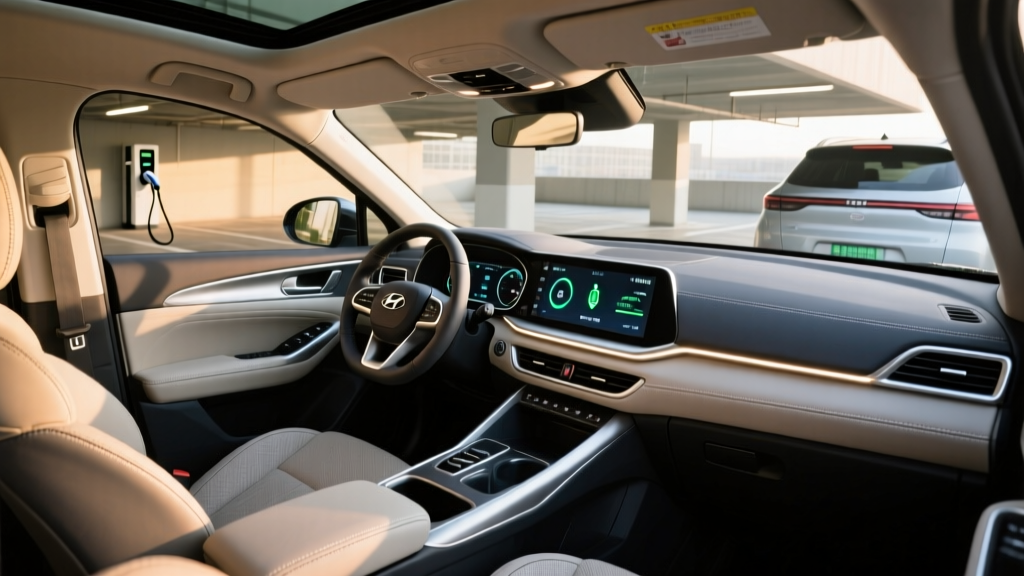
The current-generation Hyundai Santa Fe Hybrid pairs a turbocharged 1.6-liter four-cylinder with an electric motor for 232 combined horsepower — wrapped in a squared-off, Land Rover-esque body that maximizes interior volume. The Hyundai Santa Fe Hybrid interior stands out in the midsize SUV segment for its dual 12.3-inch curved display, available H-Tex synthetic leather, and genuine three-row usability. For buyers who want plug-in electric commuting with gas-engine road-trip flexibility, the Santa Fe Plug-in Hybrid variant adds 31 miles of EPA-rated electric-only range and a significantly larger battery.
Hyundai Santa Fe Hybrid Interior: Space, Materials, and Tech
Hyundai redesigned the Santa Fe from the ground up with interior-first design thinking, and it shows. The cabin uses a horizontal, wide-dashboard layout with soft-touch materials across the upper dash and door panels. Even in the base Blue trim, the fit and finish rivals competitors costing $10,000 more.
Seating and Cargo Capacity
The Santa Fe comes standard with three rows, though the third row is best suited for children or short trips. Cargo volume is generous for the class:
- Behind third row: ~14.6 cu ft
- Behind second row (third row folded): ~40.5 cu ft
- Behind front row (all rear seats folded): ~79.6 cu ft
The hybrid battery pack is mounted under the front seats, so cargo volume is identical between the HEV and PHEV variants — a practical advantage over competitors that sacrifice trunk space for electrification.
Tech and Infotainment
Both hybrid variants feature Hyundai's dual-screen curved panoramic display: a 12.3-inch digital instrument cluster and a 12.3-inch touchscreen running the latest infotainment software with wireless Apple CarPlay and Android Auto. Higher trims (Limited, Calligraphy) add a head-up display, digital key, dual wireless phone charging pads, and a UV-C sterilization tray in the glovebox. Physical climate controls remain, which is a practical win over touchscreen-only HVAC systems.
Powertrain and Performance Specs
| Spec | Santa Fe Hybrid (HEV) | Santa Fe Plug-in Hybrid (PHEV) |
|---|---|---|
| Engine | 1.6L turbo I4 | 1.6L turbo I4 |
| Combined HP | 232 hp | 261 hp |
| Combined Torque | 271 lb-ft | 271 lb-ft |
| Electric Motor | 47.7 kW (64 hp) | 74 kW (99 hp) |
| Transmission | 6-speed auto | 6-speed auto |
| Drivetrain | AWD (standard) | AWD (standard) |
| Battery Capacity | 1.49 kWh (Li-ion) | 13.8 kWh (Li-ion) |
| EPA Electric-Only Range | N/A (not a plug-in) | 31 miles |
| Total Combined Range | ~540 miles | ~430 miles (gas + electric) |
| 0-60 mph (est.) | ~7.5 sec | ~7.0 sec |
| Towing Capacity | 2,000 lbs | 2,000 lbs |
The PHEV's larger motor and battery give it a meaningful power advantage (261 hp vs 232 hp) and stronger electric-only acceleration for around-town driving. Both variants come standard with HTRAC all-wheel drive, which uses the electric motor to power the rear axle in the hybrid system.
Fuel Economy: EPA MPG and Real-World Efficiency
| Metric | HEV (Blue) | HEV (SEL/Limited) | PHEV (MPGe, electric) | PHEV (MPG, gas-only) |
|---|---|---|---|---|
| City | 36 MPG | 35 MPG | 79 MPGe | 33 MPG |
| Highway | 35 MPG | 34 MPG | — | 30 MPG |
| Combined | 36 MPG | 34 MPG | 79 MPGe | 32 MPG |
Source: fueleconomy.gov (EPA estimates). Actual mileage will vary.
PHEV Charging: Battery, Charge Time, and Home Setup
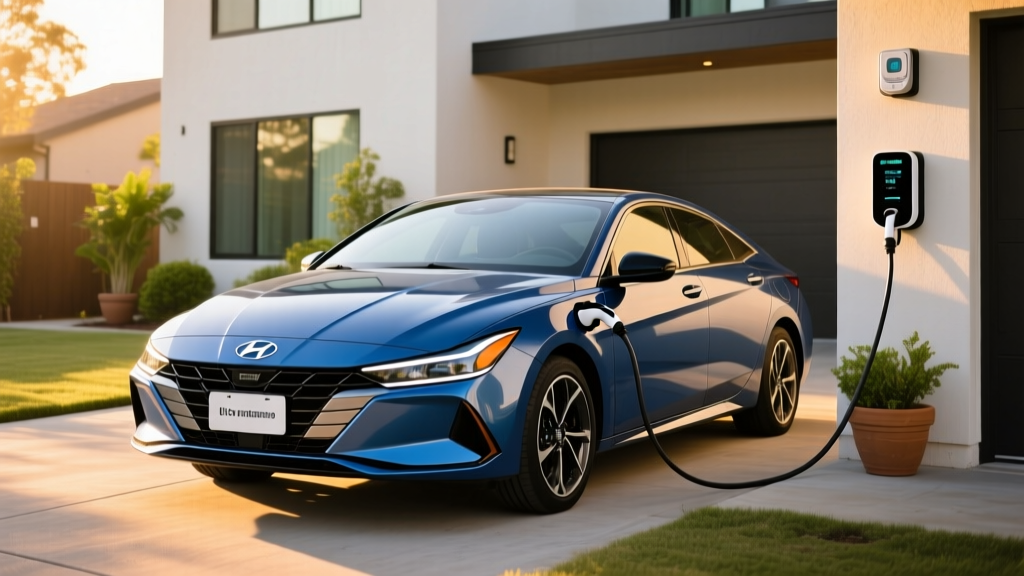
The Santa Fe Plug-in Hybrid's 13.8 kWh lithium-ion battery supports Level 1 and Level 2 AC charging. There is no DC fast charging capability — this is typical for PHEVs, whose smaller batteries don't justify the added cost and weight of DC hardware.
- Level 1 (120V household outlet): ~2.0 kW — full charge in approximately 7 hours. Overnight charging works fine for daily commuters.
- Level 2 (240V home charger, 32A): ~7.2 kW — full charge in approximately 2 hours. Ideal for topping up midday or quick turnaround between errands.
Home Level 2 installation for a PHEV typically costs $500–$1,800 depending on whether your electrical panel needs an upgrade. Since PHEV batteries are small, you don't need the highest-amperage charger — a basic 32A unit (~$300–$500 for the hardware) is sufficient.
Pricing, Trims, and Tax Credit Eligibility
The 2026 Hyundai Santa Fe Hybrid starts at approximately $39,500 MSRP (Blue trim, including destination), while the Plug-in Hybrid begins around $43,500. Upper trims (Limited, Calligraphy) push the PHEV past $50,000.
- Buyer AGI must not exceed $150,000 (single) / $300,000 (joint)
- Vehicle MSRP must not exceed $80,000 (SUVs)
- Battery components and critical minerals must meet sourcing thresholds
- Credit can be transferred to the dealer at point of sale as a purchase discount
Reliability, Battery Warranty, and Replacement Cost
Hyundai's hybrid systems have proven reliable in real-world ownership. The 1.6L turbo engine is well-established across the Hyundai-Kia lineup. The conventional hybrid's 1.49 kWh battery is small and operates within a narrow state-of-charge window (roughly 40–60% SoC), which minimizes degradation. PHEV batteries face more cycling but benefit from active thermal management.
If a hybrid battery replacement is needed outside warranty, expect $2,500–$4,500 for the HEV pack and $5,000–$8,000 for the PHEV pack (parts and labor). However, most hybrid batteries outlast 150,000+ miles with minimal capacity loss, and Hyundai's 10-year coverage means the vast majority of original owners will never face this cost.
Hybrid vs PHEV vs Full EV: Which Santa Fe Fits You?
- You can't charge at home (apartment, street parking)
- You want maximum simplicity — no plug, no behavior change
- Your budget is tighter (~$4,000 less than PHEV)
- You drive mostly highway miles where PHEV electric range adds little
- You can install a Level 2 charger at home
- Your daily commute is under 30 miles round-trip
- You want electric-only weekday driving with gas flexibility for road trips
- You want the extra 29 hp from the larger motor
- You have reliable home Level 2 charging
- You want the lowest per-mile fuel cost (~$0.04–0.06/mi vs ~$0.10/mi hybrid)
- You want to eliminate oil changes and engine maintenance
- You qualify for the full $7,500 federal EV credit
Pros and Cons
- Spacious, boxy interior with standard third row
- HEV achieves 36 MPG combined — strong for a 3-row AWD SUV
- PHEV offers 31 mi electric range for daily commuting
- 10-year/100,000-mi hybrid battery warranty
- Premium interior materials rival luxury competitors
- Standard HTRAC AWD on all trims
- Third row is tight for adults on long trips
- HEV doesn't qualify for federal tax credits
- PHEV lacks DC fast charging
- Starting price (~$39,500 HEV) is higher than some rivals
- Highway fuel economy drops noticeably above 75 mph
- Towing limited to 2,000 lbs (not competitive for heavy hauling)
Frequently Asked Questions
How many MPG does the Hyundai Santa Fe Hybrid get?
The 2026 Santa Fe Hybrid Blue trim is EPA-rated at 36 city / 35 highway / 36 combined MPG. Higher trims (SEL, Limited) drop slightly to 35/34/34 MPG due to larger wheels and added weight. In real-world city driving, many owners see 37–39 MPG thanks to aggressive regenerative braking. Highway cruising at 75+ mph typically yields 30–32 MPG.
How far can the Santa Fe Plug-in Hybrid go on electric only?
The PHEV delivers 31 miles of EPA-rated electric-only range from its 13.8 kWh battery. This covers most daily commutes without using any gasoline. Once the battery is depleted, the vehicle seamlessly switches to hybrid mode, achieving 32 MPG combined. Total range (electric + gas) exceeds 430 miles.
Is the Hyundai Santa Fe Hybrid reliable?
Hyundai's hybrid powertrain has a strong reliability track record. The 1.6L turbocharged engine is shared across multiple Hyundai-Kia models with millions of units on the road. The hybrid battery is covered by a 10-year/100,000-mile warranty — one of the best in the industry. Battery replacement outside warranty costs $2,500–$4,500 (HEV) but is rarely needed before 150,000+ miles.
Does the Santa Fe Hybrid qualify for a tax credit?
The conventional hybrid (HEV) does not qualify for the §30D federal tax credit because it cannot be plugged in. The Plug-in Hybrid (PHEV) may qualify for up to $3,750, subject to IRS battery-sourcing requirements, buyer income caps ($150K single / $300K joint), and the $80,000 SUV MSRP cap. The credit can be applied as a point-of-sale discount at the dealer. Always confirm eligibility at IRS.gov before purchasing.
Can I charge the Santa Fe Hybrid at home?
Only the Plug-in Hybrid (PHEV) can be charged at home. The conventional hybrid (HEV) has no plug — it charges its small battery internally through regenerative braking and the gas engine. PHEV owners can use a standard 120V outlet (~7 hours for a full charge) or install a 240V Level 2 home charger (~2 hours).
What's the difference between the Santa Fe Hybrid and the Tucson Hybrid?
The Santa Fe is larger (midsize, 3-row, ~80 cu ft max cargo) while the Tucson is compact (2-row, ~80 cu ft with seats folded but less overall volume). The Santa Fe Hybrid offers 232 hp and 36 MPG combined; the Tucson Hybrid offers 226 hp and up to 38 MPG combined. The Santa Fe costs roughly $5,000–$7,000 more but provides genuine three-row seating and a more premium interior.