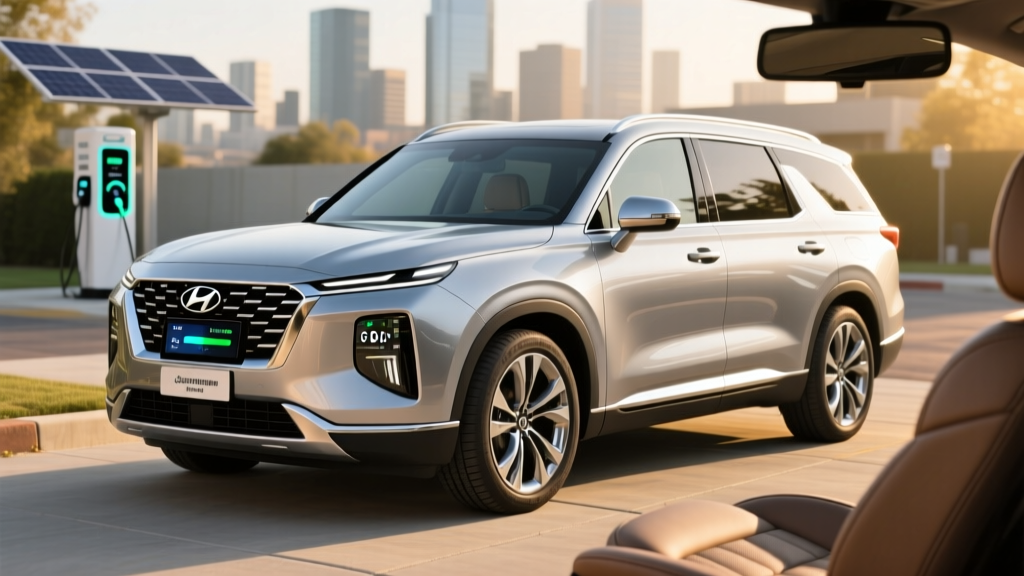
The 2026 Hyundai Palisade Calligraphy Hybrid arrives as the most electrified version of Hyundai's flagship three-row SUV, pairing a turbocharged four-cylinder with an electric motor in a conventional hybrid (HEV) configuration. For buyers who want three-row utility and luxury-tier appointments without plugging in, the Calligraphy Hybrid sits at the top of the Palisade lineup. But does the hybrid powertrain deliver meaningful fuel savings over the gas model, and how does it stack up against plug-in hybrid and full-electric alternatives? Here's the data-driven breakdown.
Hyundai Palisade Calligraphy Hybrid: Quick Verdict
The 2026 Palisade Calligraphy Hybrid is a conventional hybrid — it does not plug in. It recovers energy through regenerative braking and uses its electric motor to assist the gas engine, shut it off at stops, and enable brief low-speed electric-only driving. The result is roughly 30–35% better combined fuel economy than the non-hybrid V6 Palisade, with no change to your daily routine. If you want plug-in electric-only commuting range, you'll need to look elsewhere — Hyundai does not currently offer a PHEV version of the Palisade for the US market.
| Spec | 2026 Palisade Calligraphy Hybrid |
|---|---|
| Powertrain | 1.6L Turbo 4-cyl + electric motor (HEV) |
| Combined Horsepower | ~258 hp |
| Transmission | 6-speed automatic |
| Drivetrain | AWD (HTRAC) |
| EPA Fuel Economy (est.) | 27 city / 28 hwy / 27 combined MPG |
| Gas Model (V6 AWD) EPA | 19 city / 24 hwy / 21 combined MPG |
| Battery | ~1.5 kWh lithium-ion (self-charging) |
| Plug-in Required? | No — conventional HEV |
| 0–60 mph (est.) | ~7.8 seconds |
| Towing Capacity | Up to 5,000 lbs (with tow package) |
| Seating | 7 passengers (2nd-row captains) or 8 |
| Cargo (behind 3rd row) | ~20 cu ft |
| Base MSRP (Calligraphy Hybrid) | ~$55,500 |
| Federal EV Tax Credit | Not eligible (HEV) |
Note: Specs listed are based on Hyundai's announced 2026 Palisade Hybrid configuration and comparable model-year data from fueleconomy.gov. Final EPA ratings and pricing may vary at launch. Confirm exact figures with Hyundai or the EPA database.
HEV vs PHEV: Understanding the Palisade Hybrid
| Feature | HEV (Palisade Hybrid) | PHEV (e.g., Tucson PHEV) | BEV (e.g., Ioniq 9) |
|---|---|---|---|
| Plugs in? | No | Yes | Yes |
| Electric-only range | ~1 mile at low speed | 30–35 miles | 250–350+ miles |
| Battery size | ~1.5 kWh | ~13–18 kWh | 77–110+ kWh |
| Home charging needed? | No | Recommended (Level 2) | Essential |
| Federal tax credit (§30D) | Not eligible | Up to $7,500* | Up to $7,500* |
| Maintenance | Standard gas-car service | Gas + electric systems | Minimal (no oil changes) |
| Best for | No charging access; wants better MPG | Short commute + home charging | Full electric lifestyle |
The Palisade Hybrid is a conventional hybrid (HEV). Its small ~1.5 kWh battery charges itself through regenerative braking and engine operation. You never plug it in. This is fundamentally different from a plug-in hybrid (PHEV) like the Hyundai Tucson PHEV, which carries a larger battery (typically 13–18 kWh), offers 30+ miles of electric-only driving, and requires a Level 2 home charger to realize its full benefit.
Hyundai does not offer a Palisade PHEV in the US for 2026. If you need three rows and plug-in capability, your closest alternatives are the Kia Sorento PHEV (sharing a platform with the Palisade, ~32 miles electric-only) or stepping up to a full BEV three-row SUV like the upcoming Hyundai Ioniq 9.
Fuel Economy: EPA Numbers and Real-World MPG
| Configuration | City MPG | Highway MPG | Combined MPG |
|---|---|---|---|
| Palisade Hybrid AWD (est.) | 27 | 28 | 27 |
| Palisade V6 Gas AWD | 19 | 24 | 21 |
| Kia Sorento Hybrid AWD | 34 | 34 | 34 |
| Toyota Grand Highlander Hybrid | 36 | 32 | 35 |
How many MPG does this hybrid get? Based on the Palisade Hybrid's powertrain architecture and comparable Hyundai/Kia HEV models, expect an EPA-estimated 27 MPG combined (27 city / 28 highway). This represents a meaningful gain over the V6 gas Palisade's 21 MPG combined — roughly 6 fewer gallons per 1,000 miles driven.
Real-world MPG reality check: Hybrids typically exceed their EPA city estimates in stop-and-go traffic because regenerative braking recovers energy that gas cars waste as heat. On highway-only road trips at 75+ mph, expect the hybrid advantage to narrow — the electric motor contributes less at sustained high speeds. In mixed driving, owners of similar Hyundai/Kia HEVs report real-world figures within 1–2 MPG of the EPA sticker. In cold weather (below 30°F), expect a 5–10% MPG reduction as the engine runs more frequently for cabin heat and battery warmup.
For context, at $3.50/gallon and 15,000 miles/year, the hybrid saves approximately $620 annually compared to the gas V6 Palisade. Over a 5-year ownership period, that's roughly $3,100 in fuel savings — not enough to offset the hybrid's higher MSRP premium on its own, but meaningful when combined with reduced engine wear from the hybrid system's start-stop and regen capabilities.
Powertrain and Performance
The 2026 Palisade Hybrid pairs a 1.6-liter turbocharged four-cylinder engine with an electric motor integrated into the transmission housing. Combined output is approximately 258 horsepower and 277 lb-ft of torque, routed through a 6-speed automatic to Hyundai's HTRAC all-wheel-drive system.
This is a parallel hybrid architecture — both the engine and motor can drive the wheels simultaneously, or the motor can handle low-speed maneuvering alone. The electric motor provides instant torque fill at low RPMs, which makes the Palisade Hybrid feel more responsive from a stop than the gas V6 despite having fewer cylinders. The 0–60 mph time is estimated at ~7.8 seconds, comparable to the V6 model.
The trade-off: the turbo-four hybrid lacks the effortless highway passing punch of a larger naturally aspirated engine. At speeds above 60 mph, you'll hear the engine working harder under heavy acceleration. For most family-SUV duty cycles — school runs, grocery trips, highway cruises — the powertrain is smooth and adequately quick. If you tow frequently (up to 5,000 lbs with the tow package), the hybrid system handles trailer loads competently, but expect fuel economy to drop to the mid-teens under tow.
Battery Warranty, Reliability, and Replacement Cost
Hyundai Hybrid Battery Warranty
- Hybrid battery: 10 years / 100,000 miles (original owner)
- Hybrid system components: 10 years / 100,000 miles
- Powertrain (engine/transmission): 10 years / 100,000 miles
- Capacity retention threshold: Battery replaced if capacity drops below ~70% during warranty period
Note: Warranty terms transfer to second owners at reduced coverage (typically 5 yr/60,000 mi). Verify current terms at HyundaiUSA.com.
Is this hybrid reliable and what is battery replacement cost? Hyundai's hybrid systems have demonstrated strong reliability in the Tucson Hybrid and Sonata Hybrid over multiple model years. The Palisade Hybrid uses the same proven architecture. The hybrid battery is a ~1.5 kWh lithium-ion pack — far smaller and less expensive than a full EV battery.
If replacement is needed out of warranty (rare before 150,000+ miles based on industry data), a conventional hybrid battery replacement typically costs $2,000–$4,000 including labor — a fraction of EV battery replacement costs ($8,000–$20,000+). This is because the HEV battery is small and modular. Hyundai's 10-year/100,000-mile hybrid battery warranty is among the best in the industry and provides strong peace of mind for first owners.
The hybrid system also reduces wear on conventional components: regenerative braking extends brake pad life (many hybrid owners report 80,000+ miles on original pads), and the engine's auto start-stop reduces idle hours. Expect standard maintenance intervals — oil changes, coolant, transmission fluid — with no special hybrid-specific service requirements beyond periodic battery health checks at the dealer.
Pricing, Trims, and Tax Credit Eligibility
The 2026 Hyundai Palisade Calligraphy Hybrid sits at the top of the lineup. Estimated pricing:
| Trim | Estimated MSRP |
|---|---|
| Palisade Hybrid SEL Premium | ~$48,000 |
| Palisade Hybrid Limited | ~$52,000 |
| Palisade Hybrid Calligraphy | ~$55,500 |
The Calligraphy trim adds Nappa leather seats, a head-up display, premium audio, massaging front seats, a digital rearview mirror, and Hyundai's full suite of ADAS features (Highway Driving Assist 2, which is an SAE Level 2 driver-assistance system — not self-driving; you must remain engaged).
Does it qualify for any tax credit? The Palisade Hybrid is a conventional HEV and does not qualify for the federal §30D clean vehicle tax credit (up to $7,500). That credit applies only to plug-in vehicles (PHEVs and BEVs) that meet battery sourcing, MSRP, and buyer income requirements per current IRS rules. Some states offer rebates for conventional hybrids, but these vary by jurisdiction — check your state energy office or dealer for local programs.
The hybrid premium over the gas Calligraphy is estimated at $1,500–$2,500. At ~$620/year in fuel savings, the payback period is roughly 3–4 years for average drivers. If you plan to keep the vehicle 5+ years, the hybrid makes financial sense even without a tax credit.
Who Should Choose the Palisade Hybrid vs EV or Gas?
Decision Framework
Choose the Palisade Hybrid if:
- You want three rows and better MPG without changing your fueling routine
- You lack access to home Level 2 charging (apartment, street parking)
- You regularly drive 15,000+ miles/year where fuel savings compound
- You tow occasionally and need gas-engine range flexibility
- You plan to keep the SUV 5+ years (warranty + fuel savings justify premium)
Choose a gas Palisade if:
- You drive fewer than 10,000 miles/year (fuel savings won't offset hybrid premium)
- You want the lowest possible purchase price
Choose a PHEV (e.g., Kia Sorento PHEV) if:
- Your daily commute is under 30 miles and you have home Level 2 charging
- You want electric-only weekday driving with gas-engine weekend flexibility
- You qualify for the §30D tax credit (up to $7,500)
Choose a full BEV (e.g., Ioniq 9, Rivian R1S) if:
- You have reliable home charging and want zero tailpipe emissions
- You want the lowest per-mile fuel cost and minimal maintenance
- You qualify for the full $7,500 federal tax credit
Calligraphy Trim: What You Get for the Premium
The Calligraphy is Hyundai's luxury-tier trim, and it delivers genuine premium features that compete with entry-level luxury SUVs at lower cost:
- Nappa leather seating surfaces with quilted stitching
- Heated and ventilated front seats; heated second-row captains
- Ergo Motion driver's seat with massage function
- Head-up display (HUD) with hybrid energy-flow graphics
- Digital rearview mirror (camera-fed)
- Premium Lexicon audio system
- Highway Driving Assist 2 (Level 2 ADAS with lane-centering and adaptive cruise)
- Remote Smart Parking Assist (vehicle self-parks via key fob)
- Acoustic laminated front glass for cabin quietness
The hybrid system adds minimal weight and does not compromise cargo volume compared to the gas model. The ~1.5 kWh battery pack is packaged under the rear seats, preserving the flat load floor and third-row usability that makes the Palisade competitive with the Toyota Grand Highlander and Mazda CX-90.
Frequently Asked Questions
How many MPG does the 2026 Palisade Calligraphy Hybrid get?
Estimated EPA rating: 27 city / 28 highway / 27 combined MPG. Real-world figures typically fall within 1–2 MPG of the sticker in mixed driving, with city driving sometimes exceeding the EPA estimate thanks to regenerative braking.
Does the Palisade Hybrid plug in?
No. It is a conventional hybrid (HEV). The battery charges itself through regenerative braking and the gas engine. You fuel it like any other gas vehicle — no plug, no charger, no behavior change required.
How far can it go on electric only?
As a conventional HEV, the Palisade Hybrid can only travel approximately 1 mile or less at very low speeds (under 25 mph) on electric power alone. It is not designed for electric-only commuting. For that, you need a PHEV with 30+ miles of electric range.
Is the hybrid battery reliable and expensive to replace?
Hyundai's hybrid batteries have strong reliability records. The battery is covered by a 10-year/100,000-mile warranty. Out-of-warranty replacement (rare before 150,000+ miles) typically costs $2,000–$4,000 — far less than an EV battery replacement.
Does the Palisade Hybrid qualify for the $7,500 federal tax credit?
No. The federal §30D clean vehicle credit applies only to plug-in vehicles (PHEVs and BEVs). Conventional hybrids like the Palisade HEV are not eligible. Check your state for any local hybrid incentives.
Hybrid vs PHEV vs EV — which fits me?
Choose the HEV if you lack home charging access and want better MPG with zero routine changes. Choose a PHEV if you can charge at home and want 30+ miles of electric commuting. Choose a BEV if you have reliable charging and want the lowest operating cost with zero tailpipe emissions.
Can I tow with the Palisade Hybrid?
Yes. With the factory tow package, the Palisade Hybrid can tow up to 5,000 lbs. Expect fuel economy to drop significantly under tow (mid-teens MPG), but the hybrid system handles trailer loads without issue.
What's the difference between the Palisade Hybrid and the Kia Sorento Hybrid?
Both share Hyundai Motor Group's hybrid architecture. The Palisade is larger (three rows standard, more cargo), while the Sorento Hybrid achieves higher MPG (~34 combined) in a slightly smaller package. The Sorento also offers a PHEV variant with ~32 miles of electric-only range.
Pros
- 27 MPG combined — ~30% improvement over gas V6
- No plug-in required; zero change to fueling habits
- Industry-leading 10-year/100,000-mile hybrid warranty
- Calligraphy trim delivers luxury features at mainstream pricing
- Three-row seating and 5,000-lb towing preserved
- Regenerative braking extends brake pad life significantly
Cons
- Not eligible for federal §30D tax credit
- MPG trails Toyota Grand Highlander Hybrid (35 combined)
- No PHEV option for electric-only commuting
- Turbo-four sounds strained under heavy acceleration
- Calligraphy trim pushes price above $55,000
- Hybrid premium takes 3–4 years to recoup via fuel savings