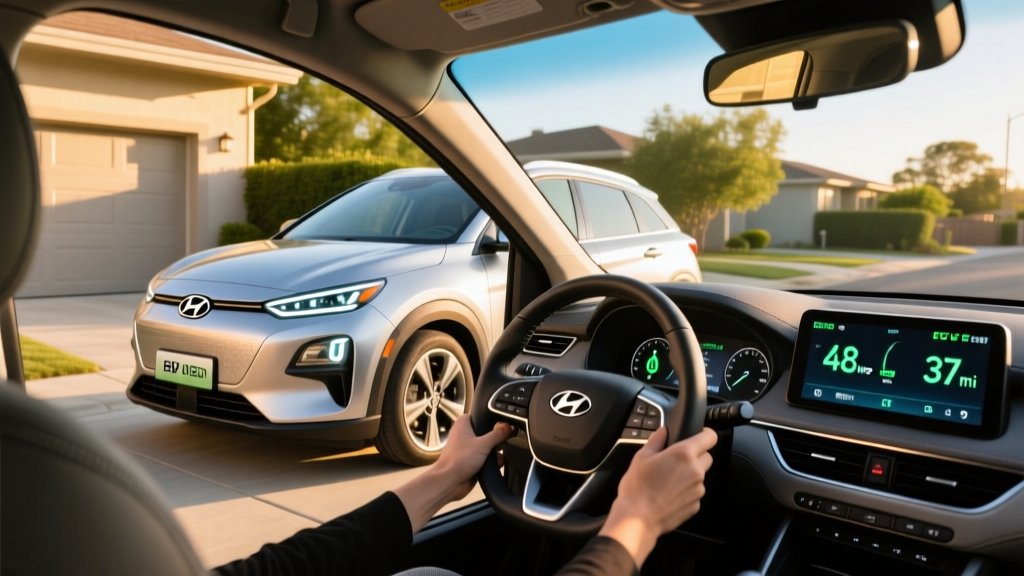
The Hyundai Niro occupies a rare sweet spot in the electrified-vehicle market: it's one of the few nameplates that lets you choose between a conventional hybrid (HEV) and a plug-in hybrid (PHEV) on the same practical, spacious crossover platform. For 2026, Hyundai continues to refine the second-generation Niro with updated infotainment, standard advanced driver-assistance features, and efficiency numbers that rival the best in the compact hybrid SUV class.
Whether you're comparing it against a Toyota RAV4 Hybrid, a Honda CR-V Hybrid, or wondering if you should skip straight to a full battery-electric vehicle, this guide breaks down every number that matters — EPA MPG, real-world fuel economy, PHEV electric-only range, battery warranty, pricing, and federal tax credit eligibility under current IRS §30D rules.
2026 Hyundai Niro Hybrid at a Glance: HEV vs PHEV Specs
Before we get into the details, it's critical to understand that Hyundai sells the Niro in two distinct electrified flavors. The conventional hybrid (HEV) never needs to be plugged in — it generates all its electricity from the gasoline engine and regenerative braking. The plug-in hybrid (PHEV) has a larger battery that you can charge from a wall outlet or public charger, giving it a meaningful electric-only driving range before the gas engine kicks in.
| Specification | Niro Hybrid (HEV) | Niro Plug-in Hybrid (PHEV) |
|---|---|---|
| Powertrain | 1.6L GDI 4-cyl + electric motor | 1.6L GDI 4-cyl + larger electric motor |
| Combined Horsepower | 139 hp | 180 hp |
| Transmission | 6-speed dual-clutch automatic | 6-speed dual-clutch automatic |
| Battery Capacity | 1.56 kWh (lithium-ion polymer) | 11.1 kWh usable (lithium-ion polymer) |
| EPA Combined MPG | 53 MPG (57 city / 49 hwy) | 48 MPG combined (gas only) / 108 MPGe |
| Electric-Only Range | N/A (not plug-in) | 33 miles |
| Total Combined Range | ~570 miles | ~440 miles (33 electric + ~407 gas) |
| Plug-In Charging | No | Yes — Level 1 & Level 2 |
| DC Fast Charging | No | No |
| Starting MSRP (2026) | $28,585 | $35,685 |
Source: fueleconomy.gov and Hyundai USA specifications. Real-world results may vary based on driving conditions, climate, and habits.
Fuel Economy: EPA MPG and Real-World Results
The headline number for the Niro Hybrid (HEV) is an EPA-estimated 53 MPG combined, with a remarkable 57 MPG city and 49 MPG highway on the SE and LX trims. Higher trims (EX, EX Touring) with larger 18-inch wheels drop slightly to 49 MPG combined (53 city / 45 highway) due to increased rolling resistance and weight.
| Niro HEV Trim | City MPG | Highway MPG | Combined MPG |
|---|---|---|---|
| SE / LX | 57 | 49 | 53 |
| EX / EX Touring | 53 | 45 | 49 |
Hybrids typically exceed their EPA city estimates in real-world stop-and-go driving because regenerative braking recaptures energy that a gas car wastes as heat. In mixed suburban driving, owners frequently report 54–58 MPG in the SE trim. Highway-only trips at 75+ MPH tend to fall closer to 44–47 MPG, as aerodynamic drag dominates and the electric motor assists less.
For the Niro PHEV, the 108 MPGe figure applies only when you're driving within the 33-mile electric-only window using grid-charged electricity. Once the battery depletes, the gasoline engine takes over and delivers an EPA-estimated 48 MPG combined — still excellent, though slightly less than the HEV due to the PHEV's heavier battery pack.
PHEV Electric-Only Range and Charging Details
The Niro PHEV's 11.1 kWh battery delivers an EPA-estimated 33 miles of electric-only driving. That covers the majority of American daily commutes — the U.S. average one-way commute is roughly 16 miles, meaning a round-trip commute fits within the electric envelope for many drivers.
Charging the PHEV battery is straightforward, but there's an important limitation: the Niro PHEV cannot DC fast charge. You're limited to AC charging only:
- Level 1 (120V household outlet): ~11 hours from empty to full using the included portable cord. Fine for overnight top-ups if your daily driving is under 30 miles.
- Level 2 (240V home or public charger): ~2 hours 45 minutes from empty to full at the vehicle's maximum 7.2 kW onboard charge rate. This is the practical daily charging method — plug in when you get home, wake up to a full battery every morning.
Real-World PHEV Range Note: Expect 28–30 miles of electric range in cold weather (below 40°F) or at sustained highway speeds above 70 MPH. Battery efficiency drops in low temperatures, and the climate control system draws from the same pack. In mild conditions with city-speed driving, some owners report 35+ miles before the engine engages.
Powertrain and Driving Dynamics
Both Niro variants use Hyundai's 1.6-liter GDI four-cylinder engine paired with an electric motor integrated into a 6-speed dual-clutch transmission (DCT). This is a meaningful differentiator: unlike the Toyota RAV4 Hybrid's CVT-style power-split device, the Niro's DCT delivers more direct, gear-based acceleration that feels familiar to anyone coming from a conventional automatic.
The HEV produces 139 combined horsepower, which is adequate for city and suburban driving but can feel strained during highway merges with a full load. The 0–60 MPH time sits around 9.3 seconds — not quick, but competitive with the Honda CR-V Hybrid and Toyota Corolla Cross Hybrid.
The PHEV bumps output to 180 combined horsepower thanks to a more powerful electric motor (83 hp vs. 43 hp in the HEV). This transforms the driving experience: 0–60 MPH drops to approximately 7.2 seconds, and electric-only acceleration is surprisingly punchy up to about 45 MPH. The extra power makes the PHEV the better choice for anyone who regularly carries passengers or cargo.
Pricing, Trims, and Tax Credit Eligibility
Here's how the 2026 Niro lineup breaks down by MSRP:
| Model & Trim | MSRP | Key Features |
|---|---|---|
| Niro HEV SE | $28,585 | 16" wheels, 10.25" touchscreen, wireless CarPlay/Android Auto, SmartSense ADAS |
| Niro HEV EX | $31,585 | 18" wheels, heated front seats, smart power liftgate |
| Niro HEV EX Touring | $34,285 | SynTex leather, ventilated seats, Harman Kardon audio |
| Niro PHEV SE | $35,685 | 33-mi EV range, Level 2 charging, heat pump |
| Niro PHEV XRT | $37,685 | Rugged styling, roof rails, all-weather package |
| Niro PHEV SX / SX Touring | $39,085–$40,785 | Full LED lighting, premium audio, heated rear seats |
Federal Tax Credit: What You Need to Know
Under current IRS §30D rules, the Niro PHEV may qualify for up to $7,500 in federal tax credits, but eligibility depends on several factors that change frequently:
- Battery sourcing requirements: The battery's critical minerals and components must meet escalating domestic-content thresholds that tighten each year. Hyundai's supply chain compliance varies by model year — always verify the current year's status on IRS.gov before purchasing.
- MSRP cap: The Niro PHEV qualifies as an SUV under §30D rules, meaning the MSRP cap is $80,000 — all trims clear this easily.
- Buyer income cap: Modified adjusted gross income (MAGI) must not exceed $150,000 (single), $225,000 (head of household), or $300,000 (joint filers).
- Point-of-sale transfer: As of 2024, qualifying buyers can transfer the credit to the dealer at purchase, reducing the vehicle price upfront rather than waiting to claim it on a tax return.
Important: The conventional Niro HEV does not qualify for the §30D federal tax credit. That credit is reserved for plug-in vehicles (PHEVs and BEVs) with batteries above a minimum capacity threshold. Some states and utilities offer separate rebates for conventional hybrids — check your local programs.
Battery Warranty, Reliability, and Replacement Costs
Hyundai backs both the Niro HEV and PHEV hybrid battery systems with one of the strongest warranties in the industry:
- Hybrid/EV battery warranty: 10 years / 100,000 miles (whichever comes first) for the original owner. In states that follow California Air Resources Board (CARB) emissions standards — including CA, NY, MA, WA, OR, and several others — coverage extends to 10 years / 150,000 miles.
- Hybrid system components: The electric motor, inverter, and related powertrain components carry the same 10-year/100,000-mile coverage.
- General powertrain warranty: 10 years / 100,000 miles.
Hybrid battery degradation is generally a non-issue for the Niro. The HEV's 1.56 kWh battery is small and shallow-cycled — it rarely charges above 60% or below 40% state of charge, which dramatically extends cell life. The PHEV's 11.1 kWh pack sees deeper cycling but benefits from active thermal management. Industry data from sources like Consumer Reports indicates that modern lithium-ion hybrid batteries from major manufacturers routinely last 150,000–200,000+ miles before capacity drops below 70% of original.
If replacement is needed out of warranty, a Niro hybrid battery typically costs $2,500–$4,500 for the HEV and $5,000–$8,000 for the PHEV pack, including labor. Third-party and refurbished options are becoming more available as the platform ages, which should reduce costs further.
Who Should Buy the Niro Hybrid vs. PHEV vs. Full EV?
Choosing between the Niro HEV, Niro PHEV, and a full battery-electric vehicle (BEV) comes down to your daily driving pattern, charging access, and budget.
Choose the Niro HEV If:
- You have no access to plug-in charging at home or work
- Your daily driving is mostly city and suburban (where the 57 MPG city shines)
- You want the lowest purchase price and simplest ownership — no charging cables, no electricity costs to track
- You regularly take long road trips and don't want to plan around charging stations
Choose the Niro PHEV If:
- You can install a Level 2 charger at home or have reliable workplace charging
- Your daily round-trip commute is under ~30 miles (you'll rarely use gas on weekdays)
- You want electric-only driving for most errands but need gas-engine flexibility for road trips
- You qualify for the §30D tax credit, which can reduce the PHEV's effective price to near the HEV's
Consider a Full EV (like the Hyundai Ioniq 5 or Kia EV6) If:
- You have reliable home Level 2 charging and your daily driving is under 250 miles
- You want to eliminate gasoline costs entirely and minimize maintenance (no oil changes, no exhaust system)
- You're willing to accept a higher upfront cost in exchange for lower per-mile operating costs
- You want 300+ miles of EPA range and DC fast charging for road trips
How the Niro Compares to Rival Hybrids
The Niro's closest competitors are the Toyota RAV4 Hybrid (41 MPG combined, $32,000+), Honda CR-V Hybrid (40 MPG combined, $35,000+), and Toyota Prius (57 MPG combined, but sedan-only). The Niro HEV's 53 MPG combined beats both the RAV4 and CR-V hybrids by a wide margin, though it's a slightly smaller vehicle with less rear cargo space (22.8 cu ft behind the rear seats vs. ~37 cu ft in the RAV4).
The Niro PHEV's 33-mile electric range is competitive with the Toyota RAV4 Prime (42 miles, but $44,000+ MSRP) and significantly longer than the Honda CR-V PHEV is not currently offered in the U.S. market. The RAV4 Prime's higher electric range and standard AWD justify its premium for some buyers, but the Niro PHEV's ~$7,000 lower starting price is a compelling offset.
Frequently Asked Questions
How many MPG does the 2026 Hyundai Niro Hybrid get?
The Niro Hybrid SE/LX achieves an EPA-estimated 57 city / 49 highway / 53 combined MPG. The EX and EX Touring trims with 18-inch wheels rate at 53 city / 45 highway / 49 combined. In real-world city driving with frequent stops, many owners report exceeding the EPA city estimate thanks to aggressive regenerative braking.
How far can the Niro PHEV go on electric only?
The EPA rates the Niro PHEV at 33 miles of electric-only range. In mild weather with moderate city speeds, expect 30–35 miles. In cold weather or sustained highway driving above 70 MPH, expect 25–28 miles before the gasoline engine seamlessly engages.
Does the Hyundai Niro Hybrid qualify for a tax credit?
The conventional Niro HEV does not qualify for the federal §30D clean vehicle tax credit — that credit is for plug-in vehicles only. The Niro PHEV may qualify for up to $7,500, subject to battery-sourcing requirements, buyer income limits ($150K single / $300K joint), and the $80,000 SUV MSRP cap. Always verify current eligibility at IRS.gov before purchasing, as sourcing rules change annually.
Is the Hyundai Niro Hybrid reliable?
Hyundai's hybrid powertrain has proven durable across two generations of the Niro. The hybrid battery carries a 10-year/100,000-mile warranty (10/150,000 in CARB states). The 6-speed dual-clutch transmission has been refined over successive model years. Overall reliability ratings from sources like J.D. Power and Consumer Reports place the Niro at or above average for the compact hybrid SUV segment.
What does a Niro hybrid battery replacement cost?
Out-of-warranty replacement runs approximately $2,500–$4,500 for the HEV battery and $5,000–$8,000 for the PHEV battery, including labor. Given the 10-year/100,000-mile warranty and typical hybrid battery lifespans of 150,000+ miles, most owners will never face this cost. Refurbished and third-party replacement options are increasingly available at lower prices.
Can I charge the Niro Hybrid at home?
The conventional Niro HEV cannot be plugged in — it's a self-charging hybrid that uses regenerative braking and the gasoline engine to maintain its small battery. The Niro PHEV can be charged at home using a standard 120V outlet (~11 hours to full) or a 240V Level 2 charger (~2 hours 45 minutes). Neither model supports DC fast charging.
Is the Niro Hybrid good for road trips?
Yes. The HEV's ~570-mile total range means you'll pass most gas stations without a second thought. The PHEV offers ~440 miles of combined range (33 electric + ~407 on gas). The cabin is quiet at highway speeds, the seats are comfortable for long stretches, and Hyundai's SmartSense suite includes adaptive cruise control with stop-and-go and lane centering for reduced highway fatigue.