The Only Two Hybrid Vans You Can Actually Buy in 2026
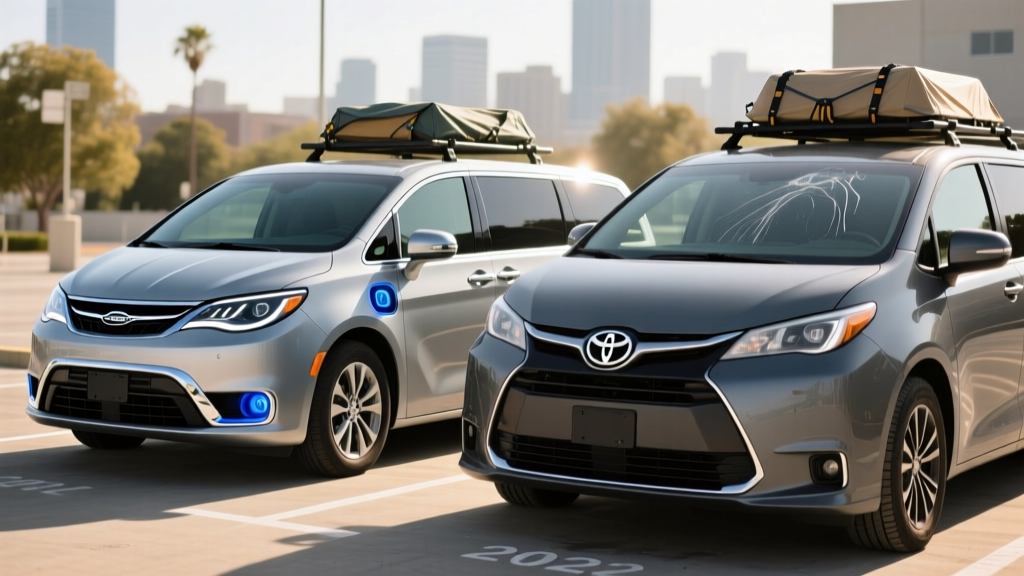
If you need three rows, sliding doors, and better fuel economy than a body-on-frame SUV, the minivan market has narrowed to exactly two electrified options: the Chrysler Pacifica Plug-In Hybrid (PHEV) and the Toyota Sienna Hybrid (HEV). Every other three-row crossover in this segment is either fully gas-powered or fully electric (like the Kia EV9). These two hybrid vans take fundamentally different approaches to electrification, and the right choice depends entirely on your daily mileage, charging access, and budget.
The Pacifica PHEV offers genuine electric-only commuting with a gas engine backup. The Sienna HEV delivers consistent hybrid efficiency with zero lifestyle changes — no plug, no charging routine, no range math. Below, we break down every spec that matters: EPA MPG, electric range, battery capacity, pricing, tax credit eligibility, and real-world ownership data.
HEV vs PHEV: What's the Actual Difference?
Before comparing specs, the distinction between these two hybrid vans is critical because it affects daily use, cost, and infrastructure requirements.
| Factor | Toyota Sienna (HEV) | Chrysler Pacifica (PHEV) |
|---|---|---|
| Plug-in required? | No — self-charging via regenerative braking and engine | Yes — plug in to access electric-only range |
| Electric-only driving | Very short distances at low speed (under 1 mile) | EPA-rated 32 miles on battery alone |
| Home charging needed? | No | Yes — Level 1 (120V) or Level 2 (240V) recommended |
| Battery size | 1.9 kWh (small, self-managing) | 16.0 kWh usable |
| Best use case | Mixed driving, no charging access, simplicity | Daily commute under 30 mi + home charging |
| Federal tax credit | Not eligible | Up to $7,500 (subject to §30D rules) |
The conventional hybrid (HEV) Sienna captures energy from braking and the engine to keep its small battery charged. You never plug it in. The PHEV Pacifica has a much larger battery that you charge from the grid, enabling substantial electric-only driving before the gas engine engages. If you never plug in the Pacifica, it still operates as a conventional hybrid — but you're paying a premium for battery capacity you're not using.
Fuel Economy: EPA MPG and Real-World Numbers
This is the metric most hybrid van buyers care about. Here are the official EPA figures from fueleconomy.gov for the 2026 model year:
| Metric | Toyota Sienna HEV (FWD) | Toyota Sienna HEV (AWD) | Chrysler Pacifica PHEV (Hybrid mode) | Chrysler Pacifica PHEV (Charge-depleting/EV) |
|---|---|---|---|---|
| City MPG | 36 | 35 | 29 | N/A (runs on electricity) |
| Highway MPG | 36 | 36 | 30 | N/A |
| Combined MPG | 36 | 35 | 30 | N/A |
| Combined MPGe (EV mode) | N/A | N/A | N/A | 82 MPGe |
| Electric-only range | N/A | N/A | EPA 32 miles | 32 miles |
| Total range (gas + electric) | ~640 miles | ~620 miles | ~520 miles combined | ~520 miles combined |
Real-world MPG reality check: Toyota's hybrid system excels in stop-and-go city driving, where regenerative braking recaptures the most energy. Owners consistently report matching or slightly exceeding the 36 MPG combined EPA figure in suburban and urban use. Highway-only road trips at 75+ mph tend to drop to 30–33 MPG, as the 2.5-liter four-cylinder works harder without electric assist at sustained high speeds.
The Pacifica PHEV's 30 MPG combined in hybrid mode (after the battery is depleted) trails the Sienna because it's a heavier vehicle with a less efficient hybrid powertrain architecture. However, if your daily round-trip commute is under 32 miles and you charge at home, you may use almost zero gasoline on weekdays. On a 20-mile daily commute charged nightly, Pacifica owners report using 5–8 gallons per month versus the Sienna's 25–30 gallons.
Powertrain and Performance Specs
| Specification | 2026 Toyota Sienna Hybrid | 2026 Chrysler Pacifica PHEV |
|---|---|---|
| Engine | 2.5L 4-cylinder Atkinson cycle | 3.6L V6 Pentastar |
| Electric motors | 2 (FWD) / 3 (AWD) | 2 integrated in eFlite CVT |
| Combined horsepower | 245 hp | 260 hp |
| Transmission | eCVT (power-split device) | eFlite CVT (single-mode electrified) |
| 0–60 mph (est.) | ~7.6 sec | ~7.1 sec |
| Drivetrain | FWD or electronic AWD | FWD only |
| Towing capacity | 3,500 lbs | 3,600 lbs |
| Cargo volume (behind 3rd row) | 33.5 cu ft | 32.3 cu ft |
| Stow 'n Go seating (3rd row folds flat) | No (battery under floor) | 2nd & 3rd row fold flat (PHEV: 3rd row only) |
The Sienna uses Toyota's proven power-split hybrid system — a planetary gearset that seamlessly blends engine and motor output. It's not fast, but it's smooth, quiet, and remarkably efficient. The AWD version adds a rear electric motor (no mechanical driveshaft), providing traction in snow without significant MPG penalty.
The Pacifica PHEV pairs a larger V6 with two electric motors in Chrysler's eFlite transmission. It has more peak horsepower and slightly better acceleration. The trade-off: when the battery is depleted, that V6 is thirstier than Toyota's four-cylinder. The PHEV also loses Chrysler's signature Stow 'n Go second-row seating because the larger battery occupies the under-floor compartment — those captain's chairs fold up but don't disappear into the floor.
PHEV Charging: Battery, Speeds, and Home Setup
This section applies only to the Chrysler Pacifica PHEV. The Sienna HEV does not plug in.
| Charging Level | Power (kW) | 0–100% Time | Infrastructure |
|---|---|---|---|
| Level 1 (120V household outlet) | ~1.4 kW | ~14 hours | Standard outlet, included cord |
| Level 2 (240V, 32A) | ~7.2 kW | ~2 hours | Home wall charger or public L2 |
| DC Fast Charging | Not supported | N/A | N/A — J1772 AC only |
The Pacifica PHEV's 16.0 kWh battery (approximately 13–14 kWh usable to protect longevity) charges exclusively via AC using a J1772 connector. There is no DC fast-charging capability, which is typical for PHEVs in this class. A Level 2 home charger at 7.2 kW refills the battery in roughly two hours — practical for topping up during the day if you work from home, or overnight for the next morning's commute.
Level 2 installation cost: Expect $800–$2,000 for a professional 240V/40A circuit installation (electrician labor, permit, NEMA 14-50 outlet or hardwired charger), assuming your electrical panel has capacity. A panel upgrade from 100A to 200A adds $1,500–$3,000. The Pacifica PHEV comes with a dual-voltage Level 1 cord that can also connect to a 240V outlet at lower amperage, but a dedicated Level 2 station (like a ChargePoint Home Flex or Emporia V2) delivers faster, more reliable daily charging.
Pricing, Trims, and Federal Tax Credit Eligibility
| Model & Trim | 2026 MSRP (est.) | Federal §30D Credit | Effective Price After Credit |
|---|---|---|---|
| Toyota Sienna LE (FWD) | $39,500 | $0 (not a PHEV/BEV) | $39,500 |
| Toyota Sienna XLE (AWD) | $45,200 | $0 | $45,200 |
| Chrysler Pacifica PHEV Select | $51,000 | Up to $7,500* | ~$43,500 |
| Chrysler Pacifica PHEV Limited | $56,500 | Up to $7,500* | ~$49,000 |
*§30D tax credit caveats (2026 rules, per IRS.gov): The full $7,500 credit requires the vehicle to meet critical-mineral and battery-component sourcing thresholds that phase up annually. The Pacifica PHEV has historically qualified for a partial credit ($3,750) rather than the full amount because some battery components are sourced from non-compliant supply chains. Additionally:
- MSRP cap: Vans/minivans must be under $80,000 MSRP (both models qualify).
- Buyer income cap: Modified AGI must not exceed $150,000 (single), $225,000 (head of household), or $300,000 (joint filers).
- Point-of-sale transfer: As of 2024, you can transfer the credit to the dealer at purchase for an immediate price reduction rather than waiting for tax filing.
- Verify before buying: Credit eligibility changes with supply-chain compliance updates. Confirm the current credit amount on the IRS Clean Vehicle Credit page or with your tax professional before signing a purchase agreement.
The conventional Sienna HEV does not qualify for any federal purchase credit — it's a hybrid, not a plug-in. Some states offer separate rebates for HEVs (check your state energy office), but these are typically $500–$1,500 and vary widely.
Battery Warranty, Reliability, and Replacement Cost
| Factor | Toyota Sienna HEV | Chrysler Pacifica PHEV |
|---|---|---|
| Hybrid battery warranty | 10 years / 150,000 miles | 10 years / 100,000 miles |
| Battery chemistry | Nickel-metal hydride (NiMH) | Lithium-ion (NMC) |
| Battery capacity | 1.9 kWh | 16.0 kWh gross |
| Estimated replacement cost (out of warranty) | $3,000–$4,500 | $8,000–$12,000 |
| Expected lifespan | 15+ years / 200,000+ mi (proven track record) | 12–15 years / 150,000+ mi (typical Li-ion) |
Toyota's hybrid reliability is the gold standard. The Sienna uses Toyota's fourth-generation hybrid system with a nickel-metal hydride battery — the same chemistry proven over 25+ years in the Prius. NiMH degrades more gracefully than lithium-ion and is less sensitive to temperature extremes. Toyota's 10-year/150,000-mile hybrid battery warranty (in CARB states; 8-year/100,000-mile in other states) reflects high confidence. Real-world data from Consumer Reports consistently ranks Toyota hybrids among the most reliable vehicles in any class.
The Pacifica PHEV's larger lithium-ion battery carries higher replacement cost risk after the warranty period. Chrysler's 10-year/100,000-mile PHEV battery warranty is competitive, and most owners will never need a replacement within that window. However, at $8,000–$12,000 out of pocket, it's a material long-term ownership cost to budget for if you plan to keep the van beyond 150,000 miles. The Pacifica has historically scored lower in reliability surveys than the Sienna, with more reported issues around electronics, the sliding-door mechanism, and the hybrid system's complexity.
Which Hybrid Van Fits Your Situation?
Choose the Toyota Sienna HEV if:
- You don't have access to home or workplace charging (apartment, street parking, rented garage)
- Your daily driving is unpredictable — some days 10 miles, some days 300
- You want the lowest total cost of ownership with minimal complexity
- You prioritize reliability and plan to keep the van 10+ years
- You need AWD for snow-belt climates
- You want 36 MPG combined without changing any habits
Choose the Chrysler Pacifica PHEV if:
- Your daily round-trip commute is under 32 miles and you can charge at home every night
- You want to drive mostly on electricity during the week but take gas-powered road trips on weekends
- You qualify for the §30D federal tax credit (income and sourcing requirements met), narrowing the price gap
- You prefer a V6 for towing or passing power
- You value the available luxury features (Pacifica Pinnacle trim with quilted leather, built-in vacuum)
Consider a full EV (like the Kia EV9) instead if:
- You have reliable home Level 2 charging and rarely drive more than 250 miles in a single day
- You want to eliminate gasoline entirely and reduce maintenance (no oil changes, no transmission fluid)
- Your household has a second gas vehicle for long road trips
Toyota Sienna HEV — Pros & Cons
Pros:
- 36 MPG combined — best-in-class for any three-row vehicle
- No plug-in required — zero infrastructure changes
- Proven long-term reliability and low battery replacement cost
- Available AWD with electronic rear motor
- Lower starting MSRP than the Pacifica PHEV
Cons:
- No federal tax credit
- 245 hp feels adequate but not quick when fully loaded
- No electric-only commuting capability
- Second-row seats don't fold into the floor (slide only)
Chrysler Pacifica PHEV — Pros & Cons
Pros:
- 32 miles electric-only covers most daily commutes gas-free
- 260 hp V6 provides confident highway merging and towing
- Federal tax credit can reduce effective price by $3,750–$7,500
- Luxury-oriented upper trims (Pinnacle) compete with premium SUVs
Cons:
- Only 30 MPG once the battery is depleted — significantly less than Sienna
- No DC fast charging; Level 2 refill takes ~2 hours
- PHEV battery replacement cost ($8,000–$12,000) is a long-term risk
- FWD only — no AWD option
- Stow 'n Go second-row seating lost to battery packaging
Frequently Asked Questions
How many MPG do these hybrid vans get?
The Toyota Sienna HEV achieves an EPA-rated 36 MPG combined (36 city / 36 highway) in FWD form, or 35 combined with AWD. The Chrysler Pacifica PHEV achieves 30 MPG combined (29 city / 30 highway) after the battery is depleted, plus 82 MPGe in electric mode. In real-world suburban driving, Sienna owners frequently match or exceed 36 MPG. Pacifica PHEV owners who charge nightly report using very little gasoline on short commutes.
How far can the Pacifica PHEV go on electric only?
The EPA rates the 2026 Chrysler Pacifica PHEV at 32 miles of electric-only range on a full charge. In real-world conditions, expect 25–30 miles in warm weather and 20–25 miles in cold weather (below 35°F), as cabin heating and battery chemistry reduce usable capacity. Highway driving at 70+ mph also depletes the battery faster than the EPA test cycle assumes.
Is a hybrid van better than a full EV for families?
For most families in 2026, a hybrid van offers a better fit than a full EV unless you have reliable home charging and rarely exceed 250 miles in a day. Hybrid vans eliminate range anxiety on road trips, require no charging infrastructure changes (HEV), and cost less upfront than three-row EVs like the Rivian R1S or Kia EV9. A PHEV like the Pacifica gives you the best of both worlds if your commute is short and you charge nightly.
Are hybrid vans reliable? What does battery replacement cost?
Toyota's hybrid system in the Sienna has a 25-year track record of exceptional reliability. The NiMH hybrid battery is warrantied for 10 years/150,000 miles (CARB states) and replacement costs $3,000–$4,500 out of warranty — most batteries last well beyond 200,000 miles. The Chrysler Pacifica PHEV's lithium-ion battery is warrantied 10 years/100,000 miles, with replacement estimated at $8,000–$12,000. Chrysler's overall reliability ratings for the Pacifica have historically trailed Toyota's, per Consumer Reports minivan ratings.
Do hybrid vans qualify for any tax credit?
Conventional hybrids (HEV) like the Toyota Sienna do not qualify for the federal §30D Clean Vehicle Credit — that credit applies only to plug-in vehicles (PHEVs and BEVs). The Chrysler Pacifica PHEV may qualify for up to $7,500, but the actual amount depends on current-year battery sourcing compliance, your income level, and the vehicle's MSRP. Many PHEVs qualify for a partial $3,750 credit rather than the full $7,500 due to critical-mineral and battery-component requirements. Always verify eligibility at fueleconomy.gov and consult a tax professional before purchase.
Do I need to plug in the Toyota Sienna hybrid?
No. The Sienna is a conventional self-charging hybrid (HEV). Its small 1.9 kWh battery recharges through regenerative braking and the gasoline engine. You fuel it like any other gas vehicle and never need a plug, charger, or electrical work. The Chrysler Pacifica PHEV, by contrast, benefits greatly from regular plug-in charging to access its 32-mile electric range — though it still operates as a hybrid if you forget to plug in.