The Only Two Hybrid Minivans You Can Buy
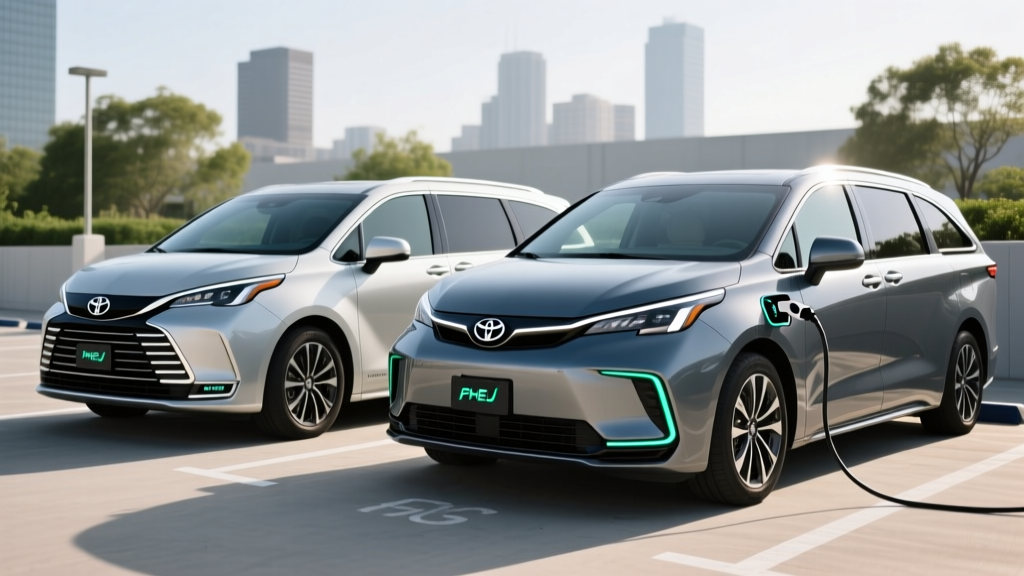
If you're searching for a hybrid minivan in 2026, your options narrow quickly to exactly two vehicles: the Toyota Sienna (a conventional hybrid, or HEV) and the Chrysler Pacifica Plug-In Hybrid (a PHEV). Every other minivan on the market — the Honda Odyssey, Kia Carnival — runs on gasoline alone. That makes this comparison unusually straightforward, but the choice between these two is anything but simple.
The Sienna delivers class-leading fuel economy without ever needing to plug in. The Pacifica PHEV lets you complete school runs and grocery trips on pure electricity before its gas engine kicks in. Both seat seven or eight, offer available all-wheel drive (Sienna only), and cost roughly $40,000–$55,000 depending on trim. Here's everything you need to decide which hybrid minivan fits your family.
HEV vs. PHEV — What's the Difference?
Conventional Hybrid (HEV): The Toyota Sienna pairs a gas engine with electric motors and a small battery (~1.6 kWh) that recharges through regenerative braking and the engine. You never plug it in. It simply uses less fuel than a gas-only vehicle.
Plug-In Hybrid (PHEV): The Chrysler Pacifica PHEV carries a larger battery (16 kWh) that you can charge from a wall outlet or Level 2 charger. It drives up to 32 miles on electricity alone before the gas engine takes over, functioning as a regular hybrid afterward.
Fuel Economy and Electric-Only Range
This is where the two minivans diverge most sharply — and where your driving habits determine the winner.
| Metric | Toyota Sienna HEV | Chrysler Pacifica PHEV |
|---|---|---|
| EPA City MPG | 36 MPG | N/A (electric in city) |
| EPA Highway MPG | 36 MPG | 30 MPG (gas only) |
| EPA Combined MPG | 36 MPG | 30 MPG (gas only) / 82 MPGe (combined) |
| Electric-Only Range | N/A | 32 miles |
| Total Range (gas + electric) | ~630 miles | ~520 miles |
| Fuel Tank | 17.9 gal | 16.5 gal |
Real-world MPG reality check: Hybrid minivans tend to meet or slightly exceed their EPA city ratings because stop-and-go driving maximizes regenerative braking. On the highway, where the gas engine does most of the work, expect the Sienna to deliver 33–35 MPG at 70 mph and the Pacifica (in hybrid mode, battery depleted) to return 28–30 MPG. In cold weather (below 30°F), both vehicles lose roughly 5–10% efficiency as the engine runs more often for cabin heat.
For the Pacifica PHEV, the 32-mile electric range holds up well for around-town errands at speeds under 45 mph. At highway speeds or in extreme heat/cold, expect 25–28 miles of electric-only driving before the 3.6L V6 engages. Source: fueleconomy.gov — Toyota Sienna.
Powertrain and Performance
| Specification | Toyota Sienna HEV | Chrysler Pacifica PHEV |
|---|---|---|
| Engine | 2.5L 4-cyl + 2 electric motors | 3.6L V6 + 2 electric motors |
| Combined Horsepower | 245 hp | 260 hp |
| Transmission | eCVT | eCVT |
| Drivetrain | FWD or AWD | FWD only |
| 0–60 mph | ~7.1 sec | ~7.0 sec |
| Towing Capacity | 3,500 lbs | Not rated (PHEV) |
| Seating | 7 or 8 | 7 |
The Sienna's 2.5L four-cylinder sounds coarse under hard acceleration, but the electric motors fill in low-end torque smoothly. The Pacifica's V6 is noticeably smoother and quieter at highway speeds, and its extra 15 hp matters when merging with a full load. However, the Pacifica PHEV is FWD-only — if you need all-wheel drive for snow or mountain driving, the Sienna is your only hybrid minivan option.
One important trade-off: the Pacifica PHEV's battery pack eliminates the Stow 'n Go second-row seating that makes the gas Pacifica so versatile. PHEV seats fold forward but don't disappear into the floor. The Sienna's second-row seats slide on long tracks but also don't fold flat into the floor.
PHEV Charging: Battery, Speed, and Home Setup
The Pacifica PHEV's 16 kWh lithium-ion battery pack is the core of its value proposition. Here's how charging works:
| Charging Level | Power (kW) | Full Charge Time | Cost (avg.) |
|---|---|---|---|
| Level 1 (120V household) | ~1.4 kW | ~13 hours | $1.50–$2.50 |
| Level 2 (240V home charger) | ~7.2 kW | ~2 hours | $1.50–$2.50 |
| DC Fast Charge | Not supported | N/A | N/A |
The Pacifica PHEV does not support DC fast charging — a common limitation for plug-in hybrids. That's fine for its use case: most PHEV owners charge overnight at home on Level 1 or Level 2 and start each morning with a full 32-mile electric buffer. A standard 120V outlet can replenish the battery overnight if you drive less than 25–30 miles per day. For a full charge in roughly two hours, a 240V Level 2 home charger (like a ChargePoint Home Flex or Emporia Vue) is ideal.
Home charging cost: At the US average electricity rate of ~$0.16/kWh, fully charging the Pacifica's 16 kWh battery costs roughly $2.56 — enough for 32 miles of electric driving, or about $0.08 per mile. Compare that to gasoline at $3.30/gal and 30 MPG: roughly $0.11 per mile on gas alone.
Pricing and Tax Credit Eligibility
| Trim / Detail | Toyota Sienna HEV | Chrysler Pacifica PHEV |
|---|---|---|
| Base Trim MSRP | LE: ~$39,500 | Select: ~$51,000 |
| Mid Trim MSRP | XLE: ~$43,500 | Limited: ~$55,000 |
| Top Trim MSRP | Platinum: ~$53,000 | Pinnacle: ~$57,500 |
| Federal Tax Credit (§30D) | Not eligible (HEV) | Up to $7,500* |
Federal tax credit details for the Pacifica PHEV: Under current IRS §30D rules, the Pacifica PHEV may qualify for up to $7,500 in federal tax credits, subject to several requirements:
- MSRP cap: Vans/minivans must have an MSRP below $80,000 (Pacifica PHEV qualifies).
- Buyer income cap: Modified AGI must not exceed $150,000 (single), $225,000 (head of household), or $300,000 (joint).
- Battery sourcing: Critical minerals and battery components must meet phased-in domestic-content thresholds that tighten each year. Verify current-year compliance on the IRS clean vehicle credit page before purchasing.
- Point-of-sale transfer: As of 2024, eligible buyers can transfer the credit to the dealer at purchase, receiving the discount upfront rather than waiting to claim it on their tax return.
*Credit amount depends on your specific tax situation and the vehicle's battery-sourcing compliance at time of purchase. Consult a tax professional and verify at fueleconomy.gov before relying on credit eligibility.
The Sienna, as a conventional hybrid, does not qualify for the §30D federal EV credit. Some states offer modest hybrid incentives — check your state energy office for current programs.
Battery Warranty and Replacement Cost
Toyota Sienna: Hybrid battery warranty is 10 years / 150,000 miles (in most states; 10 yr/150k mi in CARB states). Toyota's hybrid batteries have an excellent longevity track record — many Prius batteries last 200,000+ miles. Out-of-warranty replacement: approximately $3,000–$4,000 for the hybrid battery pack.
Chrysler Pacifica PHEV: High-voltage battery warranty is 10 years / 100,000 miles (8 yr/100k mi in non-CARB states, 10 yr/150k mi in CARB states). Replacement cost for the 16 kWh pack is higher: approximately $7,000–$9,000 out of warranty. The larger battery stores more energy but costs more to replace.
Both warranties guarantee the battery will retain a minimum capacity (typically 60–70% of original) over the warranty period. Degradation in PHEV batteries is somewhat faster than in full EVs because PHEVs cycle through a larger percentage of their smaller battery daily.
Reliability and Long-Term Ownership
Toyota's hybrid powertrain is among the most proven in the automotive industry. The Sienna's fourth-generation hybrid system shares architecture with millions of Prius, Camry Hybrid, and RAV4 Hybrid vehicles on the road. The eCVT transmission has no traditional gears or belts — it's a planetary gearset that's virtually bulletproof. Toyota consistently earns top reliability ratings from Consumer Reports and J.D. Power for its hybrid lineup.
The Pacifica PHEV has a more complex track record. Earlier model years (2017–2020) saw recalls related to the high-voltage battery and electrical system. Chrysler has addressed many of these issues, and post-2022 models have been more reliable. However, the Pacifica's combination of a V6, two electric motors, and a 16 kWh battery pack means more potential failure points than the Sienna's simpler four-cylinder system. The Pacifica's eCVT is also a proven design, but the overall vehicle has more electronics and thermal management complexity.
Maintenance costs: Both vehicles eliminate the traditional automatic transmission, reducing long-term service needs. Neither requires transmission fluid changes on the same schedule as a conventional automatic. Brake wear is significantly reduced thanks to regenerative braking — many hybrid minivan owners report original brake pads lasting 80,000–100,000 miles.
Toyota Sienna HEV — Pros
- 36 MPG combined — best-in-class for any minivan
- Available AWD (only hybrid minivan with this)
- 10 yr / 150k mi hybrid battery warranty
- Lower starting price (~$39,500)
- Proven long-term reliability
- No plug-in charging required
Toyota Sienna HEV — Cons
- No electric-only driving
- No federal tax credit
- 4-cylinder engine sounds rough under load
- Second-row seats don't fold into floor
- No DC fast charging (not applicable for HEV)
Chrysler Pacifica PHEV — Pros
- 32 miles electric-only for daily errands
- Up to $7,500 federal tax credit
- Smoother V6 power
- 82 MPGe when battery is charged
- Quieter cabin at highway speed
Chrysler Pacifica PHEV — Cons
- ~$12,000 higher starting MSRP
- FWD only — no AWD option
- No DC fast charging
- Stow 'n Go seats eliminated by battery
- Lower reliability history vs. Toyota
- 30 MPG gas-only (worse than Sienna)
Hybrid vs. PHEV vs. Full EV: Which Minivan Fits You?
While no mainstream full-electric minivan is currently on sale in the US (the Zeekr 009 and Volvo EM90 are not sold stateside), it's worth framing how these two hybrids fit into the broader electrification landscape.
Choose the Toyota Sienna HEV if:
- You can't charge at home (apartment, street parking, no garage)
- You need all-wheel drive for snow or mountain roads
- You want the lowest cost per mile without changing habits
- You regularly take road trips over 400 miles
- You prioritize long-term reliability and resale value
Choose the Chrysler Pacifica PHEV if:
- You can charge at home (even a standard 120V outlet works)
- Your daily driving is under 30 miles round-trip
- You want to drive mostly electric on weekdays and take gas road trips on weekends
- You qualify for the $7,500 federal tax credit (effectively closing the price gap with the Sienna)
- You prefer the Pacifica's V6 smoothness and interior layout
Wait for a full EV minivan if:
- You have reliable home Level 2 charging and want zero gasoline
- You drive under 250 miles daily and rarely road-trip
- You're willing to wait — several electric minivans are expected from Korean and Chinese automakers by 2027–2028, though US availability is uncertain
5-Year Cost of Ownership Comparison
Assuming 15,000 miles/year, $3.30/gal gas, $0.16/kWh electricity, and Pacifica PHEV owner charging nightly (using electric for ~28 miles/day of a 30-mile daily commute):
| 5-Year Cost | Toyota Sienna HEV | Chrysler Pacifica PHEV |
|---|---|---|
| Purchase Price (mid-trim) | $43,500 | $55,000 |
| Federal Tax Credit | $0 | −$7,500 |
| Net Purchase | $43,500 | $47,500 |
| Fuel/Energy (5 yrs) | $6,875 | $3,200 |
| Maintenance (est.) | $2,800 | $3,200 |
| Insurance (est.) | $8,500 | $9,200 |
| Total 5-Year Cost | $61,675 | $63,100 |
The Pacifica PHEV's tax credit and lower energy costs nearly close the gap with the Sienna over five years. If you charge religiously and drive mostly under 30 miles daily, the Pacifica can actually cost less per month in combined energy than the Sienna. But the Sienna's lower purchase price and stronger resale value (Toyota minivans hold value exceptionally well) keep it competitive.
Frequently Asked Questions
How many MPG does a hybrid minivan get?
The Toyota Sienna hybrid gets an EPA-rated 36 MPG combined (36 city / 36 highway). The Chrysler Pacifica PHEV gets 30 MPG combined when running on gasoline alone, or 82 MPGe when factoring in electric-only driving. In real-world city driving, the Sienna often exceeds its EPA rating, returning 37–39 MPG in stop-and-go traffic where regenerative braking is maximized.
How far can the Pacifica PHEV go on electric only?
The EPA rates the Pacifica PHEV at 32 miles of electric-only range. In practice, expect 28–32 miles in mild weather at speeds under 50 mph, and 24–27 miles at highway speeds or in cold weather. Once the battery is depleted, the Pacifica operates as a conventional hybrid at 30 MPG.
Is a hybrid minivan reliable, and what does battery replacement cost?
Toyota's hybrid system has decades of proven reliability, with the Sienna carrying a 10-year/150,000-mile hybrid battery warranty. Out-of-warranty replacement runs $3,000–$4,000. The Pacifica PHEV's warranty is 10 years/100,000 miles (in CARB states), with replacement costs of $7,000–$9,000 for the larger 16 kWh pack. Toyota's hybrid track record is significantly stronger based on historical data.
Does a hybrid minivan qualify for a tax credit?
Only the Chrysler Pacifica PHEV qualifies for the federal §30D clean vehicle credit — up to $7,500, subject to buyer income limits ($300,000 joint AGI cap), MSRP caps ($80,000 for vans), and battery-sourcing requirements. The Toyota Sienna, as a conventional hybrid, does not qualify for any federal credit. Some states offer separate hybrid or PHEV rebates — check your state's energy office.
Do I need to plug in a hybrid minivan?
Only the Chrysler Pacifica PHEV needs to be plugged in to realize its electric-range benefit — and even then, it will still drive as a regular hybrid if you forget to charge. The Toyota Sienna HEV never needs to be plugged in. Its small battery charges entirely through regenerative braking and the gasoline engine.
Can I get an all-wheel-drive hybrid minivan?
Yes — but only the Toyota Sienna offers AWD. The Pacifica PHEV is front-wheel drive only. The Sienna's AWD system uses a separate rear electric motor (no mechanical driveshaft), providing confident traction in snow and rain without significantly impacting fuel economy.