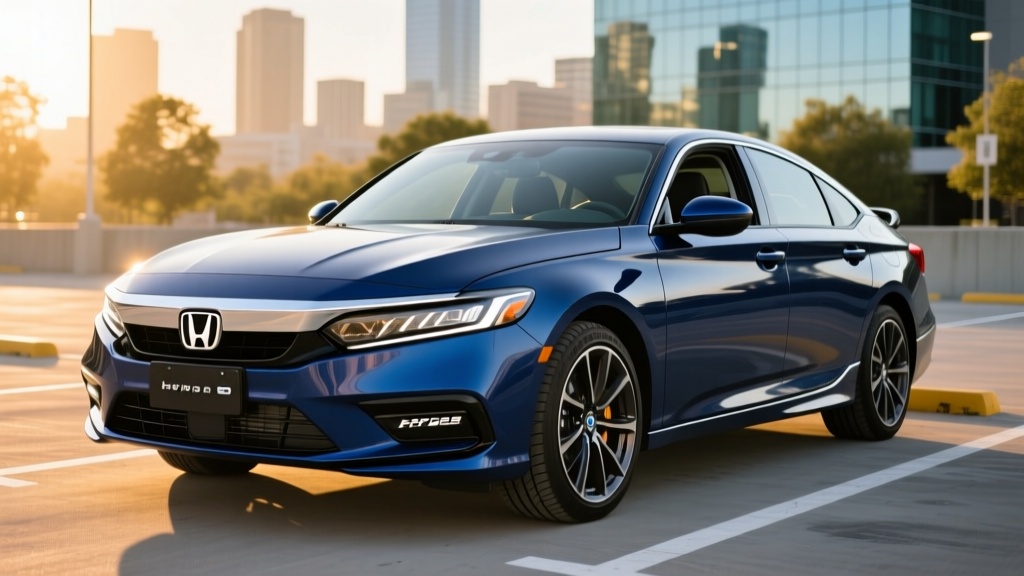
The 2025 Honda Accord Sport Hybrid occupies a pragmatic sweet spot in the midsize sedan market: it pairs genuine fuel sipping with a genuinely engaging drive, all without requiring you to change a single habit. No plugs, no range math, no charging-app frustration. Just a 2.0-liter four-cylinder working in concert with a two-motor hybrid system to deliver an EPA-rated 48 MPG combined.
For buyers cross-shopping electrified sedans, the Accord Sport Hybrid raises a specific question: is a conventional hybrid (HEV) the right choice, or should you look at a plug-in hybrid (PHEV) or a full battery-electric vehicle (BEV)? This guide breaks down every relevant number — efficiency, powertrain output, battery durability, warranty coverage, pricing, and federal incentive eligibility — so you can make that call with data, not marketing.
Fuel Economy: EPA Ratings and Real-World MPG
The Accord Sport Hybrid uses Honda's fourth-generation two-motor hybrid system. The EPA rates it identically across all hybrid trims (Sport, Sport-L, EX-L):
| Driving Cycle | EPA Rating | Real-World Expectation |
|---|---|---|
| City | 51 MPG | 48–54 MPG (hybrids often exceed EPA in stop-and-go) |
| Highway | 44 MPG | 40–46 MPG (sustained 75+ mph reduces regen benefit) |
| Combined | 48 MPG | 44–50 MPG depending on commute mix |
For context, the non-hybrid Accord (the 1.5T turbo) earns an EPA 32 MPG combined — meaning the Sport Hybrid saves roughly 3.5 gallons per 100 miles, or about $550–$700 annually at 15,000 miles driven and $3.50/gallon fuel. Over five years, that's $2,750–$3,500 in fuel savings.
How the Accord Sport Hybrid Powertrain Works
The Accord hybrid powertrain is fundamentally different from a traditional gasoline car with a bolted-on electric assist. Here's the architecture:
| Specification | 2025 Accord Sport Hybrid |
|---|---|
| Engine | 2.0L Atkinson-cycle 4-cylinder (146 hp / 134 lb-ft) |
| Drive Motor | AC permanent-magnet synchronous (181 hp / 247 lb-ft) |
| Combined System Output | 204 hp / 247 lb-ft torque |
| Transmission | Direct-drive (no conventional gearbox); engine clutch for highway cruise |
| Hybrid Battery | ~1.1 kWh lithium-ion (HEV — not plug-in capable) |
| 0–60 mph | ~6.5 seconds (estimated) |
| Drivetrain | Front-wheel drive |
| Fuel Tank | 12.8 gallons |
| Total Driving Range | ~614 miles (EPA combined) |
At low speeds and during acceleration, the drive motor propels the car using electricity drawn from the small battery pack. The gasoline engine spins a generator motor to produce electricity on demand — it is not mechanically connected to the wheels at these speeds. At steady highway cruising (roughly 45–80 mph), a lock-up clutch engages, connecting the engine directly to the wheels for efficiency. Under hard acceleration, both the engine and motor contribute to the combined 204 hp output.
The result is smooth, linear acceleration that feels more like an EV than a conventional sedan — because at most speeds, it effectively is being driven by an electric motor. The gasoline engine is simply an onboard generator.
HEV vs. PHEV vs. BEV: Which Electrified Sedan Fits You?
A common point of confusion is the difference between a conventional hybrid (HEV) like the Accord Sport Hybrid and a plug-in hybrid (PHEV). The Accord does not plug in. It has no electric-only driving range beyond a fraction of a mile at very low speeds. All energy ultimately comes from gasoline.
| Feature | HEV (Accord Sport Hybrid) | PHEV (e.g., Toyota Prius Prime) | BEV (e.g., Hyundai Ioniq 6) |
|---|---|---|---|
| Plugs in? | No | Yes (Level 1/2) | Yes (Level 1/2/DC) |
| Electric-only range | ~0 miles | 25–44 miles typical | 250–360 miles |
| Battery size | ~1.1 kWh | 13–18 kWh | 58–77 kWh |
| Gasoline needed? | Yes (always) | Yes (after EV range) | No |
| Federal tax credit | Not eligible | Up to $7,500 (§30D, if eligible) | Up to $7,500 (§30D, if eligible) |
| Home charging install | None required | Level 2 recommended (~$500–$1,500) | Level 2 required (~$500–$2,500) |
| Best for | No home charging, long road trips, simplicity | Home charging + short commutes + road trips | Home charging, mostly local/suburban driving |
- You rent or live somewhere without reliable access to a charging outlet
- You regularly drive 400+ miles between fuel stops and don't want to plan charging
- You want maximum simplicity — no apps, no charging networks, no preconditioning
- Your budget is below $35,000 and you don't qualify for EV/PHEV tax credits
- You can install a Level 2 charger at home and your daily commute is under 35 miles
- You want electric-only daily driving but still need gasoline range for road trips
- You qualify for the §30D federal tax credit (income and sourcing rules apply)
- You have reliable home Level 2 charging
- Most trips are under 250 miles or you're willing to plan DC fast-charging stops
- You want the lowest per-mile fuel cost and minimal drivetrain maintenance
Pricing, Trims, and Tax Credit Eligibility
The 2025 Honda Accord Sport Hybrid starts at an MSRP of approximately $32,895 (including destination). Key trim pricing:
| Trim | MSRP (incl. destination) | Key Additions |
|---|---|---|
| Sport Hybrid | $32,895 | 19" wheels, heated front seats, wireless CarPlay/Android Auto, Honda Sensing suite |
| Sport-L Hybrid | $34,895 | Leather-trimmed seats, wireless phone charger, 10-speaker audio |
| EX-L Hybrid | $36,895 | Power moonroof, heated rear seats, navigation, front parking sensors |
Some states and local utilities offer modest rebates for conventional hybrids, but these vary by jurisdiction and change frequently. Check your state energy office or utility provider for current programs. A tax professional can advise on any applicable state-level credits.
Battery Warranty, Lifespan, and Replacement Cost
Hybrid battery longevity is the single most common concern among first-time hybrid buyers. Here's what the data shows for Honda's system:
- Coverage: 8 years / 100,000 miles (10 years / 150,000 miles in CARB states including CA, NY, MA, WA, and others)
- What's covered: Defects and capacity loss below a defined threshold (typically ~60–70% of original capacity)
- Hybrid system components: Inverter, motor, and control electronics carry the same warranty period
Honda's hybrid battery pack in the Accord is relatively small (~1.1 kWh) and operates within a narrow state-of-charge window — it never fully charges or fully discharges. This shallow-cycling strategy dramatically extends cell life. Based on fleet data and owner reports from Honda's previous-generation hybrid systems (Insight, Accord Hybrid 2018–2022), the battery pack typically lasts 150,000–200,000+ miles before meaningful degradation occurs.
Replacement cost: If the hybrid battery does require replacement out of warranty, expect $2,000–$4,000 for a refurbished or new pack including labor at a Honda dealer. Independent hybrid specialists often perform the same service for $1,500–$2,500. This is substantially less than a BEV battery replacement ($10,000–$20,000+) because the pack is small and accessible.
The 12-volt auxiliary battery (a separate, conventional battery that powers electronics when the hybrid system is off) typically lasts 3–5 years and costs $150–$250 to replace — same as any other car.
Reliability, Safety, and Ownership Costs
Honda's hybrid powertrain has compiled a strong reliability record since the introduction of the two-motor system in the 2014 Accord Hybrid. The system has fewer moving parts than a conventional automatic transmission (no torque converter, no multi-speed gearbox), and regenerative braking reduces wear on the friction brake pads — many hybrid owners report original brake pads lasting 80,000–100,000 miles.
Safety ratings: The 2025 Accord earned a 5-star overall rating from NHTSA and was named an IIHS Top Safety Pick+ when equipped with specific headlights. The Honda Sensing suite (adaptive cruise control, lane-keeping assist, automatic emergency braking, traffic sign recognition) is standard on every trim.
Estimated 5-year ownership cost advantages:
- Fuel savings vs. non-hybrid Accord 1.5T: ~$2,750–$3,500
- Brake pad replacement savings: ~$300–$600 (one fewer service interval)
- No transmission fluid changes required (the e-CVT uses a sealed system)
- Insurance: typically comparable to the non-hybrid Accord; check your provider
Pros and Cons at a Glance
- 48 MPG combined with no behavioral changes required
- Smooth, EV-like acceleration from the 181-hp drive motor
- Spacious interior with 16.7 cu-ft trunk (no battery intrusion)
- Standard Honda Sensing ADAS suite on all trims
- Strong reliability record and long battery warranty
- Under $33K starting price — well below PHEV and BEV competitors
- 614-mile total range eliminates fuel-stop planning on road trips
- No plug-in capability — cannot drive on electricity alone
- No federal tax credit eligibility (HEV, not PHEV/BEV)
- Engine drone under hard acceleration (generator-mode RPM doesn't match road speed)
- Sport trim uses cloth seats; leather requires Sport-L upgrade
- No all-wheel-drive option (FWD only)
- Infotainment can feel a generation behind competitors on responsiveness
Frequently Asked Questions
How many MPG does the 2025 Honda Accord Sport Hybrid get?
The EPA rates the Accord Sport Hybrid at 51 MPG city, 44 MPG highway, and 48 MPG combined. In real-world driving, city-dominant commuters often see 50–53 MPG, while highway-dominant drivers should expect 42–46 MPG. Cold weather (below 30°F) typically reduces efficiency by 3–5 MPG.
Does the Accord Sport Hybrid plug in?
No. The Accord Sport Hybrid is a conventional hybrid (HEV). It charges its small battery exclusively through regenerative braking and the onboard gasoline engine/generator. There is no plug, no charging port, and no electric-only driving range. If you want plug-in capability, you'll need to look at a PHEV like the Toyota Prius Prime or a full BEV.
Is the Honda Accord Hybrid reliable?
Yes. Honda's two-motor hybrid system has been in production since 2014 with strong long-term reliability data. The system eliminates the conventional transmission entirely, reducing mechanical complexity. The hybrid battery is warrantied for 8 years/100,000 miles (10 years/150,000 miles in CARB states) and typically lasts 150,000–200,000+ miles based on fleet and owner data. Consumer Reports has consistently given the Accord Hybrid above-average reliability scores.
What does it cost to replace the Accord Hybrid battery?
Out-of-warranty hybrid battery replacement costs approximately $2,000–$4,000 at a Honda dealer, or $1,500–$2,500 at an independent hybrid specialist. This is significantly less than a BEV battery replacement. The battery is covered under Honda's hybrid system warranty for 8 years/100,000 miles (10 years/150,000 miles in CARB states).
Does the Accord Hybrid qualify for any tax credits?
The Accord Sport Hybrid does not qualify for the federal §30D Clean Vehicle Credit, which applies only to plug-in electric vehicles (PHEVs and BEVs). Some states and utilities offer small rebates for conventional hybrids, but these vary by location. Check your state energy office for current programs.
How does the Accord Hybrid compare to a PHEV or full EV?
The Accord Hybrid offers the simplest ownership experience — no charging infrastructure needed, no range planning, and a lower purchase price. A PHEV gives you 25–44 miles of electric-only driving for daily commutes (if you can charge at home) plus gasoline range for road trips. A BEV offers the lowest per-mile fuel cost and zero tailpipe emissions but requires home charging access and road-trip planning around DC fast chargers. The Accord Hybrid is the right call if charging access is uncertain or you prioritize simplicity and low upfront cost.
What is the total driving range of the Accord Sport Hybrid?
With a 12.8-gallon fuel tank and 48 MPG combined, the Accord Sport Hybrid delivers approximately 614 miles of total range — enough to drive from Los Angeles to San Francisco and back on a single tank, or from New York to Washington, D.C., with fuel to spare.