Quick Verdict: The Hybrid Mini Cooper Countryman at a Glance
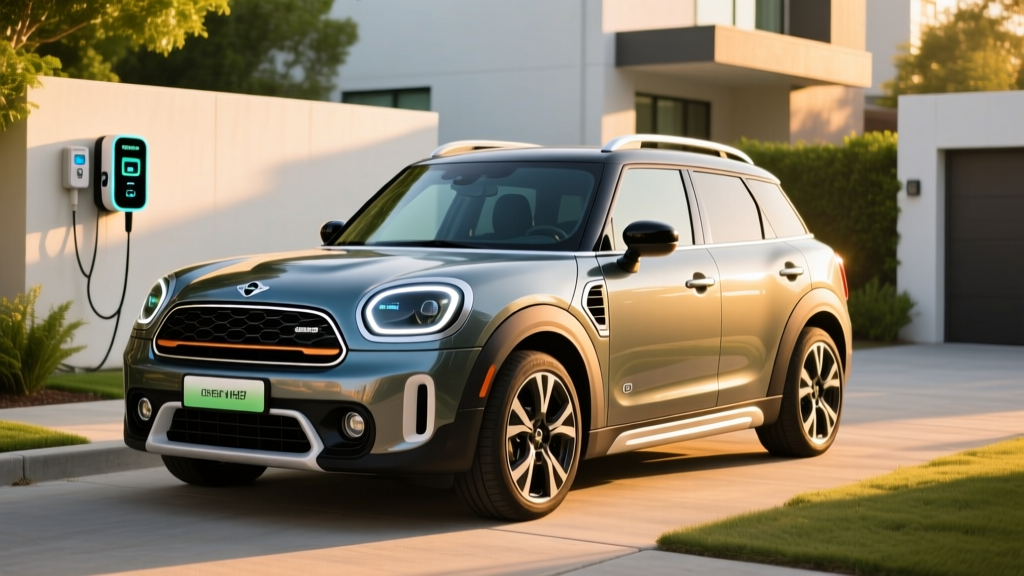
The Mini Cooper Countryman has long been the brand's most practical offering, and the plug-in hybrid variant — officially the Mini Cooper S E ALL4 — is the most versatile version in the lineup. For 2026, it pairs a turbocharged 1.5-liter three-cylinder engine with a rear-axle electric motor for standard all-wheel drive, 310 combined horsepower, and an EPA-estimated 27 miles of electric-only range. If you're searching for a "hybrid Mini Cooper," this is the one to know about.
Unlike a conventional hybrid (HEV) such as a Toyota Prius, the Countryman PHEV must be plugged in to realize its electric-range and efficiency benefits. Drive it without charging, and you're hauling extra battery weight on gasoline alone. Charge it nightly, though, and many owners can complete daily commutes without burning a drop of fuel.
Mini does not currently sell a conventional (non-plug-in) hybrid in the US market. The Cooper Countryman SE ALL4 is a plug-in hybrid electric vehicle (PHEV), meaning it has a larger battery you charge via a plug and can drive on electricity alone for short distances. A conventional hybrid (HEV) charges its small battery solely through regenerative braking and the engine — no plug required, but no electric-only range either.
| Spec | Value |
|---|---|
| Powertrain | 1.5L turbo I3 + rear electric motor (AWD) |
| Combined Horsepower | 310 HP |
| Combined Torque | 350 lb-ft |
| Battery (Usable) | ~16.3 kWh (NMC chemistry) |
| EPA Electric-Only Range | 27 miles |
| EPA MPGe (Electric + Gas) | 77 MPGe |
| EPA MPG (Gas Only, Combined) | 29 MPG combined (27 city / 32 highway) |
| 0–60 mph | 5.4 seconds |
| Max AC Charge Rate | 7.4 kW (Level 2) |
| DC Fast Charging | Not available |
| Level 2 Charge Time (0–100%) | ~2.5 hours |
| Level 1 Charge Time (120V) | ~8–9 hours |
| Cargo Volume | 19.4 cu ft (rear seats up) / 47.6 cu ft (folded) |
| Base MSRP | ~$41,900 (before destination) |
| Battery/Powertrain Warranty | 8 years / 100,000 miles (hybrid battery); 4 yr / 50,000 mi (bumper-to-bumper) |
How Many MPG Does the Hybrid Mini Cooper Countryman Get?
The EPA rates the 2026 Countryman SE ALL4 at 77 MPGe when operating in combined electric-and-gasoline mode. MPGe (miles per gallon equivalent) converts electrical energy into a gasoline-equivalent figure so you can compare across powertrain types.
Once the battery depletes and the car operates as a gasoline-only hybrid, the EPA rates it at 29 MPG combined — 27 city / 32 highway. That's the number that matters if you rarely plug in or take long road trips beyond the 27-mile electric buffer.
In mixed suburban driving with regular Level 2 charging, owners frequently report effective fuel consumption well below the gas-only EPA figure — sometimes burning no gasoline at all on sub-30-mile daily commutes. On highway-only road trips at 70–75 mph with a depleted battery, expect closer to 28–30 MPG, which aligns with the EPA highway estimate. In cold weather (below 30°F), electric-only range drops to roughly 18–22 miles due to cabin heating demands and reduced battery efficiency.
Electric-Only Range and Charging: What PHEV Buyers Need to Know
The Countryman SE ALL4's 27-mile EPA electric range is enough to cover the average American's one-way commute (the US Census Bureau puts the mean at roughly 16 miles each way). If you can charge at home overnight and at work, you may go weeks between fill-ups.
Charging is straightforward but limited to AC power:
- Level 1 (120V household outlet): Adds roughly 3–4 miles of range per hour. A full 0–100% charge takes approximately 8–9 hours — viable for overnight top-ups if you drive less than 25 miles daily.
- Level 2 (240V, 7.4 kW max): A home Level 2 station or public AC charger replenishes the battery from empty in about 2.5 hours. This is the practical charging method for PHEV owners.
- DC Fast Charging: Not supported. The Countryman PHEV uses a J1772 connector and cannot accept DC fast charging — a common limitation among PHEVs due to smaller battery sizes that don't justify the added hardware cost and weight.
A key nuance: the onboard charger caps at 7.4 kW, so even if you plug into a 48-amp Level 2 station capable of 11.5 kW, the car will only draw 7.4 kW. This is perfectly adequate for a 16.3 kWh battery — faster charging wouldn't meaningfully reduce your wait time.
Powertrain Deep Dive: Engine, Motor, and the ALL4 System
The Countryman SE ALL4 uses a through-the-road hybrid architecture, meaning the engine and electric motor drive separate axles:
- Front axle: A BMW-sourced 1.5-liter turbocharged inline-three producing approximately 161 HP and 170 lb-ft of torque, paired with a 7-speed dual-clutch automatic transmission.
- Rear axle: A synchronous electric motor producing approximately 174 HP and 184 lb-ft, powered by the under-floor battery pack.
- Combined output: 310 HP and 350 lb-ft, with all-wheel traction provided by the engine up front and motor in the rear — no mechanical driveshaft connecting them.
This setup gives the Countryman SE ALL4 a genuinely quick 5.4-second 0–60 mph time, making it one of the fastest vehicles in the Mini lineup. The electric motor provides instant torque from a stop, while the turbo three-cylinder fills in at higher speeds. The transition between electric and gas power is mostly seamless, though you may notice the engine engage under hard acceleration or when the battery is depleted.
Driving modes include an EV-only setting (Max eDrive), a hybrid auto mode that optimizes between gas and electric, and a battery-save mode that preserves charge for later use — useful if you're highway-driving to a city destination where you want electric-only operation.
Pricing, Trims, and Federal Tax Credit Eligibility
The 2026 Mini Cooper Countryman SE ALL4 starts at approximately $41,900 (before the $995 destination charge). Well-equipped examples with the Signature or Iconic trim packages, premium paint, and the panoramic roof can push the sticker past $48,000.
Under IRS §30D Clean Vehicle Credit rules, plug-in hybrids with at least 7 kWh of battery capacity can qualify for up to $7,500, split between a critical-minerals requirement ($3,750) and a battery-component requirement ($3,750). However, eligibility depends on:
- MSRP cap: SUVs/vans must be under $80,000 — the Countryman clears this easily.
- Buyer income cap: AGI must not exceed $150,000 (single), $225,000 (head of household), or $300,000 (joint).
- Battery sourcing: Critical minerals and component manufacturing must meet phased-in domestic/free-trade-agreement thresholds. Mini (BMW Group) sources vary by model year.
As of early 2026, the Countryman SE ALL4 may qualify for a partial credit of $3,750 depending on the battery-component and critical-mineral sourcing compliance for the specific production batch. The point-of-sale transfer option lets you apply the credit as a down-payment reduction at the dealer. Always verify current eligibility on fueleconomy.gov and consult a tax professional before relying on credit assumptions.
Hybrid vs PHEV vs Full EV — Which Mini Cooper Fits Your Life?
Mini's current US lineup spans gasoline, PHEV, and fully electric options. Here's how to decide:
| Factor | Gas (Cooper S) | PHEV (SE ALL4) | Full EV (SE ALL4 Electric) |
|---|---|---|---|
| Starting Price | ~$35,500 | ~$41,900 | ~$45,200 |
| EPA Range / Efficiency | ~28 MPG combined | 27 mi EV + 29 MPG gas | ~230 mi (EPA est.) |
| Home Charging Needed? | No | Recommended | Essential |
| Road-Trip Convenience | Excellent | Good (gas backup) | Requires DCFC planning |
| Daily EV Commute? | No | Yes (≤27 mi) | Yes (full range) |
| Federal Tax Credit | None | Up to $3,750–$7,500 | Up to $7,500 |
- Your daily round-trip commute is under 30 miles and you can charge at home.
- You take 3+ road trips per year and don't want to plan around DC fast chargers.
- You want AWD for snow/rain but don't have access to reliable public charging infrastructure.
- You have Level 2 home charging and rarely drive more than 180 miles in a single day.
- You want to eliminate oil changes, spark plugs, and gas-engine maintenance entirely.
- You qualify for the full $7,500 federal credit, narrowing the price gap.
- You lack home charging access (apartment/street parking).
- Your budget is firm below $38,000.
- Your mileage is low enough that fuel savings won't offset the PHEV premium.
Reliability, Battery Warranty, and Long-Term Ownership Costs
The Countryman SE ALL4 benefits from BMW Group's extensive PHEV engineering experience (the same basic hybrid architecture underpins the BMW X1 xDrive28e and several other models). The high-voltage battery uses NMC (nickel-manganese-cobalt) chemistry, which offers good energy density in a compact package.
Mini covers the hybrid battery for 8 years or 100,000 miles (whichever comes first), with a capacity-retention threshold typically set at 70% of original capacity. If the battery degrades below that threshold within the warranty period, Mini will repair or replace it at no cost.
Out-of-warranty replacement for the ~16.3 kWh PHEV battery pack is estimated at $5,000–$8,000 including labor, based on comparable BMW Group PHEV service pricing. However, PHEV batteries tend to experience less stress than full-EV packs because they cycle through a smaller portion of their total capacity and are buffered by the gasoline engine — many last well beyond 150,000 miles without significant degradation.
For comparison, the standard 4-year/50,000-mile bumper-to-bumper warranty and included scheduled maintenance for 3 years/36,000 miles apply to all Mini models.
On the maintenance side, PHEV ownership costs sit between gas and full EV. You still have engine oil changes (roughly every 10,000 miles or annually), a transmission, and spark plugs — but regenerative braking extends pad life, and the engine runs less overall. Insurance premiums for the Countryman SE ALL4 run approximately 10–15% higher than the gas Cooper S due to the higher MSRP and specialized repair requirements.
Pros and Cons of the Hybrid Mini Cooper Countryman
- 27-mile EV range covers most daily commutes gas-free
- 310 HP and 5.4-sec 0–60 — genuinely quick for a subcompact crossover
- Standard AWD via through-the-road hybrid system
- 2.5-hour Level 2 charge time is practical for home/work charging
- Premium interior with Mini's updated infotainment and circular OLED display
- Partial federal tax credit eligibility reduces effective price
- No DC fast charging — road-trip EV range is fixed at 27 miles
- Gas-only MPG (29 combined) is unremarkable for a hybrid
- Premium pricing: ~$42K base, ~$48K as most buyers configure it
- Electric range drops to ~18–22 mi in freezing temperatures
- Cargo space slightly reduced vs gas model due to battery placement
- Tax credit amount varies by production batch and sourcing compliance
Frequently Asked Questions
Does Mini make a conventional hybrid (non-plug-in)?
No. Mini does not currently offer a conventional HEV (self-charging hybrid) in the United States. The only electrified Countryman is the SE ALL4 plug-in hybrid. If you want a Mini-badged vehicle that doesn't need plugging in, your options are the gasoline Cooper and Cooper S models.
Can I drive the Countryman PHEV without ever plugging it in?
Yes — the car operates as a gasoline-powered hybrid once the battery depletes, delivering around 29 MPG combined. However, you'll miss the entire efficiency and cost-saving benefit of the electric powertrain, and you'll be carrying ~300 lbs of battery and motor you're not utilizing. If you can't charge at home or work, a conventional gas car or full EV (charged at public stations) may make more financial sense.
How long does the hybrid battery last?
Based on BMW Group data from similar PHEV platforms, the high-voltage battery is engineered for 10–15 years of service with gradual capacity loss. The 8-year/100,000-mile warranty covers defects and excessive degradation (below 70% capacity). Real-world reports from earlier-generation Mini/BMW PHEVs show most batteries retaining 80–90% capacity at the 100,000-mile mark.
Does the Countryman PHEV qualify for the $7,500 federal tax credit?
Eligibility depends on battery-component and critical-mineral sourcing rules under IRS §30D. As of 2026, the Countryman SE ALL4 may qualify for $3,750 (one of the two credit halves). Income caps ($150K single / $300K joint) and the $80,000 SUV MSRP cap apply. The point-of-sale transfer option lets dealers apply the credit at purchase. Verify your specific vehicle's VIN on fueleconomy.gov before committing.
Is the hybrid Mini Cooper Countryman reliable?
Mini as a brand has improved its reliability rankings in recent years, and the PHEV powertrain benefits from mature BMW Group engineering shared across multiple models. The main risk areas are the dual-clutch transmission (which has drawn occasional complaints in earlier generations) and electrical gremlins common to premium European vehicles. The hybrid-specific components (battery, electric motor, power electronics) have proven durable across the BMW/MINI PHEV family. NHTSA and IIHS ratings should be checked for the latest crash-test results.
What's the total cost of ownership vs a gas Mini?
Over 5 years and 60,000 miles, assuming regular home charging and a commute under 27 miles, a Countryman SE ALL4 owner might spend roughly $2,500–$3,500 less on fuel compared to the gas Cooper S (based on $3.50/gal gasoline and $0.14/kWh electricity). Factor in the potential $3,750 tax credit, and the PHEV premium over the gas model narrows significantly. However, insurance costs ~$150–$250 more annually, and the higher MSRP means faster dollar depreciation even if the percentage is similar.