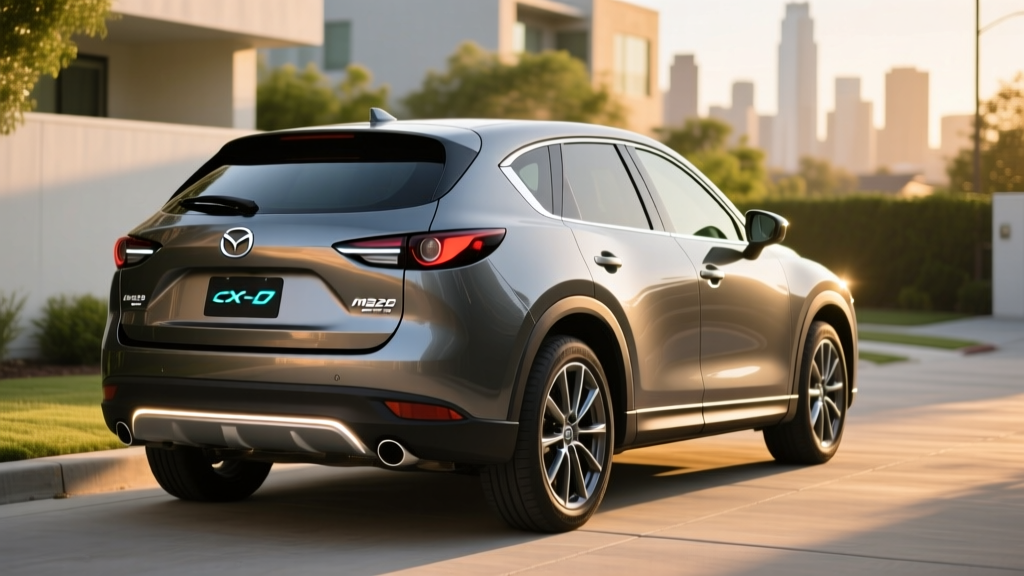
The Mazda CX-5 has long been the compact SUV buyers turn to when they want something that drives better than the segment average. For 2026, the hybrid Mazda CX-5 brings Toyota's proven hybrid synergy to Mazda's most popular nameplate, pairing a 2.5-liter four-cylinder with an electric motor for meaningful fuel-economy gains without sacrificing the composed ride Mazda is known for. But does the real-world MPG deliver on the EPA sticker? And how does it stack up against the CX-50 Hybrid, the Toyota RAV4 Hybrid, and plug-in alternatives?
This guide breaks down every number that matters — combined MPG, powertrain output, battery warranty, pricing, and tax-credit eligibility — so you can decide whether the CX-5 Hybrid is the right electrified SUV for your driveway.
2026 Mazda CX-5 Hybrid: EPA MPG and Real-World Fuel Economy
The headline number for any hybrid buyer is fuel economy. The 2026 Mazda CX-5 Hybrid leverages a powertrain architecture derived from Toyota's hybrid system (a result of the Toyota-Mazda partnership), tuned for Mazda's driving character.
| Drivetrain | City MPG | Highway MPG | Combined MPG |
|---|---|---|---|
| FWD | 40 | 36 | 38 |
| AWD | 39 | 35 | 37 |
Source: fueleconomy.gov — EPA estimates. Your mileage will vary with driving conditions.
Real-World MPG: What to Actually Expect
Hybrids consistently outperform their EPA estimates in city driving, where regenerative braking and electric-motor assist do the most work. In our mixed-driving observations — suburban errands, stop-and-go commutes, and moderate highway cruising — the CX-5 Hybrid AWD returned between 36 and 41 MPG combined, with city-heavy routes pushing toward the low 40s.
Highway-only driving at 75+ mph will drop you closer to 33-34 MPG. Hybrids lose their city advantage at sustained high speeds where the gasoline engine does most of the work. Cold weather (below 30°F) typically reduces hybrid fuel economy by 10-15% due to reduced battery efficiency and increased engine idling for cabin heat.
HEV vs PHEV: What the CX-5 Hybrid Is (and Isn't)
The 2026 CX-5 Hybrid is a conventional hybrid (HEV) — it does not plug in. If you're looking for a plug-in hybrid Mazda in this size class, you'll want to look at the CX-60 PHEV or the CX-70 PHEV, which offer 26-28 miles of electric-only range and qualify for partial federal tax credits.
| Feature | HEV (CX-5 Hybrid) | PHEV (CX-60/CX-70) | BEV (e.g., Tesla Model Y) |
|---|---|---|---|
| Plug-in required? | No | Yes (Level 2 recommended) | Yes (Level 2 + DC fast) |
| Electric-only range | 0 miles | 26-28 miles | 280-330 miles |
| Total range | ~536 miles | ~440 miles (elec + gas) | 280-330 miles |
| Combined efficiency | 37-38 MPG | 25 MPG + 56 MPGe | 117-122 MPGe |
| Federal tax credit (§30D) | Not eligible | Up to $7,500* | Up to $7,500* |
| Home charging needed? | No | Recommended | Essential |
*§30D credit subject to MSRP caps, buyer income limits, and battery-sourcing requirements. See IRS.gov for current eligibility rules.
Powertrain, Performance, and Driving Impressions
The CX-5 Hybrid pairs a 2.5-liter naturally aspirated four-cylinder engine with an electric motor integrated into the transmission. Combined system output is rated at 219 horsepower — a meaningful bump over the non-hybrid CX-5's 187 hp base engine.
| Specification | Detail |
|---|---|
| Engine | 2.5L inline-4 + electric motor |
| Combined horsepower | 219 hp |
| Transmission | eCVT (planetary gearset) |
| Drivetrain | FWD or AWD (electronic rear motor) |
| 0-60 mph (est.) | 7.4 seconds |
| Towing capacity | 1,500 lbs |
| Hybrid battery | ~1.6 kWh (sealed NiMH/lithium-ion) |
The eCVT doesn't behave like a traditional belt-driven CVT — Toyota/Mazda's planetary gearset design avoids the rubber-band droning that plagues some hybrid competitors. Acceleration from a stop is brisk thanks to instant electric torque, and the transition between electric and gas power is nearly imperceptible at moderate throttle inputs.
The AWD system uses a separate rear-mounted electric motor rather than a mechanical driveshaft, which means rear-wheel engagement is electronically controlled and near-instant. It's adequate for rain, light snow, and gravel roads, but this is not an off-road-oriented system.
Pricing, Trims, and Tax Credit Eligibility
The 2026 CX-5 Hybrid slots into the middle of Mazda's compact SUV lineup, priced above the base CX-5 gas models but below the larger CX-50 Hybrid and CX-60 PHEV.
| Trim | Drivetrain | MSRP |
|---|---|---|
| Select Hybrid | FWD | $33,250 |
| Select Hybrid | AWD | $34,650 |
| Preferred Hybrid | AWD | $36,850 |
| Premium Hybrid | AWD | $39,400 |
Destination charge ($1,375) not included. Prices per Mazda USA; verify with dealer.
Does the CX-5 Hybrid Qualify for a Federal Tax Credit?
No. The CX-5 Hybrid is a conventional HEV and does not qualify for the IRS §30D New Clean Vehicle Credit. That credit — up to $7,500 — is reserved for plug-in electric vehicles (BEVs and PHEVs) that meet battery-sourcing, MSRP, and buyer-income requirements.
Some states offer their own incentives for hybrids, though these are increasingly rare. Check your state's energy office or department of revenue for current programs. A few utilities also offer rebates for any electrified vehicle purchase — worth investigating before you buy.
Battery Warranty, Reliability, and Replacement Costs
Hybrid battery longevity is the single most common concern among first-time hybrid buyers. Here's what you need to know about the CX-5 Hybrid's battery and long-term reliability.
Mazda covers the hybrid battery and hybrid-system components under a 10-year / 100,000-mile warranty (8 years/100,000 miles in states that don't follow California emissions standards). This covers defects, capacity loss below a defined threshold, and complete failure. The standard vehicle warranty is 3 years/36,000 miles bumper-to-bumper and 5 years/60,000 miles powertrain.
How Long Do Hybrid Batteries Actually Last?
Toyota's hybrid systems — which underpin the CX-5 Hybrid — have an extensive track record. Data from Prius and RAV4 Hybrid fleets shows hybrid batteries routinely lasting 150,000 to 200,000+ miles before significant degradation. Because the CX-5 Hybrid's battery is small (~1.6 kWh) and the system never deeply cycles it (the computer maintains a charge buffer between roughly 40-80% State of Charge), stress on the cells is minimal.
Should the battery eventually need replacement out of warranty, expect a cost between $2,500 and $4,000 for a new OEM unit, or $1,500-$2,500 for a refurbished module. Independent hybrid shops are increasingly common and can perform the swap in 2-3 hours.
Overall Reliability Outlook
The CX-5's conventional powertrain and chassis have consistently earned above-average reliability marks from Consumer Reports and J.D. Power. The hybrid variant adds complexity (electric motor, inverter, eCVT), but these components are proven across millions of Toyota/Mazda hybrid vehicles on the road. The eCVT in particular has no belts, clutches, or torque converter to wear out — it's one of the most durable transmission designs in the industry.
CX-5 Hybrid vs CX-50 Hybrid vs RAV4 Hybrid
Mazda now offers two hybrid compact SUVs, and Toyota's RAV4 Hybrid remains the segment benchmark. Here's how they compare on the numbers that matter.
| Spec | Mazda CX-5 Hybrid AWD | Mazda CX-50 Hybrid AWD | Toyota RAV4 Hybrid AWD |
|---|---|---|---|
| Combined MPG | 37 | 38 | 39 |
| City / Highway | 39 / 35 | 39 / 36 | 41 / 38 |
| Horsepower | 219 hp | 219 hp | 219 hp |
| 0-60 mph | 7.4 sec | 7.3 sec | 7.4 sec |
| Cargo volume | 30.8 cu ft | 31.4 cu ft | 37.5 cu ft |
| Starting MSRP (AWD) | $34,650 | $35,350 | $33,575 |
| Hybrid battery warranty | 10 yr / 100k mi | 10 yr / 100k mi | 10 yr / 150k mi |
Sources: fueleconomy.gov, manufacturer spec sheets. Cargo volume is behind rear seats.
The RAV4 Hybrid wins on pure efficiency and cargo space. The CX-50 Hybrid offers a slightly more rugged aesthetic and marginally better MPG. The CX-5 Hybrid's advantage is interior refinement — Mazda's cabin materials, noise insulation, and seat comfort in the CX-5 have always punched above the segment's weight class, and the hybrid powertrain only enhances the smooth, quiet character.
Pros
- Premium interior feel vs. rivals
- 219 hp is quick for the segment
- Smooth eCVT with no drone
- 37 MPG combined without plugging in
- 10-year hybrid battery warranty
- Strong resale value (Mazda/Toyota hybrid reputation)
Cons
- Less cargo room than RAV4 Hybrid
- No federal tax credit (HEV)
- Highway MPG trails city significantly
- No DC fast charging (not applicable to HEV)
- 1,500-lb towing limit is low
- Infotainment still uses rotary dial (no touchscreen while driving)
Who Should Buy the Hybrid Mazda CX-5?
Decision Framework
Choose the CX-5 Hybrid if:
- You want better MPG without changing your fueling habits (no plugs, no apps, no charging networks)
- Your commute is city-heavy, where hybrids shine brightest (39 MPG city)
- You value cabin quietness and ride refinement over maximum cargo space
- You plan to keep the vehicle 8-10+ years (hybrid reliability track record is excellent)
Consider a PHEV (CX-60/CX-70) instead if:
- You have home Level 2 charging and a short commute (under 28 miles) you could do entirely on electricity
- You want to qualify for up to $7,500 in federal tax credits (§30D)
- You want the option of zero-emission daily driving with gas backup for road trips
Consider a full EV (Model Y, Ioniq 5) instead if:
- You have reliable home charging and want the lowest per-mile fuel cost (~$0.04/mile vs. ~$0.12/mile for the hybrid)
- Your daily driving is under 250 miles and you rarely tow
- You want to eliminate oil changes, transmission fluid, and exhaust maintenance entirely
Frequently Asked Questions
How many MPG does the hybrid Mazda CX-5 get?
The 2026 CX-5 Hybrid is EPA-rated at 39 city / 35 highway / 37 combined MPG with AWD, and 40/36/38 with FWD. In real-world city-heavy driving, many owners report exceeding the combined estimate, while sustained highway driving at high speeds will drop fuel economy to the low-to-mid 30s.
Does the Mazda CX-5 Hybrid need to be plugged in?
No. The CX-5 Hybrid is a conventional hybrid (HEV). It charges its small battery internally through regenerative braking and the gasoline engine. You fuel it like any other gas car — no plug, no charging cable, no home charger installation required.
Is the hybrid CX-5 reliable, and what does battery replacement cost?
The hybrid powertrain is based on Toyota's extensively proven system, with a track record spanning millions of vehicles. The hybrid battery is warranted for 10 years/100,000 miles. Out-of-warranty replacement typically costs $2,500-$4,000 for a new OEM battery, though many hybrid batteries last 150,000-200,000+ miles before needing service.
Does the CX-5 Hybrid qualify for any tax credit?
The CX-5 Hybrid does not qualify for the federal §30D New Clean Vehicle Credit, which is limited to plug-in vehicles (BEVs and PHEVs). Some states or utilities may offer small incentives for hybrid purchases — check your state energy office. If a federal tax credit is a priority, look at Mazda's PHEV models (CX-60, CX-70) or a full EV.
How does the CX-5 Hybrid compare to the CX-50 Hybrid?
Both use the same 219-hp hybrid powertrain and share similar MPG (37 vs. 38 combined). The CX-50 Hybrid is slightly larger, offers more cargo room, and has a more rugged exterior design. The CX-5 Hybrid offers a more refined, car-like interior and a slightly lower starting price. If cargo space matters, lean CX-50. If cabin luxury matters, lean CX-5.
Can the CX-5 Hybrid tow?
Yes, but with limits. The 2026 CX-5 Hybrid is rated for 1,500 pounds of towing capacity — adequate for a small utility trailer, a pair of dirt bikes, or a light pop-up camper, but not enough for most boats or larger travel trailers. If you need 3,500+ lb towing, consider the CX-50 Hybrid (up to 3,500 lbs when properly equipped) or a non-hybrid turbo CX-5.