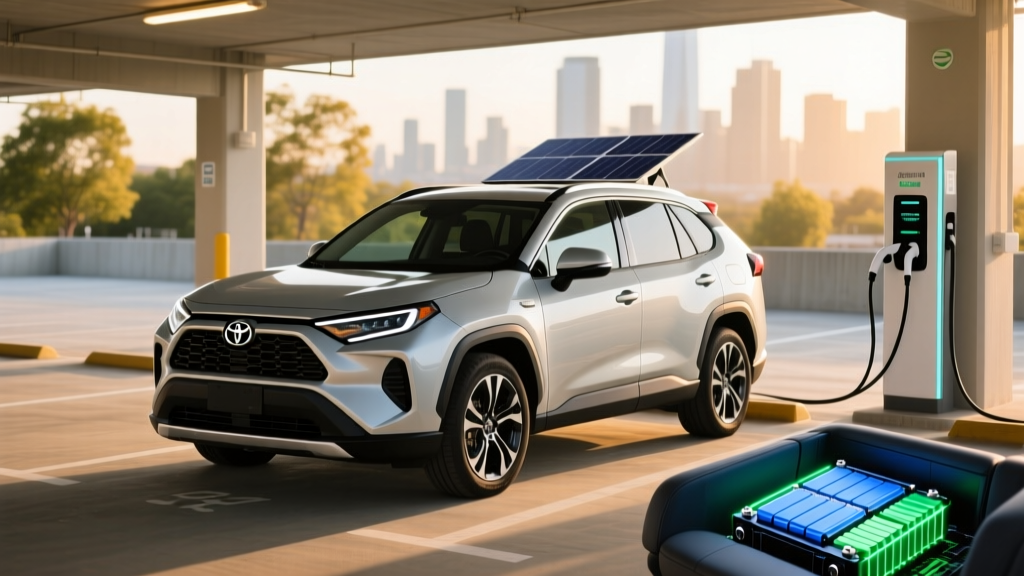
If you have searched for a plug in SUV hybrid that balances genuine electric-only commuting with the flexibility of a gas engine for road trips, the 2026 Toyota RAV4 Prime remains the segment benchmark. Now in its sixth model year since the 2021 launch, the RAV4 Prime pairs an 18.1 kWh lithium-ion battery with a 2.5-liter four-cylinder engine and dual electric motors to deliver 302 combined horsepower, 42 miles of EPA-rated electric range, and 94 MPGe. It is the best-selling PHEV in America for good reason — but it is not perfect, and the 2026 model year brings pricing shifts and evolving tax credit rules that every buyer should understand before signing a deal.
This review breaks down the RAV4 Prime's real-world efficiency, charging behavior, powertrain specs, ownership costs, and battery longevity so you can decide whether this plug in SUV hybrid is the right fit — or whether a conventional hybrid (HEV), a rival PHEV, or a full battery-electric vehicle (BEV) better serves your needs.
Quick Verdict: Who Should Buy the 2026 RAV4 Prime?
Choose the RAV4 Prime (PHEV) if:
- Your daily commute is under 40 miles round-trip and you can charge at home (Level 1 or Level 2).
- You take road trips of 300+ miles at least a few times per year and do not want to plan around DC fast chargers.
- You want AWD with strong acceleration (5.7-second 0–60) without range anxiety.
- You want a mainstream brand with a deep dealer network and proven hybrid reliability.
Look elsewhere if:
- You never have access to a plug — buy the RAV4 Hybrid (HEV) instead and save ~$6,000 upfront.
- You want 200+ miles of zero-emission driving — consider the Tesla Model Y, Hyundai Ioniq 5, or Ford Mustang Mach-E.
- You need three-row seating — the RAV4 Prime is strictly a five-passenger SUV.
HEV vs. PHEV: Understanding What You Are Buying
Before diving into specs, it is critical to distinguish a conventional hybrid (HEV) from a plug-in hybrid (PHEV), because the RAV4 lineup offers both.
| Feature | RAV4 Hybrid (HEV) | RAV4 Prime (PHEV) |
|---|---|---|
| Plug-in charging? | No — regenerates and charges via engine | Yes — plug in to charge the 18.1 kWh battery |
| Electric-only range | ~1 mile at low speed | 42 miles (EPA) |
| Combined horsepower | 219 HP | 302 HP |
| EPA combined MPG (gas mode) | 41 MPG | 38 MPG (charge-depleted) |
| EPA MPGe (electric + gas) | N/A | 94 MPGe |
| 0–60 mph | 7.4 seconds | 5.7 seconds |
| Drivetrain | AWD (eAWD) | AWD (eAWD, more powerful rear motor) |
| Starting MSRP (2026) | ~$33,590 | $44,590 |
| Federal tax credit (§30D) | Not eligible | Up to $7,500 (eligibility varies) |
The RAV4 Hybrid is an excellent choice for buyers who cannot charge at home. It never needs to be plugged in — the gasoline engine and regenerative braking keep its small ~1.6 kWh battery charged. You get strong fuel economy (41 MPG combined) with zero behavioral change versus a gas car.
The RAV4 Prime (PHEV) adds a much larger 18.1 kWh battery and more powerful electric motors. Plug it in overnight and you get 42 miles of pure electric driving — enough for most daily commutes without burning a drop of gas. Once the battery is depleted, it operates as a conventional hybrid at 38 MPG combined. The tradeoff: a ~$11,000 higher starting price (before any tax credits), and you need access to a plug to capture the efficiency benefit.
EPA Range, MPGe, and Real-World Fuel Economy
According to fueleconomy.gov, the 2026 RAV4 Prime carries the following EPA ratings:
| Metric | EPA Rating | Real-World Expectation |
|---|---|---|
| Electric-only range | 42 miles | 35–42 mi (30–35 mi in cold weather / highway) |
| MPGe (electric + gas combined) | 94 MPGe | 85–94 MPGe with regular charging |
| Gas-only city MPG (charge-depleted) | 40 MPG | 38–42 MPG (hybrids often exceed EPA in city) |
| Gas-only highway MPG | 36 MPG | 33–37 MPG |
| Gas-only combined MPG | 38 MPG | 36–40 MPG |
| Total combined range (electric + gas) | ~600 miles | 550–620 mi depending on conditions |
Real-world range note: The 42-mile electric range assumes moderate temperatures and mixed driving. In our experience and owner reports, expect 35–38 miles of electric range during summer highway driving at 70+ mph, and 28–33 miles in sub-freezing winter conditions where cabin heating draws significant energy from the battery. City driving in mild weather can sometimes exceed the EPA figure, reaching 44–45 miles thanks to aggressive regenerative braking.
One of the RAV4 Prime's strengths is that even when the battery is fully depleted, it still delivers 38 MPG combined as a conventional hybrid. That means a 400-mile road trip only uses about 10.5 gallons of gas — comparable to the standard RAV4 Hybrid and far better than a gas-only compact SUV at ~28 MPG.
Powertrain Specs: 302 HP and Standard AWD
The RAV4 Prime's powertrain is a series-parallel hybrid system combining three power sources:
- Gasoline engine: 2.5-liter inline-4 (Atkinson cycle), 177 HP / 165 lb-ft torque
- Front electric motor: 134 kW (180 HP) integrated into the transaxle
- Rear electric motor: 40 kW (54 HP) powering the rear axle for AWD
- Combined system output: 302 HP
- 0–60 mph: 5.7 seconds (Toyota-confirmed)
- Drivetrain: Electronic on-demand AWD (eAWD) — no mechanical driveshaft to the rear wheels
That 5.7-second 0–60 time makes the RAV4 Prime one of the quickest compact SUVs in its class, gas or electric. The instant torque from the electric motors gives it strong passing power, and the AWD system engages the rear motor automatically when slip is detected or during hard acceleration. Unlike some PHEVs that become sluggish once the battery depletes, the RAV4 Prime retains strong performance in hybrid mode because the 2.5L engine can both drive the wheels and charge the battery simultaneously.
Charging: How Long, What Level, and Can It DC Fast Charge?
Charging capability is where the RAV4 Prime draws its sharpest criticism — and where buyers need realistic expectations.
| Charging Level | Power (kW) | Time (0–100% battery) | Notes |
|---|---|---|---|
| Level 1 (120V household outlet) | ~1.4 kW | ~12 hours | Included cord; sufficient for overnight if daily use is under 42 mi |
| Level 2 (240V, SE trim) | 3.3 kW | ~5.5 hours | SE trim onboard charger limit |
| Level 2 (240V, XSE trim) | 6.6 kW | ~2.5 hours | XSE trim; full charge in under 3 hours with a 32A+ Level 2 station |
| DC Fast Charging | Not available | N/A | RAV4 Prime does NOT support DC fast charging |
The absence of DC fast charging is the RAV4 Prime's biggest limitation for road-trip use. On a long trip, you cannot pull into a DC fast charging station and top up the battery in 20 minutes — the vehicle simply charges via the engine while driving in hybrid mode. This is typical for most PHEVs (the Hyundai Tucson PHEV and Ford Escape PHEV also lack DC fast charging), but it means the RAV4 Prime's electric range is primarily a commuter benefit, not a road-trip one.
Practical charging advice: Most RAV4 Prime owners charge overnight on a standard 120V outlet (Level 1). At 1.4 kW, 12 hours adds roughly 40 miles of electric range — enough to fully replenish the battery for most daily commutes. If your electrical panel supports it, a Level 2 home charger (240V) on the XSE trim cuts charging to 2.5 hours, which is convenient for mid-day top-ups if you work from home.
Pricing, Trims, and Federal Tax Credit Eligibility
For the 2026 model year, the RAV4 Prime is offered in two trims:
- SE: $44,590 MSRP (3.3 kW onboard charger, 18-inch wheels, SofTex seats)
- XSE: $48,440 MSRP (6.6 kW onboard charger, 19-inch wheels, panoramic roof available, premium audio)
Both trims include Toyota Safety Sense 3.0 (adaptive cruise, lane-keeping, automatic emergency braking, blind-spot monitoring), heated front seats, an 8-inch or 10.5-inch touchscreen, and wireless Apple CarPlay/Android Auto.
Does the RAV4 Prime Qualify for the Federal EV Tax Credit?
Under current IRS §30D rules, the RAV4 Prime is classified as a plug-in hybrid and may qualify for a federal tax credit of up to $7,500 — but eligibility depends on several requirements that change frequently:
- Battery capacity: Must be ≥7 kWh — the RAV4 Prime's 18.1 kWh battery qualifies. ✓
- MSRP cap: SUVs must be under $80,000 MSRP — the RAV4 Prime qualifies. ✓
- Buyer income cap: AGI must be ≤$150,000 (single) / ≤$300,000 (joint) — verify your tax situation.
- Battery component sourcing: A percentage of battery components must be manufactured or assembled in North America — this requirement tightens annually and has affected PHEV eligibility in prior years.
- Critical minerals sourcing: A percentage of critical minerals must be sourced from the U.S. or FTA partners — also tightens annually.
- Point-of-sale transfer: As of 2024, eligible buyers can transfer the credit to the dealer for an immediate price reduction at purchase rather than waiting to claim it on their tax return.
Important caveat: Battery sourcing requirements have disqualified several PHEVs in recent years. Before purchasing, verify current eligibility on the fueleconomy.gov tax credit page and consult a tax professional. Never assume you will receive the full $7,500 without confirming your specific eligibility.
If the credit applies, the effective price of the SE trim drops to approximately $37,090 — narrowing the gap with the RAV4 Hybrid and making the PHEV significantly more compelling financially.
Battery Longevity, Warranty, and Replacement Cost
Hybrid and PHEV battery longevity is consistently the top concern among buyers considering their first electrified vehicle. Here is what the data shows for the RAV4 Prime:
| Coverage | Terms |
|---|---|
| Hybrid battery warranty | 10 years / 150,000 miles (whichever comes first) |
| Hybrid system components warranty | 8 years / 100,000 miles |
| Capacity retention guarantee | Toyota warrants the battery will retain sufficient capacity to meet emissions standards — typically interpreted as ~70% of original capacity |
| Basic vehicle warranty | 3 years / 36,000 miles |
| Powertrain warranty | 5 years / 60,000 miles |
Toyota's 10-year/150,000-mile hybrid battery warranty is among the best in the industry, matching Hyundai/Kia's coverage. Toyota has been building hybrid vehicles since the 1997 Prius, and real-world data from millions of Toyota hybrids on the road shows that hybrid battery failures before 150,000 miles are uncommon.
The RAV4 Prime uses an 18.1 kWh lithium-ion pack (NMC chemistry). Because PHEV batteries are larger than HEV batteries but smaller than full EV batteries, the RAV4 Prime's system uses a generous buffer — it never charges to true 100% or discharges to true 0%, which significantly reduces degradation stress. Most owners report negligible range loss over the first 3–5 years.
Battery replacement cost: If the hybrid battery fails outside of warranty, a replacement currently costs approximately $4,000–$6,500 including parts and labor at a Toyota dealer. However, individual module replacement (rather than the full pack) is sometimes possible for $1,500–$3,000 at independent hybrid specialists. Given the 10-year/150,000-mile warranty, most original owners will never face this cost.
Is the RAV4 Prime Reliable?
The RAV4 Prime inherits Toyota's strong reliability reputation. The 2.5-liter A25A-FXS engine is a proven Atkinson-cycle design shared across Toyota's hybrid lineup, and the eAWD system has no mechanical linkage to the rear wheels — fewer moving parts to fail. The hybrid transaxle (e-CVT) has no traditional gears, belts, or clutch packs, which reduces maintenance compared to conventional automatic transmissions.
Toyota does not publish model-specific reliability scores, but the RAV4 line consistently earns above-average marks from J.D. Power and Consumer Reports. The PHEV variant adds complexity (larger battery, more powerful motors, onboard charger), but these are mature technologies in Toyota's lineup. There are no widespread reports of systemic RAV4 Prime failures as of early 2026.
Maintenance advantage: Like all hybrids, the RAV4 Prime uses regenerative braking extensively, which significantly reduces brake pad wear. Many owners report original brake pads lasting 80,000+ miles. There is no transmission fluid to change on the e-CVT schedule, and the gasoline engine runs less frequently than in a conventional car, potentially extending oil-change intervals (though Toyota still recommends the standard 10,000-mile interval).
Pros and Cons at a Glance
Pros
- 42-mile electric range covers most commutes without gas
- 302 HP and 5.7-second 0–60 — quickest RAV4 ever
- 38 MPG combined even with a fully depleted battery
- Standard AWD with no mechanical complexity
- 10-year/150,000-mile hybrid battery warranty
- No range anxiety on road trips — fills up at any gas station
- Strong resale value; RAV4 Primes hold value exceptionally well
- Eligible for up to $7,500 federal tax credit (verify eligibility)
Cons
- No DC fast charging — road trips run entirely on gas
- ~$11,000 premium over the RAV4 Hybrid before credits
- Only two trims (SE, XSE) — limited configuration options
- 14.5-gallon fuel tank is smaller than the Hybrid's (reduced cargo space for battery)
- Dealer markups remain common due to high demand and limited supply
- 6.6 kW onboard charger requires XSE trim (adds ~$3,850)
- Rear cargo floor is slightly raised vs. the standard RAV4
RAV4 Prime vs. the Competition
The plug in SUV hybrid segment has grown considerably. Here is how the RAV4 Prime stacks up against its closest rivals for 2026:
| Spec | Toyota RAV4 Prime | Hyundai Tucson PHEV | Ford Escape PHEV | Chrysler Pacifica PHEV |
|---|---|---|---|---|
| Electric range (EPA) | 42 mi | 33 mi | 37 mi | 32 mi |
| Combined HP | 302 HP | 261 HP | 210 HP | 260 HP |
| Gas MPG (depleted) | 38 MPG | 35 MPG | 40 MPG | 30 MPG |
| Battery (kWh) | 18.1 | 13.8 | 14.4 | 16.0 |
| Level 2 charge time | 2.5 hr (XSE) | ~2 hr | ~3.5 hr | ~2 hr |
| DC fast charge | No | No | No | No |
| 0–60 mph | 5.7 sec | 7.4 sec | 8.0 sec | 7.1 sec |
| Starting MSRP | $44,590 | $39,390 | $38,500 | $51,095 |
| AWD standard? | Yes | Yes | No (FWD only) | No (FWD only) |
The RAV4 Prime wins on electric range, power, and AWD availability but carries a price premium. The Ford Escape PHEV offers the best gas-mode efficiency (40 MPG) and a lower entry price, while the Tucson PHEV undercuts on price with competitive specs. The Pacifica PHEV is a minivan, not a direct SUV competitor, but is worth considering for families needing three rows and a sliding-door layout.
Hybrid vs. PHEV vs. Full EV: Which Fits Your Life?
Choosing between a conventional hybrid, a plug-in hybrid, and a full EV depends on your charging access, driving patterns, and risk tolerance:
| Factor | HEV (e.g., RAV4 Hybrid) | PHEV (e.g., RAV4 Prime) | BEV (e.g., Tesla Model Y) |
|---|---|---|---|
| Home charging needed? | No | Yes, to capture EV benefit | Yes, strongly recommended |
| Daily electric driving | Negligible | 30–42 miles | 250–330 miles |
| Road-trip convenience | Gas station, 5 min | Gas station, 5 min | DC fast charge, 20–40 min |
| Fuel cost (per mile) | ~$0.10–0.13 | ~$0.04 electric / $0.11 gas | ~$0.03–0.05 |
| Maintenance cost | Low (no plug-in system) | Moderate (two powertrains) | Lowest (no engine, no oil changes) |
| Upfront price | Lowest | Moderate (after credits) | Highest (before credits) |
| Best for | No plug access, budget-first | Plug access + road trips | Plug access, mostly local/suburban |
If you can install a Level 2 charger at home and your daily driving stays under 40 miles, the RAV4 Prime lets you drive on electricity most days while eliminating range anxiety on longer trips. If you cannot charge at home, the standard RAV4 Hybrid delivers 41 MPG without any plug and costs significantly less. If your driving is mostly local and you want the lowest operating cost and zero tailpipe emissions, a full EV like the Model Y, Ioniq 5, or Chevrolet Equinox EV may be a better long-term investment.
Frequently Asked Questions
How many MPG does the RAV4 Prime get?
The EPA rates the 2026 RAV4 Prime at 94 MPGe when combining electric and gas driving, and 38 MPG combined (40 city / 36 highway) when operating purely on gasoline after the battery is depleted. In real-world city driving, many owners report 40–43 MPG in hybrid mode, as stop-and-go traffic maximizes regenerative braking. Highway driving at 75+ mph typically yields 33–37 MPG.
How far can the RAV4 Prime go on electric only?
The EPA rates the RAV4 Prime at 42 miles of electric-only range. Real-world results range from about 28 miles in cold winter highway driving to 45 miles in mild-weather city conditions. For a typical mixed commute in moderate temperatures, expect 36–42 miles.
Does the RAV4 Prime qualify for a tax credit?
The RAV4 Prime may qualify for up to $7,500 under the IRS §30D clean vehicle credit, subject to battery sourcing requirements, buyer income caps ($150K single / $300K joint), and the $80,000 SUV MSRP cap. Eligibility changes as sourcing rules tighten. Check fueleconomy.gov and consult a tax professional before relying on the credit in your purchase decision. The credit can be transferred to the dealer at point of sale for an immediate price reduction if eligible.
Is the RAV4 Prime reliable, and what does a battery replacement cost?
Toyota's hybrid systems are among the most proven in the industry, with millions of hybrid vehicles on the road and low failure rates. The RAV4 Prime's hybrid battery is covered by a 10-year/150,000-mile warranty. Out-of-warranty replacement costs approximately $4,000–$6,500 at a dealer, though independent hybrid shops can sometimes replace individual modules for less. Most owners will never need a replacement within the warranty period.
Can I charge the RAV4 Prime on a regular household outlet?
Yes. The included Level 1 charging cord plugs into a standard 120V household outlet and fully charges the battery in approximately 12 hours. For most owners who drive under 42 miles per day and plug in overnight, Level 1 is sufficient. A Level 2 (240V) home charger reduces charging time to 2.5 hours on the XSE trim or 5.5 hours on the SE trim.
Does the RAV4 Prime support DC fast charging?
No. The RAV4 Prime does not have a DC fast charging port. This is standard for most PHEVs — the battery is too small to benefit meaningfully from DC fast charging infrastructure, and the added hardware cost and weight are not justified. On road trips, the gasoline engine charges the battery as you drive.
How does the RAV4 Prime compare to the standard RAV4 Hybrid?
The RAV4 Prime offers 42 miles of electric range, 302 HP (vs. 219 HP), and a 5.7-second 0–60 time (vs. 7.4 seconds) for approximately $11,000 more. If you never plug in, the RAV4 Hybrid is the better value at 41 MPG combined. If you can charge daily and want the performance and electric-commuting benefit, the Prime's premium pays off — especially if you qualify for the $7,500 federal tax credit, which narrows the gap to roughly $3,500.