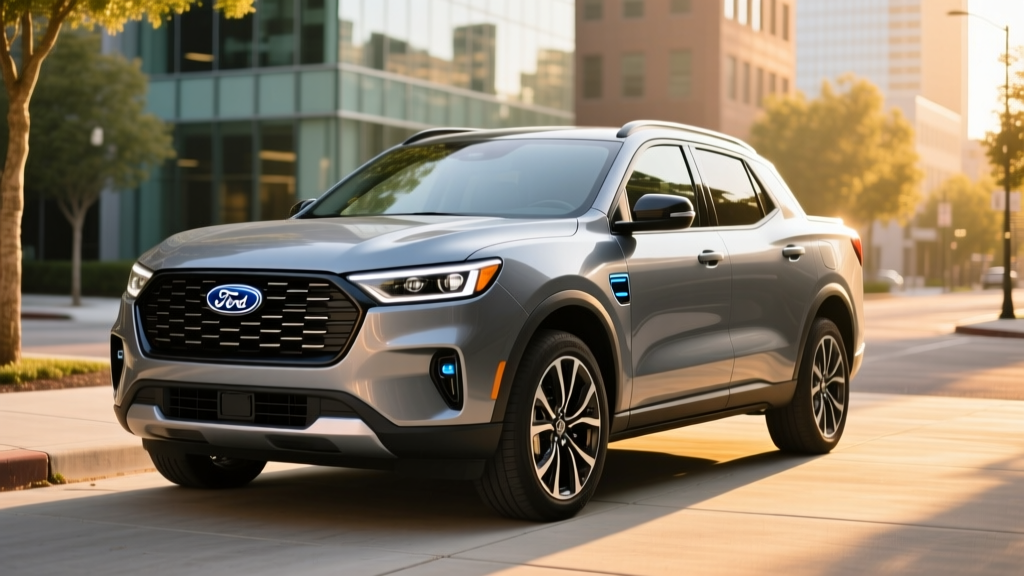
The Ford Maverick Hybrid has earned its reputation as one of the most fuel-efficient trucks on the market — but the numbers on the window sticker only tell part of the story. For 2026, the Maverick Hybrid continues to pair a 2.5-liter Atkinson-cycle four-cylinder with an electric motor in a conventional hybrid (HEV) configuration, meaning you never plug it in. It simply refuels like any gas truck and lets the hybrid system handle the efficiency gains.
If you've been searching for a hybrid Maverick and want to know what you're actually getting — real-world MPG, how the powertrain behaves under load, whether the battery will outlast the truck, and what it costs to own — this guide covers every number that matters.
How Many MPG Does the Hybrid Maverick Get?
The EPA rates the 2026 Ford Maverick Hybrid at 42 MPG city / 33 MPG highway / 37 MPG combined when equipped with front-wheel drive. Those numbers place it ahead of nearly every midsize sedan and rival compact trucks by a wide margin. For context, the gas-only Maverick with the 2.0L EcoBoost AWD returns 22/29/25 MPG — a 12 MPG combined gap that compounds into real savings over five years of ownership.
| Configuration | City MPG | Highway MPG | Combined MPG |
|---|---|---|---|
| Hybrid FWD | 42 | 33 | 37 |
| Hybrid AWD | 40 | 32 | 35 |
| 2.0L EcoBoost FWD | 23 | 30 | 26 |
| 2.0L EcoBoost AWD | 22 | 29 | 25 |
Source: fueleconomy.gov
Real-World MPG vs. EPA Estimates
Conventional hybrids like the Maverick's powertrain tend to exceed their EPA city rating in stop-and-go traffic because regenerative braking recovers energy that a gas-only truck wastes as heat. Owner-reported data on platforms like Fuelly consistently shows the Maverick Hybrid averaging 38-44 MPG in mixed city driving, with some drivers seeing 45+ MPG on flat urban routes in mild weather.
Highway driving tells a different story. At sustained speeds above 70 mph, the electric motor contributes less, and the 2.5L engine does most of the work. Expect 30-33 MPG on the highway — right around the EPA figure. Cold weather, roof cargo boxes, and aggressive driving can push highway numbers into the high 20s. Towing also significantly reduces efficiency; Ford rates the Hybrid for 2,000 lbs maximum towing (4,000 lbs with the tow package on non-hybrid models), and you'll see MPG drop to the low-to-mid 20s under a loaded trailer.
Hybrid (HEV) vs. Plug-In Hybrid (PHEV): What the Maverick Actually Is
This is a common source of confusion, so let's be precise: the Ford Maverick Hybrid is a conventional HEV, not a PHEV. There is no plug, no electric-only driving mode, and no external charging. The truck's small battery recharges through regenerative braking and engine-driven generation. You fuel it at a gas station exactly like a conventional truck.
HEV vs. PHEV — Key Differences
| Feature | HEV (Maverick Hybrid) | PHEV (e.g., Ford Escape PHEV) |
|---|---|---|
| Plug-in charging? | No — gas station only | Yes — Level 1/Level 2 |
| Electric-only range | None (motor assists engine) | Typically 30-40 miles |
| Battery size | ~1.1 kWh (small buffer) | 14-20 kWh |
| Federal tax credit | Not eligible | Potentially eligible (varies) |
| Best for | No home charging access | Home charging + short commutes |
If Ford ever introduces a Maverick PHEV, it would offer roughly 30-40 miles of electric-only range and qualify for partial federal incentives. As of the 2026 model year, that variant does not exist — the Maverick Hybrid remains strictly an HEV.
Powertrain and Performance Specs
The Maverick Hybrid uses Ford's fourth-generation hybrid system, shared in concept with the Escape Hybrid and Lincoln Corsair Hybrid. Here's the exact hardware:
| Spec | Value |
|---|---|
| Engine | 2.5L Atkinson-cycle I4 |
| Engine horsepower | 162 hp |
| Electric motor output | 126 hp |
| Combined system output | 191 hp |
| Transmission | eCVT (planetary gearset) |
| Drivetrain | FWD standard; AWD available |
| 0-60 mph | ~7.8 seconds (FWD) |
| Battery type | Lithium-ion (~1.1 kWh) |
| Max towing capacity | 2,000 lbs |
| Max payload | 1,500 lbs |
| Fuel tank | 16.5 gallons |
| Total driving range | ~610 miles (combined) |
The eCVT is not a belt-driven CVT like those found in some competitors — it's a planetary gearset that blends engine and motor power with no fixed gear ratios. The result is smooth, linear acceleration without the rubber-band effect that older CVTs are known for. That said, 191 hp in a truck means merging onto fast highways requires planning. The Maverick Hybrid is adequate, not quick.
The AWD variant adds a rear-mounted electric motor that provides torque to the rear wheels when needed. Unlike a mechanical AWD system with a driveshaft, this setup adds minimal weight and only a small MPG penalty (2 MPG combined). It's a smart solution for buyers in snow-belt states who need traction without sacrificing much efficiency.
Pricing, Trims, and Tax Credit Eligibility
The 2026 Maverick Hybrid is available across multiple trim levels. Pricing has crept up modestly from the Maverick's original $19,995 launch MSRP, but it remains one of the most affordable new trucks in America.
| Trim | MSRP (approx.) |
|---|---|
| XL Hybrid FWD | $27,995 |
| XLT Hybrid FWD | $29,995 |
| Lariat Hybrid FWD | $34,995 |
| Lobo Hybrid (AWD) | $37,995 |
| Tremor Hybrid (AWD) | $40,995 |
Pricing approximate; destination charge additional. Verify at ford.com.
Does the Hybrid Maverick Qualify for a Federal Tax Credit?
No. The federal §30D Clean Vehicle Credit applies only to plug-in electric vehicles (BEVs and PHEVs) that meet battery sourcing, critical mineral, MSRP cap, and buyer income requirements. Because the Maverick Hybrid is a conventional HEV with no plug, it does not qualify for the federal EV tax credit.
Some states offer their own incentives for efficient vehicles, and certain employer or utility programs provide rebates for hybrid purchases. Check your state's energy office and local utility for current programs. The IRS §30D page outlines exactly which vehicle types qualify federally.
Tax Credit Eligibility Checklist — Why the Maverick Hybrid Doesn't Qualify
- Plug-in requirement: §30D requires a vehicle that can be charged from an external source — the Maverick Hybrid cannot
- Battery capacity threshold: Federal rules require a minimum battery capacity for plug-in vehicles; the Maverick's ~1.1 kWh pack is far below
- Vehicle type: Only BEVs and qualifying PHEVs are eligible under current law
- State incentives: Some states may offer hybrid rebates independently — check local programs
Battery Warranty, Reliability, and Replacement Cost
Hybrid battery longevity is the single most common concern among first-time hybrid buyers. Here's what the data shows for the Maverick's powertrain:
Battery and Powertrain Warranty
Hybrid battery: 8 years / 100,000 miles (10 years / 150,000 miles in California and states that follow CARB emissions standards)
Hybrid system components: 8 years / 100,000 miles
Powertrain (engine, transmission): 5 years / 60,000 miles
Bumper-to-bumper: 3 years / 36,000 miles
Ford's hybrid battery warranty covers capacity degradation that causes the battery to fall below a usable threshold (typically around 60-70% of original capacity). In practice, Ford's lithium-ion hybrid packs have proven durable. The Escape Hybrid, which uses a similar architecture, has accumulated hundreds of thousands of fleet miles (notably in NYC taxi service) with very few battery failures before 150,000 miles.
Battery Replacement Cost
If the hybrid battery does fail outside warranty, replacement costs for the Maverick Hybrid battery pack currently range from $2,000 to $4,000 (parts and labor), depending on the service provider. That's significantly less than a full EV traction battery replacement, which can run $8,000-$20,000. The Maverick's small ~1.1 kWh pack is comparatively inexpensive.
Independent hybrid specialists often refurbish or replace individual cells rather than the entire pack, which can reduce costs further. Given the 8-10 year warranty and the track record of Ford's hybrid systems, unplanned battery replacement is a low-probability event during typical ownership.
Overall Reliability
The Maverick Hybrid's powertrain benefits from Ford's two decades of hybrid experience (dating back to the 2005 Escape Hybrid). The eCVT planetary gearset has no belts, clutches, or torque converter to wear out — it's one of the most mechanically simple transmissions in production. The main reliability watch items are the same as any modern vehicle: electronics, sensors, and infotainment glitches rather than powertrain failures.
For crash safety data, the Maverick has been evaluated by the NHTSA and the IIHS, with ratings varying by model year and headlight trim.
Who Should Buy the Hybrid Maverick — and Who Shouldn't?
Decision Framework
Choose the Hybrid Maverick if:
- You drive primarily in city or suburban traffic where regenerative braking maximizes MPG
- You don't have access to home or workplace charging (making a BEV or PHEV impractical)
- You want a truck bed but prioritize fuel economy over towing capacity
- Your annual mileage is above 12,000 miles, making fuel savings meaningful
- You want to reduce fuel spending without changing your refueling habits
Consider a full EV (like the Ford F-150 Lightning or Rivian R1T) instead if:
- You have reliable Level 2 home charging and a daily commute under 50 miles
- You want zero tailpipe emissions and lower per-mile energy costs
- You qualify for the full $7,500 federal tax credit on a qualifying BEV
- You don't regularly tow heavy loads or drive in extreme cold
Stick with the gas-only Maverick (2.0L EcoBoost) if:
- You regularly tow above 2,000 lbs (the EcoBoost with tow package handles 4,000 lbs)
- You prioritize acceleration — the EcoBoost does 0-60 in roughly 6.5 seconds
- The hybrid premium ($1,000-$2,000 depending on trim) doesn't pencil out for your annual mileage
Five-Year Fuel Cost Comparison
| Powertrain | Combined MPG | Annual Fuel Cost | 5-Year Total |
|---|---|---|---|
| Hybrid FWD | 37 | $1,378 | $6,892 |
| EcoBoost AWD | 25 | $2,040 | $10,200 |
| 5-year savings with Hybrid: | $3,308 | ||
Based on EPA combined MPG and national average gas price. Your actual costs will vary with local fuel prices and driving mix.
Real-World Ownership Insights
Beyond the spec sheet, here's what Maverick Hybrid owners consistently report after 12+ months with the truck:
City MPG exceeds expectations. Drivers in dense metro areas (Chicago, LA, Atlanta) regularly report 43-46 MPG on commutes with frequent stops. The hybrid system shines in exactly the conditions where a gas truck suffers most.
Highway range is solid but not exceptional. At 33 MPG highway with a 16.5-gallon tank, you'll see roughly 540 highway miles between fill-ups. That's excellent for a truck but less than the 610-mile combined figure suggests. Road trippers should plan fuel stops every 4-5 hours.
The bed is genuinely useful. At 4.5 feet, the Maverick's bed is shorter than an F-150's, but it fits standard 4x8 sheets of plywood with the tailgate down. The hybrid's fuel savings make it practical as a daily driver that occasionally hauls — the use case Ford designed it for.
AWD is worth it in snow country. The rear electric motor engages seamlessly on slippery surfaces. The 2 MPG penalty is a small trade for the confidence it provides in winter driving. For buyers south of the Mason-Dixon line, FWD is the efficiency-maximizing choice.
Pros and Cons — 2026 Maverick Hybrid
Pros
- 42 MPG city EPA — best-in-class for trucks
- Low starting price for a new truck
- No charging infrastructure needed
- Strong battery warranty (8-10 years)
- Practical bed with clever storage features
- Smooth eCVT with no belt-driven CVT feel
Cons
- 191 hp feels modest on highway on-ramps
- 2,000-lb max towing (no heavy-duty option for hybrid)
- No federal tax credit eligibility
- Highway MPG drops noticeably above 75 mph
- AWD hybrid availability can be limited at dealers
- Cabin materials reflect the budget price point
Frequently Asked Questions
How many MPG does the hybrid Maverick get in real driving?
The EPA rates it at 42 city / 33 highway / 37 combined (FWD). In real-world city driving, many owners report 40-46 MPG. Highway driving at 70+ mph typically yields 30-33 MPG. Cold weather and towing will reduce these numbers.
Do I need to plug in the Maverick Hybrid?
No. The Maverick Hybrid is a conventional HEV, not a plug-in hybrid. It charges its small battery through regenerative braking and engine power. You refuel it at a gas station like any other vehicle.
Is the Maverick Hybrid reliable? What if the battery dies?
Ford's hybrid system has a strong reliability track record spanning two decades. The hybrid battery is warranted for 8 years/100,000 miles (10 years/150,000 in CARB states). Out-of-warranty battery replacement costs approximately $2,000-$4,000 — far less than an EV battery.
Does the hybrid Maverick qualify for any tax credits?
No federal tax credit applies to the Maverick Hybrid because it is not a plug-in vehicle. The §30D Clean Vehicle Credit requires external charging capability. Some state or utility programs may offer hybrid incentives — check locally.
Can the Maverick Hybrid tow a trailer?
Yes, but with limits. The hybrid is rated for 2,000 lbs of towing. If you need to tow 4,000 lbs, you'll need the EcoBoost engine with the optional tow package. Towing also reduces hybrid MPG significantly, typically into the low-to-mid 20s.
Hybrid vs. PHEV vs. EV — which truck is right for me?
If you lack home charging and want maximum fuel savings with zero behavior change, the Maverick Hybrid (HEV) is the answer. If you have home charging and a short commute, a PHEV offers electric-only daily driving with gas backup for longer trips. A full EV (BEV) delivers the lowest per-mile cost and zero tailpipe emissions but requires reliable charging access and a higher upfront investment. The Maverick Hybrid sits at the low-risk, low-complexity end of that spectrum.