Quick Verdict: The Three-Row Hybrid That Actually Fits Adults
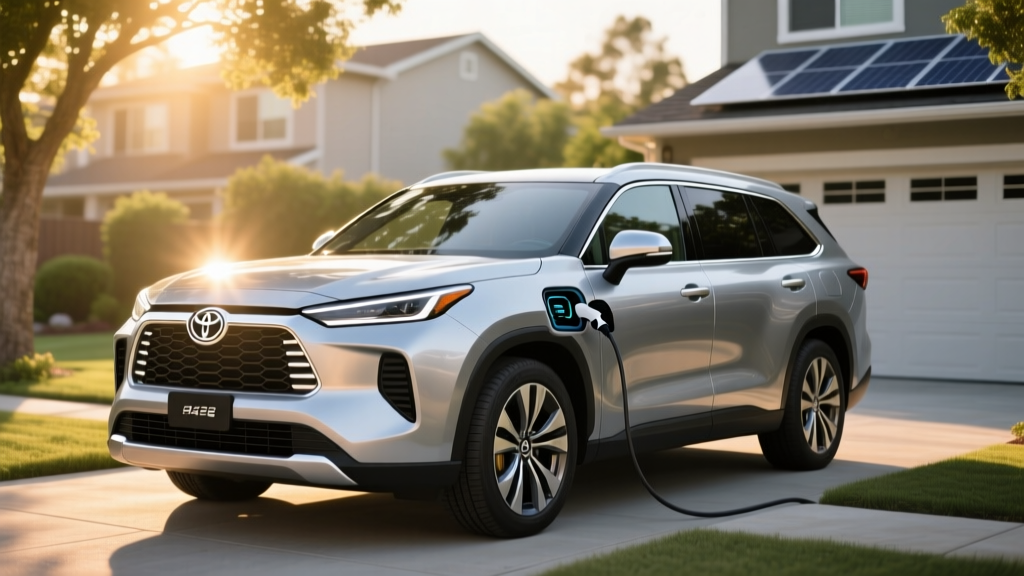
The Toyota Grand Highlander Hybrid occupies a specific niche that few vehicles can fill: a genuine three-row SUV with usable third-row space that sips fuel like a compact sedan. For 2026, Toyota continues offering this family hauler with two distinct hybrid powertrains — the efficiency-focused standard hybrid and the performance-oriented Hybrid MAX — each delivering a very different ownership experience. Neither is a plug-in hybrid; both are self-charging conventional hybrids (HEVs) that require zero behavioral change from a gas-car driver.
After analyzing EPA data and real-world driving patterns, the standard Grand Highlander Hybrid remains one of the most compelling arguments for families who want electrified efficiency without range anxiety, charging logistics, or the premium pricing of a full EV three-row SUV.
The Grand Highlander is offered exclusively as a conventional hybrid (HEV). It regenerates energy through braking and engine operation to charge a small battery. You never plug it in. This differs from a plug-in hybrid (PHEV) like the Toyota RAV4 Prime, which has a larger battery you charge from a wall outlet for 30-40 miles of electric-only driving. Toyota does not currently offer a Grand Highlander PHEV variant.
Fuel Economy: EPA Numbers and Real-World MPG
The headline number for the standard Grand Highlander Hybrid is 36 MPG combined — a remarkable figure for a 4,700-pound, three-row SUV. But as with any EPA estimate, real-world results depend heavily on driving conditions, and hybrids often behave differently than their stickers suggest.
| Powertrain | City MPG | Highway MPG | Combined MPG |
|---|---|---|---|
| Standard Hybrid (FWD) | 37 | 34 | 36 |
| Standard Hybrid (AWD) | 36 | 32 | 34 |
| Hybrid MAX (AWD) | 26 | 27 | 27 |
Source: fueleconomy.gov
Real-World MPG: What to Actually Expect
Toyota's hybrid system excels in stop-and-go city driving, where the electric motor handles low-speed propulsion and regenerative braking recaptures energy. Many owners report exceeding the EPA city estimate by 2-4 MPG in urban commuting, hitting 38-40 MPG in warm weather on flat terrain. This is the inverse of a conventional gas car, which typically gets worse mileage in the city.
Highway driving tells a different story. At sustained 70-80 mph speeds, the gasoline engine does most of the work, and the aerodynamic profile of a large SUV creates significant drag. Expect 30-33 MPG on the highway in real-world conditions — slightly below the EPA highway estimate. Cold weather (below 40°F) drops efficiency further, as the engine runs more frequently to provide cabin heat and the battery's charge/discharge efficiency decreases. In winter highway driving, 28-30 MPG is common for the AWD standard hybrid.
The Hybrid MAX trades efficiency for performance. Its turbocharged engine and sport-tuned hybrid system deliver 362 combined horsepower but drop fuel economy to 27 MPG combined. Think of it as the enthusiast's three-row option — it competes more with turbocharged V6 gas SUVs on efficiency while offering substantially more torque and acceleration.
Powertrain Deep Dive: Two Hybrid Systems Compared
| Specification | Standard Hybrid | Hybrid MAX |
|---|---|---|
| Engine | 2.5L 4-cyl Atkinson | 2.4L Turbo 4-cyl |
| Combined System HP | 245 hp | 362 hp |
| Combined Torque | 173 lb-ft (engine) + electric motor torque | 400 lb-ft |
| Transmission | eCVT | 6-speed automatic |
| Drivetrain Options | FWD or AWD (eAWD) | AWD only |
| 0-60 mph (est.) | ~7.8 sec | ~6.0 sec |
| Towing Capacity | 3,500 lbs | 3,500 lbs |
| Hybrid Battery | ~1.6 kWh NiMH/Li-ion | ~1.9 kWh Li-ion |
The standard hybrid uses Toyota's proven series-parallel system: the 2.5-liter Atkinson-cycle engine pairs with front and (on AWD models) rear electric motors. The rear motor enables electronic AWD without a mechanical driveshaft — it engages only when traction is needed or during hard acceleration. This eAWD system is lighter and more efficient than traditional AWD but provides less rear-axle torque for serious off-road or towing scenarios.
The Hybrid MAX is fundamentally different. It uses a turbocharged 2.4-liter engine with a more powerful electric motor sandwiched between the engine and a conventional 6-speed automatic transmission. This Direct Shift hybrid system delivers the responsiveness of a turbo engine with electric torque fill at low RPMs, eliminating turbo lag. The trade-off is weight, complexity, and fuel economy.
Hybrid Battery: Warranty, Lifespan, and Replacement Cost
Toyota covers the Grand Highlander Hybrid battery with a 10-year / 150,000-mile warranty (whichever comes first) for hybrid system components. This applies in all 50 states. California-emissions states receive additional coverage on certain emissions-related hybrid components. The warranty covers battery capacity loss below a defined threshold and defects in hybrid system parts including the inverter, electric motors, and control modules.
The hybrid battery in the Grand Highlander is small — roughly 1.6 to 1.9 kWh depending on the powertrain — because it only needs to buffer energy for short electric-only assists, not power the vehicle for extended distances. This small capacity means fewer charge/discharge cycles per mile driven, which contributes to longevity.
Toyota's hybrid batteries have an established track record. The Prius, now in its fifth generation, routinely sees original batteries lasting 150,000-200,000+ miles with proper maintenance. The Grand Highlander uses Toyota's fourth-generation hybrid system architecture, which has shown excellent durability in the Highlander Hybrid (on sale since 2020) and Sienna hybrid minivan.
Battery Replacement Cost
If the hybrid battery does fail outside warranty, replacement cost for a Toyota midsize hybrid battery typically runs $3,000 to $5,000 including labor at a dealership. Independent hybrid specialists often offer refurbished battery packs for $1,500 to $2,500. Given the warranty coverage and Toyota's hybrid reliability history, this is a low-probability expense for most owners — but it's a number worth knowing for long-term ownership planning.
Unlike a full EV battery (which can cost $10,000-$20,000+ to replace), the Grand Highlander's small hybrid battery is relatively affordable because it contains far fewer cells and less raw material. The hybrid system's other components — electric motors, power control unit, inverter — are also covered under the hybrid warranty and rarely fail independently.
Pricing, Trims, and Tax Credit Eligibility
The 2026 Grand Highlander Hybrid starts at approximately $42,000 MSRP for the LE trim with the standard hybrid powertrain and FWD. Adding AWD costs roughly $1,600. The Hybrid MAX is reserved for higher trims (Limited and Platinum), with pricing starting around $53,000 and reaching the low $60,000s when fully loaded.
| Trim | Powertrain | Est. MSRP |
|---|---|---|
| LE | Standard Hybrid | ~$42,000 |
| XLE | Standard Hybrid | ~$46,500 |
| Limited | Standard Hybrid or MAX | ~$50,000–$53,000 |
| Platinum | Hybrid MAX | ~$58,000–$62,000 |
Federal Tax Credit: Does the Grand Highlander Hybrid Qualify?
No. The Grand Highlander Hybrid is a conventional HEV, not a plug-in vehicle. Under IRS §30D clean vehicle credit rules, only plug-in electric vehicles (BEVs and PHEVs with at least 7 kWh of battery capacity and the ability to charge from an external source) are eligible for the federal tax credit of up to $7,500. Conventional hybrids like the Grand Highlander Hybrid, Honda CR-V Hybrid, and Ford Maverick Hybrid do not qualify for any federal purchase incentive.
Some states offer their own incentives for hybrid vehicles, though these are increasingly rare as state programs shift toward zero-emission vehicles. Check your state's energy office or department of environmental quality for current programs. A few states historically offered $500-$1,000 rebates for HEVs, but most have sunset these as hybrid technology became mainstream.
Hybrid vs PHEV vs Full EV: Which Powertrain Fits Your Family?
The three-row family SUV segment now offers all three electrification levels. Here's how to decide which is right for your situation:
Choose the Grand Highlander Hybrid (HEV) if:
- You lack access to home charging (apartment, street parking, no garage)
- You want zero behavioral change from your current gas car
- You drive 15,000+ miles/year and want consistent 34-36 MPG
- Your budget is $42,000-$55,000
- You frequently take long road trips and don't want to plan charging stops
Consider a PHEV (e.g., Mazda CX-90 PHEV) if:
- You can install a Level 2 charger at home
- Your daily commute is under 30 miles round-trip (drive on electricity most days)
- You want to reduce gas consumption by 60-80% without range anxiety on road trips
- You qualify for the $7,500 federal tax credit (check IRS §30D requirements)
- Budget allows for higher MSRP offset by the tax credit
Consider a Full EV (e.g., Kia EV9, Tesla Model X) if:
- You have reliable home Level 2 charging and access to DC fast chargers on road-trip routes
- You want the lowest per-mile energy cost (~$0.04-$0.06/mi on home electricity vs ~$0.14-$0.18/mi on gas for the hybrid)
- You want maximum federal and state incentives
- You're comfortable with 270-320 miles of real-world range and 20-30 minute DC fast-charge stops on road trips
- You prioritize instant torque, one-pedal driving, and zero tailpipe emissions
For most families without home charging access, the Grand Highlander Hybrid remains the pragmatic sweet spot. You get 40%+ better fuel economy than a comparable gas-only three-row SUV (the non-hybrid Grand Highlander gets 24 MPG combined) with no infrastructure requirements and no premium pricing penalty.
Ownership Economics: 5-Year Fuel Cost Comparison
To put the Grand Highlander Hybrid's efficiency in context, here's a five-year fuel cost estimate compared to the gas-only Grand Highlander and a comparable EV, assuming 15,000 miles/year and national average fuel/electricity prices:
| Vehicle | Combined MPG / MPGe | Est. 5-Year Fuel Cost |
|---|---|---|
| Grand Highlander Gas (2.4T AWD) | 24 MPG | ~$11,700 |
| Grand Highlander Hybrid (AWD) | 34 MPG | ~$8,250 |
| Kia EV9 (home charging) | 89 MPGe | ~$3,800 |
Based on $3.75/gal regular unleaded and $0.16/kWh national average electricity. Actual costs vary by region. Source: fueleconomy.gov
The hybrid saves roughly $3,450 over five years compared to the gas-only Grand Highlander — about $690/year or $58/month. That savings nearly covers the hybrid powertrain's typical price premium over the gas model. Against a full EV charging at home, the hybrid costs about $4,450 more over five years, but the EV requires home charger installation ($500-$2,000) and carries a higher purchase price before incentives.
Pros, Cons, and Final Recommendation
✓ Pros
- 34-36 MPG combined in a genuine three-row SUV
- Adults fit in the third row (rare for the segment)
- No plug-in charging required — zero lifestyle change
- 10-year/150,000-mile hybrid battery warranty
- Toyota's proven hybrid reliability track record
- Smooth, quiet low-speed electric driving in traffic
- Standard Toyota Safety Sense 3.0 ADAS suite
✗ Cons
- No PHEV option for electric-only commuting
- No federal tax credit eligibility
- Hybrid MAX fuel economy is unimpressive (27 MPG)
- eAWD rear axle has limited torque for heavy towing
- Higher base price than gas-only Grand Highlander
- CVT drone under hard acceleration (standard hybrid)
- Third-row access still requires second-row fold/slide
The Grand Highlander Hybrid is the default recommendation for families who need three usable rows, want to minimize fuel costs, and either cannot or prefer not to deal with plug-in charging. It does one thing exceptionally well — move seven or eight people efficiently — without asking anything of the driver beyond filling up at a gas station.
Frequently Asked Questions
How many MPG does the Grand Highlander Hybrid actually get?
The EPA rates the standard hybrid at 36 MPG combined (FWD) or 34 MPG combined (AWD). In real-world driving, expect 38-40 MPG in warm-weather city commuting and 30-33 MPG on the highway. Cold weather and sustained high speeds reduce efficiency. The Hybrid MAX returns about 27 MPG combined.
Does the Grand Highlander Hybrid need to be plugged in?
No. It is a conventional hybrid (HEV), not a plug-in hybrid. The battery charges through regenerative braking and the gasoline engine. You fuel it exactly like a regular gas car — there is no charging port, no plug, and no electric-only driving range to manage.
Is the Grand Highlander Hybrid reliable? What about battery replacement?
Toyota's hybrid systems have two decades of proven reliability. The hybrid battery is warranted for 10 years/150,000 miles. If replacement is ever needed outside warranty, expect $3,000-$5,000 at a dealer — far less than a full EV battery. Many Toyota hybrids exceed 200,000 miles on the original battery.
Does the Grand Highlander Hybrid qualify for a federal tax credit?
No. The federal §30D clean vehicle credit applies only to plug-in vehicles (BEVs and PHEVs). Conventional hybrids like the Grand Highlander Hybrid are not eligible for federal purchase incentives. Some states may offer small hybrid rebates — check your state energy office.
How does the Grand Highlander Hybrid compare to a hybrid minivan like the Sienna?
The Toyota Sienna hybrid (also a conventional HEV, 36 MPG combined) offers more interior cargo volume and easier third-row access via sliding doors, making it the practical choice for families with young children. The Grand Highlander Hybrid offers a more SUV-like driving position, slightly more ground clearance, and a more traditional SUV aesthetic. Both share Toyota's hybrid system architecture and achieve similar fuel economy. Choose based on body style preference and whether you prioritize cargo utility (Sienna) or SUV styling and ride height (Grand Highlander).
Is the Hybrid MAX worth the premium over the standard hybrid?
Only if you prioritize acceleration and driving engagement over fuel economy. The Hybrid MAX's 362 HP and 6.0-second 0-60 time are genuinely quick for a three-row SUV, but fuel economy drops to 27 MPG combined — a 25% penalty versus the standard hybrid. The MAX also requires higher trims (Limited and above), pushing the price above $53,000. For most family-hauling duties, the standard hybrid's 245 HP and 34-36 MPG represent the better value proposition.