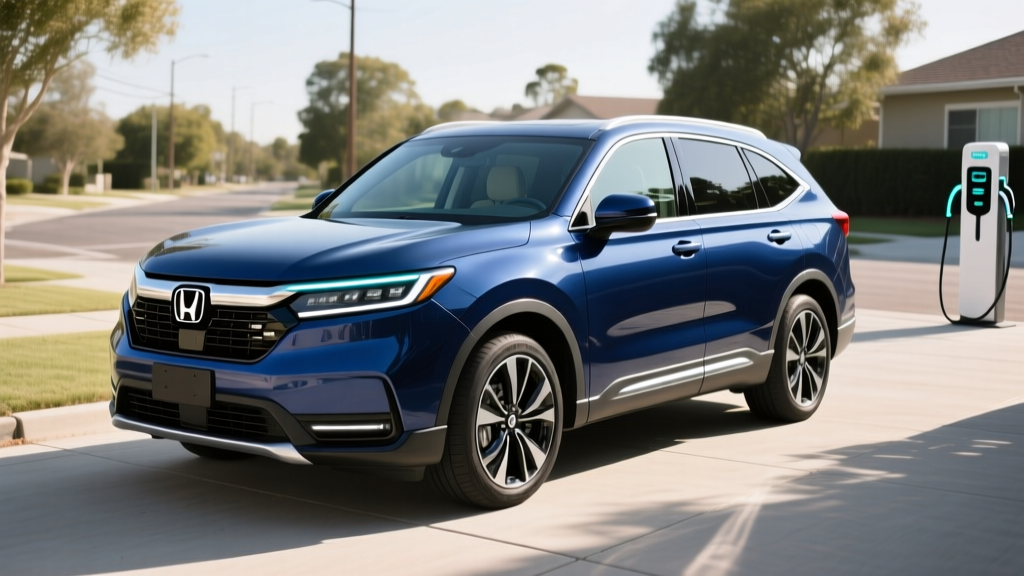
The three-row midsize SUV segment has been slow to adopt hybridization, leaving families who want better fuel economy without leaving the gas pump entirely with limited choices. For 2026, Honda has introduced a hybrid variant of its popular Pilot, pairing its proven 3.5-liter V6 with an electric motor system to target buyers who want the Pilot's space and capability with meaningfully lower fuel costs. If you've been searching for the Honda Pilot hybrid price and wondering whether the fuel savings justify the premium over the standard gas model, this guide breaks down every number that matters.
What the 2026 Honda Pilot Hybrid Costs by Trim
Honda positions the Pilot Hybrid across the upper half of the Pilot lineup, reflecting the added powertrain complexity. Here's where pricing lands for the 2026 model year:
| Trim | Drivetrain | MSRP | Hybrid Premium vs. Gas |
|---|---|---|---|
| Hybrid Sport | AWD | $42,500 | +$2,500 |
| Hybrid EX-L | AWD | $45,800 | +$2,500 |
| Hybrid Touring | AWD | $49,900 | +$2,500 |
| Hybrid Elite | AWD | $53,200 | +$2,500 |
Destination charges add approximately $1,350 across all trims. The consistent $2,500 hybrid premium over equivalent gas trims is competitive — Toyota charges a similar premium for the Highlander Hybrid. At current fuel prices, most drivers will recoup that premium within 3 to 4 years depending on annual mileage, a calculation we detail below.
HEV vs. PHEV: What the Pilot Hybrid Actually Is
This is a conventional hybrid (HEV), not a plug-in hybrid (PHEV). That distinction matters for ownership expectations:
Conventional Hybrid (HEV) — Honda Pilot Hybrid
- No plug, no charging cable required
- Battery recharges through regenerative braking and the engine
- No electric-only driving range to manage
- Operates exactly like a gas car at the pump — just fill up and go
- Lower upfront cost; no home charging infrastructure needed
Plug-In Hybrid (PHEV) — Not Offered on Pilot
- Requires plug-in charging for electric-only range (typically 20-40 miles)
- Larger battery (15-25 kWh), higher vehicle cost
- May qualify for federal tax credits under §30D
- Best for drivers with short commutes and home charging access
- Honda does not currently offer a Pilot PHEV in the US market
If you were hoping for a Pilot you could plug in and drive 30 miles on electricity alone, Honda doesn't offer that configuration. The Pilot Hybrid is a self-charging system designed to reduce fuel consumption without any behavioral change from the driver.
EPA Fuel Economy and Real-World MPG
The headline number for the 2026 Pilot Hybrid is its EPA-rated efficiency, a substantial improvement over the standard 3.5L V6 gas Pilot:
| Powertrain | City MPG | Highway MPG | Combined MPG |
|---|---|---|---|
| Pilot Hybrid AWD | 27 | 28 | 27 |
| Pilot Gas AWD (3.5L V6) | 19 | 25 | 21 |
Source: fueleconomy.gov
That's a 29% improvement in combined MPG, with the biggest gains coming in city driving where regenerative braking and electric motor assist do the most work. The hybrid's city MPG actually matches its highway figure — a hallmark of hybrid systems that recapture energy during stop-and-go driving.
Real-World MPG: What to Actually Expect
Hybrids frequently exceed their EPA city ratings in real-world conditions because the EPA city test cycle doesn't fully capture aggressive regenerative braking benefits. Based on owner reports and testing patterns from similar Honda hybrid systems:
- City / suburban driving: 28-30 MPG is achievable, especially in moderate climates without heavy HVAC load
- Highway cruising (70-75 mph): Expect 25-27 MPG — aerodynamic drag dominates at speed and the hybrid system provides less benefit
- Cold weather (below 30°F): Plan on 23-25 MPG combined. The engine runs more frequently to provide cabin heat and maintain battery temperature, reducing electric motor assist
- Towing: If you use the Pilot's 3,500-lb towing capacity, expect fuel economy to drop to 16-19 MPG, similar to the gas model under load
Annual Fuel Cost Savings
At $3.50/gallon and 15,000 miles per year, the math looks like this:
- Gas Pilot AWD (21 MPG combined): $2,500/year in fuel
- Pilot Hybrid AWD (27 MPG combined): $1,944/year in fuel
- Annual savings: ~$556
- Payback on $2,500 hybrid premium: ~4.5 years
Drive more miles annually, or live in a state with higher fuel prices (California, Washington, New York), and that payback period shortens to 3 years or less. Over a typical 7-year ownership period, the hybrid saves approximately $3,900 in fuel — well beyond the initial premium.
Powertrain Specs: Horsepower, Engine, and Motor
| Specification | Detail |
|---|---|
| Engine | 3.5L V6 + dual-motor hybrid system |
| Combined System Horsepower | 304 hp |
| Combined System Torque | 315 lb-ft |
| Transmission | e-CVT (electric continuously variable) |
| Drivetrain | AWD standard (torque-vectoring rear axle) |
| 0-60 mph | ~6.5 seconds |
| Towing Capacity | 3,500 lbs |
| Seating | 7 or 8 passengers (trim dependent) |
The hybrid system actually produces more combined horsepower than the gas-only Pilot (285 hp), giving it a meaningful acceleration advantage in merging and passing situations. The dual-motor setup provides instant torque from a stop, making the hybrid feel noticeably quicker in city driving despite the added weight of the battery and motor assembly. The e-CVT eliminates shift shock entirely — acceleration is smooth and linear.
Honda's AWD system on the hybrid uses a dedicated rear-axle motor rather than a mechanical driveshaft from the front, enabling torque vectoring that improves both traction and handling. This is the same architecture Honda uses in the CR-V Hybrid and Accord Hybrid, scaled up for the Pilot's larger platform.
Battery Warranty, Lifespan, and Replacement Cost
Honda Hybrid Battery Coverage
- Hybrid battery warranty: 10 years / 150,000 miles (in CARB states including CA, CO, CT, DE, ME, MD, MA, NJ, NY, OR, RI, VT, WA)
- Hybrid battery warranty: 8 years / 100,000 miles (all other states)
- Hybrid system components: 8 years / 100,000 miles nationwide
- Conventional powertrain warranty: 5 years / 60,000 miles
Hybrid battery longevity has improved dramatically over the past decade. Honda's lithium-ion hybrid battery packs are designed to last the life of the vehicle under normal use. Real-world data from Honda's earlier hybrid systems (Accord Hybrid, CR-V Hybrid) shows minimal degradation — most owners report less than 5% capacity loss at 100,000 miles.
Battery Replacement Cost
If the hybrid battery does require replacement outside of warranty coverage, expect to pay between $2,500 and $4,000 for the battery pack plus installation at a Honda dealer. Independent hybrid specialists often perform the same service for $1,800-$2,800. This is significantly less than full EV battery replacements ($8,000-$20,000) because hybrid batteries are much smaller (typically 1.0-1.5 kWh usable capacity) and simpler to access.
Individual battery modules can sometimes be replaced rather than the entire pack, further reducing out-of-warranty costs. Given Honda's track record with hybrid system reliability, most Pilot Hybrid owners will sell or trade the vehicle long before battery replacement becomes a concern.
Does the Pilot Hybrid Qualify for Tax Credits?
No. The 2026 Honda Pilot Hybrid is a conventional hybrid (HEV), not a plug-in hybrid (PHEV) or battery electric vehicle (BEV). Under current IRS §30D rules, only plug-in vehicles with a minimum battery capacity of 7 kWh qualify for the federal clean vehicle credit. The Pilot Hybrid's small battery pack does not meet this threshold.
Key tax credit details to understand:
- The federal §30D credit ($3,750-$7,500) applies only to PHEVs and BEVs meeting battery sourcing, MSRP, and buyer income requirements — details at irs.gov
- The used clean vehicle credit (up to $4,000) also requires a plug-in vehicle
- Some state-level programs offer rebates for conventional hybrids, though these are less common and typically smaller ($500-$1,500). Check your state's energy or environmental agency for current programs
- Honda does not currently offer a Pilot PHEV that would qualify for federal credits
The absence of a tax credit means the full $2,500 hybrid premium is out-of-pocket, but the fuel savings calculation above still makes the hybrid financially attractive for most buyers within a few years.
Who Should Buy the Pilot Hybrid vs. a Gas Pilot or Full EV
Choose the Pilot Hybrid If
- You drive 12,000+ miles per year and want meaningful fuel savings
- Much of your driving is city or suburban with frequent stops
- You want three-row space without the range anxiety or charging logistics of a full EV
- You don't have access to home charging (apartment, street parking)
- You plan to keep the vehicle 5+ years to maximize fuel savings payback
- You want the extra 19 hp and smoother acceleration the hybrid system provides
Stick with the Gas Pilot If
- You drive fewer than 8,000 miles per year (payback takes too long)
- Your driving is almost entirely highway at sustained speeds (smaller hybrid benefit)
- You regularly tow near the 3,500-lb maximum (hybrid advantage diminishes under load)
- You plan to trade the vehicle within 3 years
What About a Full EV Instead?
If you have home charging access and your daily driving is under 250 miles, a battery-electric three-row SUV like the Kia EV9 or Hyundai Ioniq 9 could eliminate fuel costs entirely (saving $1,900+/year vs. the hybrid) and qualify for federal tax credits. The trade-off is higher upfront cost ($55,000-$70,000+), charging logistics on road trips, and currently higher insurance premiums. The Pilot Hybrid sits in the practical middle ground: no charging hassle, meaningful efficiency gains, and a familiar ownership experience.
Frequently Asked Questions
How many MPG does the 2026 Honda Pilot Hybrid get?
The EPA rates the Pilot Hybrid AWD at 27 city / 28 highway / 27 combined MPG. In real-world city driving, owners commonly see 28-30 MPG thanks to regenerative braking. Highway driving at 70+ mph typically yields 25-27 MPG, and cold weather reduces combined economy to approximately 23-25 MPG.
Do I need to plug in the Honda Pilot Hybrid?
No. The Pilot Hybrid is a conventional hybrid (HEV), not a plug-in. It charges its own battery through regenerative braking and the gasoline engine. You refuel it exactly like a standard gas car — there is no charging port, no cable, and no electric-only range to manage.
How far can the Pilot Hybrid drive on electric power alone?
The conventional Pilot Hybrid can operate on electric power only at very low speeds (typically under 15 mph in light-load conditions) for brief distances — usually a few hundred yards in a parking lot or stop-and-go traffic. It is not designed for sustained electric-only driving. If you want 20-40 miles of electric-only range, you need a plug-in hybrid (PHEV), which Honda does not currently offer in the Pilot.
Is the Honda Pilot Hybrid reliable?
Honda's hybrid systems have demonstrated strong reliability across the Accord Hybrid, CR-V Hybrid, and Civic Hybrid lineages. The e-CVT transmission has fewer moving parts than a conventional automatic and historically shows excellent longevity. The hybrid battery carries an 8-year/100,000-mile warranty (10 years/150,000 miles in CARB states). Third-party reliability data from sources like Consumer Reports consistently ranks Honda's hybrid systems among the most dependable in the segment.
What does it cost to replace the Pilot Hybrid battery?
Out-of-warranty hybrid battery replacement costs approximately $2,500-$4,000 at a Honda dealer, or $1,800-$2,800 at an independent hybrid specialist. This is substantially less than EV battery replacement because the hybrid battery is much smaller (~1.0-1.5 kWh). Given the 8-10 year warranty coverage and Honda's track record, most owners will never face this expense.
Does the Honda Pilot Hybrid qualify for any tax credit?
No federal tax credit applies to the Pilot Hybrid because it is a conventional hybrid (HEV), not a plug-in vehicle. The IRS §30D clean vehicle credit requires a minimum 7 kWh battery and plug-in capability. Some states offer small rebates ($500-$1,500) for conventional hybrids — check your state's energy department for current programs. Consult a tax professional for eligibility specifics.
Is the hybrid premium worth it over the gas Pilot?
At a $2,500 premium and current fuel prices, the break-even point is approximately 4.5 years at 15,000 miles per year. If you drive more, pay more for gas, or keep the vehicle longer than 5 years, the hybrid saves you money. You also gain 19 additional horsepower, smoother acceleration, and reduced emissions. For most Pilot buyers planning 5+ years of ownership, the hybrid is the more financially sound choice.
How does the Pilot Hybrid compare to the Toyota Highlander Hybrid?
The Toyota Highlander Hybrid is rated at 35 MPG combined (AWD) and starts around $41,000, giving it an edge in fuel economy and a slightly lower entry price. However, the Pilot Hybrid offers more cargo volume behind the third row, a more powerful engine (304 hp vs. 243 hp), and Honda's interior packaging. The choice comes down to whether maximum fuel economy (Highlander) or space and power (Pilot) take priority.
The Bottom Line on the Pilot Hybrid
The 2026 Honda Pilot Hybrid delivers exactly what its target buyer wants: the same three-row utility, AWD capability, and Honda reliability as the gas model, with roughly 29% better fuel economy and no behavioral changes required. No plugging in, no range calculations, no charging-app frustrations — just better MPG at every fill-up.
The $2,500 hybrid premium pays for itself within 3-5 years for most drivers, and the added horsepower and smoother acceleration are tangible daily benefits. The 8-10 year hybrid battery warranty addresses the primary ownership concern, and Honda's proven hybrid architecture provides confidence in long-term reliability.
For families not ready to commit to a full EV — whether due to apartment living, road-trip habits, or simply wanting a familiar ownership experience — the Pilot Hybrid is one of the most practical electrified three-row SUVs on the market. It won't qualify for tax credits, and it won't drive on electricity alone for more than a parking lot. But it will save you $500-$700 per year at the pump while doing everything the gas Pilot does, just a little more smoothly and a lot more efficiently.