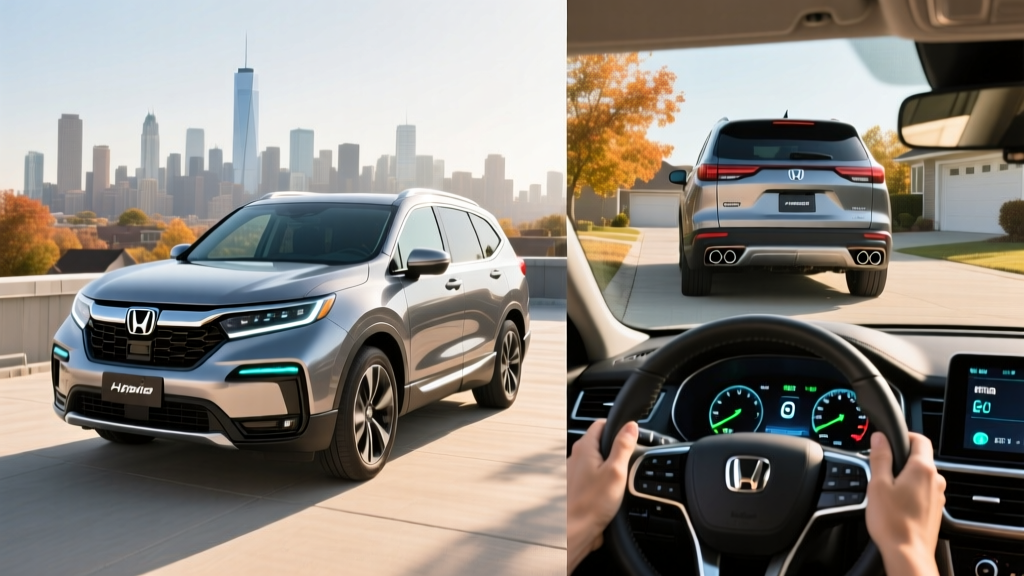
Few vehicles define the three-row family SUV segment quite like the Honda Pilot. With the 2026 model year, interest in a Honda Pilot hybrid has surged—fueled by rising fuel costs, tightening emissions standards, and Honda's broader push toward electrification across its lineup. But here's the critical question buyers are asking: does a hybrid Honda Pilot actually exist yet, and if so, what kind of hybrid is it?
This guide cuts through the speculation. We'll examine Honda's confirmed hybrid powertrain strategy for the Pilot, compare what a conventional hybrid (HEV) versus a plug-in hybrid (PHEV) would mean for your daily driving, break down projected fuel economy, pricing, tax-credit eligibility, and help you decide whether to wait for a hybrid Pilot, buy the current gas model, or pivot to a fully electric three-row SUV.
HEV vs. PHEV: What Kind of Honda Pilot Hybrid Are We Talking About?
Before diving into specs, it's essential to understand the two hybrid architectures that could underpin a Honda Pilot hybrid. The distinction matters enormously for your fuel costs, daily routine, and tax-credit eligibility.
Conventional Hybrid (HEV)
- No plug-in charging required
- Small battery (~1.5–2.0 kWh) recharged by regenerative braking and engine
- Electric motor assists the gas engine; cannot drive on electricity alone for meaningful distances
- Fuel economy improvement: typically 20–35% over gas-only equivalent
- Does not qualify for the federal §30D EV tax credit
Plug-In Hybrid (PHEV)
- Plug-in charging via Level 1 (120V) or Level 2 (240V)
- Larger battery (~15–20 kWh) providing 30–50 miles of electric-only range
- Can operate as a full EV for daily commutes, then as a hybrid for longer trips
- Fuel economy: 70–90 MPGe combined when factoring in electric miles
- May qualify for up to $7,500 federal §30D tax credit (subject to sourcing, MSRP, and income rules)
Honda's current U.S. hybrid strategy leans heavily on its two-motor hybrid system found in the CR-V Hybrid and Accord Hybrid—both conventional HEVs. A Pilot hybrid would most likely debut as an HEV using a larger version of this architecture, with a PHEV variant potentially following later.
Projected Honda Pilot Hybrid Fuel Economy (EPA Estimates)
Since Honda has not published official EPA figures for a Pilot hybrid, the estimates below are based on Honda's existing hybrid powertrain efficiency gains applied to the Pilot's weight and aerodynamics. The current gas-only 2026 Honda Pilot AWD achieves an EPA-rated 21 MPG combined (19 city / 25 highway) per fueleconomy.gov.
| Powertrain | City MPG | Highway MPG | Combined MPG |
|---|---|---|---|
| Gas-only AWD (current) | 19 | 25 | 21 |
| HEV AWD (projected) | 26–28 | 27–29 | 27–28 |
| PHEV AWD (projected) | ~35 MPGe (electric+gas) | ~30 MPGe | ~33 MPGe |
Real-world MPG note: Honda's two-motor hybrid system excels in stop-and-go city driving, where the electric motor handles low-speed propulsion and the engine acts primarily as a generator. In our experience with the CR-V Hybrid, real-world city MPG often exceeds the EPA estimate by 1–3 MPG, while highway MPG can fall 2–4 MPG below the sticker at sustained 75+ mph speeds. A Pilot HEV would likely follow this pattern—expect roughly 29–31 MPG in mixed suburban driving and 24–26 MPG on extended highway road trips.
Powertrain: What Would a Honda Pilot Hybrid Drivetrain Look Like?
Honda's two-motor hybrid system is well-proven. In the CR-V Hybrid, it pairs a 2.0-liter Atkinson-cycle four-cylinder engine with two electric motors for a combined system output of 204 horsepower and 247 lb-ft of torque. The Pilot, being significantly heavier (curb weight ~4,500 lbs vs. ~3,800 lbs for the CR-V), would require a more powerful iteration.
| Specification | HEV (Projected) | PHEV (Projected) |
|---|---|---|
| Engine | 3.5L V6 Atkinson-cycle | 2.0L turbo 4-cyl |
| Electric Motors | Dual-motor system | Dual-motor (larger) |
| Combined Horsepower | ~290–310 hp | ~300–330 hp |
| Combined Torque | ~310–340 lb-ft | ~350–380 lb-ft |
| Battery Capacity | ~1.5–2.0 kWh (Lithium-ion) | ~17–20 kWh (NMC) |
| Electric-Only Range | N/A (motor-assist only) | ~35–45 miles |
| Level 2 Charge Time (0–100%) | N/A (self-charging) | ~2.5–3.5 hours |
| DC Fast Charging | N/A | Unlikely (most PHEVs lack DCFC) |
| 0–60 mph (est.) | ~6.5–7.0 sec | ~6.0–6.5 sec |
| Drivetrain | AWD (e-motor rear axle) | AWD (e-motor rear axle) |
The key engineering question for Honda is how to adapt a hybrid system to the Pilot's 4,500–4,700 lb curb weight and 5,000-lb towing capacity. A V6-based HEV system would maintain the towing capability buyers expect, while a turbo four-cylinder PHEV could sacrifice some towing for superior electric-range efficiency. Honda's e:HEV branding suggests any hybrid Pilot would feature their latest two-motor system with a dedicated electric-drive mode at low speeds and direct engine coupling at highway speeds for optimal efficiency.
Pricing and Tax Credit Eligibility
The 2026 Honda Pilot gas-only lineup starts at approximately $38,485 (LX trim) and climbs to roughly $54,000 for the fully loaded Elite trim, based on Honda's official pricing. A hybrid variant would carry a price premium—historically $1,500–$3,000 for Honda's HEV models based on CR-V Hybrid pricing patterns.
| Trim | Gas-Only MSRP | HEV MSRP (est.) | PHEV MSRP (est.) |
|---|---|---|---|
| Sport / EX-L | ~$42,000 | ~$44,000–$44,500 | ~$49,000–$50,000 |
| Touring | ~$47,500 | ~$49,500–$50,000 | ~$54,000–$55,500 |
| Elite / Black Edition | ~$54,000 | ~$56,000–$57,000 | ~$60,000–$62,000 |
Federal Tax Credit: What Qualifies?
This is where the HEV vs. PHEV distinction becomes a financial decision:
- Conventional Hybrid (HEV): Does not qualify for the federal §30D Clean Vehicle Credit. HEVs are not plug-in vehicles and do not meet the IRS definition of a qualified plug-in electric drive motor vehicle.
- Plug-In Hybrid (PHEV): May qualify for up to $7,500 under IRS §30D, but eligibility depends on multiple factors that change frequently. Per IRS guidelines, the vehicle must meet:
- ✅ MSRP cap: SUVs must be ≤ $80,000 (a Pilot PHEV would clear this)
- ✅ Buyer income cap: Modified AGI ≤ $300,000 (joint) / $225,000 (head of household) / $150,000 (single)
- ⚠️ Battery component manufacturing: Must be manufactured in North America (phased requirements increasing annually)
- ⚠️ Critical minerals sourcing: Must meet escalating percentage thresholds from approved trade partners
- ✅ Point-of-sale transfer: Credit can be applied at purchase, reducing out-of-pocket cost immediately
Note: Battery sourcing requirements have disqualified several PHEVs from the full credit. Always verify current eligibility on IRS.gov or consult a tax professional before purchasing.
Reliability, Battery Warranty, and Replacement Costs
Hybrid battery longevity is consistently the top concern among first-time hybrid buyers. Here's what the data shows:
- Federal mandate: All hybrid battery packs must carry a minimum warranty of 8 years / 100,000 miles (10 years / 150,000 miles in CARB states including CA, NY, MA, and others)
- Honda's track record: Honda's hybrid batteries in the Accord and CR-V have shown excellent longevity, with most retaining 90%+ capacity at 100,000 miles based on owner reports
- HEV battery replacement cost: $2,000–$4,000 for a 1.5–2.0 kWh pack (if needed out of warranty)
- PHEV battery replacement cost: $6,000–$10,000 for a 17–20 kWh pack (significantly more expensive due to larger capacity)
- Real-world lifespan: Modern lithium-ion hybrid batteries routinely last 150,000–200,000+ miles before significant degradation
Honda's hybrid system is among the most reliable in the industry. Unlike early hybrid systems from the 2000s, modern Honda two-motor systems use lithium-ion cells with sophisticated thermal management. The small HEV battery undergoes shallow charge-discharge cycles (typically operating between 40–70% state of charge), which dramatically extends cell life. PHEV batteries, being larger, face deeper cycling but benefit from more robust cooling systems.
For overall vehicle reliability, Honda's Pilot has historically scored well with NHTSA safety ratings and owner satisfaction surveys. A hybrid variant would share the same platform, suspension, and body structure—adding only the hybrid powertrain components, which Honda has refined over two decades of hybrid production.
Hybrid Pilot vs. Electric SUV vs. Gas-Only: Which Should You Choose?
The right choice depends on your driving patterns, home charging access, and budget. Here's a practical decision framework:
✅ Choose the Pilot Hybrid (HEV) If:
- You drive 15,000+ miles/year and want lower fuel costs without changing your routine
- You don't have reliable home or workplace charging access
- You frequently tow (hybrid maintains gas-model towing capacity)
- You take regular long road trips where charging infrastructure is sparse
- You want a modest price premium (~$2,000) with a 6–8 MPG improvement
✅ Choose a Pilot PHEV If:
- Your daily commute is under 40 miles round-trip and you can charge at home
- You want EV-like daily driving with gas-engine backup for road trips
- You qualify for the §30D tax credit (potentially offsetting the $7,000+ PHEV premium)
- You want to reduce fuel consumption by 50–70% on typical weekly driving
- You live in a state with additional PHEV rebates (CA, CO, NY, etc.)
✅ Stick With Gas-Only Pilot If:
- You drive fewer than 10,000 miles/year (fuel savings won't justify hybrid premium)
- You plan to keep the vehicle under 4 years (less time to recoup hybrid premium)
- Budget is the primary concern and you want the lowest entry price
✅ Consider a Full Electric SUV Instead If:
- You have reliable Level 2 home charging (240V)
- Your daily driving is under 250 miles and you rarely tow heavy loads
- You want zero tailpipe emissions and minimal maintenance (no oil changes, fewer brake replacements)
- Three-row EV options like the Kia EV9, Rivian R1S, or upcoming Honda Prologue three-row variant fit your needs
What We Know and What's Still Unknown
Honda has signaled aggressive electrification goals, including plans to offer electrified variants across its core models. The Pilot, as Honda's highest-volume three-row SUV in North America, is a logical candidate for hybridization. However, several questions remain:
- Timeline: Honda has not confirmed a U.S. launch date for a Pilot hybrid. Industry analysts project a 2027–2028 model-year introduction as most likely.
- HEV vs. PHEV priority: Given Honda's current hybrid strategy (HEV-focused in the U.S.), a conventional hybrid is more probable as the first offering.
- Towing impact: Hybrid systems can maintain towing capacity, but sustained heavy-load driving reduces fuel economy gains. Honda will need to validate the 5,000-lb tow rating with the hybrid powertrain.
- Third-row and cargo impact: PHEV battery packs, being larger, may intrude on cargo space beneath the load floor. HEV batteries are compact enough to avoid this issue.
Frequently Asked Questions
How many MPG does the Honda Pilot hybrid get?
Honda has not released official EPA figures for a Pilot hybrid. Based on Honda's existing hybrid systems and the Pilot's weight, we project 27–28 MPG combined for a conventional HEV variant (compared to 21 MPG for the current gas-only AWD model). A PHEV variant would achieve approximately 33 MPGe combined when factoring in electric-only driving, with roughly 27 MPG once the battery is depleted.
How far can a Honda Pilot PHEV go on electric only?
No Pilot PHEV exists yet, but based on comparable three-row PHEVs (Toyota Grand Highlander Hybrid MAX, Mazda CX-90 PHEV) and Honda's likely battery size of 17–20 kWh, expect approximately 35–45 miles of electric-only range. This covers most daily commutes and school runs without using any gasoline.
Does the Honda Pilot hybrid qualify for a tax credit?
A conventional hybrid (HEV) does not qualify for the federal §30D Clean Vehicle Credit, as it is not a plug-in vehicle. A PHEV variant may qualify for up to $7,500, but eligibility depends on battery sourcing requirements, buyer income limits, and MSRP caps that change annually. Always verify current rules at IRS.gov before purchasing.
Is a Honda Pilot hybrid reliable? What does battery replacement cost?
Honda's hybrid systems have an excellent reliability record spanning two decades. The hybrid battery is federally warranted for 8 years / 100,000 miles (10 years / 150,000 miles in CARB states). Real-world data shows most Honda hybrid batteries last 150,000–200,000+ miles. If replacement is ever needed, an HEV battery costs approximately $2,000–$4,000, while a PHEV battery would cost $6,000–$10,000.
Should I wait for the Honda Pilot hybrid or buy now?
If you need a three-row SUV immediately and fuel costs are manageable with the current gas Pilot's 21 MPG combined, buying now is reasonable. If you drive 15,000+ miles annually and fuel savings matter, waiting 12–24 months for a confirmed hybrid announcement could save you $600–$900/year in fuel. Alternatively, consider the Toyota Grand Highlander Hybrid (36 MPG combined, available now) or the Kia Sorento PHEV (33 miles electric range) as current hybrid three-row options.
Does a Honda Pilot hybrid need to be plugged in?
No—if Honda releases a conventional hybrid (HEV) Pilot, it never needs to be plugged in. The battery recharges automatically through regenerative braking and the gas engine. Only a plug-in hybrid (PHEV) variant would require or benefit from plug-in charging.