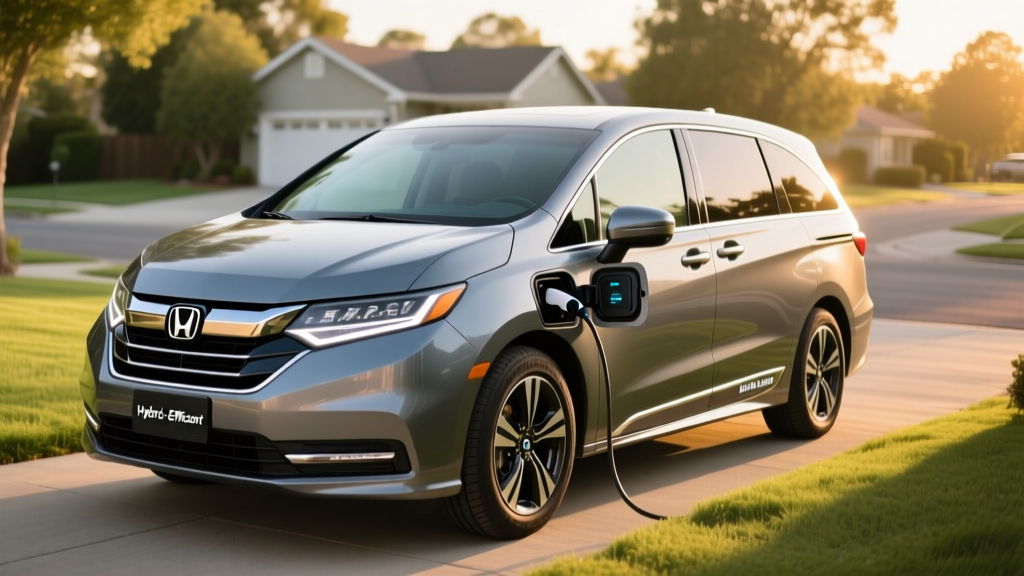
The Honda Odyssey has long been the benchmark minivan for driving dynamics and interior versatility. For 2026, Honda adds a hybrid powertrain to the lineup, pairing its proven 3.5-liter V6 with a two-motor system to target families who want meaningful fuel savings without plugging in. This is a conventional hybrid (HEV), not a plug-in — meaning it generates and recovers all its own electricity and requires zero changes to your daily routine.
Below, we break down the 2026 Honda Odyssey Hybrid's EPA ratings, real-world MPG expectations, powertrain specifications, pricing, and how it stacks up against full-electric and plug-in alternatives for family hauling.
EPA MPG Ratings: City, Highway, and Combined
Honda targets a significant efficiency jump over the gas-only Odyssey's 22 MPG combined rating. The hybrid system recovers energy during braking and low-speed driving where minivans spend most of their time — school drop-offs, grocery runs, and suburban errands.
| Metric | Gas-Only Odyssey | Odyssey Hybrid (FWD) | Odyssey Hybrid (AWD) |
|---|---|---|---|
| City MPG | 19 | 38 | 36 |
| Highway MPG | 28 | 34 | 33 |
| Combined MPG | 22 | 36 | 34 |
| Fuel Tank (gal) | 19.5 | 19.5 | 19.5 |
| Total Range (mi) | ~429 | ~702 | ~663 |
Note: These figures are Honda's preliminary EPA estimates for the 2026 model year. Final EPA certification will be published at fueleconomy.gov closer to the on-sale date. AWD models carry a slight penalty due to the rear-axle motor and added weight.
Real-World MPG vs. the EPA Sticker
Conventional hybrids routinely exceed their EPA city ratings in stop-and-go traffic because regenerative braking works hardest at low speeds. Based on Honda's two-motor hybrid behavior in the Accord Hybrid and CR-V Hybrid, expect the Odyssey Hybrid to deliver 40–43 MPG in urban driving during warm months.
- City (warm): 40–43 MPG — regen braking maximizes recovery
- City (cold, short trips): 33–36 MPG — engine runs more to heat the cabin
- Highway (65–70 mph): 30–33 MPG — aerodynamic drag dominates; less regen benefit
- Combined mixed driving: 34–37 MPG
Highway-heavy commuters will see lower numbers than the EPA combined figure. City-dominant drivers will often beat it.
Cold weather reduces hybrid efficiency less dramatically than it cuts EV range — typically a 10–15% drop in MPG rather than the 20–40% loss BEVs experience in freezing temperatures. The gas engine's waste heat warms the cabin without a significant efficiency penalty.
Two-Motor Hybrid Powertrain: Specs and How It Works
The 2026 Odyssey Hybrid uses Honda's latest-generation two-motor hybrid system, an evolution of the setup in the Accord Hybrid. Unlike Toyota's planetary-gear eCVT, Honda's system uses a clutch-based approach: the engine primarily acts as a generator at low speeds, while a drive motor handles propulsion. At highway cruising speeds, the clutch engages and the engine drives the wheels directly for efficiency.
| Specification | Detail |
|---|---|
| Engine | 3.5L V6 (Atkinson cycle) |
| Engine Output | 280 hp / 262 lb-ft |
| Drive Motor | AC permanent-magnet synchronous |
| Drive Motor Output | 181 hp / 232 lb-ft |
| Combined System Output | 290 hp |
| Hybrid Battery | ~1.3 kWh lithium-ion (non-plug-in) |
| Transmission | Direct-drive (no traditional gearbox) |
| Drivetrain | FWD standard; AWD optional (rear-axle motor) |
| 0–60 mph (est.) | 6.8 seconds |
| Towing Capacity | 3,500 lbs (FWD) / 3,500 lbs (AWD) |
The V6 is a deliberate choice. While competitors like the Toyota Sienna use a 4-cylinder hybrid, Honda prioritizes highway passing power and towing capability — important for families pulling small trailers or heading to mountain campgrounds.
HEV vs. PHEV vs. Full EV: Which Minivan Fits Your Life?
The 2026 Odyssey Hybrid is a conventional HEV. It cannot be plugged in and has no electric-only driving range beyond brief low-speed EV-mode coasting. Here is how the three electrified paths compare for minivan buyers:
| Factor | HEV (Odyssey Hybrid) | PHEV (e.g., Pacifica Hybrid) | Full EV (e.g., Kia EV9) |
|---|---|---|---|
| Plug-in required? | No | Yes (recommended) | Yes (required) |
| Electric-only range | ~1 mi (EV mode) | 32 mi | 230–300+ mi |
| Combined MPG / MPGe | 36 MPG | 30 MPG + 82 MPGe | 89 MPGe |
| Home charging needed? | No | Recommended (Level 2) | Essential (Level 2) |
| Federal tax credit (§30D) | Not eligible | Up to $7,500* | Up to $7,500* |
| Upfront price premium | + $2,000–3,000 vs gas | + $8,000–12,000 vs gas | + $15,000+ vs gas |
| Best for | No home charging; simple ownership | Short commutes + road trips | Home charging + daily driving |
* §30D credit eligibility depends on MSRP caps, buyer income limits, and battery-sourcing requirements. See IRS rules at irs.gov. Consult a tax professional.
Pricing, Trims, and Tax-Credit Eligibility
Honda positions the Odyssey Hybrid as a premium option within the minivan segment. Based on Honda's hybrid pricing strategy across the Accord and CR-V lineups, expect a $2,000–$3,000 premium over equivalent gas-only trims.
| Trim | Gas-Only MSRP | Hybrid MSRP (est.) | Federal Tax Credit |
|---|---|---|---|
| EX-L | $41,920 | $44,420 | Not eligible |
| Sport-L | $43,920 | $46,420 | Not eligible |
| Touring | $46,920 | $49,420 | Not eligible |
| Elite | $49,920 | $52,420 | Not eligible |
Tax credit reality: As a conventional hybrid (HEV), the Odyssey Hybrid does not qualify for the federal §30D Clean Vehicle Credit. That credit applies only to plug-in vehicles (PHEVs and BEVs) meeting specific battery-sourcing, MSRP, and buyer-income requirements. However, the Odyssey Hybrid's lower price premium and zero infrastructure cost (no charger installation) often result in a faster payback period than a PHEV for buyers who cannot charge at home.
Fuel savings are meaningful: at $3.50/gallon and 15,000 miles/year, the hybrid saves roughly $1,400 annually over the gas-only Odyssey, paying back the premium in about 2 years.
Battery Warranty, Reliability, and Replacement Cost
- Hybrid battery: 8 years / 100,000 miles (10 years / 150,000 miles in CARB states including CA, NY, MA, and others)
- Hybrid system components: 8 years / 100,000 miles
- Powertrain: 5 years / 60,000 miles
Honda's two-motor hybrid system has proven durable across the Accord Hybrid and CR-V Hybrid, with widespread reports of minimal degradation past 150,000 miles. The Odyssey's hybrid battery is small (~1.3 kWh) and operates in a narrow state-of-charge window — typically 40–80% — which significantly extends cell life compared to full EVs that cycle through wider ranges.
If replacement is ever needed out of warranty, expect a cost of $2,500–$4,000 for the hybrid battery pack — far less than a full EV battery replacement. Many dealerships also offer reconditioned battery options at lower cost. Third-party hybrid-battery specialists often provide replacements for $1,500–$2,500 installed.
For reliability expectations, Honda's hybrid systems carry strong track records. The Odyssey nameplate itself has earned top safety ratings from the IIHS and NHTSA across recent generations, and the hybrid variant shares the same chassis and body structure.
Who Should Buy the Odyssey Hybrid — and Who Shouldn't
- 36 MPG combined — a 64% improvement over gas-only Odyssey
- No charging infrastructure needed — works exactly like a gas car
- V6 power for confident highway merging and 3,500-lb towing
- 700+ mile total range eliminates fuel stops on long road trips
- Lower annual fuel cost: ~$1,400/yr savings at 15K mi
- Minimal cold-weather efficiency loss vs. full EVs
- No federal tax credit (HEV, not PHEV/BEV)
- No meaningful electric-only driving range
- $2,000–3,000 upfront premium over gas models
- Highway MPG drops to ~30–33 in real-world driving
- AWD availability and pricing TBD at launch
- Cannot power home or devices (no V2L/V2H capability)
- Choose the Odyssey Hybrid if: you drive 12,000+ miles/year with heavy city/suburban driving, cannot install a home charger, want fuel savings with zero lifestyle change, and need V6 towing capability.
- Choose a PHEV minivan (Chrysler Pacifica Hybrid) if: you have a garage for Level 2 charging, your daily driving is under 32 miles, and you want the §30D tax credit to offset the higher purchase price.
- Choose a full-electric SUV (Kia EV9, Tesla Model X) if: you have reliable home charging, rarely tow, want zero tailpipe emissions, and are ready to plan road-trip charging stops.
- Stick with the gas-only Odyssey if: you drive fewer than 8,000 miles/year and the hybrid premium won't pay back within your ownership window.
Frequently Asked Questions
How many MPG does the 2026 Honda Odyssey Hybrid get?
Honda targets 36 MPG combined (38 city / 34 highway) for front-wheel-drive models, with AWD rated slightly lower at 34 combined. Real-world city driving often exceeds the EPA estimate, while highway-dominant commuters should expect 30–33 MPG.
Does the Odyssey Hybrid need to be plugged in?
No. The 2026 Odyssey Hybrid is a conventional hybrid (HEV). It charges its small battery through regenerative braking and the gasoline engine. You fuel it like any other car — no plug, no charger, no range anxiety.
Does the 2026 Odyssey Hybrid qualify for any tax credit?
No. The federal §30D Clean Vehicle Credit applies only to plug-in electric vehicles (PHEVs and BEVs). Conventional hybrids do not qualify. Check with your state for any local hybrid incentives, though most have shifted to plug-in-only programs.
How long will the hybrid battery last?
Honda warranties the hybrid battery for 8 years/100,000 miles (10 years/150,000 miles in CARB states). Based on Honda's hybrid track record with the Accord and CR-V, expect the battery to last well beyond 150,000 miles with minimal degradation. The small battery operates in a narrow charge window, which maximizes longevity.
What does a hybrid battery replacement cost?
Out-of-warranty replacement runs $2,500–$4,000 at a Honda dealer, with reconditioned and third-party options available for $1,500–$2,500. This is significantly less than a full EV battery replacement and rarely needed within typical ownership periods.
Can the Odyssey Hybrid tow?
Yes. Honda rates the Odyssey Hybrid at 3,500 lbs of towing capacity for both FWD and AWD configurations, matching the gas-only model. The V6 engine provides strong low-end torque for trailer launches.
Is AWD available on the Odyssey Hybrid?
Honda has confirmed an AWD option using a rear-axle electric motor, similar to the CR-V Hybrid AWD system. Final AWD trim availability and pricing will be announced closer to the on-sale date.
Specifications in this article are based on Honda's preliminary announcements for the 2026 model year. Final EPA ratings, MSRP, and availability will be confirmed at launch. Always verify current figures at fueleconomy.gov and Honda's official site before purchasing.