When shoppers search for fuel-efficient vehicles that won't strand them at a repair shop, Honda hybrid reliability consistently ranks near the top of consideration lists. Unlike full battery-electric vehicles (BEVs), Honda's conventional hybrid lineup requires zero behavioral change — no plug, no charging apps, no range planning. You simply fill up with gas and drive, while the hybrid system silently slashes fuel consumption by 30–50% compared to a gas-only equivalent.
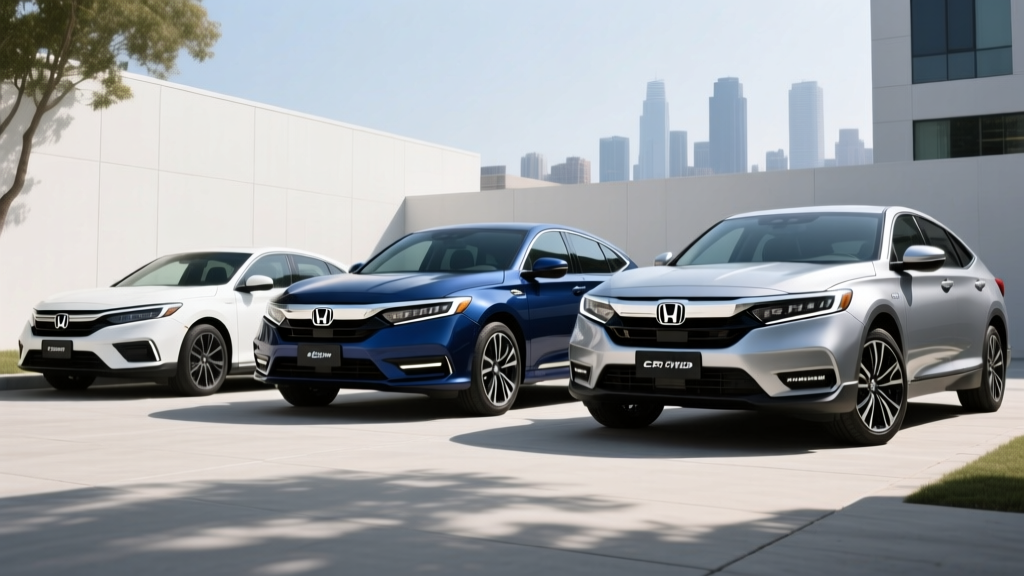
For 2026, Honda offers three core hybrid models in the U.S.: the Accord Hybrid, CR-V Hybrid, and the returning Civic Hybrid. All three use Honda's two-motor hybrid system (no traditional transmission), and none of them are plug-in hybrids. This guide breaks down the real-world reliability picture, EPA and observed MPG, battery warranty coverage, and whether a Honda hybrid still makes financial sense against a PHEV or full EV.
HEV vs PHEV: Where Honda Hybrids Fit
Before diving into model-specific data, it's critical to distinguish Honda's current hybrid approach from plug-in alternatives:
| Feature | Honda HEV (Accord, CR-V, Civic Hybrid) | Typical PHEV (e.g., Toyota RAV4 Prime) | Full EV (e.g., Tesla Model Y) |
|---|---|---|---|
| Plug-in required? | No — charges via regenerative braking & engine | Yes — 120V or 240V outlet | Yes — Level 2 or DC fast charger |
| Electric-only range | ~1 mile at low speed | 25–42 miles | 250–330 miles (EPA) |
| Total range | 500–600+ miles | 400–550 miles | 250–330 miles |
| Federal tax credit (§30D) | Not eligible | Up to $7,500 (if sourcing/income rules met) | Up to $7,500 (if sourcing/income rules met) |
| Home charging install | None needed | $500–$2,000 (Level 2 recommended) | $800–$3,000+ (Level 2 required) |
| Best for | No home charging access; high-mileage drivers | Home chargers with short daily commutes | Home chargers wanting zero gas |
Honda does not currently sell a PHEV in the U.S. market (the Clarity PHEV was discontinued after 2021). If you need electric-only commuting, you'll need to look at competitors like the Toyota RAV4 Prime, Hyundai Tucson PHEV, or a full EV. But if your priority is proven reliability, low running costs, and zero charging infrastructure, Honda's HEV lineup is purpose-built for that mission.
2026 Honda Hybrid Lineup: MPG, Powertrain & Pricing
All three Honda hybrids use variants of the same two-motor hybrid architecture: a 2.0L Atkinson-cycle four-cylinder engine paired with two electric motors and a small lithium-ion battery pack (roughly 1.0–1.3 kWh). There is no conventional transmission — the system operates primarily as a series hybrid at low speeds (engine generates electricity, motor drives wheels) and switches to direct engine drive at highway cruising speeds.
| Spec | 2026 Accord Hybrid | 2026 CR-V Hybrid | 2026 Civic Hybrid |
|---|---|---|---|
| Combined HP | 204 hp | 204 hp | 200 hp |
| Engine | 2.0L I-4 Atkinson | 2.0L I-4 Atkinson | 2.0L I-4 Atkinson |
| EPA City MPG | 51 | 43 (FWD) / 40 (AWD) | 50 |
| EPA Highway MPG | 44 | 36 (FWD) / 34 (AWD) | 47 |
| EPA Combined MPG | 48 | 40 (FWD) / 37 (AWD) | 49 |
| Drivetrain | FWD | FWD or AWD | FWD |
| 0–60 mph (est.) | ~7.2 sec | ~7.6 sec | ~6.5 sec |
| Starting MSRP | ~$34,500 | ~$36,350 | ~$30,000 |
| Federal Tax Credit | None (HEV) | None (HEV) | None (HEV) |
Real-World MPG vs. EPA Sticker
One of the most consistent patterns with Honda's two-motor hybrid system is that real-world city MPG often exceeds the EPA city estimate, while highway MPG tends to fall slightly below. This is the opposite of what most gas-car drivers expect.
The reason is physics: hybrids recapture braking energy and shut off the engine at stops — advantages that multiply in stop-and-go traffic. On the highway, the engine is running more often and aerodynamic drag dominates.
Real-World MPG Expectations (Based on Owner Data & Testing):
- Accord Hybrid: EPA 48 combined — owners commonly report 46–52 combined. City-heavy drivers often see 50+ MPG. Highway-only cruising at 75+ mph may drop to 40–42 MPG.
- CR-V Hybrid (AWD): EPA 37 combined — expect 35–40 combined. Short city trips yield the best numbers; sustained highway towing or mountain driving can dip to 30–32 MPG.
- Civic Hybrid: EPA 49 combined — real-world reports cluster around 47–53 combined. This is Honda's most efficient current model.
Sources: fueleconomy.gov, owner forums, and third-party testing.
Honda Hybrid Battery Longevity & Warranty
The single biggest reliability concern hybrid buyers raise is the traction battery. Will it fail? What does replacement cost? Here's what the data shows:
Honda Hybrid Battery Warranty:
- Coverage: 8 years / 100,000 miles (10 years / 150,000 miles in CARB states including CA, NY, MA, and others)
- Capacity threshold: Honda replaces or repairs the battery if it falls below functional specifications (typically ~60–70% capacity)
- Chemistry: Lithium-ion (small ~1.0–1.3 kWh pack — much smaller and less stressed than a full EV battery)
Degradation Reality: Why Honda Hybrid Batteries Last
Honda's hybrid battery packs are remarkably small compared to EVs — roughly 1.0–1.3 kWh vs. 60–100 kWh in a BEV. Because the system never fully charges or fully depletes the pack (operating in a narrow ~40–80% state-of-charge window), the cells experience far less stress than an EV battery.
Long-term data from high-mileage Honda hybrid owners (particularly Accord Hybrid and earlier Insight owners) shows battery packs routinely lasting 150,000–200,000+ miles before significant degradation. Failures within the warranty period are uncommon based on reliability surveys from Consumer Reports and owner community data.
Battery Replacement Cost
If a Honda hybrid battery does need replacement out of warranty:
- OEM replacement (dealer): $2,000–$4,000 depending on model, including labor
- Refurbished/aftermarket: $1,000–$2,500
- Individual cell replacement (specialist shops): $500–$1,500
Compared to EV battery replacements ($5,000–$20,000+), Honda hybrid battery costs are modest — a direct result of the much smaller pack size.
Reliability Track Record: What the Data Shows
Honda's hybrid system has been in production since the early 2000s (first-generation Insight, then Civic Hybrid). The current two-motor system, introduced with the 2014 Accord Hybrid, has matured through multiple generations. Here's how reliability stacks up:
Consumer Reports & Industry Surveys: Honda's hybrid powertrains consistently score average to above-average in predicted reliability. The two-motor system has fewer moving parts than a conventional automatic transmission (no torque converter, no planetary gearset, no clutch packs to wear), which reduces mechanical failure points.
Common Issues (Non-Battery):
- 12V auxiliary battery drain: Like all modern vehicles, the 12V battery can die if the car sits unused for weeks. This is not the hybrid traction battery — it's the standard accessory battery that powers electronics. Jump-starting or replacing the 12V battery resolves this.
- Brake feel adaptation: The regenerative braking system blends regen and friction braking, which some drivers describe as "different" or "less linear" than a gas car. This is normal operation, not a defect.
- Engine noise under hard acceleration: The Atkinson-cycle engine can sound buzzy when the system demands maximum power. This is characteristic of the design, not a reliability concern.
What Doesn't Break:
- No traditional transmission to rebuild or replace
- Regenerative braking reduces wear on friction brake pads (many owners report 80,000–100,000+ miles on original brake pads)
- No turbocharger, timing belt (chain-driven), or complex emissions equipment to maintain
- Engine runs less often, reducing oil contamination and wear
For authoritative safety data, see the NHTSA and IIHS ratings for each model — all three Honda hybrids carry top safety picks.
Total Cost of Ownership: Honda Hybrid vs Gas vs EV
Reliability matters, but the financial case for a Honda hybrid hinges on fuel savings vs. the hybrid price premium. Let's run the numbers for the Accord Hybrid vs. the gas-only Accord over 5 years / 75,000 miles:
| Cost Factor | Accord Hybrid (48 MPG) | Accord Gas (33 MPG combined) | Difference |
|---|---|---|---|
| Fuel (75,000 mi at $3.40/gal) | $5,313 | $7,727 | Hybrid saves $2,414 |
| Hybrid price premium | ~$1,200–$1,800 (depending on trim) | ||
| Maintenance (est. 5 yr) | ~$2,200 | ~$2,800 | Hybrid saves ~$600 |
| Brake pad replacement | Likely 0 (regen extends life) | 1–2 sets ($300–$600) | Hybrid saves $300–$600 |
| Net 5-Year Savings | $1,500–$2,500+ | ||
The hybrid pays for itself within 3–4 years for most drivers, and the savings accelerate as you keep the vehicle longer. The Accord Hybrid's lack of federal tax credit eligibility (it's an HEV, not a PHEV or EV) is offset by the lower upfront cost — no $7,500 credit needed when the hybrid premium is only ~$1,500.
Note on tax credits: Under current IRS §30D rules, only plug-in electric vehicles (PHEVs and BEVs) with sufficient battery capacity qualify for the federal clean vehicle credit. Conventional hybrids like Honda's do not qualify. Some states offer separate hybrid incentives — check your state's energy office for current programs.
Who Should Choose a Honda Hybrid vs a PHEV or Full EV?
Choose a Honda Hybrid (HEV) if:
- You don't have access to home or workplace charging (apartment, street parking, no garage outlet)
- You drive 15,000+ miles per year and want maximum fuel savings without behavioral change
- You want proven reliability with minimal new-technology risk
- You frequently take long road trips and don't want to plan around charging stations
- You want a lower purchase price than a comparable PHEV or EV
Choose a PHEV (from another brand) if:
- You have home charging and a commute under 30–40 miles round-trip
- You want electric-only daily driving but gas flexibility for road trips
- You qualify for the §30D federal tax credit (income and sourcing requirements apply)
Choose a full EV if:
- You have reliable home Level 2 charging
- You want zero tailpipe emissions and the lowest per-mile energy cost
- You're ready to plan longer trips around DC fast charging (15–30 min stops every 200–250 miles)
- You want maximum tax credit benefits and lower maintenance costs
Pros and Cons of Honda's Hybrid Lineup
Pros
- Class-leading city MPG (Accord Hybrid 51 city, Civic Hybrid 50 city)
- No plug-in charging required — zero infrastructure investment
- Proven two-motor system with 10+ years of refinement
- Strong battery warranty (8 yr/100k mi; 10 yr/150k mi in CARB states)
- Reduced brake wear from regenerative braking
- No transmission to service or replace
- 600+ mile total range on a single tank (Accord Hybrid)
- Lower purchase price than PHEV/EV equivalents
Cons
- No federal tax credit eligibility (HEV, not PHEV)
- No electric-only commuting capability (unlike a PHEV)
- Highway MPG falls below city MPG (opposite of gas cars)
- AWD only available on CR-V Hybrid (not Accord or Civic)
- Engine drone under hard acceleration (two-motor system characteristic)
- Small hybrid battery means no V2L/V2H power capability
Frequently Asked Questions
How many MPG does a Honda hybrid get?
The 2026 Accord Hybrid achieves 51 city / 44 highway / 48 combined MPG. The CR-V Hybrid gets 43/36/40 (FWD) or 40/34/37 (AWD). The Civic Hybrid leads the lineup at 50/47/49 MPG. Real-world city driving often exceeds EPA estimates; highway driving at high speeds may fall 3–6 MPG below.
Is Honda hybrid reliability better than Toyota?
Both Honda and Toyota hybrid systems are among the most reliable in the industry. Toyota has a longer track record (Prius since 2001) and slightly more hybrid models. Honda's two-motor system, in production since 2014, has proven equally durable in long-term ownership data. Neither brand shows systemic hybrid battery failure patterns. The choice between them typically comes down to model preference, driving feel, and specific MPG targets rather than reliability differences.
What is the Honda hybrid battery replacement cost?
Out-of-warranty Honda hybrid battery replacement costs $2,000–$4,000 at a dealer for an OEM pack, or $1,000–$2,500 for a refurbished unit. Because Honda hybrid packs are small (~1.0–1.3 kWh) and operate in a narrow state-of-charge window, most last 150,000–200,000+ miles. The 8-year/100,000-mile warranty (10/150k in CARB states) covers premature failures.
Does a Honda hybrid qualify for any tax credit?
No. Under current IRS §30D rules, only plug-in electric vehicles (PHEVs and BEVs) qualify for the federal clean vehicle credit. Honda's hybrids are conventional HEVs that cannot be plugged in. Some states may offer minor hybrid incentives, but these vary by jurisdiction and are typically far smaller than the federal credit. Check your state energy office for current programs.
Do Honda hybrids need to be plugged in?
No. Honda's hybrid models (Accord Hybrid, CR-V Hybrid, Civic Hybrid) are conventional HEVs. The small battery charges entirely through regenerative braking and the gasoline engine. There is no plug, no charging cable, and no need for any home electrical work. You fuel them exactly like a gas car.
How long do Honda hybrid batteries last?
Based on long-term owner data and the system's conservative charge management, Honda hybrid batteries typically last 150,000–200,000+ miles before significant degradation. The system never fully charges or depletes the pack, keeping cells in a low-stress ~40–80% state-of-charge window. Many first-generation Honda hybrid batteries (2000s-era Insight and Civic Hybrid) lasted the life of the vehicle.
Hybrid vs PHEV vs EV — which fits my lifestyle?
If you lack home charging access or drive high annual mileage with frequent long trips, a Honda HEV hybrid is the lowest-friction choice. If you have home charging and a short commute, a PHEV gives you electric-only daily driving with gas backup. If you have home charging and want the lowest operating cost with zero gas, a full EV is ideal — but requires trip planning for road trips beyond ~250 miles.
Sources: fueleconomy.gov (EPA MPG data), IRS §30D Clean Vehicle Credit, Honda Newsroom (manufacturer specifications), IIHS safety ratings.