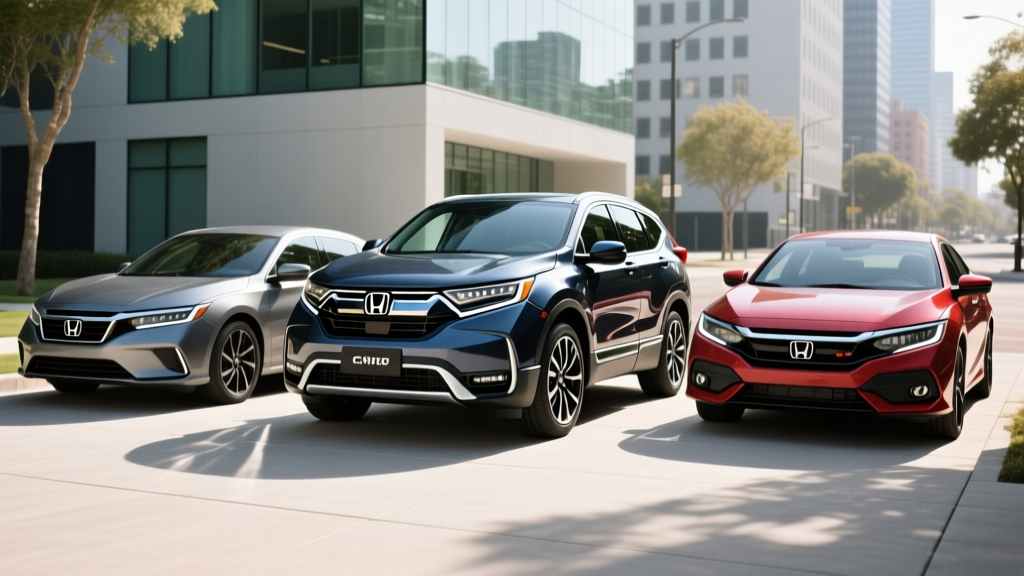
Honda's hybrid lineup in 2026 covers three of the most popular vehicle segments in America — the compact SUV, the midsize sedan, and the compact sedan — each offering a distinct efficiency proposition at a different price point. But understanding the true Honda hybrid cost means looking beyond the sticker price. It means calculating fuel savings versus a gas-only equivalent, understanding battery longevity, and knowing whether any tax incentives apply.
This guide breaks down every current Honda hybrid model with exact EPA figures, real-world MPG expectations, powertrain specifications, ownership costs, and the critical question of whether a Honda hybrid, a plug-in hybrid from a competitor, or a full battery-electric vehicle makes the most financial sense for your situation.
2026 Honda Hybrid Lineup: Pricing at a Glance
Honda currently offers three hybrid models in the US market, all using the brand's two-motor hybrid system. None are plug-in hybrids — they are conventional HEVs that recharge their small battery through regenerative braking and the gasoline engine. You never plug them in.
| Model | Base MSRP | Top Trim MSRP | EPA Combined MPG | Powertrain HP |
|---|---|---|---|---|
| 2026 Civic Hybrid | $29,845 | $33,245 (Sport Touring) | 49 MPG | 200 hp |
| 2026 Accord Hybrid | $34,595 | $40,395 (Sport-L Touring) | 48 MPG | 204 hp |
| 2026 CR-V Hybrid | $36,395 | $43,295 (Sport Touring) | 43 MPG | 204 hp |
The hybrid premium over a gas-only equivalent typically runs $1,200 to $2,500 depending on the model and trim. For the Civic, the hybrid replaces the upper gas trims entirely, so the price gap narrows. For the CR-V, the Sport and Sport Touring trims are hybrid-only, while the Accord offers hybrid powertrains across four trims.
EPA MPG and Real-World Fuel Economy
Honda's two-motor hybrid system excels in city driving, where the electric motor handles most low-speed propulsion and the engine acts primarily as a generator. This is the opposite of how most drivers expect efficiency to work — these cars actually beat their EPA city estimates in stop-and-go traffic.
| Model | EPA City | EPA Highway | EPA Combined | Real-World Expectation |
|---|---|---|---|---|
| Civic Hybrid | 50 MPG | 47 MPG | 49 MPG | 46-52 MPG (city-favorable); 42-45 MPG sustained highway at 75+ mph |
| Accord Hybrid (Sport) | 46 MPG | 41 MPG | 44 MPG | 43-48 MPG city; 38-41 MPG highway |
| Accord Hybrid (EX-L/Touring) | 51 MPG | 44 MPG | 48 MPG | 47-53 MPG city; 40-43 MPG highway |
| CR-V Hybrid (Sport) | 43 MPG | 36 MPG | 40 MPG | 40-46 MPG city; 33-36 MPG highway |
| CR-V Hybrid (Sport Touring AWD) | 40 MPG | 34 MPG | 37 MPG | 37-42 MPG city; 31-34 MPG highway |
Powertrain Details: Honda's Two-Motor Hybrid System
All three Honda hybrids use the same fundamental architecture: a 2.0-liter Atkinson-cycle four-cylinder engine paired with two electric motors and a lithium-ion battery pack. One motor drives the wheels; the other acts as a generator. At highway speeds, a lock-up clutch connects the engine directly to the wheels for efficiency.
The Civic Hybrid uses a slightly smaller-displacement version of this system tuned for the lighter compact platform, producing a combined 200 horsepower and 232 lb-ft of torque. The Accord and CR-V hybrids produce 204 hp and 247 lb-ft. All models use an e-CVT — not a traditional belt-and-cone CVT, but a direct-drive system with a single fixed gear ratio for the engine-to-wheels connection.
| Specification | Civic Hybrid | Accord Hybrid | CR-V Hybrid |
|---|---|---|---|
| Engine | 2.0L Atkinson I-4 | 2.0L Atkinson I-4 | 2.0L Atkinson I-4 |
| Combined System HP | 200 hp | 204 hp | 204 hp |
| Combined Torque | 232 lb-ft | 247 lb-ft | 247 lb-ft |
| Transmission | e-CVT (direct drive) | e-CVT (direct drive) | e-CVT (direct drive) |
| Drivetrain | FWD | FWD | FWD or AWD |
| 0-60 mph (est.) | ~7.2 sec | ~7.0 sec | ~7.6 sec (AWD) |
| Hybrid Battery | ~1.0 kWh Li-ion | ~1.0 kWh Li-ion | ~1.0 kWh Li-ion |
These are conventional hybrids (HEVs), not plug-in hybrids (PHEVs). The battery is small — roughly 1 kWh — and exists to buffer energy from regenerative braking and the engine for short electric-assist bursts. There is no electric-only driving range to speak of beyond very low-speed maneuvers in parking lots.
HEV vs PHEV vs EV: Which Powertrain Fits You?
| Factor | Honda HEV (these models) | Competitor PHEV (e.g., Toyota RAV4 Prime) | Full EV (e.g., Tesla Model Y) |
|---|---|---|---|
| Plug-in required? | No | Yes (for EV range) | Yes |
| Electric-only range | ~0 miles | 25-42 miles | 250-330 miles |
| Home charging needed | No | Recommended (Level 2) | Essential (Level 2) |
| Fuel/energy cost per mile | ~$0.10-0.12 | ~$0.04-0.11 (varies) | ~$0.03-0.05 |
| Upfront price premium | +$1,200-$2,500 vs gas | +$5,000-$8,000 vs gas | +$8,000-$15,000 vs gas |
| Federal tax credit (§30D) | Not eligible | Up to $7,500 (if eligible) | Up to $7,500 (if eligible) |
| Best for | No home charging access; want simplicity | Home charging + short commute + road trips | Home charging + mostly under 250 mi/day |
The Honda hybrid cost equation favors drivers who cannot install a home charger — apartment dwellers, street parkers, or those in condos with no electrical access. You get 40-50 MPG with zero behavior change. If you can charge at home and have a commute under 30 miles, a PHEV from Toyota or Hyundai may offer lower per-mile operating costs while retaining road-trip flexibility. A full EV delivers the lowest running costs but requires charging infrastructure and acceptance of range planning on longer trips.
Total Ownership Cost: Honda Hybrid vs Gas vs EV
The real measure of Honda hybrid cost isn't the MSRP — it's the five-year total cost of ownership. Here's how a 2026 CR-V Hybrid Sport Touring AWD ($43,295) compares to the gas CR-V EX-L AWD ($38,795) and a similarly sized electric SUV over five years and 75,000 miles.
| Cost Factor | CR-V Hybrid AWD | CR-V Gas AWD | Comparable EV SUV |
|---|---|---|---|
| Purchase Price | $43,295 | $38,795 | $48,000 |
| Federal Tax Credit | $0 | $0 | Up to $7,500* |
| Fuel/Energy (75k mi) | ~$6,300 | ~$9,450 | ~$2,625 |
| Maintenance (5 yr) | ~$2,800 | ~$3,200 | ~$1,800 |
| Insurance (5 yr est.) | ~$8,500 | ~$8,200 | ~$9,200 |
| 5-Year Depreciation (est.) | ~$18,500 | ~$17,800 | ~$22,000 |
| Net 5-Year Cost | ~$42,395 | ~$41,645 | ~$42,125 |
*EV tax credit subject to IRS §30D eligibility: buyer income caps ($150k single/$300k joint), MSRP caps ($55k cars/$80k SUVs), and battery critical-mineral/component sourcing requirements. Check IRS.gov for current rules. Honda HEVs do not qualify for §30D credits.
The hybrid's fuel savings of roughly $3,150 over five years nearly offsets its $4,500 price premium over the gas model. Where the hybrid pulls ahead is in lower maintenance — fewer brake replacements thanks to regenerative braking, and less engine wear since the Atkinson-cycle engine runs under lighter loads. The gap narrows to roughly $750 over five years, making the hybrid the marginally better financial choice for most buyers while delivering substantially lower emissions.
Battery Warranty, Reliability, and Replacement Cost
Honda's hybrid battery packs are small (~1 kWh) and operate within a conservative state-of-charge window — typically between 40% and 80% — which dramatically reduces degradation stress compared to a full EV battery that cycles through a wider range. This is why Honda hybrid batteries routinely last 150,000-200,000+ miles before needing replacement.
When replacement is eventually needed out of warranty, expect these approximate costs:
- Civic Hybrid battery replacement: $2,000-$3,000 (parts + labor)
- Accord Hybrid battery replacement: $2,500-$4,000
- CR-V Hybrid battery replacement: $2,500-$4,000
These figures are significantly lower than EV battery replacements ($8,000-$20,000) because the packs are small. Independent hybrid shops often offer refurbished battery replacements for $1,200-$2,000, extending the vehicle's life economically well past 200,000 miles.
Regarding reliability: Honda's two-motor hybrid system has been in production since 2014 (Accord Hybrid) and has proven robust. The system eliminates the traditional transmission entirely — no CVT belt, no torque converter, no planetary gearset — removing a major failure point. IIHS ratings for the 2026 Accord and CR-V reflect top safety performance, and the hybrid components add no meaningful reliability risk versus the gas powertrain.
Tax Credits and Incentives: What Honda Hybrid Buyers Should Know
Here's the straightforward truth: conventional Honda hybrids (HEVs) do not qualify for the federal §30D Clean Vehicle tax credit. That credit requires a minimum battery capacity of 7 kWh and plug-in capability, neither of which these vehicles have.
- Federal §30D credit ($7,500): Not available for Honda HEVs — requires PHEV or BEV with ≥7 kWh battery
- Federal used-EV credit (up to $4,000): Not applicable — applies to used PHEVs and BEVs only
- State hybrid incentives: Some states offer modest rebates ($250-$1,000) for HEV purchases — check your state energy office or DMV for current programs
- Insurance discounts: Some insurers offer 5-10% green-vehicle discounts on hybrids — check with your provider
- HOV lane access: Generally not available for HEVs; most states require PHEV or BEV for carpool-lane stickers
If the federal tax credit is a decisive factor in your purchase, you'll need to look at PHEVs (like the Toyota RAV4 Prime or Hyundai Tucson PHEV) or full EVs. However, the credit's income caps ($150,000 single / $300,000 joint AGI), MSRP caps, and battery-sourcing requirements eliminate many PHEV and EV candidates anyway. For buyers who don't qualify for §30D, the Honda hybrid cost proposition becomes more competitive — you're getting most of the fuel savings without the credit-dependent pricing game.
Decision Framework: Is a Honda Hybrid Right for You?
Choose a Honda Hybrid if:
- You can't charge at home (apartment, street parking, no garage)
- You want 40-50 MPG with zero behavior change or range planning
- Your daily driving includes a mix of city and highway
- You want proven reliability with low maintenance costs
- You don't qualify for the federal EV/PHEV tax credit due to income or vehicle sourcing rules
Choose a PHEV instead if:
- You can install a Level 2 home charger
- Your commute is under 30 miles round-trip (covers most daily driving on electric)
- You qualify for the §30D credit and want to offset a higher purchase price
- You want electric-only driving for local errands with gas backup for road trips
Choose a full EV instead if:
- You have reliable home Level 2 charging
- Your daily driving is under 200 miles
- You want the lowest possible per-mile energy cost (~$0.04/mi vs ~$0.11/mi for hybrid)
- You qualify for the §30D credit and want maximum long-term savings
- Best-in-class city MPG (50+ real-world in stop-and-go)
- No charging infrastructure needed
- Minimal price premium over gas trims ($1,200-$2,500)
- Proven two-motor system with no traditional transmission
- 8-10 year battery warranty with low replacement cost
- Strong resale value across all three models
- No federal tax credit eligibility
- No electric-only driving range
- Highway MPG drops noticeably above 70 mph
- AWD only available on CR-V (not Civic/Accord hybrid)
- No DC fast charging capability (not applicable — no plug)
- Hybrid trims start at mid-range; no base-price hybrid option
Frequently Asked Questions
How many MPG does a Honda hybrid get?
The 2026 Honda Civic Hybrid achieves 49 MPG combined (50 city/47 highway). The Accord Hybrid ranges from 44 to 48 MPG combined depending on trim. The CR-V Hybrid achieves 37-40 MPG combined depending on FWD vs AWD. In real-world city driving, all three tend to exceed their EPA city estimates by 2-4 MPG.
Do Honda hybrids need to be plugged in?
No. All current Honda hybrids are conventional HEVs. The battery recharges through regenerative braking and the gasoline engine. There is no plug, no charging cable, and no electric-only driving range. You fuel them exactly like a gas car.
Does the Honda hybrid qualify for any tax credit?
No. The federal §30D Clean Vehicle credit requires plug-in capability and a minimum 7 kWh battery. Honda's HEV battery is approximately 1 kWh with no plug. Some states may offer small rebates for hybrid purchases — check your state's energy office.
How long do Honda hybrid batteries last?
Honda hybrid batteries typically last 150,000-200,000+ miles. They're covered by an 8-year/100,000-mile warranty (10 years/150,000 miles in CARB states). The conservative charge window (40-80% SoC) and small pack size minimize degradation. Out-of-warranty replacement costs $2,000-$4,000.
Is the Honda hybrid more expensive to maintain than a gas car?
No — typically less expensive. The hybrid system eliminates the traditional transmission, reduces brake wear through regenerative braking, and puts less thermal stress on the engine. Oil change intervals remain the same. Expect $2,800-$3,200 in maintenance over five years versus $3,200-$3,800 for a gas equivalent.
How does Honda hybrid cost compare to a Toyota hybrid?
Pricing is competitive within $500-$1,500 depending on segment. The Civic Hybrid undercuts the Toyota Prius on price while offering similar MPG. The CR-V Hybrid and RAV4 Hybrid are closely matched, though Toyota offers the RAV4 Prime PHEV variant (42 miles EV range, ~$44,500) for buyers wanting plug-in capability — something Honda doesn't offer.
Should I buy a Honda hybrid or wait for a Honda EV?
Honda's EV plans include the Prologue (already available, built on GM's Ultium platform) and upcoming models on Honda's own e:Architecture. If you need a vehicle now and lack home charging, the hybrid is the pragmatic choice. If you have home charging and can wait, Honda's next-generation EVs (expected 2027+) may offer a compelling all-electric option — but the hybrid remains a strong ownership proposition regardless.