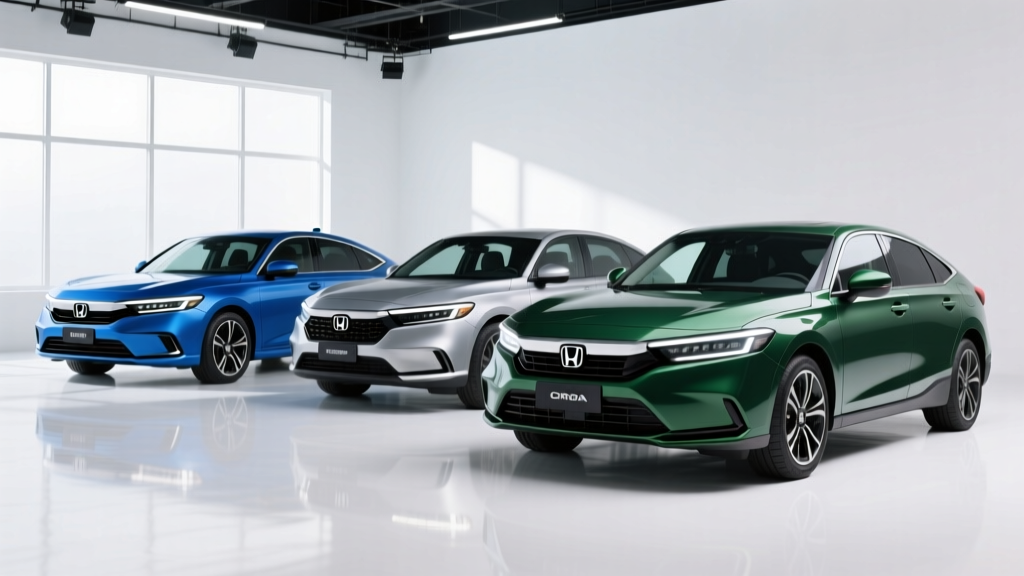
Honda's 2026 hybrid lineup now spans three of its highest-volume nameplates: the Accord, CR-V, and Civic. Unlike Toyota's broad hybrid portfolio, Honda has concentrated its two-motor hybrid system on models where fuel economy gains matter most to buyers. All three are conventional hybrids (HEVs) — meaning no plug, no range anxiety, and no behavior change required. You just fill up with gas and drive.
This guide breaks down every 2026 Honda hybrid model with exact EPA numbers, powertrain specs, real-world fuel economy observations, battery warranty details, and pricing — so you can decide which one fits your commute and budget.
2026 Honda Hybrid Lineup at a Glance
| Model | Powertrain | Combined HP | EPA Combined MPG | Base MSRP |
|---|---|---|---|---|
| Accord Hybrid (Sport/LX Hybrid) | 2.0L 4-cyl + 2 motors | 204 hp | 44 MPG | $30,495 |
| CR-V Hybrid (Sport/Sport Touring) | 2.0L 4-cyl + 2 motors | 204 hp | 40 MPG (FWD) / 37 MPG (AWD) | $36,395 |
| Civic Hybrid (Sport Sedan) | 2.0L 4-cyl + 2 motors | 200 hp | 49 MPG | $29,845 |
All three models use Honda's fourth-generation two-motor hybrid system, which pairs an Atkinson-cycle 2.0-liter inline-four with a drive motor and a generator motor. There is no conventional transmission — the system uses an e-CVT configuration that routes power electrically in most driving conditions and engages a direct mechanical clutch only at sustained highway speeds.
EPA Fuel Economy: City, Highway, and Combined
| Model | City MPG | Highway MPG | Combined MPG | Annual Fuel Cost* |
|---|---|---|---|---|
| Accord Hybrid | 51 | 38 | 44 | ~$1,150 |
| CR-V Hybrid FWD | 43 | 36 | 40 | ~$1,250 |
| CR-V Hybrid AWD | 40 | 34 | 37 | ~$1,350 |
| Civic Hybrid | 50 | 47 | 49 | ~$1,050 |
*Annual fuel cost estimates based on 15,000 miles/year and $3.50/gallon regular unleaded per fueleconomy.gov. Your actual costs will vary with local fuel prices and driving patterns.
The Accord Hybrid's 51 MPG city figure is particularly strong — Honda's hybrid system runs the gasoline engine primarily as a generator at low speeds, letting the electric drive motor handle propulsion. This means the Accord Hybrid behaves almost like an EV in stop-and-go traffic, which is where city MPG numbers spike.
Real-World MPG: What Owners Actually Report
- Accord Hybrid: EPA 44 combined — expect 42–48 combined in mixed driving. City-heavy commuters often see 48–52 MPG. Highway-only at 75+ MPH drops to 36–38 MPG.
- CR-V Hybrid FWD: EPA 40 combined — expect 37–43 combined. The boxier SUV profile hurts highway efficiency. City driving yields 41–45 MPG; sustained highway drops to 33–36 MPG.
- Civic Hybrid: EPA 49 combined — expect 46–53 combined. This is the efficiency star. Light weight and aerodynamic sedan body help it exceed EPA estimates in moderate-speed suburban driving.
Key insight: Honda hybrids, like most HEVs, tend to exceed EPA city estimates in warm weather but fall short on sustained highway driving above 70 MPH. Cold weather (below 35°F) typically reduces MPG by 5–12% across all three models due to engine warm-up cycles and reduced regenerative braking efficiency.
Powertrain Deep Dive: Honda's Two-Motor Hybrid System
Honda's hybrid architecture is fundamentally different from Toyota's planetary-gear Hybrid Synergy Drive. Here's how it works:
- Low to moderate speeds (most city driving): The gasoline engine runs only to spin the generator motor, which produces electricity. That electricity either powers the drive motor directly or charges the small lithium-ion battery pack. The car is effectively a series hybrid — propelled entirely by the electric motor.
- Hard acceleration: The battery supplements generator output, delivering combined system power of 204 hp (Accord/CR-V) or 200 hp (Civic) to the drive motor.
- Sustained highway cruising (roughly 65–80 MPH): A lock-up clutch mechanically connects the engine to the drive wheels, bypassing the electric motors for maximum efficiency at steady state.
The result is smooth, EV-like acceleration from a stop with no gear-shift shudder, plus efficient highway cruising. The lithium-ion battery packs in all three models are small — approximately 1.06 kWh usable — because they're designed for frequent shallow charge/discharge cycles, not sustained electric-only driving.
| Attribute | Honda HEV (Accord/CR-V/Civic Hybrid) | Typical PHEV (e.g., Toyota RAV4 Prime) | Full BEV (e.g., Tesla Model 3) |
|---|---|---|---|
| Plug required? | No | Yes (Level 2 recommended) | Yes (Level 2 or DC fast) |
| Electric-only range | ~1 mile at low speed | 35–42 miles | 250–360 miles |
| Fuel source | Gasoline only | Gasoline + grid electricity | Grid electricity only |
| EPA combined efficiency | 40–49 MPG | 38 MPG gas / 94 MPGe electric | 120–132 MPGe |
| Home charging install | Not needed | $500–$2,000 (240V outlet) | $800–$3,000 (Level 2 station) |
| Federal tax credit (§30D) | Not eligible | Up to $7,500 (if sourcing/income rules met) | Up to $7,500 (if sourcing/income rules met) |
| Best for | No-plug buyers, apartment dwellers | Home chargers with short commutes | Home chargers wanting zero gas |
Pricing, Trims, and Tax Credit Eligibility
2026 Honda Accord Hybrid
- Sport Hybrid: $30,495
- EX-L Hybrid: $34,495
- Sport-L Hybrid: $35,195
- Touring Hybrid: $39,495
2026 Honda CR-V Hybrid
- Sport Hybrid (FWD): $36,395
- Sport Hybrid (AWD): $37,895
- Sport Touring Hybrid (AWD): $41,795
2026 Honda Civic Hybrid
- Sport Hybrid Sedan: $29,845
- Sport Touring Hybrid Sedan: $32,845
None of Honda's 2026 conventional hybrids qualify for the IRS §30D Clean Vehicle Credit. That credit applies only to plug-in electric vehicles (PHEVs and BEVs) that meet battery-sourcing, MSRP cap, and buyer income requirements. Honda does not currently sell a plug-in hybrid in the U.S. market for 2026.
Some states offer their own hybrid or efficiency incentives — check your state energy office or Alternative Fuels Data Center for local programs. These vary widely and change frequently.
Battery Warranty, Lifespan, and Replacement Cost
- Coverage: 8 years / 100,000 miles (10 years / 150,000 miles in CARB states including CA, NY, MA, and others)
- What's covered: Hybrid battery pack and hybrid system components (drive motor, generator motor, power control unit)
- Capacity threshold: Honda warrants the battery against defect and abnormal degradation — there is no published minimum capacity retention percentage (unlike some EV warranties that guarantee 70% SoH)
How long do Honda hybrid batteries actually last? Based on long-term data from the Accord Hybrid (introduced in the U.S. in 2014 with the current two-motor system) and owner reports, Honda's lithium-ion hybrid packs routinely last 150,000–200,000+ miles without significant degradation. The packs are small (~1 kWh), never deeply discharged, and thermally managed — all factors that extend cycle life dramatically compared to larger EV battery packs.
Replacement cost if out of warranty: A replacement hybrid battery pack for a Honda Accord or CR-V Hybrid typically runs $2,000–$3,500 for the part, plus $500–$1,000 in labor, for a total of roughly $2,500–$4,500 at a dealership. Independent hybrid specialists may offer refurbished packs for $1,500–$2,500 installed. This is a fraction of EV battery replacement costs ($10,000–$20,000+), reflecting the much smaller pack size.
Driving Impressions and Ownership Practicalities
All three Honda hybrids share a driving character that sets them apart from Toyota's hybrid offerings: they feel more responsive off the line. Because the drive motor handles propulsion from a stop (up to ~295 lb-ft of torque in the Accord and CR-V), initial acceleration is immediate and linear — no wait for the engine to spool up or the planetary gearset to redirect torque.
Accord Hybrid: The most refined of the three. Cabin noise is well-controlled, the hybrid system transitions between EV drive, engine generation, and direct mechanical drive almost imperceptibly. At highway speeds, the engine-only direct-drive mode keeps RPM low and fuel consumption minimal. This is Honda's best argument for a midsize sedan in an SUV world.
CR-V Hybrid: Available with AWD (the rear wheels are driven by a separate electric motor, not a mechanical driveshaft). The AWD system engages automatically under acceleration or low-traction conditions. Expect about 3 MPG less than FWD in exchange for all-weather confidence. Cargo space is unchanged from the gas CR-V at 36.3 cu ft behind the rear seats — the hybrid battery is packaged under the cargo floor without intrusion.
Civic Hybrid: The efficiency leader. At 49 MPG combined EPA, it matches or beats many smaller cars while offering more interior space and a more engaging chassis. The Sport Hybrid trim includes sport-tuned suspension and paddle shifters that adjust regenerative braking strength — not true one-pedal driving, but enough to slow the car meaningfully in traffic.
- Best-in-class city MPG (Accord 51, Civic 50)
- No plug required — zero behavior change from a gas car
- EV-like smooth acceleration from a stop
- Small battery = low replacement cost vs. EV
- Honda Sensing safety suite standard on all trims
- Strong resale value; Accord and CR-V historically lead segment
- Highway MPG trails city by 10–13 MPG (engine direct-drive less efficient than electric at high speed)
- No PHEV option for buyers who want electric-only commuting
- No federal tax credit eligibility
- Engine noise under hard acceleration (generator revs high to produce electricity)
- CR-V Hybrid commands a ~$4,000 premium over gas CR-V base trims
Hybrid vs. PHEV vs. EV: Which Honda Buyer Are You?
- You cannot charge at home (apartment, street parking, no garage)
- You want maximum fuel savings with zero lifestyle change
- Your commute is mixed city/highway and you average 12,000–18,000 miles/year
- You want lower upfront cost than a PHEV or EV ($29,845–$36,395 range)
- You drive in extreme cold regularly (hybrid MPG drops less than EV range in winter)
- You have Level 2 home charging and a commute under 35 miles
- You want to drive mostly on electricity but keep a gas engine for road trips
- You want to qualify for the federal §30D credit (up to $7,500 point-of-sale)
- Consider the Toyota RAV4 Prime (42 mi electric), Hyundai Tucson PHEV (33 mi), or Jeep Wrangler 4xe (22 mi)
- You have reliable home Level 2 charging
- You want the lowest per-mile fuel cost ($0.04–$0.06/mile vs. $0.08–$0.10/mile for a 44 MPG hybrid at $3.50/gal)
- You want zero tailpipe emissions and minimal maintenance (no oil changes, no engine)
- Consider the Hyundai Ioniq 5, Tesla Model 3, or Chevrolet Equinox EV
Reliability and Long-Term Ownership Data
Honda's two-motor hybrid system has been in production since 2013 (Japan-market Accord) and 2014 (U.S. Accord Hybrid). The system has fewer moving parts than a conventional automatic transmission — no torque converter, no multi-gear planetary set, no clutch packs that wear over time. The e-CVT architecture is mechanically simpler and has proven durable.
According to IIHS and NHTSA data, the 2026 Accord and CR-V carry Top Safety Pick+ and 5-Star ratings respectively, with the Honda Sensing suite (adaptive cruise, lane-keeping, automatic emergency braking, blind-spot monitoring) standard on every hybrid trim.
Common long-term maintenance items for Honda hybrids are identical to their gas counterparts: brake fluid flushes, coolant changes, tire rotations, and cabin air filters. Brake pad life is typically extended to 80,000–100,000+ miles thanks to regenerative braking handling most deceleration. The gasoline engine still requires regular oil changes at the factory-recommended interval (typically every 7,500–10,000 miles with synthetic oil).
Frequently Asked Questions
How many MPG does the 2026 Honda Accord Hybrid get?
The EPA rates the 2026 Accord Hybrid at 51 city / 38 highway / 44 combined MPG. In real-world driving, city-heavy commuters frequently report 46–52 MPG, while sustained highway driving at 75+ MPH yields 36–38 MPG. Cold weather (below 35°F) reduces these figures by roughly 5–10%.
Does the 2026 Honda CR-V Hybrid have AWD?
Yes. The CR-V Hybrid is available with an electronic AWD system that uses a rear-mounted electric motor (no mechanical driveshaft). AWD models are rated at 40 city / 34 highway / 37 combined MPG, compared to 43/36/40 for FWD. The AWD system adds approximately $1,500 to the MSRP.
Can any 2026 Honda hybrid be plugged in to charge?
No. All 2026 Honda hybrids sold in the U.S. — Accord Hybrid, CR-V Hybrid, and Civic Hybrid — are conventional hybrids (HEVs). They charge their small battery packs through regenerative braking and the onboard gasoline engine. Honda does not currently offer a plug-in hybrid (PHEV) in the U.S. market for the 2026 model year.
Is the Honda hybrid battery reliable, and what does replacement cost?
Honda hybrid batteries are among the most reliable in the industry. The small lithium-ion packs (~1 kWh) are never deeply discharged and are thermally managed, leading to lifespans of 150,000–200,000+ miles in most cases. Warranty coverage is 8 years/100,000 miles (10 years/150,000 miles in CARB states). Out-of-warranty replacement costs approximately $2,500–$4,500 at a dealership, or $1,500–$2,500 with an independent hybrid specialist using a refurbished pack.
Does the 2026 Honda Civic Hybrid qualify for a tax credit?
No. The federal §30D Clean Vehicle Credit applies only to plug-in electric vehicles (PHEVs and BEVs) that meet specific battery-sourcing, MSRP, and buyer income requirements. The Civic Hybrid is a conventional HEV and does not qualify. Check your state's energy office for any local hybrid incentives, which vary by jurisdiction.
How does the Civic Hybrid compare to the Toyota Prius?
The 2026 Civic Hybrid (49 MPG combined EPA, 200 hp) competes closely with the Toyota Prius (57 MPG combined, 194 hp for FWD). The Prius edges out on pure fuel economy by 8 MPG combined, but the Civic offers a more conventional sedan design, a roomier rear seat, and more responsive acceleration feel from Honda's electric-motor-dominant hybrid system. The Prius also offers AWD (54 MPG combined). Both are strong choices — the Prius for maximum MPG, the Civic for a more engaging drive.
Is a Honda hybrid better than a full EV for my commute?
It depends on your charging access. If you can install a Level 2 charger at home and your round-trip commute is under 250 miles, a full EV will cost less per mile ($0.04–$0.06/mile vs. ~$0.08/mile for a 44 MPG hybrid) and require less maintenance. If you rent, park on the street, or frequently drive 400+ mile road trips through areas with sparse charging infrastructure, the Honda hybrid's no-plug convenience and 500+ mile total range make it the more practical choice.
Sources: fueleconomy.gov (EPA fuel economy data), IRS §30D Clean Vehicle Credit, Honda Newsroom official specifications.