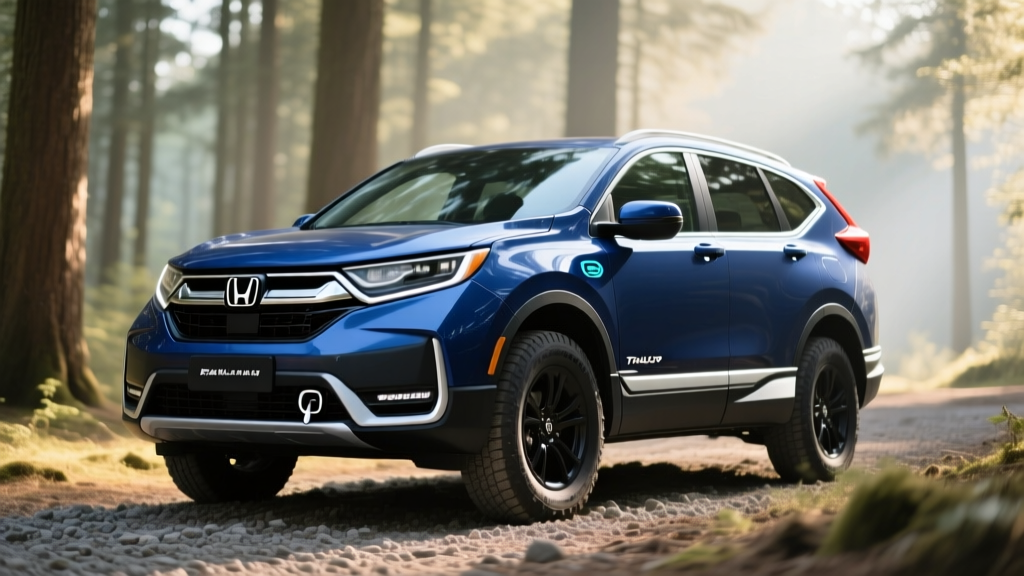
If you want the off-road styling and 8.3 inches of ground clearance of Honda's TrailSport badge without the fuel-pump pain of a turbo-only SUV, the 2026 Honda CR-V Hybrid TrailSport occupies a very specific lane. It pairs Honda's two-motor hybrid powertrain with the TrailSport's all-terrain tires, retuned suspension, and underbody protection — and returns EPA-estimated fuel economy that shames most compact crossovers, electrified or not.
This guide breaks down the exact numbers you need before signing: EPA and real-world MPG, the hybrid powertrain's output, battery warranty and replacement expectations, pricing by trim, tax-credit eligibility, and how the CR-V Hybrid TrailSport stacks up against a PHEV like the Toyota RAV4 Prime or a full EV like the Hyundai Ioniq 5.
HEV vs PHEV: What the CR-V Hybrid TrailSport Actually Is
Before we get to the numbers, a critical distinction: the 2026 CR-V Hybrid TrailSport is a conventional hybrid (HEV), not a plug-in hybrid (PHEV). That means:
- No plug, no charging cable. The 1.3 kWh lithium-ion battery recharges itself via regenerative braking and the gasoline engine.
- No electric-only driving range to speak of. The battery assists the engine during acceleration and enables brief low-speed EV mode, but you cannot commute on electricity alone.
- No federal §30D tax credit. Only plug-in vehicles with batteries ≥7 kWh (PHEVs and BEVs) qualify for the up-to-$7,500 clean vehicle credit under current IRS rules.
If you want plug-in capability in a Honda, you would need to look at the (discontinued) Clarity PHEV or wait for Honda's upcoming PHEV models. In the compact SUV segment, the RAV4 Prime and Hyundai Tucson PHEV are the plug-in benchmarks.
Fuel Economy: EPA Numbers vs What You'll Actually See
| Metric | EPA Estimate | Real-World Expectation |
|---|---|---|
| City MPG | 40 MPG | 38–43 MPG (hybrids often beat EPA in stop-and-go) |
| Highway MPG | 34 MPG | 31–35 MPG (hybrid advantage shrinks at sustained 70+ mph) |
| Combined MPG | 37 MPG | 35–39 MPG depending on driving mix |
| Total Range (14.0-gal tank) | ~518 miles | ~450–540 miles |
The CR-V Hybrid TrailSport's AWD hybrid system is rated at 37 MPG combined by the EPA. That's a 4 MPG combined penalty versus the front-wheel-drive CR-V Hybrid (41 combined) due to the weight and driveline loss of standard AWD and the TrailSport's all-terrain tire compound.
In mixed suburban-and-highway driving, owners consistently report that Honda's two-motor hybrid system overdelivers in city traffic — where the electric motor handles most low-speed propulsion and the engine acts primarily as a generator. On long, flat highway cruises at 65 mph, expect to see numbers near or slightly above the 34 MPG highway sticker. Push past 75 mph or tackle mountain grades, and the 2.0-liter Atkinson-cycle engine works harder; 30–32 MPG is realistic in those conditions.
Cold-weather impact is modest compared to a full EV. Expect a 5–10% fuel economy drop in sub-freezing temperatures as the engine runs more frequently for cabin heat and battery warmup — far less punishing than the 20–30% range loss a BEV experiences in winter.
Powertrain: Two Motors, One Smart System
| Specification | 2026 CR-V Hybrid TrailSport AWD |
|---|---|
| Engine | 2.0L DOHC Atkinson-cycle 4-cylinder |
| Engine Output | 145 hp @ 6,100 rpm / 134 lb-ft torque |
| Electric Motors | Dual-motor hybrid system (propulsion + generator) |
| Electric Motor Output | 184 hp / 247 lb-ft torque |
| Combined System Output | 204 hp / 247 lb-ft torque |
| Transmission | Direct-drive (e-CVT, no fixed gears) |
| Drivetrain | Real Time AWD™ with torque vectoring |
| 0–60 mph | ~7.8 seconds (est.) |
| Ground Clearance | 8.3 inches |
| Towing Capacity | 1,500 lbs |
| Battery (hybrid) | ~1.3 kWh lithium-ion |
Honda's fourth-generation two-motor hybrid system is one of the smoothest in the segment. Unlike Toyota's planetary-gear power-split device, Honda's system operates primarily in series-hybrid mode at low and moderate speeds — the engine spins the generator motor, which feeds electricity to the propulsion motor that actually drives the wheels. Only at highway cruising does a lockup clutch connect the engine directly to the wheels for efficiency.
The result is seamless, linear acceleration with the torque characteristics of an EV around town. The 247 lb-ft of electric torque is available from near zero rpm, which gives the TrailSport confident passing punch even though 204 combined horsepower sounds modest on paper. The Real Time AWD system can route up to 50% of torque rearward and applies brake-based torque vectoring across the rear axle — useful on loose gravel and snow, though not a substitute for a dedicated off-roader's locking differential.
TrailSport-Specific Hardware: What You're Paying For
The TrailSport trim isn't just an appearance package. For 2026, Honda equips it with:
- Continental CrossContact ATR all-terrain tires (235/60R18) — more aggressive tread than the standard all-season rubber, with a modest fuel economy trade-off
- Retuned dampers for better compliance over washboard and chunky surfaces
- Steel underbody skid plates protecting the engine, fuel tank, and rear differential
- Orange recovery hooks (front) and TrailSport badging
- Orange contrast stitching and all-weather floor liners
These additions add roughly 80–100 lbs over the CR-V Hybrid Sport Touring, which accounts for a portion of the 4 MPG combined difference between the two trims.
Pricing, Tax Credits, and Value
The 2026 Honda CR-V Hybrid TrailSport carries an expected MSRP of approximately $39,845 (including destination). That positions it between the Hybrid Sport ($36,895) and the Hybrid Sport Touring ($42,295).
Federal tax credit: The CR-V Hybrid TrailSport does not qualify for the §30D New Clean Vehicle Credit. Its 1.3 kWh battery falls well below the 7 kWh minimum required for plug-in vehicles. There is no federal hybrid-specific tax credit as of 2026.
State incentives: A handful of states offer rebates for conventional hybrids (e.g., Colorado's innovative motor vehicle credit has at times included HEVs at lower tiers). Check your state's energy office or the AFDC state incentive database for current eligibility.
For buyers who want the federal credit, the path is a PHEV (like the RAV4 Prime, if you can find one) or a full EV. The credit now transfers to the dealer at point of sale under current IRS §30D rules, but comes with MSRP caps ($80,000 for SUVs), buyer income limits ($300K joint / $150K single), and strict battery-mineral sourcing requirements.
Reliability, Battery Warranty, and Replacement Cost
Hybrid Battery Warranty: Honda covers the CR-V Hybrid's lithium-ion traction battery for 8 years / 100,000 miles (10 years / 150,000 miles in CARB-emission states including CA, CO, CT, MA, ME, MD, NJ, NY, OR, RI, VT, WA).
Powertrain Warranty: 5 years / 60,000 miles.
Real-world longevity: Honda's hybrid systems have proven durable. Taxi-fleet data and owner reports on earlier-generation Honda hybrids (Insight, Accord Hybrid) show the traction battery typically retains 85–90%+ capacity at 150,000 miles. Full failure before 200,000 miles is uncommon.
Replacement cost (out of warranty): A hybrid battery pack replacement runs approximately $2,500–$4,000 including labor at a Honda dealer — a fraction of a full EV battery replacement ($8,000–$20,000+). Third-party refurbishers offer rebuilt packs for $1,500–$2,500.
Honda's hybrid system is simpler than a conventional automatic transmission — no torque converter, no multi-speed gearsets, no clutch packs. The e-CVT is a direct-drive unit with fewer wear components. Combined with Honda's strong IIHS safety ratings, the CR-V Hybrid is one of the lower-risk ownership propositions in the compact SUV segment.
CR-V Hybrid TrailSport vs the Alternatives
| Vehicle | Type | Combined MPG / MPGe | EV Range | Starting MSRP | Federal Credit |
|---|---|---|---|---|---|
| 2026 Honda CR-V Hybrid TrailSport AWD | HEV | 37 MPG | N/A | ~$39,845 | None |
| 2026 Toyota RAV4 Prime SE AWD | PHEV | 94 MPGe / 38 MPG (gas) | 42 mi | ~$44,500 | Up to $7,500* |
| 2026 Hyundai Tucson PHEV SEL | PHEV | 80 MPGe / 35 MPG (gas) | 33 mi | ~$39,000 | Up to $7,500* |
| 2026 Hyundai Ioniq 5 SEL AWD | BEV | 110 MPGe | 290 mi (EPA) | ~$47,500 | Up to $7,500* |
*Credit eligibility depends on MSRP caps, buyer income, battery sourcing, and current-year IRS rules. Confirm at irs.gov.
Choose the CR-V Hybrid TrailSport if:
- You don't have access to home or workplace charging (apartment, street parking)
- You want off-road credibility without range anxiety on remote trails
- You drive 12,000–18,000 miles/year and want a simple, proven powertrain
- You want to avoid the $5,000–$8,000 price premium of a PHEV
Choose a PHEV (RAV4 Prime / Tucson PHEV) if:
- You can charge at home (Level 2) and your commute is under 35 miles
- You want to run most daily driving on electricity while keeping gas for road trips
- You qualify for the $7,500 federal credit, which largely closes the price gap
Choose a full EV (Ioniq 5 / Tesla Model Y) if:
- You have reliable home charging and rarely drive beyond 250 miles without a stop
- You want near-zero maintenance (no oil changes, no engine, no exhaust system)
- You qualify for the federal credit and your state offers additional EV incentives
Who Should — and Shouldn't — Buy the CR-V Hybrid TrailSport
This is a compelling SUV for a specific buyer: someone who wants AWD capability for snow, forest roads, or camping trips, values fuel efficiency, and doesn't have the charging access (or the appetite for the EV price premium) that a plug-in vehicle demands. The TrailSport's 8.3 inches of ground clearance and genuine all-terrain tires give it trail credibility that the Subaru Forester Wilderness and Toyota RAV4 TRD Off-Road take seriously — but with a hybrid's city-MPG advantage those gas-only rivals can't match.
It's the wrong choice if your daily commute is short and you have a garage with a 240V outlet. In that scenario, a PHEV like the RAV4 Prime will use zero gasoline on most weekdays, and the $7,500 federal credit (if you qualify) nearly erases the price gap. It's also the wrong choice if you want the silent, instant-torque experience of a full EV — the CR-V Hybrid drives like a refined gas car that happens to get excellent mileage, not like an electric vehicle.
Pros
- 37 MPG combined AWD is best-in-class for off-road-oriented compact SUVs
- Smooth, EV-like low-speed driving from the two-motor system
- Genuine off-road hardware (skid plates, ATR tires, retuned suspension)
- 8-year/100,000-mile hybrid battery warranty (10/150K in CARB states)
- Strong resale value and Honda reliability track record
- No charging infrastructure required
Cons
- No plug-in option — cannot drive on electricity alone
- No federal tax credit eligibility
- 1,500-lb towing capacity trails turbocharged rivals (RAV4 gas: 1,500 lbs; some competitors: 3,500 lbs)
- All-terrain tires generate more road noise than all-seasons at highway speed
- Infotainment (7-inch on TrailSport) lags behind competitors' standard 10+ inch screens
Frequently Asked Questions
How many MPG does the 2026 Honda CR-V Hybrid TrailSport get?
The EPA rates it at 40 city / 34 highway / 37 combined MPG. In real-world mixed driving, most owners see 35–39 combined, with city driving often exceeding the 40 MPG sticker thanks to the hybrid system's regenerative braking and electric-only low-speed operation.
Can I plug in the CR-V Hybrid TrailSport to charge it?
No. The CR-V Hybrid is a conventional HEV (hybrid electric vehicle), not a plug-in hybrid. The small 1.3 kWh battery recharges through regenerative braking and the gasoline engine. There is no charging port and no electric-only driving range beyond brief low-speed EV-mode creep.
How long will the hybrid battery last, and what does replacement cost?
Honda warranties the hybrid battery for 8 years/100,000 miles (10 years/150,000 miles in CARB states). Real-world data from Honda's hybrid fleet shows most packs retain 85%+ capacity beyond 150,000 miles. Out-of-warranty replacement costs approximately $2,500–$4,000 at a dealer, or $1,500–$2,500 from a third-party refurbisher.
Does the CR-V Hybrid TrailSport qualify for a federal tax credit?
No. The federal §30D New Clean Vehicle Credit requires a battery capacity of at least 7 kWh and plug-in capability. The CR-V Hybrid's 1.3 kWh battery does not qualify. A small number of states offer hybrid-specific rebates — check the AFDC state incentive database for your area.
How does the CR-V Hybrid TrailSport compare to the RAV4 Prime?
The RAV4 Prime is a PHEV with 42 miles of electric-only range and 94 MPGe when charged. It qualifies for up to $7,500 in federal credits (if you meet income, MSRP, and sourcing requirements), which narrows its price premium over the CR-V Hybrid TrailSport. The trade-off: the RAV4 Prime requires home charging access to realize its efficiency advantage, and it's frequently in short supply at dealers. If you can charge at home and your commute is under 40 miles, the RAV4 Prime is the more economical daily driver. If you lack charging access or regularly venture off-grid, the CR-V Hybrid TrailSport is simpler and more trail-capable.
Is the TrailSport trim worth the premium over the CR-V Hybrid Sport?
If you actually use the off-road hardware — forest service roads, snowy driveways, camping on unpaved sites — yes. The all-terrain tires, skid plates, and retuned suspension are functional upgrades, not cosmetic. If your driving is strictly pavement, the Hybrid Sport or Sport Touring delivers 4 MPG better combined fuel economy and a quieter highway ride for less money.