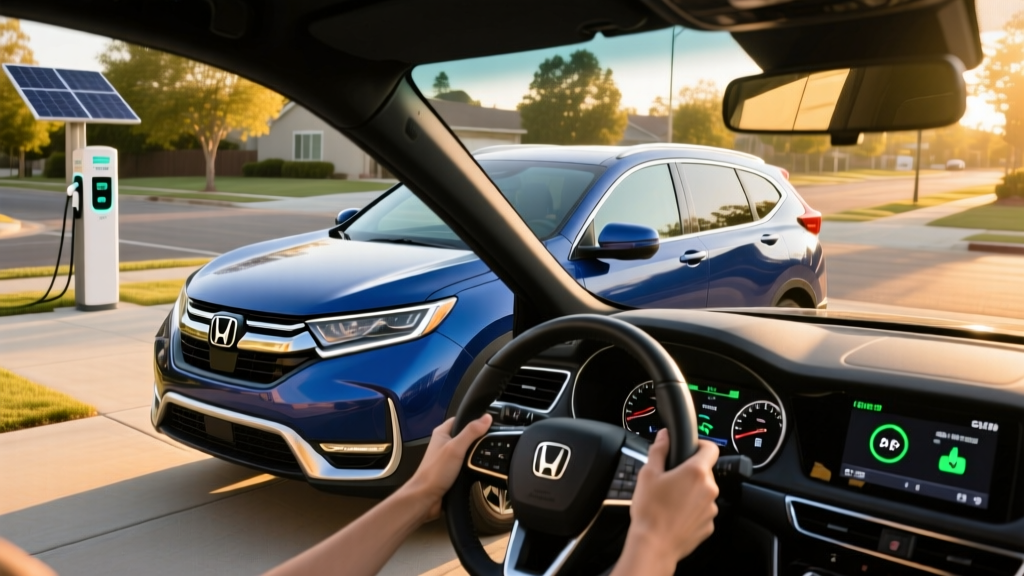
The 2025 Honda CR-V Hybrid occupies a specific niche in the electrified SUV market: it's a conventional hybrid (HEV) that requires no plug, no charging cable, and no behavioral change from the driver. You fill it with gas, and the two-motor hybrid system handles the rest. For buyers weighing the CR-V Hybrid against a full battery-electric vehicle (BEV) or a plug-in hybrid (PHEV), the decision hinges on one question — do you have reliable home charging access?
If the answer is no, the 2025 CR-V Hybrid delivers meaningful fuel savings over its gasoline-only sibling without any infrastructure dependency. Here's the complete breakdown of what this powertrain actually delivers in the real world, what it costs, and where it fits in the broader electrified-vehicle landscape.
HEV vs. PHEV: Where the CR-V Hybrid Fits
Before examining the numbers, it's critical to understand what the 2025 CR-V Hybrid is — and what it isn't. Honda sells the CR-V Hybrid as a conventional hybrid (HEV). It has a small 1.06 kWh lithium-ion battery pack that charges exclusively through regenerative braking and the gasoline engine. You never plug it in. There is no electric-only driving range to speak of — the electric motors assist the engine and enable brief low-speed electric-only operation, but the gas engine is always part of the equation.
| Feature | CR-V Hybrid (HEV) | Typical PHEV (e.g., Toyota RAV4 Prime) | Full EV (e.g., Tesla Model Y) |
|---|---|---|---|
| Plug-in charging required | No | Yes (Level 1 or 2) | Yes (Level 2 + DC fast) |
| Electric-only range | ~1 mi at low speed | 35–42 mi | 260–330 mi |
| Battery capacity | 1.06 kWh | 18.1 kWh | 60–82 kWh |
| DC fast charging | No | No (most PHEVs) | Yes (150–250 kW) |
| Federal tax credit (§30D) | Not eligible | Up to $7,500 (if eligible) | Up to $7,500 (if eligible) |
| Fuel required | Gasoline | Gasoline + electricity | Electricity only |
This distinction matters because buyers sometimes assume "hybrid" means plug-in capability. The CR-V Hybrid is a self-charging system. If you want electric-only commuting range, you'd need to look at a PHEV like the Toyota RAV4 Prime or a full BEV. The CR-V Hybrid's value proposition is simpler: substantially better fuel economy than a gas-only CR-V, with zero lifestyle adjustment.
Fuel Economy: EPA Ratings and Real-World MPG
The 2025 Honda CR-V Hybrid uses Honda's fourth-generation two-motor hybrid system, pairing a 2.0-liter Atkinson-cycle four-cylinder engine with two electric motors for a combined system output of 204 horsepower and 247 lb-ft of torque. The result is competitive fuel economy across the lineup.
| Trim / Drivetrain | City MPG | Highway MPG | Combined MPG |
|---|---|---|---|
| Sport Hybrid (FWD) | 43 | 36 | 40 |
| Sport Hybrid (AWD) | 40 | 34 | 37 |
| Sport-L Hybrid (AWD) | 40 | 34 | 37 |
| Sport Touring Hybrid (AWD) | 40 | 34 | 37 |
| Gas-only CR-V (AWD, for comparison) | 27 | 32 | 29 |
Source: fueleconomy.gov — EPA estimates. Your mileage will vary.
Real-World MPG: What Owners Actually See
Hybrids typically outperform their EPA city estimates in stop-and-go driving because regenerative braking recaptures energy that a gas car wastes as heat. On the highway, where the gas engine does most of the work, hybrids often fall slightly below their EPA highway number.
Based on owner-reported data and independent testing, expect the following from the 2025 CR-V Hybrid AWD in real-world conditions:
- City driving (mixed stop-and-go): 38–44 MPG — many owners report exceeding the 40 MPG city EPA figure in moderate climates
- Highway cruising (70–75 mph): 31–34 MPG — aerodynamic drag reduces the hybrid system's advantage at sustained speed
- Cold weather (below 32°F): 30–33 MPG combined — the engine runs more frequently to provide cabin heat and maintain battery temperature
- Combined mixed driving: 35–39 MPG for AWD trims, which is close to or slightly above the 37 MPG EPA combined rating
The FWD Sport Hybrid trim, rated at 40 MPG combined, is the efficiency leader in the lineup. If maximum fuel economy is your priority and AWD isn't essential for your climate, the FWD configuration saves roughly 3 MPG combined and approximately $1,500 in MSRP.
Powertrain and Performance Specs
| Specification | 2025 Honda CR-V Hybrid |
|---|---|
| Engine | 2.0L Atkinson-cycle DOHC 4-cylinder |
| Engine output | 145 hp @ 6,100 rpm / 134 lb-ft torque |
| Electric motors | Two-motor hybrid system (drive + generator) |
| Combined system output | 204 hp / 247 lb-ft torque |
| Transmission | Direct-drive (no traditional CVT or gears) |
| 0–60 mph | ~7.6 seconds (AWD) |
| Drivetrain options | FWD (Sport trim) or Real Time AWD |
| Battery | 1.06 kWh lithium-ion |
| Towing capacity | 1,000 lbs |
| Cargo volume (behind rear seats) | 36.3 cu ft (39.3 cu ft gas model) |
| Cargo volume (rear seats folded) | 76.5 cu ft |
The two-motor system operates in three modes: EV Drive (electric motor only, at low speeds and light loads), Hybrid Drive (engine generates electricity to power the drive motor), and Engine Drive (engine directly powers the wheels at highway cruising speeds via a lock-up clutch). This is fundamentally different from a traditional planetary-gear hybrid like Toyota's system — Honda's approach feels more like an EV in city driving because the electric motor handles most low-speed propulsion.
The 204 hp combined output is competitive within the compact hybrid SUV segment. The CR-V Hybrid doesn't feel slow in daily driving, though the 7.6-second 0–60 time trails the turbocharged gas-only CR-V (which hits 60 in roughly 7.0 seconds) and significantly trails PHEV competitors like the RAV4 Prime (5.7 seconds with 302 hp).
Pricing, Trims, and Tax Credit Eligibility
The 2025 Honda CR-V Hybrid is available in four trims, all positioned in the upper half of the CR-V range:
| Trim | Drivetrain | MSRP (incl. destination) |
|---|---|---|
| Sport Hybrid | FWD or AWD | $36,395 (FWD) / $37,895 (AWD) |
| Sport-L Hybrid | AWD | $40,695 |
| Sport Touring Hybrid | AWD | $43,195 |
Federal Tax Credit: Not Eligible
The 2025 CR-V Hybrid does not qualify for the federal §30D Clean Vehicle Credit. Under current IRS rules, only plug-in electric vehicles (BEVs and PHEVs) with sufficient battery capacity (at least 7 kWh) and meeting battery-component and critical-mineral sourcing requirements are eligible. Conventional hybrids like the CR-V Hybrid, with a 1.06 kWh battery, fall well outside the program's scope.
This means the effective purchase price is the sticker price minus any dealer discounts, state-level hybrid incentives (rare but available in a few jurisdictions), and fuel savings over time. Some states offer modest rebates or HOV-lane access for hybrids — check your state's energy office for current programs.
Total Cost of Ownership vs. Gas-Only CR-V
The CR-V Hybrid AWD carries a roughly $3,000–$4,000 premium over an equivalently equipped gas-only CR-V (e.g., the EX-L AWD at ~$37,295). At 37 MPG combined versus 29 MPG combined, and assuming $3.40/gallon regular unleaded and 12,000 miles/year:
- Gas-only CR-V AWD: ~414 gallons/year = ~$1,407/year in fuel
- CR-V Hybrid AWD: ~324 gallons/year = ~$1,102/year in fuel
- Annual fuel savings: ~$305/year
- Break-even on the hybrid premium: approximately 10–13 years at current fuel prices
The financial case for the CR-V Hybrid strengthens considerably if gas prices rise, if you drive more than 12,000 miles/year, or if you do a high proportion of city driving where the hybrid's advantage is greatest. The hybrid also tends to hold resale value well, which partially offsets the upfront premium.
Battery Warranty, Reliability, and Replacement Cost
Honda Hybrid Battery Warranty: 8 years / 100,000 miles (10 years / 150,000 miles in CARB states including CA, CO, CT, ME, MA, NJ, NY, OR, RI, VT, WA). Coverage applies if the hybrid battery drops below a specified capacity threshold or fails outright.
Honda's hybrid system has proven durable across multiple generations. The 1.06 kWh battery pack is small and operates within a narrow state-of-charge window (typically 40–80%), which minimizes degradation stress. Unlike a full EV battery, which cycles through a much wider range daily, the CR-V Hybrid's battery experiences relatively gentle use.
Based on historical data from Honda's hybrid lineup (Accord Hybrid, Insight, previous-gen CR-V Hybrid), battery failures within the warranty period are uncommon. When out-of-warranty replacement is eventually needed — typically well beyond 150,000 miles — expect the following:
- Hybrid battery replacement cost: $2,000–$4,000 (parts and labor at a Honda dealer)
- Refurbished/remanufactured options: $1,200–$2,500 from independent hybrid specialists
- Expected battery lifespan: 150,000–200,000+ miles before significant capacity loss, based on historical Honda hybrid data
The CR-V as a nameplate scores well in reliability surveys. The 2025 model carries over the proven sixth-generation platform with the fourth-generation hybrid powertrain, both of which have accumulated substantial real-world mileage data. NHTSA and IIHS ratings for the CR-V platform have historically been strong, though 2025-specific crash-test results should be verified as they're published.
Who Should Buy the CR-V Hybrid — and Who Shouldn't
Pros
- 40 MPG combined (FWD) with zero plug-in requirement
- Smooth, EV-like low-speed driving feel from two-motor system
- 204 hp is adequate for merging and passing
- Strong 8yr/100k-mile hybrid battery warranty (10yr/150k in CARB states)
- Competitive cargo space with only 3 cu ft lost to hybrid battery
- Available across four well-equipped trims
Cons
- No federal tax credit eligibility
- No electric-only commuting range (not a PHEV)
- AWD fuel economy drops to 37 MPG combined
- 1,000-lb towing limit (gas model: 1,500 lbs)
- ~$3,000–$4,000 premium over gas-only CR-V
- Long break-even period on hybrid premium at current gas prices
The Decision Framework
Choose the CR-V Hybrid if:
- You lack access to home or workplace charging (apartment, street parking, no garage outlet)
- You do a high proportion of city and suburban driving where hybrid efficiency peaks
- You want a 35–40 MPG compact SUV with no behavioral changes required
- You plan to keep the vehicle 8+ years and want proven hybrid reliability
Consider a PHEV (RAV4 Prime, Tucson PHEV) if:
- You have Level 2 home charging and a commute under 35 miles
- You want electric-only daily driving with gas-engine road-trip range
- You may qualify for the §30D federal tax credit (income, MSRP, and sourcing requirements apply)
Consider a full BEV (Model Y, Ioniq 5, EV6) if:
- You have reliable Level 2 home charging
- Your daily driving is under 250 miles and you're comfortable with DC fast charging for road trips
- You want the lowest per-mile energy cost (~$0.04–$0.06/mi on home electricity vs. ~$0.10–$0.12/mi for the hybrid)
Frequently Asked Questions
How many MPG does the 2025 Honda CR-V Hybrid get?
The FWD Sport Hybrid is EPA-rated at 43 city / 36 highway / 40 combined MPG. AWD trims (Sport, Sport-L, Sport Touring) are rated at 40 city / 34 highway / 37 combined. Real-world combined MPG for AWD models typically falls between 35–39, with city driving often exceeding the EPA estimate and highway driving sometimes falling slightly below.
Does the CR-V Hybrid need to be plugged in?
No. The 2025 CR-V Hybrid is a conventional hybrid (HEV). Its 1.06 kWh battery charges through regenerative braking and the gasoline engine. You never plug it in — just fill it with regular unleaded gasoline.
Is there a plug-in hybrid (PHEV) version of the Honda CR-V?
Not in the United States for the 2025 model year. Honda sells a CR-V e:PHEV in China and Europe, but it is not available in the U.S. market. American buyers seeking a plug-in compact SUV from Honda would need to look at competitors like the Toyota RAV4 Prime, Hyundai Tucson PHEV, or Kia Sportage PHEV.
Does the 2025 CR-V Hybrid qualify for any tax credit?
It does not qualify for the federal §30D Clean Vehicle Credit, which requires a plug-in vehicle with at least 7 kWh of battery capacity. The CR-V Hybrid's 1.06 kWh battery is far below this threshold. Some states may offer minor incentives for hybrids, but these vary by jurisdiction — check your state's energy or environmental agency for current programs.
How long will the CR-V Hybrid battery last?
Honda covers the hybrid battery for 8 years / 100,000 miles nationwide, and 10 years / 150,000 miles in CARB-emission states. Based on historical data from Honda's hybrid systems, the battery typically lasts 150,000–200,000+ miles before needing replacement. Out-of-warranty replacement costs range from $2,000–$4,000 at a dealer, or $1,200–$2,500 with a refurbished unit from an independent shop.
Is the CR-V Hybrid slower than the gas model?
Marginally. The hybrid's 204 hp and 7.6-second 0–60 time trail the gas-only CR-V's 190 hp turbocharged engine, which reaches 60 mph in roughly 7.0 seconds. However, the hybrid's electric motor provides instant torque at low speeds, making it feel responsive in city driving. The difference is most noticeable during sustained highway passing maneuvers.
How much cargo space does the hybrid lose?
The hybrid battery is mounted under the cargo floor, reducing cargo volume by approximately 3 cubic feet. The hybrid offers 36.3 cu ft behind the rear seats and 76.5 cu ft with seats folded, compared to 39.3 cu ft and 79.5 cu ft in the gas-only model. The cargo floor is slightly higher in the hybrid, but the difference is barely noticeable in daily use.