Quick Verdict: The 2026 Honda CR-V Hybrid at a Glance
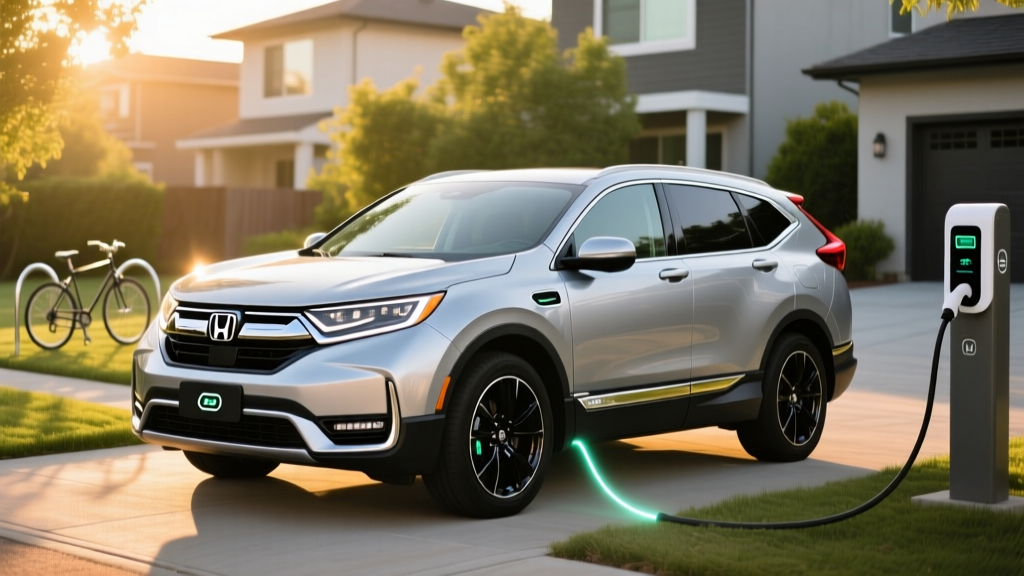
The 2026 Honda CR-V Hybrid remains one of the most compelling compact SUVs for buyers who want electrified efficiency without plugging in. Honda's two-motor hybrid system delivers strong low-end torque, class-leading cargo space, and EPA-rated fuel economy that routinely beats its sticker numbers in real-world city driving. For 2026, the CR-V Hybrid lineup continues across Sport, Sport-L, and Sport Touring trims, with pricing starting in the mid-$30,000 range and all-wheel drive available across the board.
This is a conventional hybrid (HEV) — not a plug-in. You never need to plug it in. The system recovers energy through regenerative braking and the gasoline engine to keep its small battery charged. If you're looking for electric-only driving range or a federal tax credit, you'll want to look at PHEVs or full BEVs instead. But if your goal is simple — spend less at the pump, never think about charging, and keep a familiar driving experience — the CR-V Hybrid is one of the best-executed options on the market.
A conventional hybrid (HEV) like the CR-V Hybrid uses a small battery (typically 1–2 kWh) charged by the engine and regenerative braking. You never plug it in. A plug-in hybrid (PHEV) has a larger battery (typically 12–25 kWh), can be plugged into a wall outlet or charger, and offers 20–50 miles of electric-only driving before the gas engine kicks in. The 2026 CR-V is offered only as an HEV in the US market — Honda does not currently sell a CR-V PHEV in North America.
2026 Honda CR-V Hybrid: Full Spec Table
| Specification | 2026 Honda CR-V Hybrid |
|---|---|
| Powertrain | 2.0L Atkinson-cycle 4-cyl + two-motor hybrid system |
| Combined Horsepower | 204 hp |
| Combined Torque | 247 lb-ft (electric motor) |
| EPA MPG (FWD) | 43 city / 36 highway / 40 combined |
| EPA MPG (AWD) | 40 city / 34 highway / 37 combined |
| Fuel Tank | 14.0 gallons |
| Total Range (FWD est.) | ~560 miles |
| 0–60 mph | ~7.8 seconds |
| Cargo Volume | 39.3 cu ft (rear seats up) / 76.5 cu ft (folded) |
| Towing Capacity | 1,000 lbs |
| Hybrid Battery Warranty | 8 years / 100,000 miles (10 yr/150,000 mi in CARB states) |
| Starting MSRP (Sport FWD) | ~$35,350 (est.) |
| Federal Tax Credit | Not eligible (§30D applies to PHEVs/BEVs only) |
Sources: fueleconomy.gov, Honda CR-V Hybrid official page. Pricing estimated based on 2025 carryover; confirm with dealer for final 2026 MSRP.
Fuel Economy: EPA Ratings vs. Real-World MPG
The EPA rates the 2026 CR-V Hybrid FWD at 43 city / 36 highway / 40 combined. AWD models drop slightly to 40 / 34 / 37. These are strong numbers for a compact SUV, and they translate directly to fuel savings — at $3.40/gallon and 12,000 miles/year, the FWD hybrid saves roughly $600–$800 annually compared to the gas-only CR-V (EPA 30 combined).
| Metric | FWD Hybrid | AWD Hybrid | Gas CR-V (AWD) |
|---|---|---|---|
| City MPG | 43 | 40 | 27 |
| Highway MPG | 36 | 34 | 32 |
| Combined MPG | 40 | 37 | 29 |
| Annual Fuel Cost* | ~$1,020 | ~$1,103 | ~$1,407 |
*Based on 12,000 miles/year at $3.40/gallon regular unleaded. Source: fueleconomy.gov.
Powertrain Deep Dive: How Honda's Two-Motor Hybrid Works
The 2026 CR-V Hybrid uses Honda's fourth-generation two-motor hybrid system paired with a 2.0-liter Atkinson-cycle four-cylinder engine. Here's how the power flows:
- At low speeds and light loads: The gasoline engine acts as a generator, producing electricity that powers the drive motor. The engine is not mechanically connected to the wheels. This gives EV-like smoothness and torque response.
- Under hard acceleration: Both the engine (via generator) and the battery feed the 181-hp drive motor simultaneously, delivering the full 247 lb-ft of torque instantly.
- At steady highway cruising: A lock-up clutch mechanically connects the engine directly to the front wheels, bypassing the electric conversion for maximum efficiency at sustained speeds.
- During braking and deceleration: The drive motor acts as a generator, recovering kinetic energy back into the ~1.1 kWh lithium-ion battery pack.
The combined system output is 204 horsepower, which is competitive with the Toyota RAV4 Hybrid (219 hp) and significantly more responsive than the Hyundai Tucson Hybrid's turbo setup in daily driving. The 247 lb-ft of electric motor torque is available from near-zero RPM, making the CR-V Hybrid feel quicker than its 7.8-second 0–60 time suggests around town.
Pricing, Trims, and Tax Credit Eligibility
The 2026 CR-V Hybrid is offered in three trims. Estimated MSRP (based on 2025 pricing with minor adjustments):
- Sport (FWD): ~$35,350
- Sport (AWD): ~$36,850
- Sport-L (AWD): ~$38,350
- Sport Touring (AWD): ~$41,850
Destination charge adds approximately $1,350.
Battery Longevity, Warranty, and Replacement Cost
The CR-V Hybrid's lithium-ion battery pack is small (~1.1 kWh usable) and operates within a narrow state-of-charge window — typically between 20% and 80% — managed by Honda's battery control system. This shallow cycling dramatically reduces degradation compared to a full BEV battery that regularly cycles from 10% to 90%.
• 8 years / 100,000 miles in most US states
• 10 years / 150,000 miles in CARB-adopting states (CA, NY, MA, CT, CO, OR, WA, VT, RI, NJ, MD, ME, NM, NV, and others)
• Covers defects and capacity loss below a functional threshold (Honda does not publish an exact percentage, but industry standard is ~60–70% capacity retention)
• Source: Honda warranty documentation
Real-world longevity data: Honda's hybrid systems have proven durable. The earlier-generation CR-V Hybrid and Accord Hybrid batteries routinely exceed 150,000 miles without significant degradation. Independent fleet data from Toyota's similar hybrid system (a close analog) shows less than 10% capacity loss at 200,000 miles.
Replacement cost if out of warranty: A CR-V Hybrid battery replacement runs approximately $2,000–$3,500 for the battery module plus labor, significantly less than a BEV battery replacement ($8,000–$20,000+). Third-party refurbishers offer replacements for $1,200–$2,000 in some markets.
Hybrid vs. PHEV vs. Full EV: Which Should You Choose?
The CR-V Hybrid sits in a spectrum of electrification. Here's how to decide which category fits your situation:
| Factor | HEV (CR-V Hybrid) | PHEV (e.g., RAV4 Prime) | Full BEV (e.g., Ioniq 5) |
|---|---|---|---|
| Plug in required? | No | Optional (best if yes) | Yes |
| Electric-only range | None (EV assist only) | 25–42 miles | 250–320 miles |
| Home charging needed? | No | Strongly recommended | Essential |
| Federal tax credit | No | Up to $7,500* | Up to $7,500* |
| Annual fuel cost (est.) | ~$1,020 | ~$600–$900 | ~$500–$700 |
| Upfront price premium | +$1,000–$1,500 vs gas | +$5,000–$8,000 vs gas | +$8,000–$15,000 vs gas |
| Road trip simplicity | Gas & go | Gas & go | Plan DC charging stops |
*§30D credit eligibility depends on MSRP caps, buyer income, battery sourcing, and point-of-sale transfer rules. See IRS.gov for current requirements.
Choose the CR-V Hybrid (HEV) if: You lack home charging access, want zero lifestyle change, drive 10,000–15,000 miles/year, and want to save $400–$600/year on fuel with minimal upfront premium.
Choose a PHEV if: You have home charging (Level 1 or 2), your daily commute is under 35 miles, you want some electric-only driving but also need gas-engine road trip flexibility, and you qualify for the federal credit.
Choose a full BEV if: You have reliable home Level 2 charging, your daily driving is under 200 miles, you want the lowest operating cost and zero tailpipe emissions, and you're comfortable with DC fast-charging on road trips.
Pros and Cons
✓ Pros
- 40+ MPG combined (FWD) with no plugging in
- Strong low-end torque (247 lb-ft) for confident city driving
- Class-leading cargo space (39.3 cu ft behind rear seats)
- 8–10 year hybrid battery warranty
- Low battery replacement cost ($2,000–$3,500) vs. BEV
- Real-world city MPG often exceeds EPA rating
- No range anxiety — 560+ mile total range
✗ Cons
- No federal tax credit eligibility (HEV)
- AWD drops combined MPG to 37
- Highway efficiency lags behind city (36/34 MPG)
- 1,000-lb towing capacity (limited for utility use)
- No PHEV variant offered in the US market
- Hybrid premium of ~$1,500 over gas-only CR-V
- Sport Touring trim pushes past $41,000
Frequently Asked Questions
How many MPG does the 2026 Honda CR-V Hybrid get?
The FWD model is EPA-rated at 43 city / 36 highway / 40 combined. The AWD model rates 40 city / 34 highway / 37 combined. In real-world city-heavy driving, many owners report 42–46 MPG. Highway-heavy driving at sustained speeds above 70 mph typically yields 33–35 MPG.
Does the Honda CR-V Hybrid need to be plugged in?
No. The CR-V Hybrid is a conventional hybrid (HEV). Its small battery recharges automatically through regenerative braking and the gasoline engine. There is no plug, no charging cable, and no need for a home charger.
Is there a plug-in hybrid (PHEV) version of the CR-V?
Not in the US market. Honda sells a CR-V e:PHEV in China and Europe, but it is not available in North America as of the 2026 model year. If you want a compact SUV PHEV, consider the Toyota RAV4 Prime (42 miles electric-only) or the Hyundai Tucson PHEV (33 miles electric-only).
Does the 2026 CR-V Hybrid qualify for a federal tax credit?
No. The IRS §30D Clean Vehicle Credit applies only to plug-in vehicles (BEVs and qualifying PHEVs). Conventional hybrids like the CR-V Hybrid are not eligible. Check your state's incentive programs at the AFDC database for any local hybrid rebates.
How long will the CR-V Hybrid battery last, and what does replacement cost?
Honda warrants the hybrid battery for 8 years/100,000 miles (10 years/150,000 miles in CARB states). Based on historical data from Honda and Toyota hybrid systems, these batteries commonly last 150,000–200,000+ miles with minimal degradation. Out-of-warranty replacement costs approximately $2,000–$3,500 including labor — far less than a BEV battery.
How does the CR-V Hybrid compare to the Toyota RAV4 Hybrid?
The RAV4 Hybrid rates 41 city / 38 highway / 40 combined (AWD standard) with 219 hp. The CR-V Hybrid AWD rates 40 / 34 / 37 with 204 hp. The RAV4 edges ahead in highway MPG and power; the CR-V offers more cargo space (39.3 vs. 37.6 cu ft) and a more refined driving feel. Both are excellent choices — test-drive both before deciding.
Who should buy the 2026 Honda CR-V Hybrid?
The CR-V Hybrid is ideal for buyers who want meaningful fuel savings (40 MPG combined) without changing their fueling habits. It's the right pick if you don't have access to home charging, take regular road trips where DC charging would be inconvenient, or simply prefer the lowest-complexity path to better fuel economy. It's not the right pick if you want electric-only commuting (look at a PHEV) or zero tailpipe emissions (look at a BEV).