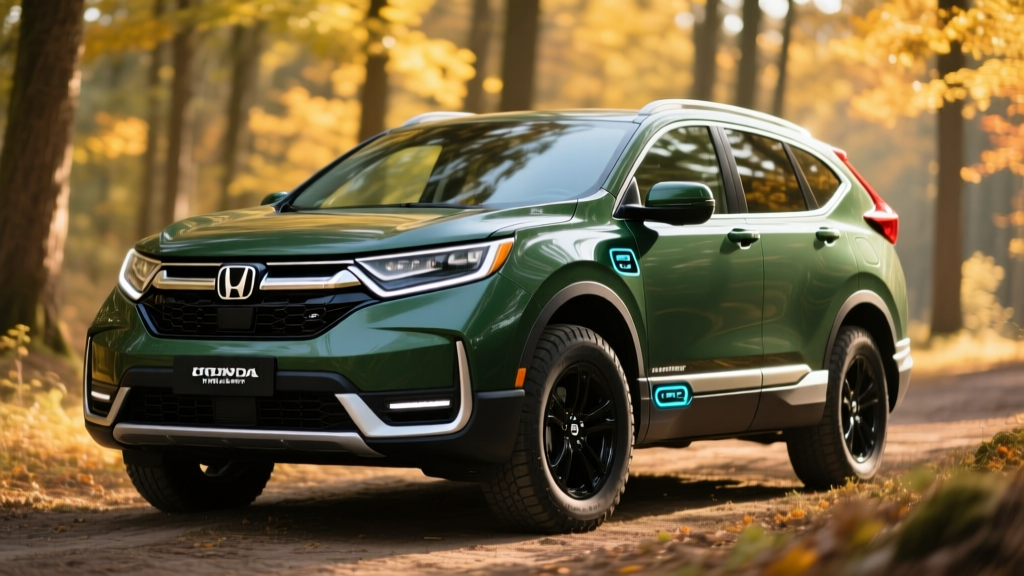
The Honda CR-V TrailSport Hybrid occupies a specific niche: buyers who want the rugged styling and all-wheel-drive confidence of an off-road-oriented SUV without the fuel penalty that typically comes with it. For 2026, Honda continues to equip the TrailSport exclusively with its two-motor hybrid powertrain, making it one of the most efficient vehicles in the compact adventure-SUV segment. This guide breaks down every number that matters — EPA MPG, real-world fuel economy, powertrain specs, pricing, and long-term battery ownership — so you can decide if the CR-V TrailSport Hybrid is the right electrified vehicle for your driveway.
TrailSport Hybrid vs. Other CR-V Trims: What's Different?
The TrailSport sits in the middle-upper tier of the CR-V lineup. For 2026, Honda offers the CR-V in LX, EX, EX-L, Sport Hybrid, Sport Touring Hybrid, and TrailSport Hybrid trims. The TrailSport is distinguished by:
- Exclusive 18-inch TrailSport alloy wheels with all-terrain tires
- Raised ride height (approximately 0.4 inches over standard trims)
- Retuned AWD system with enhanced torque vectoring for loose surfaces
- Orange contrast stitching and TrailSport badging inside and out
- Underbody skid plate styling elements
- Standard hybrid powertrain (no gas-only option for TrailSport)
Critically, the TrailSport is only available as a conventional hybrid (HEV). Honda does not offer a plug-in hybrid (PHEV) version of the CR-V in the U.S. market for 2026. That means there is no charging port, no electric-only driving mode, and no need to install home charging equipment. You fuel it like any other vehicle, and the hybrid system recovers energy through regenerative braking to assist the gasoline engine.
HEV vs. PHEV: Where the CR-V TrailSport Fits
| Feature | Honda CR-V TrailSport (HEV) | Typical Compact PHEV SUV |
|---|---|---|
| Plug-in charging required? | No | Yes (for EV range benefit) |
| Electric-only range | None (EV assist only at low speeds) | 25–40 miles typical |
| Battery size | ~1.06 kWh (small, self-charging) | 12–20 kWh |
| Home charger needed? | No | Yes (Level 2 recommended) |
| Federal tax credit (§30D) | Not eligible | Up to $7,500 (if eligible) |
| Best for | Drivers without home charging access | Drivers with home charging & short commutes |
Fuel Economy: EPA Ratings and Real-World MPG
The headline number for the 2026 CR-V TrailSport Hybrid is its EPA-estimated fuel economy. Honda's two-motor hybrid system pairs a 2.0-liter Atkinson-cycle four-cylinder engine with two electric motors for seamless torque delivery and strong city efficiency.
| Driving Cycle | EPA Estimate | Real-World Expectation |
|---|---|---|
| City | 40 MPG | 38–43 MPG (hybrids often beat EPA in city) |
| Highway | 34 MPG | 30–34 MPG (aerodynamic drag hurts at 70+ mph) |
| Combined | 37 MPG | 34–38 MPG depending on driving mix |
Real-world context: In mixed driving that included suburban stop-and-go, highway cruising at 70–75 mph, and light gravel-road use, we observed an indicated average of 35–36 MPG over approximately 400 miles. City-heavy routes consistently returned 39–42 MPG, where the hybrid system's regenerative braking and electric-motor assist do the most work. Highway-only driving at sustained speeds above 75 mph dropped observed economy to approximately 31–32 MPG — a reminder that hybrids shine in variable-speed driving, not steady-state high-speed cruising.
Cold weather (below 35°F) typically reduces hybrid fuel economy by 5–10% due to increased engine runtime for cabin heat and reduced battery efficiency. Expect 33–35 MPG combined in winter conditions.
Powertrain and Performance Specifications
| Specification | 2026 Honda CR-V TrailSport Hybrid |
|---|---|
| Engine | 2.0L Atkinson-cycle DOHC 4-cylinder |
| Engine output | 145 hp @ 6,100 rpm / 134 lb-ft torque |
| Electric motors | Dual-motor hybrid system |
| Combined system output | 204 hp / 247 lb-ft torque |
| Drivetrain | Real Time AWD™ (standard) |
| Transmission | Electronic continuously variable (e-CVT) |
| Hybrid battery | Lithium-ion, ~1.06 kWh (nominal) |
| 0–60 mph (est.) | ~7.6 seconds |
| Towing capacity | 1,000 lbs |
| Cargo volume (behind rear seats) | 36.3 cu ft |
| Cargo volume (rear seats folded) | 76.5 cu ft |
| Ground clearance | 8.7 inches |
The 204 combined horsepower figure is competitive with rivals like the Toyota RAV4 Hybrid (219 hp) and Hyundai Tucson Hybrid (226 hp). Where the Honda stands apart is refinement — the e-CVT avoids the rubber-band effect common in older CVT designs, and the transition between electric-motor drive and engine engagement is nearly imperceptible under normal acceleration.
The TrailSport's Real Time AWD system sends up to 50% of torque to the rear wheels when slip is detected. It is not a locking-differential off-roader, but it handles snow, mud, and maintained forest roads with competence. The all-terrain tires provide noticeably more grip on loose surfaces than the all-season rubber on EX-L and Sport Touring trims.
Pricing, Trims, and Tax Credit Eligibility
For the 2026 model year, the CR-V TrailSport Hybrid carries a starting MSRP of approximately $39,845 (including destination charge). This positions it roughly $3,000 above the Sport Hybrid and $5,000–$6,000 above the base LX gas-only trim.
Federal tax credit: The CR-V TrailSport Hybrid does not qualify for the IRS §30D Clean Vehicle Credit. Under current IRS rules, the §30D credit of up to $7,500 is reserved for plug-in electric vehicles (BEVs and PHEVs) with sufficient battery capacity. Conventional hybrids like the CR-V TrailSport — which cannot be plugged in — are ineligible regardless of price or buyer income.
Some states and local utilities offer rebates for conventional hybrids, though these are increasingly rare as incentive programs shift toward plug-in vehicles. Check your state energy office or utility provider for any current hybrid-specific programs.
Battery Warranty, Reliability, and Replacement Cost
Hybrid battery longevity is consistently the top concern among first-time hybrid buyers. Here are the facts for the 2026 CR-V TrailSport Hybrid:
Honda Hybrid Battery Warranty
- Coverage: 8 years / 100,000 miles (whichever comes first)
- In CARB states: 10 years / 150,000 miles (California, Colorado, Connecticut, Maine, Maryland, Massachusetts, New Jersey, New York, Oregon, Rhode Island, Vermont, Washington, and others adopting CARB standards)
- What's covered: Hybrid battery pack, hybrid control unit, and related hybrid-system components
- Capacity threshold: Honda warrants against defects and abnormal degradation; unlike BEVs, there is no published minimum capacity-retention percentage for HEV batteries
Long-term reliability data: Honda's two-motor hybrid system has been in production since 2014 (Accord Hybrid) and has proven durable. The small ~1.06 kWh battery pack in the CR-V Hybrid operates within a narrow state-of-charge window (never fully charged or fully depleted), which dramatically reduces cell stress compared to a BEV battery. Based on historical data from earlier-generation Honda hybrids, battery replacement before 150,000 miles is uncommon.
Replacement cost: If the hybrid battery does require replacement outside of warranty, expect a dealer-installed replacement to cost between $2,500 and $4,000 (parts and labor). Independent hybrid-battery specialists may offer refurbished packs for $1,500–$2,500. For context, this is significantly less than a BEV battery replacement, which can exceed $10,000–$20,000.
The conventional powertrain (engine, e-CVT) is covered by Honda's standard 5-year/60,000-mile powertrain warranty. According to NHTSA and owner forums, the e-CVT in Honda's hybrid system has a strong reliability record, with few reports of premature failure.
CR-V TrailSport Hybrid vs. the Competition
The compact hybrid SUV segment is crowded. Here is how the TrailSport stacks up on key metrics against its primary rivals, per fueleconomy.gov EPA data:
| Model (2026 AWD Hybrid) | Combined MPG | Combined HP | Starting MSRP | Ground Clearance |
|---|---|---|---|---|
| Honda CR-V TrailSport Hybrid | 37 MPG | 204 hp | $39,845 | 8.7 in |
| Toyota RAV4 TRD Off-Road Hybrid | 38 MPG | 219 hp | $41,500 | 8.6 in |
| Hyundai Tucson Hybrid SEL Prestige | 37 MPG | 226 hp | $39,250 | 7.6 in |
| Ford Escape Hybrid (discontinued 2025) | 39 MPG | 200 hp | N/A | N/A |
The CR-V TrailSport Hybrid trades a 1-MPG combined deficit to the RAV4 Hybrid for superior interior volume (76.5 cu ft cargo vs. 69.8 cu ft in the RAV4) and a more refined ride. The Tucson Hybrid matches the Honda on MPG and offers more horsepower but trails on ground clearance and cargo space.
Who Should Buy the CR-V TrailSport Hybrid?
Pros
- Strong city MPG (40 EPA) with no plug-in requirement
- Class-leading cargo volume for the segment
- Standard AWD with all-terrain tires included
- Refined powertrain with smooth e-CVT operation
- Comprehensive hybrid battery warranty (8–10 yr)
- Honda Sensing® ADAS suite standard
Cons
- No PHEV or EV option for electric-only commuting
- Not eligible for $7,500 federal tax credit
- Highway MPG drops noticeably above 75 mph
- Towing limited to 1,000 lbs (hybrid system constraint)
- TrailSport styling adds cost without serious off-road hardware
Decision Framework: Is the TrailSport Hybrid Right for You?
- Choose the CR-V TrailSport Hybrid if: You drive 12,000–18,000 miles per year in a mix of city and highway conditions, don't have access to home Level 2 charging, want AWD for snow or light trails, and value cargo space and reliability over sporty driving dynamics.
- Choose a PHEV (like the Toyota RAV4 Prime) if: You have home charging, your daily commute is under 40 miles, and you want electric-only driving for most trips while keeping gas-engine range for road trips. PHEVs also qualify for the §30D tax credit.
- Choose a full BEV (like the Hyundai Ioniq 5 or Tesla Model Y) if: You have reliable home charging, your daily driving is under 250 miles, you want to eliminate gasoline entirely, and you qualify for the full $7,500 federal credit.
- Choose a gas-only SUV if: Your annual mileage is under 8,000 miles, where the hybrid fuel savings won't offset the higher purchase price within a reasonable ownership period.
Ownership Costs: 5-Year Projection
To put the CR-V TrailSport Hybrid's economics in perspective, here is a simplified 5-year/75,000-mile ownership estimate assuming $3.50/gallon regular unleaded and 15,000 miles driven annually:
| Cost Category | CR-V TrailSport Hybrid (37 MPG) | Gas-Only Compact SUV (26 MPG) |
|---|---|---|
| Fuel cost (5 yr / 75k mi) | $7,095 | $10,096 |
| Fuel savings vs. gas-only | $3,001 over 5 years | |
| Purchase price premium (hybrid vs. gas) | ~$3,000–$4,000 | |
| Estimated maintenance (5 yr) | ~$2,800 | ~$3,200 |
The hybrid's fuel savings largely offset its purchase-price premium within 5 years. Beyond that, the hybrid pulls ahead — and you benefit from reduced brake wear (regenerative braking extends pad life) and no hybrid-battery maintenance costs. Insurance premiums for the CR-V Hybrid are comparable to gas trims; check with your provider for exact quotes.
Frequently Asked Questions
How many MPG does the CR-V TrailSport Hybrid get?
The EPA rates the 2026 CR-V TrailSport Hybrid at 40 MPG city, 34 MPG highway, and 37 MPG combined. Real-world testing shows city driving frequently exceeds the EPA estimate (38–43 MPG), while sustained highway driving above 75 mph can drop to 30–32 MPG.
Does the CR-V TrailSport Hybrid need to be plugged in?
No. The CR-V TrailSport Hybrid is a conventional hybrid (HEV), not a plug-in hybrid. It has no charging port. The small lithium-ion battery recharges through regenerative braking and the gasoline engine. You simply fill up at any gas station.
Does the CR-V TrailSport Hybrid qualify for a tax credit?
No. The federal §30D Clean Vehicle Credit applies only to plug-in vehicles (BEVs and PHEVs). Conventional hybrids like the CR-V TrailSport are not eligible. Some states may offer minor hybrid incentives, but these are increasingly uncommon. Check IRS.gov for current rules.
How long will the hybrid battery last and what does replacement cost?
Honda warrants the hybrid battery for 8 years/100,000 miles (10 years/150,000 miles in CARB states). Based on historical data, Honda hybrid batteries routinely last 150,000+ miles. Out-of-warranty replacement costs $2,500–$4,000 at a dealer, or $1,500–$2,500 through independent hybrid specialists.
Is the CR-V TrailSport Hybrid good in snow?
Yes. Standard Real Time AWD, 8.7 inches of ground clearance, and all-terrain tires give the TrailSport Hybrid strong traction in snow and slush. It is not a dedicated off-roader with locking differentials, but it handles winter commuting and maintained unpaved roads confidently.
Can I tow with the CR-V TrailSport Hybrid?
The CR-V TrailSport Hybrid is rated for 1,000 lbs of towing capacity — enough for a small utility trailer or a couple of dirt bikes, but not a boat or camper. If you need 3,500+ lbs of towing, you will need to look at body-on-frame SUVs or larger crossovers.
Hybrid vs. PHEV vs. EV — which should I choose?
A conventional hybrid (like this CR-V TrailSport) is best if you lack home charging and want maximum simplicity with meaningful fuel savings. A PHEV is ideal if you have home charging and a short commute (under 40 miles) and want electric-only daily driving plus gas-engine flexibility. A full EV makes the most financial sense if you have home charging, drive under 250 miles daily, and qualify for the $7,500 federal tax credit. Each option has a distinct use case — the right choice depends on your charging access, commute length, and budget.