The Honda CR-V has been America's best-selling compact SUV for years, and its hybrid variant now accounts for a growing share of that volume. For 2026, the CR-V Hybrid continues with Honda's fourth-generation two-motor system, delivering strong city fuel economy and standard all-wheel drive across every trim. If you're researching the CR-V Honda Hybrid to decide whether it fits your commute, budget, and garage situation, this guide covers every number that matters — from EPA MPG breakdowns to real-world expectations, battery longevity, and total cost of ownership.
HEV vs PHEV: What Honda Actually Offers
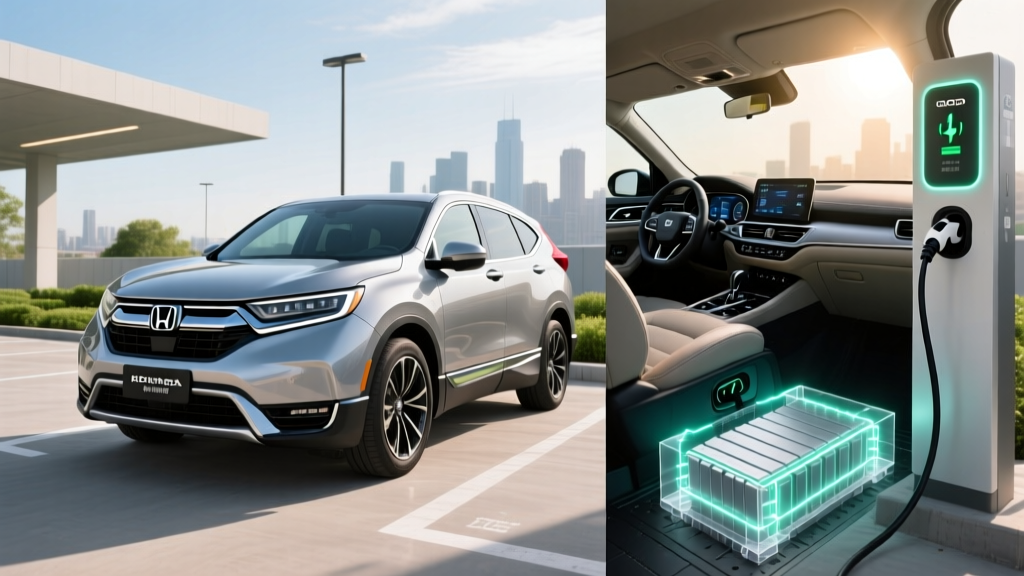
Before getting into the numbers, a critical clarification. The US-market 2026 Honda CR-V Hybrid is a conventional hybrid (HEV) — it does not plug in. You fuel it with gasoline, and the hybrid system recovers energy through regenerative braking and engine optimization to boost efficiency. There is no electric-only driving mode beyond very low-speed maneuvering.
In some international markets, Honda offers a CR-V e:PHEV with a larger battery and roughly 30–40 miles of electric-only range, but that plug-in variant is not sold in the United States as of the 2026 model year. If you need plug-in capability, you'd be looking at competitors like the Toyota RAV4 Prime or Hyundai Tucson PHEV instead.
HEV (US CR-V Hybrid) vs PHEV (Not US-Available)
| Attribute | CR-V Hybrid (HEV) | CR-V e:PHEV (Intl) |
|---|---|---|
| Plugs in? | No | Yes |
| Battery capacity | ~1.06 kWh (buffer-limited) | ~17.7 kWh |
| Electric-only range | N/A (low-speed assist only) | ~37 miles (WLTP) |
| Refueling | Gasoline only | Gas + Level 2 AC charge |
| US availability (2026) | Yes | No |
Fuel Economy: EPA Numbers and Real-World MPG
The 2026 Honda CR-V Hybrid comes exclusively with all-wheel drive (AWD) in the US market. Here's the EPA breakdown as published on fueleconomy.gov:
| Driving Cycle | EPA MPG |
|---|---|
| City | 40 MPG |
| Highway | 34 MPG |
| Combined | 37 MPG |
That 40 MPG city figure is where Honda's two-motor hybrid system shines. The CR-V Hybrid operates primarily as a series hybrid at lower speeds — the gasoline engine generates electricity while the drive motor propels the wheels. This avoids the efficiency losses of a conventional transmission in stop-and-go traffic, which is why the city rating exceeds the highway rating.
Real-World MPG: What Owners Actually See
Based on aggregated owner reports and independent testing, real-world results for the CR-V Hybrid typically land in the following ranges:
- City/suburban driving: 38–43 MPG — many owners exceed the EPA city estimate in moderate climates
- Highway (70+ mph sustained): 30–34 MPG — aerodynamic drag and the engine operating in direct-drive mode reduce efficiency at speed
- Cold weather (below 30°F): 30–35 MPG combined — engine runs more frequently for cabin heat and battery warming
- Combined mixed driving: 34–39 MPG
The takeaway: if your commute is primarily urban or suburban at speeds under 50 mph, expect to meet or beat the EPA combined rating. Highway-heavy drivers will see numbers closer to the low 30s.
Powertrain Specs: Horsepower, Torque, and Drivetrain
| Specification | 2026 Honda CR-V Hybrid |
|---|---|
| Engine | 2.0L Atkinson-cycle 4-cylinder |
| Engine output | 145 hp / 138 lb-ft |
| Drive motor output | 184 hp / 247 lb-ft |
| Combined system output | 204 hp / 247 lb-ft |
| Transmission | e-CVT (direct-drive with lockup clutch) |
| Drivetrain | Standard AWD (rear motor) |
| 0–60 mph | ~7.6 seconds |
| Fuel tank | 14.0 gallons |
| Total driving range | ~518 miles (EPA combined) |
Honda's hybrid system uses two electric motors: one primarily as a generator and one as the drive motor. At highway speeds, a lockup clutch connects the engine directly to the front wheels for efficient cruising. The AWD system adds a dedicated rear-axle motor — there's no mechanical driveshaft — providing torque to the rear wheels when traction demands it.
At 204 combined horsepower, the CR-V Hybrid has adequate acceleration for merging and passing. It's not sporty, but the instant electric torque (247 lb-ft available from zero RPM) makes it feel responsive around town. The e-CVT avoids the rubber-band sensation of some competitors because Honda's system switches to direct mechanical drive at higher speeds.
Pricing, Trims, and Tax Credit Eligibility
The 2026 CR-V Hybrid is available in three trims in the US market:
| Trim | MSRP (approx.) | Key Features |
|---|---|---|
| Sport Hybrid | $36,395 | 18" wheels, wireless CarPlay/Android Auto, heated seats |
| Sport-L Hybrid | $39,445 | Leather seats, power liftgate, wireless charging pad |
| Sport Touring Hybrid | $42,395 | Bose audio, navigation, heated steering wheel, hands-free liftgate |
Does the CR-V Hybrid Qualify for a Federal Tax Credit?
No. The federal §30D Clean Vehicle Credit applies only to plug-in electric vehicles (BEVs and PHEVs) with qualifying battery capacity and sourcing. Because the CR-V Hybrid is a conventional HEV with no plug, it does not qualify for the federal EV tax credit. This is consistent across all conventional hybrids — the IRS §30D rules require plug-in capability and minimum battery capacity thresholds that HEVs don't meet.
Some states offer their own incentives for hybrids, but these are increasingly rare as state programs shift focus to zero-emission vehicles. Check your state's energy office or department of environmental quality for current programs.
Battery Warranty, Longevity, and Replacement Cost
Honda Hybrid Battery Warranty
- Coverage: 8 years / 100,000 miles (10 years / 150,000 miles in CARB states including CA, NY, MA, and others)
- What's covered: Defects and capacity loss below functional thresholds
- Hybrid system components: Inverter, electric motors, and control units also covered under the hybrid system warranty
The CR-V Hybrid's lithium-ion battery pack is relatively small (~1.06 kWh gross) because it functions as a buffer rather than a primary energy source. This small size is actually an advantage for longevity — the battery operates within a narrow state-of-charge window (roughly 40–60%), which minimizes stress and degradation.
How Long Will the Hybrid Battery Last?
Honda's hybrid batteries have proven durable in real-world use. Owner reports and fleet data suggest these packs routinely last 150,000–200,000+ miles before any significant capacity loss. The third-generation system in the 2023–2026 CR-V is newer, so long-term data is still accumulating, but Honda's earlier hybrid systems (Accord Hybrid, Insight) demonstrated strong longevity.
Battery Replacement Cost
If a replacement is needed outside warranty, expect the following approximate costs:
- OEM battery pack: $2,000–$4,000 (parts)
- Labor: $500–$1,200
- Total out-of-pocket: $2,500–$5,200
Compared to full EV battery replacements ($8,000–$20,000+), hybrid battery replacement is relatively affordable because the pack is small and accessible. Third-party refurbished packs may reduce costs further.
CR-V Hybrid vs RAV4 Hybrid vs Full EV: Which Fits You?
The CR-V Hybrid competes most directly with the Toyota RAV4 Hybrid and Hyundai Tucson Hybrid. Here's how they compare on the numbers that matter:
| Attribute | Honda CR-V Hybrid | Toyota RAV4 Hybrid | Toyota RAV4 Prime (PHEV) |
|---|---|---|---|
| EPA combined MPG | 37 MPG | 39 MPG | 38 MPG (gas) + 94 MPGe |
| City MPG | 40 MPG | 41 MPG | 40 MPG |
| Highway MPG | 34 MPG | 38 MPG | 36 MPG |
| Combined HP | 204 hp | 219 hp | 302 hp |
| EV-only range | N/A | N/A | 42 miles |
| AWD | Standard | Standard | Standard |
| Base MSRP (approx.) | $36,395 | $34,050 | $44,515 |
| Federal tax credit | None | None | Up to $7,500* |
*RAV4 Prime federal credit eligibility depends on current-year IRS sourcing rules and buyer income limits. Verify at fueleconomy.gov.
Choose the CR-V Hybrid If:
- You want a no-plug, no-behavior-change upgrade over a gas-only SUV
- Your commute is city/suburban-heavy where the 40 MPG city rating pays off
- You value Honda's interior quality, Honda Sensing safety suite, and cargo practicality
- You don't have access to home or workplace charging
Consider a PHEV (like RAV4 Prime) If:
- You can charge at home and want 30–40+ miles of electric-only daily driving
- You want to qualify for the federal §30D tax credit (up to $7,500, subject to eligibility)
- Your daily round-trip commute is under 40 miles and you want to burn minimal gas
Consider a Full BEV If:
- You have reliable home Level 2 charging
- You want zero tailpipe emissions and the lowest per-mile energy cost
- You're ready to plan around DC fast charging on road trips
Ownership Costs: Fuel Savings vs Gas-Only CR-V
Let's compare the CR-V Hybrid to the gas-only CR-V (1.5L turbo, AWD, EPA 29 MPG combined) on annual fuel cost:
| Metric | CR-V Hybrid (37 MPG) | CR-V Gas AWD (29 MPG) |
|---|---|---|
| Annual miles (assumed) | 15,000 | 15,000 |
| Gallons per year | 405 gal | 517 gal |
| Annual fuel cost @ $3.40/gal | $1,377 | $1,758 |
| Annual savings | $381/year with hybrid | |
| 5-year fuel savings | ~$1,905 | |
The hybrid premium over a comparably trimmed gas CR-V is roughly $1,500–$2,000. At current fuel prices, you'll recover that premium through fuel savings in approximately 4–5 years of average driving. Higher annual mileage, higher local gas prices, or more city driving accelerate the payback. The hybrid also tends to hold resale value well, which further narrows the gap.
Pros and Cons
Pros
- 40 MPG city — among the best in the compact SUV segment
- Standard AWD with rear electric motor on every trim
- Smooth, responsive electric torque around town
- Generous cargo space (36.3 cu ft behind rear seats, 76.5 cu ft max)
- Honda Sensing ADAS suite standard (adaptive cruise, lane-keeping, collision mitigation)
- Proven hybrid reliability with robust battery warranty
- No plug required — no charging infrastructure dependency
Cons
- Highway MPG (34) trails some competitors including RAV4 Hybrid
- No PHEV option in the US market — can't drive on electric only
- Hybrid trims start ~$1,500+ above equivalent gas trims
- No federal tax credit eligibility
- Engine drone under hard acceleration (e-CVT characteristic)
- Sport Touring trim pushes past $42,000 — approaching luxury territory
Frequently Asked Questions
How many MPG does the Honda CR-V Hybrid get?
The 2026 Honda CR-V Hybrid AWD is EPA-rated at 40 MPG city, 34 MPG highway, and 37 MPG combined. Real-world city driving often matches or slightly exceeds the EPA city number, while sustained highway driving at 70+ mph typically yields 30–34 MPG.
Does the Honda CR-V Hybrid need to be plugged in?
No. The US-market CR-V Hybrid is a conventional hybrid (HEV). It charges its small battery through regenerative braking and the gasoline engine. You simply fill it with gas like any other vehicle.
Is there a plug-in CR-V Hybrid available?
Not in the United States as of the 2026 model year. Honda sells a CR-V e:PHEV in China and Europe with approximately 37 miles of electric-only range, but it hasn't been introduced to the US market. If you need a plug-in compact SUV hybrid, consider the Toyota RAV4 Prime, Hyundai Tucson PHEV, or Kia Sportage PHEV.
Is the Honda CR-V Hybrid reliable?
Honda's hybrid powertrain has a strong reliability track record. The two-motor system has fewer wear components than a conventional automatic transmission (no traditional gearbox, no starter motor, regenerative braking reduces brake pad wear). The hybrid battery is warranted for 8 years/100,000 miles (10 years/150,000 miles in CARB states), and real-world data shows these packs commonly lasting 150,000+ miles.
How much does it cost to replace the CR-V Hybrid battery?
Out-of-warranty replacement typically runs $2,500–$5,200 including parts and labor. The small battery pack is far less expensive to replace than a full EV battery. Many owners never need a replacement within the vehicle's typical lifespan.
Does the CR-V Hybrid qualify for any tax credit?
No. The federal §30D Clean Vehicle Credit applies only to plug-in vehicles (BEVs and PHEVs). The CR-V Hybrid is a conventional HEV and does not qualify. Check your state's incentive programs for any local hybrid rebates, though these have become uncommon.
How does the CR-V Hybrid compare to a full EV like the Hyundai Ioniq 5?
The CR-V Hybrid offers 37 MPG combined with no charging requirement and a ~$36,000 starting price. A full EV like the Ioniq 5 offers zero tailpipe emissions, lower per-mile energy costs (especially with home charging), and potential federal tax credits, but requires charging access and a higher starting price (~$42,000+). If you lack home charging or frequently drive long distances in areas with sparse DC fast charging, the CR-V Hybrid is the more practical choice.
The 2026 Honda CR-V Hybrid is a strong pick for buyers who want meaningful fuel savings without changing their refueling habits. Its 40 MPG city rating, standard AWD, and Honda's proven hybrid reliability make it one of the most practical compact SUVs on the market — just know that it's a gas-electric hybrid, not a plug-in, and plan your expectations accordingly.