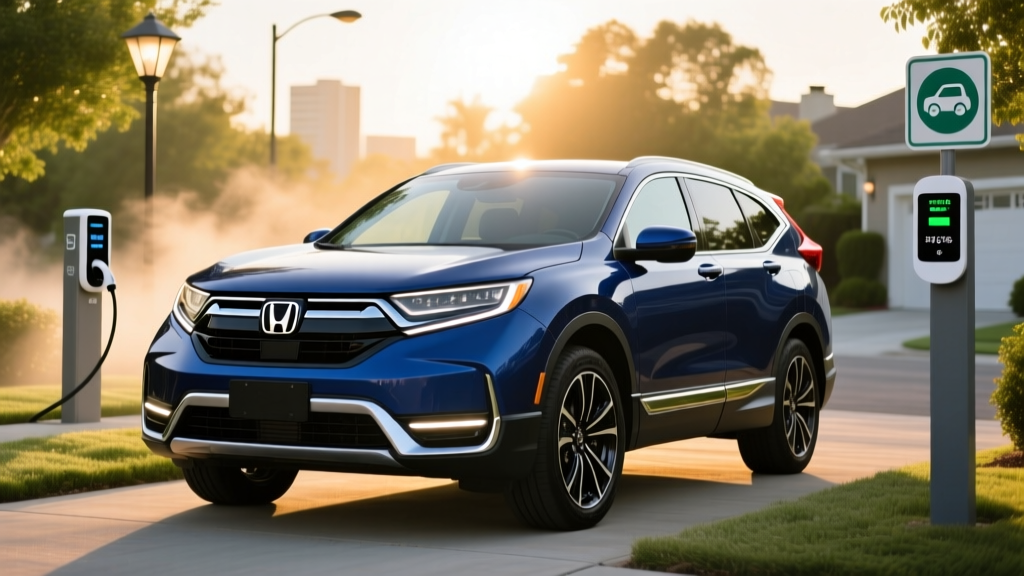
The 2026 Honda CR-V Hybrid occupies a specific niche: buyers who want electric-motor efficiency without plugging in, and who need more cargo room than a sedan but less complexity than a full EV. With an EPA-rated 40 MPG combined on front-wheel-drive trims, it competes directly with the Toyota RAV4 Hybrid and Hyundai Tucson Hybrid in one of the most competitive segments in the market. This review covers the exact numbers, real-world expectations, and ownership math you need before signing.
HEV vs PHEV: What Honda Actually Sells
First, a critical distinction. The 2026 CR-V Hybrid is a conventional hybrid electric vehicle (HEV). It uses a gasoline engine paired with electric motors to improve fuel economy, but you never plug it in. The battery recharges through regenerative braking and engine power.
Honda does not currently offer a CR-V plug-in hybrid (PHEV) in the United States. If you want a Honda PHEV with electric-only driving range, you would need to look at previous-generation models or other manufacturers. This article focuses entirely on the HEV powertrain that Honda sells new for 2026.
| Feature | CR-V Hybrid (HEV) | Typical PHEV (e.g., Tucson PHEV) |
|---|---|---|
| Plug-in Charging | No — refuels with gas only | Yes — plug in for electric-only miles |
| Electric-Only Range | None (EV assist only at low speeds) | 30–38 miles typical |
| Battery Size | ~1.3 kWh (small buffer) | 13–18 kWh usable |
| Federal Tax Credit (§30D) | Not eligible | Up to $7,500 if eligible |
| Home Charging Needed | No | Yes (Level 2 recommended) |
EPA Fuel Economy and Real-World MPG
The 2026 Honda CR-V Hybrid powertrain pairs a 2.0-liter Atkinson-cycle four-cylinder engine with a two-motor hybrid system. Here are the official EPA figures:
| Drivetrain | City | Highway | Combined |
|---|---|---|---|
| FWD (Sport, Sport Touring) | 43 MPG | 36 MPG | 40 MPG |
| AWD (Sport, Sport Touring) | 40 MPG | 34 MPG | 37 MPG |
Source: fueleconomy.gov
Real-World MPG: What to Expect
Hybrids typically exceed their EPA city rating in stop-and-go traffic, where regenerative braking recovers the most energy. On the highway, where the gasoline engine does most of the work, expect numbers closer to or slightly below the EPA highway figure.
- City/suburban driving: 42–48 MPG FWD is achievable in warm weather with moderate driving
- Highway (70–75 mph): 33–36 MPG, consistent with EPA estimates
- Cold weather (below 35°F): Expect a 5–12% drop due to engine running more for cabin heat and reduced battery efficiency
- Mountainous terrain: Highly variable; regenerative braking on descents can partially offset uphill consumption
Powertrain: 204 Horsepower, Two-Motor System
The 2026 CR-V Hybrid uses Honda's fourth-generation two-motor hybrid system, which operates primarily as a series hybrid at lower speeds (engine generates electricity, motor drives wheels) and switches to parallel operation at highway cruising.
| Engine | 2.0L Atkinson-cycle DOHC 4-cylinder |
| Engine Output | 145 hp @ 6,100 rpm / 134 lb-ft @ 4,500 rpm |
| Electric Motors | Two-motor hybrid system |
| Combined System Output | 204 hp / 247 lb-ft torque |
| Transmission | e-CVT (no traditional gears) |
| Drivetrain | FWD or Real Time AWD |
| 0–60 mph | ~7.6 seconds (estimated) |
| Towing Capacity | 1,000 lbs |
| Battery Type | Lithium-ion, ~1.3 kWh |
The 247 lb-ft of torque from the electric motors gives the CR-V Hybrid strong low-end acceleration that feels more responsive than its 204 hp figure suggests. However, at sustained highway speeds above 75 mph, the system relies more heavily on the 145-hp gasoline engine, which is adequate but not quick.
Pricing and Tax Credit Eligibility
The CR-V Hybrid is offered in two trims for 2026, both positioned above the base gasoline-only CR-V models:
| Trim | Drivetrain | MSRP (incl. destination) |
|---|---|---|
| Sport Hybrid | FWD | $36,395 |
| Sport Hybrid | AWD | $37,895 |
| Sport Touring Hybrid | AWD (standard) | $41,795 |
Federal Tax Credit: Not Eligible
Because the CR-V Hybrid is a conventional HEV — not a plug-in vehicle — it does not qualify for the federal §30D Clean Vehicle Credit. That credit, which offers up to $7,500 for qualifying new EVs and PHEVs, requires a minimum battery capacity of 7 kWh and plug-in charging capability. The CR-V Hybrid's ~1.3 kWh battery does not meet this threshold.
Some states offer separate incentives for conventional hybrids, but these are increasingly rare as incentive programs shift toward plug-in vehicles. Check your state's energy office or department of environmental quality for current programs.
Battery Warranty, Reliability, and Replacement Cost
Hybrid battery longevity is the top concern for buyers considering their first hybrid. Honda's warranty coverage and the track record of its hybrid systems provide strong reassurance.
Honda Hybrid Battery Warranty
- Coverage: 8 years / 100,000 miles (10 years / 150,000 miles in CARB states including CA, NY, MA, and others)
- What's covered: Hybrid battery pack, hybrid control unit, and related hybrid-system components
- Capacity threshold: Honda warrants against defects and abnormal degradation; no specific percentage retention guarantee like EVs
Long-Term Reliability Data
Honda's hybrid systems have proven durable in real-world use. The two-motor architecture is mechanically simpler than traditional transmissions — there are no gear sets or torque converters to wear. The hybrid battery is small (~1.3 kWh) and operates within a narrow state-of-charge window, which significantly reduces degradation compared to larger EV batteries that cycle through deep charge states.
Based on long-term ownership reports and fleet data, Honda hybrid battery packs routinely exceed 150,000 miles before needing replacement. Out-of-warranty replacement cost for the hybrid battery typically ranges from $2,000 to $4,000 depending on the source (dealer vs. independent hybrid specialist) and whether you choose a new, refurbished, or remanufactured unit.
Who Should Buy the CR-V Hybrid — and Who Shouldn't
Reasons to Choose It
- You drive 15,000+ miles/year and want to cut fuel costs without changing habits
- You can't install a home charger or lack reliable public charging access
- You want a compact SUV with class-leading cargo space (36.3 cu ft rear, 76.5 cu ft total)
- You prioritize proven reliability and strong resale value
- You want AWD availability without a fuel-economy penalty
Reasons to Look Elsewhere
- You want electric-only driving or plug-in capability (consider a PHEV or BEV)
- You want to qualify for the $7,500 federal tax credit (requires a qualifying PHEV or EV)
- You tow more than 1,000 lbs (the hybrid's towing limit is restrictive)
- You want third-row seating (CR-V is strictly a two-row SUV)
- You want a fully digital driver display or the latest infotainment (Honda's system is functional but not class-leading)
CR-V Hybrid vs Full EV vs Gas: Decision Framework
Choose the CR-V Hybrid if: You want 37–40 MPG, can't charge at home, and need a practical compact SUV without range anxiety. Total fuel cost at 15,000 miles/year and $3.50/gallon gas: approximately $1,310–$1,420 annually.
Choose a PHEV (like the Toyota RAV4 Prime) if: You can charge at home, want 35–42 miles of electric-only commuting, and still want gas-engine range for road trips. Higher upfront cost but potential $7,500 tax credit.
Choose a full EV (like the Hyundai Ioniq 5) if: You can charge at home, drive under 250 miles daily, want zero tailpipe emissions, and want to access the full $7,500 federal credit. Annual fuel (electricity) cost: $500–$800 depending on rates.
Driving Impressions and Daily Usability
The 2026 CR-V Hybrid drives like a well-tuned compact SUV with a torque advantage. Off the line, the electric motors provide immediate thrust that makes merging and city driving feel effortless. The e-CVT operates smoothly without the rubber-band effect that plagued earlier generations. Road noise is moderate — improved over the previous generation but still noticeable on coarse highway pavement.
The Sport Touring Hybrid trim adds leather seats, a Bose 12-speaker audio system, wireless Apple CarPlay/Android Auto, a heated steering wheel, and Honda's full suite of Honda Sensing driver-assistive features including adaptive cruise control, lane-keeping assist, and blind-spot monitoring.
Cargo space remains generous at 36.3 cubic feet behind the rear seats and 76.5 cubic feet with the rear seats folded — competitive with the RAV4 Hybrid and slightly larger than the Tucson Hybrid.
Ownership Costs: 5-Year Fuel Savings vs Gas CR-V
| Model | Combined MPG | Annual Fuel Cost | 5-Year Fuel Cost |
|---|---|---|---|
| CR-V Hybrid (FWD) | 40 MPG | $1,313 | $6,563 |
| CR-V Hybrid (AWD) | 37 MPG | $1,419 | $7,095 |
| CR-V Gas (FWD, 28 combined) | 28 MPG | $1,875 | $9,375 |
| CR-V Gas (AWD, 26 combined) | 26 MPG | $2,019 | $10,096 |
The Hybrid FWD saves approximately $2,812 over 5 years compared to the gas FWD model. The Hybrid AWD saves approximately $3,001 versus the gas AWD. Given the roughly $1,700–$2,500 price premium for the Hybrid powertrain over comparable gas trims, the payback period is approximately 3–4 years at current fuel prices — faster if gas prices rise.
Frequently Asked Questions
How many MPG does the Honda CR-V Hybrid get?
The 2026 CR-V Hybrid gets 43 city / 36 highway / 40 combined MPG with FWD, and 40 city / 34 highway / 37 combined MPG with AWD, per the EPA. Real-world city driving often exceeds the EPA figure, while highway driving tends to match or fall slightly below.
Does the CR-V Hybrid need to be plugged in?
No. The CR-V Hybrid is a conventional HEV that charges its small battery through regenerative braking and the gasoline engine. You refuel it exclusively at gas stations.
Is the Honda CR-V Hybrid reliable?
Honda's hybrid systems have a strong long-term reliability record. The two-motor design has fewer moving parts than a traditional automatic transmission, and the small hybrid battery operates within a narrow charge window that minimizes degradation. Honda covers the hybrid battery for 8 years/100,000 miles (10/150,000 in CARB states).
How much does a CR-V Hybrid battery replacement cost?
Out-of-warranty hybrid battery replacement typically costs $2,000–$4,000 depending on whether you use a dealer (new OEM) or an independent hybrid specialist (remanufactured). Most Honda hybrid batteries last well beyond 150,000 miles before requiring replacement.
Does the Honda CR-V Hybrid qualify for any tax credit?
No. The federal §30D Clean Vehicle Credit requires plug-in capability and a minimum 7 kWh battery. The CR-V Hybrid is a conventional HEV with a ~1.3 kWh battery and no plug-in port, so it does not qualify for the federal credit or most state EV incentives.
Hybrid vs PHEV vs EV — which is right for me?
Choose the CR-V Hybrid if you can't charge at home and want maximum simplicity. Choose a PHEV if you can charge at home and want 30–40 miles of electric-only commuting with gas backup for road trips. Choose a full EV if you can charge at home, drive under 250 miles daily, and want the lowest operating costs plus federal tax credits.
Can the CR-V Hybrid tow?
Yes, but the maximum towing capacity is 1,000 pounds — enough for a small utility trailer or a pair of dirt bikes, but not a camping trailer or boat. If you need to tow more, consider the gas-only CR-V (1,500 lbs) or a larger SUV.