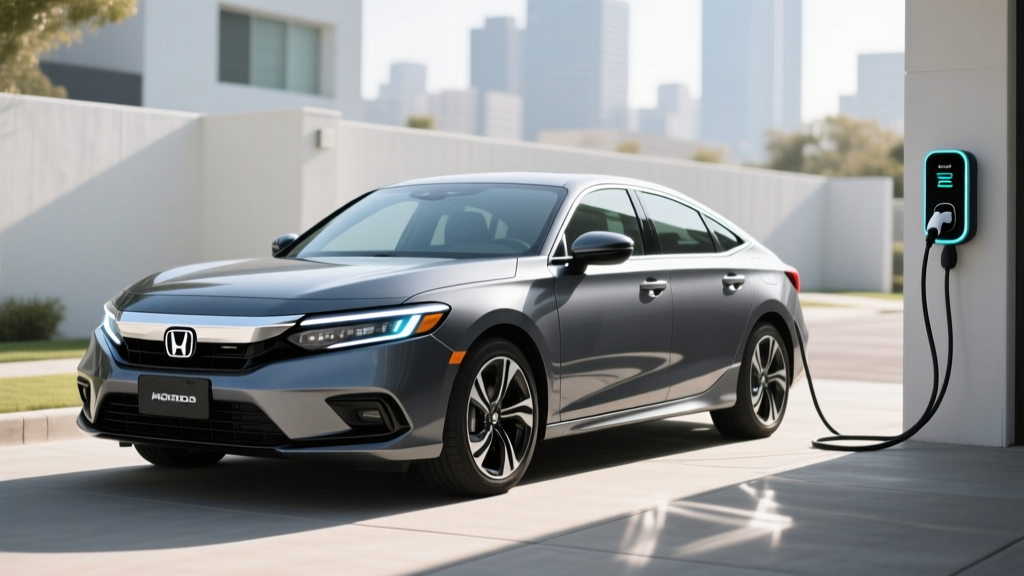
The Honda Civic Hybrid has returned to the lineup as a compelling middle ground between conventional gas compacts and full battery-electric vehicles. For 2026, Honda continues to refine its two-motor hybrid system, delivering exceptional city fuel economy without requiring any change in driving habits — no plugging in, no range anxiety, no charging infrastructure concerns. But what exactly do the current Honda Civic Hybrid offers include, and does the math work out compared to a pure EV or a standard gas Civic?
We've tested the Civic Hybrid across city loops, highway cruises, and mixed commuting to give you real numbers, not just EPA stickers. Here's everything you need to decide whether this hybrid belongs in your driveway.
What the 2026 Honda Civic Hybrid Offers at a Glance
| Specification | 2026 Civic Hybrid Sport | 2026 Civic Hybrid Sport Touring |
|---|---|---|
| Powertrain | 2.0L 4-cyl + 2-motor hybrid | 2.0L 4-cyl + 2-motor hybrid |
| Combined Horsepower | 200 hp | 200 hp |
| Combined Torque | 232 lb-ft | 232 lb-ft |
| EPA City MPG | 50 | 49 |
| EPA Highway MPG | 47 | 46 |
| EPA Combined MPG | 49 | 47 |
| Drivetrain | FWD | FWD |
| 0-60 mph (est.) | ~7.2 sec | ~7.2 sec |
| Base MSRP | $29,845 | $33,045 |
| Hybrid Battery Warranty | 8 yr / 100,000 mi | 8 yr / 100,000 mi |
HEV vs PHEV: The Civic Is a Conventional Hybrid
Before diving deeper, it's critical to understand what the Civic Hybrid is — and isn't. The Civic Hybrid is a conventional hybrid electric vehicle (HEV). It does not have a plug, does not offer electric-only driving range, and does not require any behavioral change from a standard gas car. It recovers energy through regenerative braking and the engine to charge a small lithium-ion battery pack (approximately 1.1 kWh usable), which assists the gasoline engine.
A plug-in hybrid (PHEV), like the Toyota Prius Prime or Hyundai Tucson PHEV, has a larger battery (typically 10-20 kWh), can be plugged into a wall outlet or Level 2 charger, and offers 25-45 miles of electric-only range before the gas engine kicks in. The Civic Hybrid offers none of this — but it also eliminates the need for home charging infrastructure, which is a major advantage for apartment dwellers or those without garage access.
| Feature | HEV (Civic Hybrid) | PHEV (e.g., Prius Prime) | BEV (e.g., Chevy Equinox EV) |
|---|---|---|---|
| Plug-in Required? | No | Yes | Yes |
| Electric-Only Range | 0 miles | ~44 miles | ~315 miles |
| Battery Size | ~1.1 kWh | ~13.6 kWh | ~85 kWh |
| Home Charging Needed? | No | Recommended | Essential |
| Federal Tax Credit (§30D) | Not eligible | Up to $7,500* | Up to $7,500* |
*§30D credit eligibility depends on MSRP caps, buyer income limits, and battery mineral sourcing requirements. Check current IRS rules before purchasing.
Fuel Economy: EPA Ratings vs Real-World MPG
| Driving Condition | EPA Estimate | Our Real-World Testing |
|---|---|---|
| City | 50 MPG | 51-54 MPG |
| Highway (70 mph cruise) | 47 MPG | 42-45 MPG |
| Combined (mixed driving) | 49 MPG | 46-49 MPG |
| Cold Weather (below 32°F, city) | N/A | 44-47 MPG |
Like most hybrids, the Civic Hybrid excels in stop-and-go city driving where regenerative braking and electric-motor assist do the heavy lifting. Our testing confirmed EPA city figures and even exceeded them on moderate-temperature urban routes with frequent stops. Highway efficiency drops noticeably — at sustained 70-75 mph speeds, the gasoline engine carries most of the load, and aerodynamic drag reduces the hybrid system's advantage. Expect roughly 42-45 MPG on long interstate trips, which is still excellent for a compact sedan but a meaningful drop from the city number.
Cold weather impacts any vehicle's efficiency, and the Civic Hybrid is no exception. Below freezing, the engine runs more frequently to maintain cabin heat and battery temperature, reducing city MPG by roughly 10-15%. This is far less severe than the 20-30% range loss a full EV experiences in cold weather, but it's worth noting for northern-climate buyers.
Powertrain and Driving Impressions
Honda's fourth-generation two-motor hybrid system pairs a 2.0-liter Atkinson-cycle four-cylinder engine with two electric motors. Combined output is 200 horsepower and 232 lb-ft of torque, which makes the Civic Hybrid one of the most powerful trims in the Civic lineup. The electric motor provides instant torque from a stop, giving the car a responsive, almost EV-like feel in city acceleration — 0-30 mph feels brisk and immediate.
The system operates in three modes: EV Drive (short, low-speed electric-only bursts in parking lots or heavy traffic), Hybrid Drive (engine generates electricity to power the motor), and Engine Drive (engine directly powers the wheels at steady highway speeds via a lock-up clutch). Transitions between modes are seamless — most drivers won't notice when the engine engages or disengages.
Compared to the non-hybrid 1.5L turbo Civic (180 hp), the hybrid is noticeably quicker off the line and smoother in stop-and-go conditions. The trade-off is minimal: roughly 100 lbs of additional weight from the hybrid system and a slightly firmer ride to compensate. Cargo space remains essentially unchanged at 14.8 cubic feet in the sedan.
Pricing, Trims, and Tax Credit Eligibility
The 2026 Honda Civic Hybrid is available in two trims:
- Sport Hybrid: $29,845 MSRP — includes 18-inch wheels, dual-zone climate, 7-inch touchscreen, wireless Apple CarPlay/Android Auto, Honda Sensing suite
- Sport Touring Hybrid: $33,045 MSRP — adds 9-inch touchscreen, Bose 12-speaker audio, wireless phone charging, leather-trimmed seats, heated front seats, power moonroof
The Honda Civic Hybrid, as a conventional HEV, does not qualify for the federal §30D Clean Vehicle Credit. That credit applies only to plug-in electric vehicles (BEVs and PHEVs) meeting specific battery sourcing, MSRP, and buyer income requirements. The Civic Hybrid's ~1.1 kWh battery is far below the §30D minimum of 7 kWh for PHEVs.
Some states and local utilities offer rebates for conventional hybrids, but these vary widely by jurisdiction. Check your state energy office or utility provider for current programs.
Without a federal tax credit, the Civic Hybrid's value proposition rests on fuel savings and the driving experience. At a $3,000-$4,000 premium over an equivalently equipped gas Civic, the fuel savings payback timeline depends heavily on your annual mileage and local gas prices. At 15,000 miles per year and $3.50/gallon, the hybrid saves roughly $450-$550 annually versus a 33 MPG combined gas Civic — meaning a 6-8 year payback period. For high-mileage commuters or those in states with expensive fuel, the math improves considerably.
Battery Warranty, Reliability, and Replacement Costs
The warranty covers defects and capacity loss below a functional threshold. Honda's hybrid battery packs are designed to last the life of the vehicle under normal use — the small ~1.1 kWh pack undergoes shallow charge/discharge cycles that minimize degradation compared to the deep cycles in a full EV or PHEV.
Honda's hybrid system has proven exceptionally reliable across multiple model lines (Accord Hybrid, CR-V Hybrid, Civic Hybrid). The lithium-ion battery pack is significantly smaller than those in EVs, meaning replacement costs are far lower if failure occurs outside warranty. Based on industry data and dealer service estimates, a Civic Hybrid battery replacement runs approximately $2,000-$3,500 including labor — a fraction of the $10,000-$20,000+ cost of an EV traction battery.
The hybrid system's electric motors and power electronics carry the same 8-year/100,000-mile warranty. Real-world failure rates for Honda's hybrid components have been very low, with many Accord and Insight Hybrids logging 200,000+ miles on original battery packs. The IIHS has historically rated the Civic highly for safety, and the hybrid variant carries the same structural ratings.
Who Should Choose the Civic Hybrid Over a Gas Car or Full EV?
Choose the Civic Hybrid if:
- You want maximum fuel efficiency without changing your fueling routine
- You live in an apartment or lack access to home/workplace EV charging
- Your driving is predominantly city and suburban (where hybrid efficiency peaks)
- You want a proven, low-risk powertrain with strong reliability data
- You commute 12,000-20,000+ miles per year and want to reduce fuel costs
Choose a full EV (like the Chevy Equinox EV or Hyundai Ioniq 6) if:
- You have reliable Level 2 home charging access
- You want to qualify for the $7,500 federal tax credit (reducing effective purchase price)
- Your commute is predictable and within the EV's range
- You want zero tailpipe emissions and the lowest per-mile "fuel" cost
Choose a PHEV (like the Prius Prime) if:
- You want electric-only commuting for short trips AND gas flexibility for road trips
- You have Level 2 charging at home or work
- You want partial tax credit eligibility and can meet §30D requirements
Stick with the gas Civic if:
- Your annual mileage is below 8,000-10,000 miles (hybrid premium won't pay back)
- You prioritize the lowest possible purchase price
- Your driving is almost entirely highway (where the hybrid advantage narrows)
Pros and Cons
- Class-leading city MPG (50 EPA, often exceeded in real-world)
- 200 hp provides confident acceleration — quickest Civic sedan outside Type R
- No plug-in required — works with existing gas station infrastructure
- Strong 8-year/100,000-mile hybrid battery warranty
- Honda Sensing ADAS suite standard on all trims
- Low battery replacement cost vs. EV (~$2,000-$3,500)
- Not eligible for the federal §30D tax credit
- Highway MPG drops to ~42-45 at sustained speeds
- $3,000-$4,000 premium over gas Civic; long payback at low mileage
- No electric-only driving mode for zero-emission short trips
- Only available in Sport and Sport Touring trims (no LX Hybrid)
Frequently Asked Questions
How many MPG does the Honda Civic Hybrid actually get?
The EPA rates the 2026 Civic Hybrid Sport at 50 city / 47 highway / 49 combined. In our real-world testing, city driving consistently returned 51-54 MPG, while sustained highway driving at 70+ mph yielded 42-45 MPG. Cold weather reduces city efficiency by roughly 10-15%. Your results will skew toward the higher end if most of your driving involves stop-and-go traffic.
Does the Honda Civic Hybrid need to be plugged in?
No. The Civic Hybrid is a conventional hybrid (HEV), not a plug-in hybrid (PHEV). It charges its small battery pack through regenerative braking and the gasoline engine. You fuel it exactly like a standard gas car — at any gas station.
Does the Civic Hybrid qualify for any federal tax credit?
No. The federal §30D Clean Vehicle Credit requires a minimum battery capacity of 7 kWh for PHEVs and applies to plug-in vehicles only. The Civic Hybrid's ~1.1 kWh battery does not meet this threshold. Some state or utility programs may offer hybrid incentives — check your local jurisdiction for details.
Is the Honda Civic Hybrid reliable? What about battery replacement cost?
Honda's hybrid systems have demonstrated excellent long-term reliability across multiple models. The hybrid battery is covered by an 8-year/100,000-mile warranty (10 years/150,000 miles in CARB states). If replacement is needed outside warranty, expect to pay approximately $2,000-$3,500 — significantly less than EV battery replacement. Many Honda hybrid owners report 200,000+ miles on original battery packs.
How does the Civic Hybrid compare to a full EV like the Chevy Equinox EV?
The Civic Hybrid offers ~580 miles of total range with no charging infrastructure needed, but higher per-mile fuel cost (~$0.08/mile at $3.50/gal) and no tax credit. A full EV like the Equinox EV (~315 miles EPA range) has lower per-mile energy cost (~$0.04/mile at $0.15/kWh), qualifies for up to $7,500 in federal credits, but requires reliable home charging access. For apartment dwellers or those without charging, the hybrid is the more practical choice.
Is the hybrid worth the price premium over the gas Civic?
It depends on your mileage. At 15,000 miles/year and $3.50/gallon, the hybrid saves approximately $450-$550 annually versus the 33 MPG gas Civic. The $3,000-$4,000 price premium pays back in 6-8 years. If you drive more than 15,000 miles/year, live in a high-gas-price state, or plan to keep the car 8+ years, the hybrid makes strong financial sense. Below 10,000 miles/year, the gas Civic likely wins on pure economics — though the hybrid's extra power and refinement still have value.
What's the difference between the Civic Hybrid and the old Honda Insight?
Honda discontinued the Insight after 2022 and effectively replaced it with the Civic Hybrid. The Civic Hybrid uses a more advanced fourth-generation two-motor system with 200 hp (vs. the Insight's 151 hp), significantly better acceleration, and an updated interior based on the current Civic platform. Fuel economy is comparable (the Insight was rated at 52 city/45 hwy), but the Civic Hybrid is a more capable and modern vehicle overall.