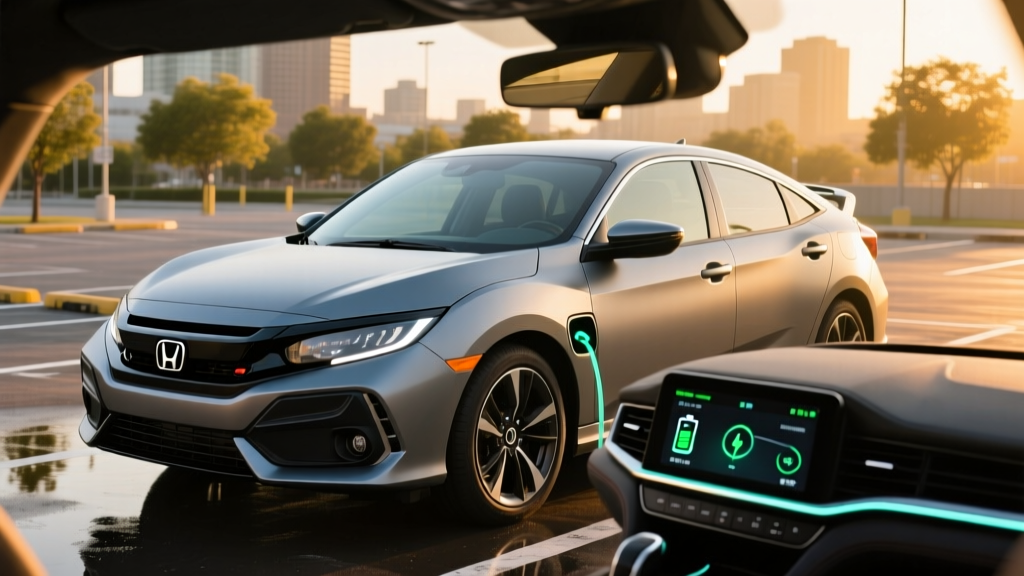
The Honda Civic Hatchback Hybrid pairs one of the most engaging compact platforms in its class with a two-motor hybrid system that delivers up to 50 MPG combined. For buyers searching for a hybrid Honda hatchback that avoids the compromises of early-generation hybrids — sluggish acceleration, numb steering, polarizing styling — the Civic Hybrid Hatchback makes a strong case for itself. This review breaks down the exact powertrain specs, real-world fuel economy, battery warranty coverage, and ownership economics you need to make an informed decision.
2026 Honda Civic Hybrid Hatchback — Key Specifications
| Spec | Value |
|---|---|
| Powertrain | 2.0L 4-cyl Atkinson-cycle + 2 electric motors (e:HEV) |
| Combined Horsepower | 200 hp |
| Combined Torque | 232 lb-ft |
| EPA MPG (City / Hwy / Combined) | 50 / 47 / 49 (Sport Touring); 50/47/49 estimated (Sport) |
| Drivetrain | FWD |
| Transmission | e-CVT (direct-drive with engine clutch) |
| Battery Type | Lithium-ion (approximately 1.0 kWh, HEV) |
| 0–60 mph | ~7.1 seconds (est.) |
| Cargo Volume | 24.5 cu ft (rear seats up) |
| Starting MSRP | ~$30,550 (Sport Hybrid); ~$33,550 (Sport Touring Hybrid) |
| Hybrid Battery Warranty | 8 years / 100,000 miles |
HEV vs PHEV: Understanding the Civic Hybrid Hatchback
Before getting into the numbers, it's essential to clarify what the Civic Hybrid Hatchback is — and what it is not. Honda offers the Civic Hatchback Hybrid as a conventional hybrid electric vehicle (HEV), not a plug-in hybrid (PHEV). That distinction carries real-world implications:
HEV vs PHEV — What's the Difference?
| Feature | HEV (Civic Hybrid Hatchback) | PHEV (e.g., Toyota Prius Prime) |
|---|---|---|
| Plug-in Charging | No — charges via regenerative braking and engine | Yes — plugs into Level 1 or Level 2 |
| Electric-Only Range | ~1 mile at low speed | 25–45 miles typical |
| Battery Size | ~1.0 kWh | 13–18 kWh typical |
| Federal Tax Credit (§30D) | Not eligible | Up to $7,500 if requirements met |
| Gas Engine Always Available | Yes | Yes |
| Best For | No home charging access, want simplicity | Short commutes, home charging available |
The Civic Hybrid Hatchback does not plug in. You fuel it with gasoline and drive it exactly like a conventional car — the hybrid system operates transparently in the background, recapturing braking energy and using electric motors to assist or briefly replace the gasoline engine. There is no charging cord, no plug, and no electric-only commuting range to manage.
Fuel Economy: EPA Ratings and Real-World MPG
Fuel efficiency is the headline reason buyers seek out a hybrid Honda hatchback, and the Civic Hybrid delivers. Here is the official EPA breakdown per fueleconomy.gov:
EPA Fuel Economy — 2026 Civic Hybrid Hatchback
| Trim | City MPG | Highway MPG | Combined MPG |
|---|---|---|---|
| Sport Hybrid | 50 | 47 | 49 |
| Sport Touring Hybrid | 50 | 47 | 49 |
Real-World MPG: What to Actually Expect
EPA numbers are measured under controlled conditions. In real-world driving, Honda's two-motor hybrid system behaves in ways that often surprise first-time hybrid owners:
- City driving: Expect to meet or slightly exceed the 50 MPG city rating. Hybrid systems shine in stop-and-go traffic where regenerative braking recaptures energy frequently and the engine shuts off at stops. Many owners report 51–54 MPG in urban conditions.
- Highway driving: Expect 43–46 MPG at sustained 70–80 mph speeds. Hybrids are less efficient on the highway because there's less braking to recapture energy and aerodynamic drag increases with the hatchback body style. This is normal for all hybrids.
- Cold weather: In sub-40°F temperatures, expect a 5–12% reduction in fuel economy. The engine runs more frequently to generate cabin heat and the battery operates less efficiently when cold.
- Combined real-world: For mixed driving (60% city / 40% highway), plan on 46–50 MPG as a realistic annual average.
At 49 MPG combined and a national average of $3.30 per gallon (regular unleaded), the Civic Hybrid Hatchback costs roughly $0.067 per mile in fuel. Compare that to a 30 MPG conventional compact at $0.11 per mile — a savings of approximately $430 per year at 10,000 miles driven, or $2,150 over five years.
Powertrain and Performance: More Than Just Efficiency
Honda's e:HEV two-motor hybrid system is one of the more sophisticated setups in the compact class. Here's how it works:
The 2.0-liter Atkinson-cycle four-cylinder engine primarily functions as a generator, producing electricity that feeds the drive motor. In most driving conditions — city, suburban, and moderate highway — the car is effectively driven by its electric motor, with the gasoline engine spinning at its most efficient RPM to generate current. This is why the Civic Hybrid feels responsive and smooth: you're getting electric-motor torque delivery (instant, linear) without needing to plug in.
At sustained highway speeds, a lock-up clutch mechanically connects the engine directly to the wheels, bypassing the generator step for maximum efficiency. This transition is seamless and imperceptible to the driver.
The combined output of 200 hp and 232 lb-ft of torque gives the Civic Hybrid Hatchback genuine passing power. The 0–60 mph time of approximately 7.1 seconds places it well ahead of most non-turbo compact hatchbacks and makes highway merging effortless. The electric motor's 232 lb-ft of torque is available from near zero RPM, which means the car feels quicker than the horsepower figure alone suggests.
Battery Warranty, Reliability, and Replacement Cost
Hybrid Battery Coverage
Warranty: 8 years or 100,000 miles (whichever comes first), covering defects and capacity loss below functional thresholds. In California Air Resources Board (CARB) states, the warranty extends to 10 years / 150,000 miles.
Expected Lifespan: Honda's lithium-ion hybrid battery pack is designed to last the life of the vehicle under normal use. Real-world data from Honda's hybrid lineup (Insight, Accord Hybrid, CR-V Hybrid) shows most packs retain adequate capacity well beyond 150,000 miles.
Is the Civic Hybrid Hatchback Reliable?
Honda's two-motor hybrid system has been in production since 2014 (Accord Hybrid) and has undergone multiple generations of refinement. The e:HEV system in the current Civic is the latest iteration. Key reliability factors:
- No plug-in complexity: Unlike PHEVs, there is no onboard charger, no charging port, and no large high-voltage battery to manage thermally. Fewer components means fewer failure points.
- Small battery, gentle cycling: The ~1.0 kWh battery operates within a narrow state-of-charge window (typically 40–60%), which dramatically reduces degradation compared to full EVs that cycle between 10–90%.
- Proven track record: Honda hybrids from the 2017+ generation (two-motor system) have shown very low battery failure rates in long-term fleet data.
Battery Replacement Cost
If the hybrid battery does require replacement outside of warranty, expect a cost in the range of $2,000–$4,000 including parts and labor at a Honda dealer. This is significantly less than a full EV battery replacement ($10,000–$20,000+) because the Civic Hybrid's battery pack is small. Independent hybrid specialists often offer refurbished packs for $1,500–$2,500. Given the warranty coverage and expected lifespan, most owners will never face this cost.
Pricing, Trims, and Tax Credit Eligibility
The 2026 Honda Civic Hybrid Hatchback is offered in two trims:
| Trim | MSRP (est.) | Key Features |
|---|---|---|
| Sport Hybrid | ~$30,550 | 18" wheels, 7" touchscreen, wireless CarPlay/Android Auto, Honda Sensing ADAS suite, cloth/leatherette seats |
| Sport Touring Hybrid | ~$33,550 | All Sport features + 9" touchscreen, Bose 12-speaker audio, leather seats, heated rear seats, wireless charging, navigation |
Does the Civic Hybrid Qualify for a Federal Tax Credit?
No. The federal §30D Clean Vehicle Credit applies only to plug-in electric vehicles (BEVs and PHEVs) with a battery capacity of at least 7 kWh, per IRS guidelines. Because the Civic Hybrid Hatchback is a conventional HEV with a ~1.0 kWh battery and no plug-in capability, it does not qualify for the federal EV tax credit.
Some states offer rebates or incentives for conventional hybrids, but these vary by jurisdiction and are typically modest ($250–$500). Check your state's energy or environmental agency website for current programs.
Despite the lack of a tax credit, the Civic Hybrid's fuel savings over five years (~$2,150 at current gas prices) effectively offset a meaningful portion of the hybrid premium over a gas-only Civic Hatchback.
Who Should Choose the Civic Hybrid Hatchback?
Decision Framework: Is This Hybrid Right for You?
Choose the Civic Hybrid Hatchback if:
- You want maximum fuel economy without changing your fueling habits (no plug required)
- You lack access to home or workplace Level 2 charging
- Your commute is long or unpredictable (40+ miles daily, or frequent road trips)
- You want hatchback cargo versatility (24.5 cu ft) with compact-car maneuverability
- You value a responsive, engaging driving experience alongside efficiency
Consider a PHEV instead if:
- You have home Level 2 charging and a commute under 30 miles round-trip
- You want electric-only driving for daily errands with gas backup for road trips
- You want eligibility for the federal §30D tax credit (up to $7,500)
Consider a full BEV instead if:
- You have reliable home charging and want zero tailpipe emissions
- Your daily driving is under 250 miles and you want the lowest per-mile energy cost
- You want to eliminate gasoline purchases and oil changes entirely
Pros
- 50 MPG city — among the best in the compact hatchback class
- 200 hp / 232 lb-ft — genuinely quick for a hybrid
- No plug-in required — fuel and go like any gas car
- Responsive electric-motor-driven feel in city driving
- Hatchback utility: 24.5 cu ft cargo, fold-flat rear seats
- Strong 8-year/100,000-mile hybrid battery warranty
- Honda Sensing ADAS suite standard on all trims
Cons
- Highway MPG drops to ~43–46 real-world at 75+ mph
- No federal tax credit eligibility (HEV, not PHEV)
- FWD only — no AWD option (unlike some competitors)
- Hybrid premium of ~$1,500–$2,000 over gas-only Civic Hatchback
- Cabin noise under hard acceleration (engine drone at high RPM)
Frequently Asked Questions
How many MPG does the Honda Civic Hybrid Hatchback get?
The EPA rates the Civic Hybrid Hatchback at 50 MPG city, 47 MPG highway, and 49 MPG combined for both Sport Hybrid and Sport Touring Hybrid trims. Real-world city driving often yields 51–54 MPG, while sustained highway driving at 70–80 mph typically returns 43–46 MPG. Cold weather reduces these figures by 5–12%.
Does the Honda Civic Hybrid Hatchback plug in?
No. The Civic Hybrid Hatchback is a conventional hybrid (HEV), not a plug-in hybrid (PHEV). It charges its small lithium-ion battery through regenerative braking and the gasoline engine. You never plug it in — just fill it with regular unleaded gasoline and drive.
How far can the Civic Hybrid go on electric power alone?
Approximately 1 mile at very low speeds (under 25 mph) in EV mode. This is not a meaningful electric-only range — the system is designed for electric assist and engine-off coasting, not electric commuting. If you need 25+ miles of electric-only range, you need a PHEV or a full BEV.
Is the Honda Civic Hybrid reliable long-term?
Yes. Honda's two-motor e:HEV hybrid system has been in production since 2014 and has demonstrated strong reliability across the Accord Hybrid, CR-V Hybrid, and Insight lineups. The hybrid battery is warranted for 8 years/100,000 miles (10 years/150,000 miles in CARB states), and real-world data shows most packs last well beyond 150,000 miles without issue. The small battery size and narrow state-of-charge cycling window contribute to longevity.
What does it cost to replace the Civic Hybrid battery?
Out-of-warranty replacement at a Honda dealer typically costs $2,000–$4,000 including parts and labor. Refurbished packs from independent hybrid specialists run $1,500–$2,500. This is a fraction of full EV battery replacement costs, and most owners will never need a replacement given the warranty and expected lifespan.
Does the Civic Hybrid Hatchback qualify for any tax credit?
It does not qualify for the federal §30D Clean Vehicle Credit, which requires plug-in capability and a minimum 7 kWh battery. Some states may offer small rebates ($250–$500) for conventional hybrids — check your state's environmental or energy agency for current programs. The fuel savings (~$430/year over a 30 MPG gas car) provide the primary financial benefit.
How does the Civic Hybrid compare to the Toyota Prius?
The Toyota Prius achieves up to 57 MPG combined (FWD LE trim), which is 8 MPG higher than the Civic Hybrid. However, the Prius is a liftback, not a traditional hatchback, and the Civic Hybrid offers 200 hp vs the Prius's 194 hp (AWD) or 196 hp (FWD), a more conventional driving position, and a more engaging chassis. The Prius also offers a PHEV variant (Prius Prime) with 44 miles of electric-only range and potential §30D tax credit eligibility — something Honda does not offer in the Civic lineup.
Is AWD available on the Civic Hybrid Hatchback?
No. The 2026 Civic Hybrid Hatchback is front-wheel drive only. If all-wheel drive is a priority in a hybrid compact, the Toyota Prius AWD (54 MPG combined) is the closest alternative.
The Honda Civic Hybrid Hatchback occupies a specific and appealing position: it delivers near-Prius efficiency in a package that drives like a conventional Civic — responsive, practical, and engaging. For buyers who want hybrid fuel savings without the complexity of plug-in charging, it's one of the strongest options in the compact segment.