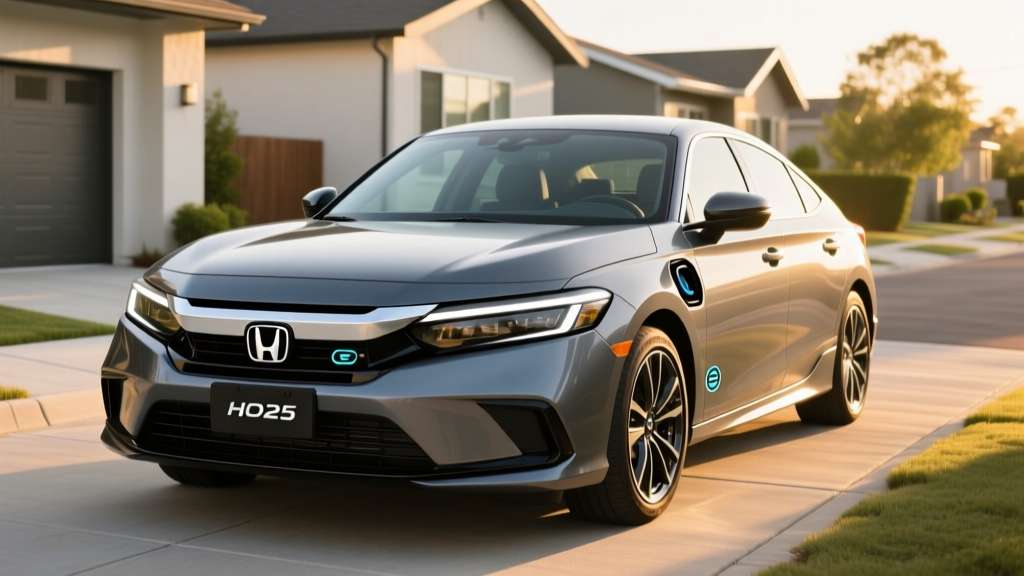
The 2025 Honda Civic Hybrid arrives at a moment when buyers are recalibrating their expectations around electrification. Full EVs still carry upfront cost premiums and charging-infrastructure questions, while conventional gas cars leave money on the table at every fill-up. The Civic Hybrid splits the difference: a conventional hybrid electric vehicle (HEV) that requires no plug, delivers 49 MPG combined, and costs roughly the same as a well-equipped gas Civic. For 2025, Honda pairs its two-motor hybrid system with a 2.0-liter direct-injected Atkinson-cycle engine to produce 200 horsepower — making this one of the most efficient and peppy compact sedans on the market.
This guide covers everything a buyer needs: EPA fuel economy versus real-world results, powertrain architecture, trim pricing, battery warranty specifics, and how the Civic Hybrid stacks up against plug-in hybrids and full EVs.
HEV vs. PHEV: What the 2025 Civic Hybrid Actually Is
A common source of confusion in the hybrid market is the difference between a conventional hybrid (HEV) and a plug-in hybrid (PHEV). The 2025 Civic Hybrid is an HEV — it cannot be plugged in, has no meaningful electric-only range, and charges its small battery exclusively through regenerative braking and the gasoline engine.
HEV vs. PHEV — Key Differences
| Feature | HEV (Civic Hybrid) | PHEV (e.g., Toyota Prius Prime) |
|---|---|---|
| Plug-in charging | No | Yes (Level 1/2) |
| Electric-only range | ~1 mi (low-speed assist) | 25–44 mi typical |
| Battery size | ~1.0 kWh (lithium-ion) | 10–14 kWh |
| Federal tax credit (§30D) | Not eligible | Up to $7,500 (if eligible) |
| Charging infrastructure needed | None | Home Level 2 recommended |
If you have reliable home charging and a short commute, a PHEV can eliminate most gasoline use on weekdays. If you live in an apartment, street-park, or simply want zero behavioral change from a gas car, the Civic Hybrid's HEV system is the lower-friction choice — you just drive and let the system manage energy recovery.
Fuel Economy: EPA Ratings and Real-World MPG
The 2025 Honda Civic Hybrid is rated by the EPA at 50 MPG city / 47 MPG highway / 49 MPG combined for the Sport sedan trim. The Sport Touring trim carries identical ratings. These figures place the Civic Hybrid among the most efficient non-plug-in vehicles sold in the U.S., trailing only the Toyota Prius (57 MPG combined on the LE trim) in the compact segment.
| Trim | City MPG | Highway MPG | Combined MPG |
|---|---|---|---|
| Civic Hybrid Sport Sedan | 50 | 47 | 49 |
| Civic Hybrid Sport Touring Sedan | 50 | 47 | 49 |
Source: EPA Fuel Economy
Real-World MPG vs. EPA Sticker
Honda's two-motor hybrid system excels in stop-and-go city driving, where regenerative braking recovers energy continuously. In real-world city and suburban driving, many owners report 51–54 MPG — slightly exceeding the EPA city rating. Highway driving at sustained 75+ MPH tends to yield 43–46 MPG, below the EPA highway figure, because the gasoline engine bears more load without regenerative assist. In cold weather (below 30°F), expect a 5–10% reduction due to cabin heating demands and reduced battery efficiency, bringing combined figures to roughly 44–47 MPG.
For context, the non-hybrid 2025 Civic with the 2.0L engine and CVT is rated at 31/40/34 MPG (city/highway/combined). The hybrid premium over the gas model is substantial — roughly 15 MPG combined — which translates to meaningful annual fuel savings.
Powertrain Architecture: 200 HP from a Two-Motor System
The 2025 Civic Hybrid uses Honda's fourth-generation two-motor hybrid system. Here's how the components break down:
| Specification | Detail |
|---|---|
| Engine | 2.0L DOHC 16-valve direct-injection Atkinson-cycle 4-cylinder |
| Engine output | 143 hp @ 6,000 rpm / 134 lb-ft torque |
| Electric motors | Two-motor system (propulsion + generator) |
| Combined system output | 200 hp / 232 lb-ft torque |
| Transmission | e-CVT (no traditional gearbox — motor-driven with engine clutch for highway cruise) |
| Battery | ~1.0 kWh lithium-ion (under rear seats) |
| Drivetrain | Front-wheel drive |
| 0–60 mph | ~7.0 seconds (est.) |
The system operates primarily in electric-drive mode at low and moderate speeds, with the gasoline engine acting as a generator to feed the propulsion motor. At highway cruising speeds, a lock-up clutch mechanically connects the engine to the drive wheels for efficiency. This architecture eliminates the "rubber-band" feel of older CVTs and delivers torque immediately off the line — the 232 lb-ft of system torque is available essentially from zero RPM, which makes the Civic Hybrid feel quicker in city traffic than its 0–60 time suggests.
For comparison, the base gas Civic produces 150 hp and 131 lb-ft, while the Civic Si (turbo 1.5L) makes 200 hp and 192 lb-ft. The hybrid matches the Si's horsepower and significantly exceeds its torque, while consuming roughly 35% less fuel.
Trims, Pricing, and Tax Credit Eligibility
The 2025 Civic Hybrid is offered in two trims for the sedan body style:
| Trim | MSRP (incl. destination) | Key Features |
|---|---|---|
| Sport Sedan | $29,845 | 18" alloy wheels, 7" touchscreen, wireless Apple CarPlay/Android Auto, Honda Sensing suite, heated front seats |
| Sport Touring Sedan | $32,845 | Adds: 9" touchscreen, Bose 12-speaker audio, wireless phone charger, leather-trimmed seats, power passenger seat, low-speed braking control |
Federal Tax Credit Status
The 2025 Honda Civic Hybrid is a conventional HEV and does not qualify for the federal §30D Clean Vehicle Credit (up to $7,500). That credit applies only to plug-in electric vehicles (BEVs and PHEVs) meeting battery-sourcing, MSRP, and buyer-income requirements per IRS guidelines. Some states offer separate incentives for hybrids — check your state energy office or DOE Alternative Fuels Data Center for local programs.
The hybrid premium over the equivalent gas Civic Sport sedan is approximately $1,500. At current national gas prices (~$3.30/gallon) and 12,000 miles/year, the Civic Hybrid saves roughly $600–$750 annually in fuel compared to the gas Civic (34 MPG combined), meaning the hybrid premium pays for itself in about two years.
Battery Warranty, Lifespan, and Replacement Cost
Hybrid battery longevity remains one of the top concerns for first-time hybrid buyers. Honda's coverage is straightforward:
Honda Hybrid Battery Warranty
- Coverage: 8 years / 100,000 miles (10 years / 150,000 miles in CARB states including CA, CO, CT, ME, MA, NJ, NY, OR, RI, VT, WA)
- What's covered: Defects and capacity loss below functional thresholds
- Hybrid system components: IPU (intelligent power unit), electric motors, and e-CVT covered under same warranty
Honda's hybrid battery in the Civic is a relatively small ~1.0 kWh lithium-ion pack positioned under the rear seats. Because it operates in a narrow state-of-charge window (roughly 40–80% SoC) managed by the vehicle's battery management system, degradation is minimal compared to full EV batteries that cycle through wider ranges. Real-world data from Honda's earlier hybrid systems (Insight, Accord Hybrid) shows these packs routinely lasting 150,000–200,000+ miles before any significant capacity loss.
If replacement is needed outside warranty, a new OEM hybrid battery for the Civic Hybrid typically costs $2,000–$3,500 including labor. Third-party refurbishment shops offer reconditioned packs for $1,000–$1,800. This is dramatically less than a full EV battery replacement, which can run $8,000–$20,000+.
How the Civic Hybrid Fits: HEV vs. PHEV vs. Full EV
Choosing between a conventional hybrid, plug-in hybrid, and full battery-electric vehicle depends on your driving pattern, charging access, and budget. Here's a practical decision framework:
Which Electrified Vehicle Fits You?
Choose the Civic Hybrid (HEV) if:
- You have no access to home or workplace charging (apartment, street parking)
- You want zero behavioral change — just fill up less often
- Your budget is under $35,000 and you want maximum fuel savings per dollar
- You take frequent long road trips and don't want to plan around charging stops
Choose a PHEV (e.g., Toyota Prius Prime, Hyundai Tucson PHEV) if:
- You can install a Level 2 charger at home
- Your daily commute is under 30–40 miles round-trip (covers most PHEV electric ranges)
- You want to drive electric most days but keep gas for road trips
- You may qualify for the $7,500 federal tax credit (check IRS §30D requirements)
Choose a full EV (e.g., Tesla Model 3, Hyundai Ioniq 6) if:
- You have reliable home Level 2 charging
- You want the lowest per-mile energy cost (~$0.04–$0.06/mi on home electricity vs. ~$0.10–$0.12/mi for the Civic Hybrid)
- You want zero tailpipe emissions and minimal maintenance (no oil changes, no transmission fluid)
- You qualify for federal/state incentives that offset the higher purchase price
The Civic Hybrid occupies a specific niche: maximum efficiency with minimum lifestyle adjustment. If your situation allows plug-in charging, the economics and emissions profile shift in favor of PHEVs or BEVs. But for the roughly 40% of U.S. households without dedicated off-street parking, a conventional hybrid like the Civic remains the most practical path to dramatically lower fuel consumption.
Pros and Cons at a Glance
✓ Pros
- 49 MPG combined — top-tier for the segment
- 200 hp / 232 lb-ft feels genuinely quick in daily driving
- No plug-in charging required — zero infrastructure dependency
- Competitive pricing starting under $30,000
- Honda Sensing ADAS suite standard on all trims
- Strong resale value and proven Honda reliability
✗ Cons
- No federal tax credit eligibility (HEV, not PHEV/BEV)
- FWD only — no AWD option (unlike Toyota Prius)
- Highway MPG drops below EPA estimate at 75+ MPH
- Sedan only — no hybrid hatchback or SUV variant in Civic lineup
- ~1.5-second slower 0–60 than Civic Si for driving enthusiasts
Frequently Asked Questions
How many MPG does the 2025 Honda Civic Hybrid get?
The EPA rates the 2025 Civic Hybrid at 50 MPG city, 47 MPG highway, and 49 MPG combined. In real-world city driving, many owners report 51–54 MPG thanks to the hybrid system's regenerative braking efficiency. Highway driving at high speeds typically yields 43–46 MPG.
Does the 2025 Civic Hybrid need to be plugged in?
No. The Civic Hybrid is a conventional HEV — it charges its small lithium-ion battery through regenerative braking and the gasoline engine. There is no plug, no charging port, and no electric-only driving mode of any meaningful distance.
Does the Civic Hybrid qualify for any tax credit?
The Civic Hybrid does not qualify for the federal §30D Clean Vehicle Credit, which is limited to plug-in vehicles (BEVs and PHEVs). Some states offer modest incentives for hybrids — check your state's energy office for current programs.
How long will the Civic Hybrid battery last?
Honda warrants the hybrid battery for 8 years/100,000 miles (10 years/150,000 miles in CARB states). Based on historical data from Honda's hybrid fleet, the battery typically lasts 150,000–200,000+ miles. Replacement cost, if needed, runs $2,000–$3,500 for an OEM pack.
Is the Civic Hybrid faster than the gas Civic?
Yes, noticeably. The hybrid's combined 200 hp and 232 lb-ft of torque outperform the base gas Civic (150 hp / 131 lb-ft) in both acceleration and passing power. The instant electric torque makes the hybrid feel particularly responsive in city and suburban driving. The 0–60 mph time of approximately 7.0 seconds is roughly 1.5 seconds quicker than the gas 2.0L Civic.
Should I buy the Civic Hybrid or a Toyota Prius?
The Prius (57 MPG combined on LE trim) beats the Civic Hybrid on pure fuel economy by 8 MPG combined and offers an AWD option. The Civic Hybrid counters with a more engaging driving feel, 200 hp versus the Prius's 194 hp, a more conventional sedan design, and Honda's strong reliability reputation. If maximum MPG is your priority, the Prius wins. If you want a more traditional compact sedan experience with near-Prius efficiency, the Civic Hybrid is the stronger pick.
Is the Civic Hybrid reliable?
Honda's hybrid powertrain has a strong track record across the Accord Hybrid, CR-V Hybrid, and previous Insight models. The two-motor system has fewer wear components than a traditional automatic transmission (no torque converter, no multi-gear shifting). Honda Sensing safety features are standard, and the Civic earned top marks from IIHS testing. Long-term reliability is expected to be excellent based on Honda's hybrid history.
Bottom Line: Who Should Buy the 2025 Civic Hybrid
The 2025 Honda Civic Hybrid is the right choice for buyers who want dramatic fuel savings without changing how they interact with their car. No charging cables, no range calculations, no route planning — just a 49-MPG sedan with 200 horsepower that starts under $30,000. For apartment dwellers, high-mileage commuters, and anyone who regularly drives beyond the reach of convenient charging infrastructure, the Civic Hybrid delivers the best efficiency-per-dollar equation in the compact segment. If you have home charging and a short commute, a PHEV or full EV may offer lower running costs and tax incentives — but for everyone else, this is the smartest gas pump you'll ever skip.